

An AUR30620 Certificate III in Light Vehicle Mechanical Technology is typically completed over a four-year apprenticeship in Australia. If you are wondering how do I start an AUR30620 apprenticeship in NSW or across the nation, begin by securing an apprenticeship that combines paid employment with quality training through a registered provider like Apeiro Institute. You will also need a Unique Student Identifier (USI) to enrol in your studies.
It is sensible to understand the pathway before committing. An apprenticeship combines hands-on work with structured training, and off-the-job study may be scheduled in blocks or on a regular day. The exact pattern depends on your employment arrangement and training provider.
This guide explains how the apprenticeship and training fit together, what to consider when looking for an opportunity, and what to expect from entry requirements and apprentice wages. You will also learn how the qualification can build practical skills for light vehicle mechanical work, so you can take your next steps with greater confidence.
Key Takeaways
- Plan for the AUR30620 apprenticeship to typically take four years, with training and paid work running alongside each other.
- Understand how off-the-job training may fit your work schedule, whether in blocks or on a regular training day.
- Get your Unique Student Identifier ready, as you’ll need one to start training.
- Compare apprentice wage information with the role and employment arrangements you’re considering, and learn how Jobs and Skills Australia reports earnings for the occupation.
- Explore the qualification, entry steps and apprenticeship arrangements in the full guide to prepare for your next move.
AUR30620 qualification and training duration
AUR30620 is the code for Certificate III in Light Vehicle Mechanical Technology. It develops skills for servicing and repairing light vehicles through structured vocational training. In Australia, it’s typically completed over a four-year apprenticeship. That timeframe combines learning with workplace experience, rather than treating the certificate as classroom study alone.
To complete AUR30620, you need to finish its required units and meet their assessment requirements. Assessment checks whether you can apply the required knowledge and skills, including through practical tasks. Your training plan sets out the units and assessment activities you’ll work through.
The qualification’s practical focus connects workshop experience with learning. For example, a vehicle servicing task can help you apply training to supervised work. Track completed training and assessment tasks, and discuss upcoming requirements with your trainer and workplace supervisor.
- Training plan: Use it to understand your units, assessment tasks and sequence of learning.
- Workplace practice: Connect training concepts with suitable tasks in your workshop role.
- Progress records: Keep track of completed learning and assessment activities.
- Support: Raise questions about a task with your trainer or supervisor as they arise.
The four-year timeframe is a planning guide, not a substitute for checking your training schedule. Progress depends on completing the qualification requirements and demonstrating the required skills. Use your training plan to see how workplace activities and formal training contribute to completion.
Before beginning, make sure you understand what AUR30620 covers and how the qualification relates to light vehicle mechanical work. Read the course information carefully, note the training and assessment expectations, and identify any questions about how learning fits around paid work. This gives you a clearer picture of the commitment before you start.
If you’re ready to explore the qualification itself, review the AUR30620 Certificate III in Light Vehicle Mechanical Technology information. It can help you understand the training option and consider whether it aligns with your goal of developing light vehicle mechanic skills through an apprenticeship.
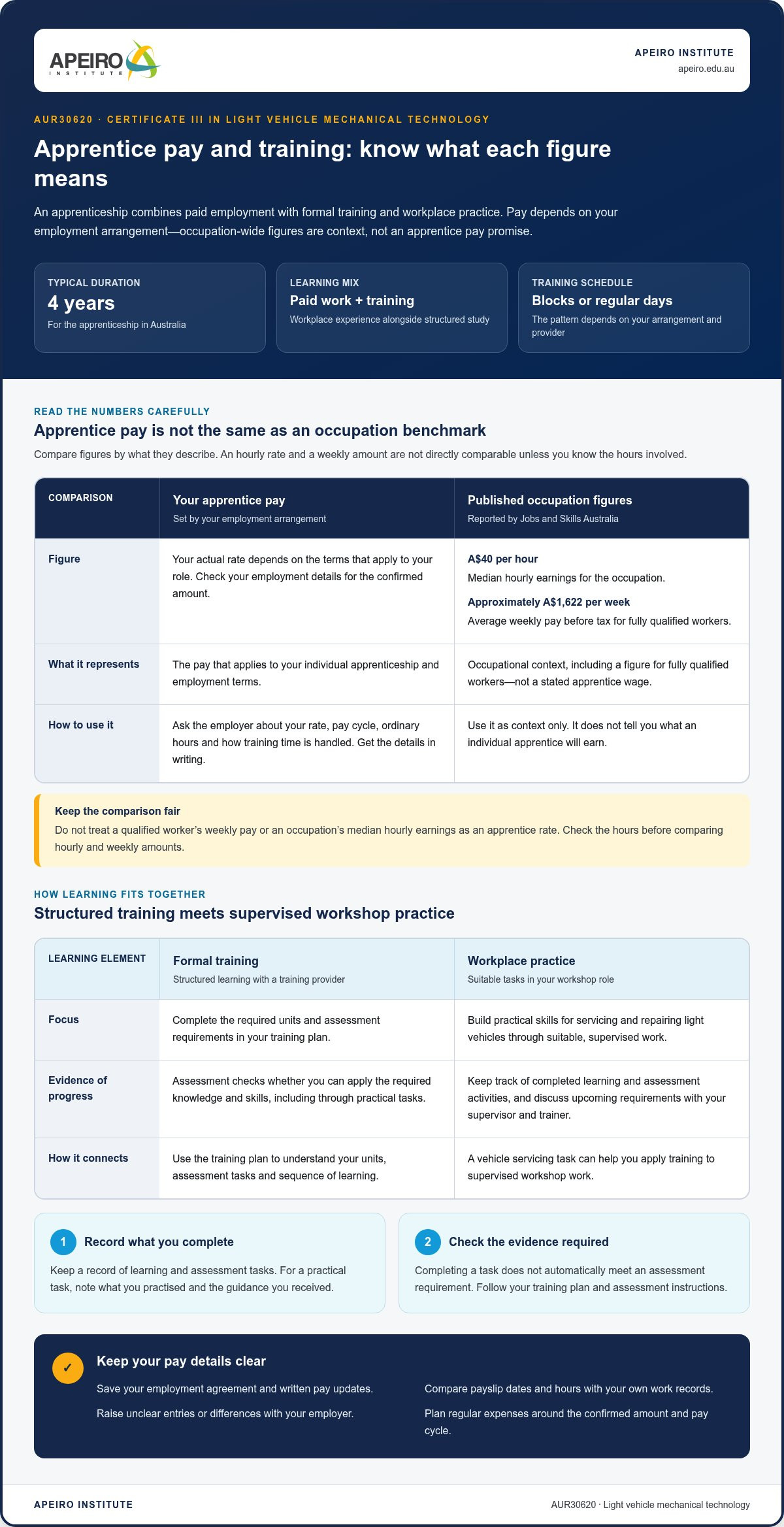
Pay information can provide another point of comparison when considering training and career goals. Jobs and Skills Australia reports average weekly pay before tax of approximately $1,622 for fully qualified workers. Treat this figure as context when weighing the qualification and your plans for light vehicle mechanical work.
Apprentice wages and support
Apprentice pay is different from the earnings of a qualified mechanic. Jobs and Skills Australia reports median hourly earnings of A$40 per hour for the occupation. Treat this as an occupational benchmark, not an apprentice wage rate. It doesn’t tell you what an individual apprentice will earn.
Your pay depends on your employment arrangement and the terms that apply to your role. Before accepting an apprenticeship, ask the employer to explain the pay rate, pay cycle, ordinary hours and how training time is handled. Get the details in writing so you can compare them with your payslip.
Compare like with like. An hourly rate and a weekly amount are not directly comparable unless you know the hours involved. Nor is a qualified mechanic’s pay directly comparable with an apprentice’s rate. Check what each figure represents before using it to plan regular expenses such as rent and transport.
A practical way to keep your finances organised is to:
- Save your employment agreement and any written updates about pay.
- Read each payslip and compare its dates and hours with your own work records.
- Note any differences or unclear entries, then raise them with your employer.
- Plan regular expenses around the amount and pay cycle stated in your employment details.
Support matters as well as pay. You’ll learn at work and complete formal training, so keep communication open with your workplace supervisor and trainer. If a work task relates to an assessment, ask how to record it and what evidence is required. Clear notes help you track progress and raise questions early.
For example, if you’re learning to inspect a vehicle component, note the task, the guidance you received and what you practised. Discuss it with your trainer to understand how it relates to your learning. Completing a task does not automatically meet an assessment requirement. Your training plan and assessment instructions explain what evidence you need.
When budgeting, separate confirmed income from estimates. Use the pay details in your employment documents for planning, rather than treating a Jobs and Skills Australia median as a promise of apprentice earnings. Keep a simple record of work hours, training commitments and pay dates to see how the apprenticeship fits your weekly routine.
How long is a light vehicle mechanic apprenticeship?
An AUR30620 apprenticeship typically takes four years in Australia. That timeframe combines paid employment with training and workplace practice. Your employment arrangement matters because it shapes where you work, who supervises your daily tasks and how your training fits around the job.
In a direct arrangement, the workshop employs you and provides your day-to-day work environment. You’ll learn through suitable tasks, guidance and feedback from experienced staff. For example, you might practise a servicing task under supervision and discuss how it relates to your training. Your employer and training provider each help organise the work and learning.
A host-employer arrangement may work differently. You could work at a host workshop while another organisation manages your employment. The workshop is your practical workplace, so clarify who handles employment matters and who directs your daily work. Ask for an explanation of both roles before agreeing to start.
Before accepting an apprenticeship, clarify these points with the relevant people:
- Employment: Identify the organisation named as your employer.
- Workplace: Confirm which workshop you’ll attend and who supervises you there.
- Communication: Find out who to approach about roster or workplace concerns.
- Training: Understand how work tasks connect with your training schedule.
- Changes: Ask how you’ll be told if your host workshop or supervisor changes.
These details help you understand the arrangement, not just the job title. If you’ll work at a host workshop, for example, clarify who approves your hours and explains workplace procedures. Keep copies of employment documents and written instructions. If information differs between conversations, ask the relevant people to clarify it before you begin.
The four-year timeframe gives you a broad planning horizon, but your day-to-day experience depends on the workplace arrangement. A suitable workshop provides tasks that support your learning, with guidance to help you build skills progressively. Ask how supervisors communicate with your trainer and how workplace learning is recorded. This helps connect practical experience with training requirements.
When comparing opportunities, look beyond the workshop name. Consider the tasks you’ll practise, the supervision available and how clearly the employment arrangement is explained. Direct employment and host-workplace models can both combine paid work and training. Knowing who employs you, where you’ll work and who supports your learning gives you a clearer starting point.
Entry requirements and USI
If you’re asking, “How do I start an AUR30620 apprenticeship in NSW?”, begin by arranging a Unique Student Identifier (USI) and understanding the training enrolment steps. You need a USI to start training. Treat it as an enrolment task alongside discussing the apprenticeship role and training arrangements. Having it ready helps you complete registration when training begins.
Starting an apprenticeship involves both the job and the training. An employer may discuss the role’s duties, workplace expectations and your availability. The training provider can explain enrolment steps and learning requirements. Treat these as separate parts of your preparation, and ask about each.
Use this checklist before applying or enrolling:
- USI: Arrange your identifier before training starts, and keep its details accessible.
- Role expectations: Ask what workshop tasks you’ll be expected to learn.
- Training arrangements: Find out how enrolment, attendance and assessment activities are organised.
- Records: Keep relevant enrolment and employment information together.
- Questions: Note anything unclear, such as who to contact about workplace matters.
If an application asks for enrolment details, having your USI ready can help you complete that step. Keep your personal information secure and enter the correct details on forms. If you already have a USI, use it rather than starting the process again.
Ask the employer about practical expectations before accepting a position. A workshop role may involve learning routines, following instructions and working safely around vehicles and equipment. Clarify which duties are suitable for a new apprentice and how supervision works. A specific example, such as assisting with a service task, can help make the role clear.
Ask how the training provider will support your learning, including what to do if an assessment task is unclear or study needs to fit around work. Knowing whom to approach gives you a clear way to raise questions. Keep the contact details of the people responsible for your employment and training.
So, “How do I start an AUR30620 apprenticeship in NSW?” Start with your USI, understand the role, and follow the training provider’s enrolment steps. Keep a record of completed tasks and outstanding questions. This preparation helps you approach the apprenticeship with the key administrative step handled and a clearer picture of expectations.
Paid work and off-the-job training
Apeiro Institute, RTO 45394, offers AUR30620 training in NSW. Light vehicle apprentices combine paid workplace duties with off-the-job training, usually in scheduled blocks or one day a week. Training arrangements organise how these parts fit together, so ask about the schedule and expectations before training starts.
Paid work gives you experience in a workshop, where you build practical skills through suitable tasks under supervision. Off-the-job training provides structured learning for the qualification. Both are important: workplace practice develops practical capability, while formal training covers learning and assessment requirements.
Plan how the commitments fit together. Ask when training dates will be shared, how attendance is recorded and whom to contact about a roster clash. For example, a scheduled training day might conflict with a workshop shift. Find out how this is handled, and keep the agreed schedule and updates together.
A simple routine can help connect work and training:
- Before training: Note scheduled sessions and tell your workplace supervisor.
- At work: Record tasks that relate to your learning.
- During training: Connect workshop examples with the concepts covered.
- After a session: Write down questions for your trainer or supervisor.
A vehicle inspection at work may relate to your training. Record what you did, the guidance you received and what you learned, then discuss the example with your trainer. This helps you understand how workplace experience relates to assessment. Don’t assume every task automatically counts as assessment evidence.
Your schedule shapes your weekly routine. Block training involves attending for an arranged period, while a regular training day creates a recurring commitment. Organise transport, work responsibilities and study time around the dates provided. Save timetable updates so you can plan for changes and share them with your supervisor.
Keep communication clear between you, your supervisor and trainer. Raise questions early if a work task, training session or assessment requirement is unclear. A short note recording the date and question can make follow-up easier and link practical work with the relevant learning activity.
Explore the AUR30620 Certificate III in Light Vehicle Mechanical Technology to understand the qualification and its training option.
Apeiro Institute: UEE30920 Certificate III in Electronics and Communications
Apeiro Institute offers Apprenticeships and Traineeships, including the AUR30620 Certificate III in Light Vehicle Mechanical Technology. If you’re ready to explore training for a light vehicle mechanic apprenticeship, this is a relevant next step. The course information can help you understand the qualification and consider how it fits your career direction.
Apeiro Institute also offers UEE30920 Certificate III in Electronics and Communications, Trade Pathways for Experienced Workers (TPEW) and Smart & Skilled Funded Courses. These suit different training pathways, so focus on the option that matches your goals and experience.
Contact Apeiro Institute to discuss your next step.
Take your next step towards the trade
If you’re deciding how to start an AUR30620 apprenticeship in NSW, turn what you’ve learned into a practical plan. Think about the kind of workshop environment where you’d like to learn, and prepare a few focused questions about the role, training arrangements and support. Clear questions can help you understand whether an opportunity fits your goals and what you need to do next.
Apeiro Institute can help you explore its apprenticeship and training pathways. You can also learn about its Trade Pathways for Experienced Workers and UEE30920 Certificate III in Electronics and Communications. Consider which pathway best matches your experience and direction before taking the next step.
Starting a trade is a meaningful commitment, and informed steps can make the path more manageable. Keep your goals in view, ask questions as you progress and approach your next opportunity with confidence.
Frequently Asked Questions
What is the AUR30620 Certificate III in Light Vehicle Mechanical Technology?
AUR30620 is a vocational qualification for light vehicle mechanical technology. It combines formal training with practical learning connected to workshop work. For example, an apprentice may relate training concepts to vehicle servicing tasks completed under supervision. Completion involves meeting the qualification’s unit and assessment requirements. The training plan explains the learning sequence and the evidence required for assessment.
What are the entry requirements for an AUR30620 apprenticeship in NSW?
You need a Unique Student Identifier (USI), an apprenticeship role and to meet the training provider’s enrolment requirements. These are separate steps: the employer assesses your fit for the workplace role, while the training provider manages course enrolment. Ask what information each needs, then keep your USI and enrolment documents ready.
How do I find an AUR30620 apprenticeship employer in NSW?
Look for light vehicle workshop roles advertised as apprenticeships or trainee positions, and apply directly to employers. Highlight relevant practical experience, reliability and your interest in learning workshop tasks. Ask what work you’ll do, who will supervise you and how training fits around the role. Keep a record of applications and follow-up conversations.
How do I register an apprenticeship in NSW and who handles the paperwork?
Agree on the apprenticeship role and training arrangements with the employer and training provider. Ask who prepares each document, what information you need to provide and which forms require your signature. Each can explain its paperwork steps. Keep copies of completed documents and note any outstanding actions so you can track progress and your responsibilities.
How long does the AUR30620 apprenticeship take in NSW?
AUR30620 is typically completed over a four-year apprenticeship in Australia, including NSW. Paid work and off-the-job training take place alongside each other during that period. Your training schedule shows when formal learning occurs, while workplace tasks build practical experience. Use both the schedule and your training plan to map upcoming commitments and keep your learning and assessment progress organised.
What are the AUR30620 apprenticeship wages and rates in NSW?
There’s no single apprentice wage figure for every role. Your employment documents should set out the pay rate. Check the rate, pay cycle and recorded hours against each payslip. An occupational earnings statistic for mechanics is not automatically an apprentice rate. If a payslip entry is unclear, raise the specific item with your employer and keep a record of your work hours.
What fees, subsidies or financial support are available for AUR30620 apprentices in NSW?
NSW Smart and Skilled funding may support eligible apprenticeship training, but eligibility depends on the qualification, your circumstances and program availability. An individual assessment is required for the exact qualification, and funding or fee-free training is not guaranteed. Ask how course fees and any subsidy are recorded in your enrolment information, and keep the details in writing.
What tools, licences or other requirements do AUR30620 apprentices need?
Tool and licence requirements depend on the job and workplace tasks. Ask the employer which equipment you’ll use, what protective items the workplace requires and whether driving duties are involved. Don’t buy tools before you understand the workshop’s expectations. Equipment for supervised servicing, for example, may differ from what other duties require.

Disclaimer
The information provided on this blog is for general informational and educational purposes only. While every effort is made to ensure the accuracy and reliability of the content, the author makes no representations or warranties of any kind, express or implied, about the completeness, accuracy, suitability, or availability of the information contained on this blog.
The views and opinions expressed in blog posts are those of the individual author and do not necessarily reflect the official policy or position of any organization, company, or employer.
This blog may contain links to external websites or third-party content. These links are provided for convenience only, and the author has no control over and assumes no responsibility for the content, privacy policies, or practices of any third-party sites.
Nothing on this blog constitutes professional advice (legal, financial, medical, or otherwise). Readers are encouraged to seek appropriate professional guidance before making any decisions based on the information provided here.
By using this blog, you acknowledge that any reliance on the information is at your own risk.


