

An automotive trade apprenticeship in NSW usually takes four years. Through national training providers like Apeiro Institute, apprentices complete a formal qualification while learning hands-on skills on the job.
That is a significant commitment, so it pays to understand your options before choosing a pathway. The right fit depends on the automotive work you want to do and the skills you want to develop.
This guide explains how apprenticeships work, how to search for opportunities in NSW, and which practical skills can help you get started. It also outlines automotive pathways, from light vehicle mechanics to further study in diagnosis or automotive technology, so you can consider how your training might develop.
Key Takeaways
- Plan for an automotive apprenticeship to usually take four years, combining workplace learning with formal training.
- Use a focused search strategy to find apprenticeship opportunities that match your interests and preferred location in NSW.
- Compare potential employers by the kind of automotive work and practical experience their workplaces can offer.
- Build careful, reliable work habits alongside hands-on skills to prepare for the demands of workshop training.
- Explore different automotive qualifications to choose a pathway that fits your goals, from light vehicle mechanics to diagnosis and automotive technology.
How long is an automotive apprenticeship?
An automotive apprenticeship in Australia usually takes four years. Apprentices develop skills at work and complete a formal qualification through an RTO. The qualification depends on the trade pathway, so first identify the work you want to do, then compare courses.
Light vehicle apprentices focus on cars and similar vehicles; heavy vehicle apprentices work with larger vehicles, while automotive electrical apprentices specialise in electrical and electronic systems. These pathways build different skills, so the qualification title and units matter as much as the word “automotive”. For example, AUR30620 Certificate III in Light Vehicle Mechanical Technology names a light vehicle pathway.
To check a qualification, search its exact code or title in the national training register. AUR30620, for instance, identifies the light vehicle qualification; matching the code helps distinguish it from similarly named courses. Check the qualification’s status and details, then compare its units with the work you hope to do. An RTO delivers the formal training, while workplace experience develops practical capability.
Good training connects classroom learning with workshop tasks. Look for clear information about how practical skills are assessed against qualification requirements and how learners practise each skill before assessment. Consider whether the training helps you apply technical concepts to real automotive work.
What are the entry requirements for an automotive trade apprenticeship in NSW? There’s no upper age limit for starting an Australian apprenticeship. You’ll need to secure an apprenticeship and meet the employer’s selection requirements. Read each vacancy carefully to understand what the employer expects.
What safety risks and licensing requirements apply to automotive apprentices in NSW? Follow workplace safety procedures and only undertake tasks within your training and supervision. Licensing requirements depend on the work involved, so establish which rules apply before performing any regulated task.
How do school-based automotive apprenticeships work in NSW? They combine secondary school with paid workplace learning and vocational training, with work arranged around school commitments. The qualification’s training requirements still apply, so school-based study does not automatically shorten the apprenticeship.
Before choosing a pathway, compare the qualification code, trade focus, workplace duties and training arrangements. These details help you assess whether it suits your goals, whether you’re starting in light vehicles or aiming for another automotive specialisation.
Searching for apprenticeships and traineeships
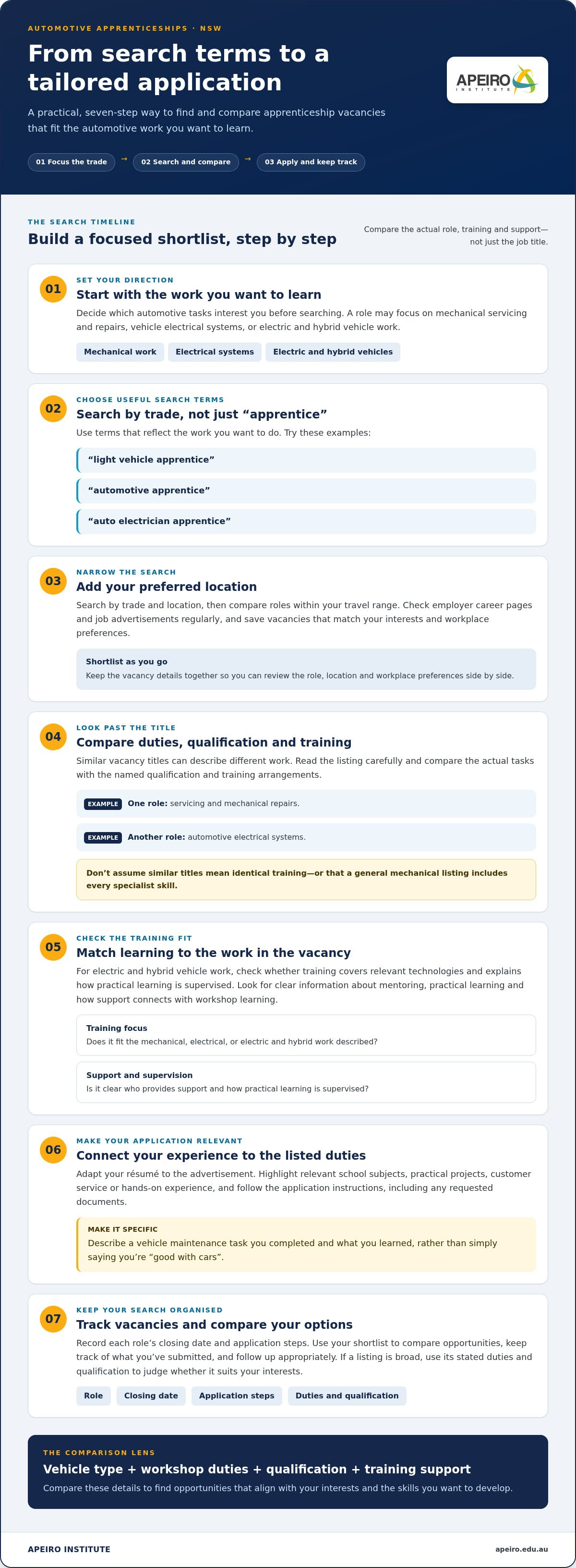
Start with the work you want to learn, then use relevant terms when searching vacancies. Try “light vehicle apprentice”, “automotive apprentice” or “auto electrician apprentice”. Search by trade and preferred location, then compare roles within your travel range. Check employer career pages and job advertisements regularly, and save vacancies that match your interests and workplace preferences.
Read each listing beyond its job title. Consider the duties, qualification and training arrangements together. One “vehicle apprentice” role may focus on servicing and mechanical repairs; another may involve automotive electrical systems. Compare the actual tasks and named qualification rather than assuming similar titles mean the training is identical. Use the vacancy details to judge whether an automotive trade apprenticeship in NSW fits your goals.
Auto electricians work with vehicle electrical and electronic systems. A vacancy may mention diagnosing faults, maintaining systems or fitting electrical components. Consider whether those duties interest you, then look for training that matches the role. For electric and hybrid vehicle work, check whether the training covers relevant technologies and explains how practical learning is supervised. Don’t assume a general mechanical listing includes every specialist skill.
A tailored application makes it easier for an employer to see your interest and relevant experience. Adapt your résumé to the advertisement, highlighting relevant school subjects, practical projects, customer service or hands-on experience. For example, describe a vehicle maintenance task you completed and what you learned, rather than simply saying you’re “good with cars”. Follow the application instructions and include the requested documents.
Consider what support will help you stay organised at work and during training. Mentoring can help you discuss progress, seek feedback and plan skill development. Life skills training may cover communication, time management and workplace expectations. Look for clear information about who provides support and how it connects with workshop learning.
- Match the role: compare its vehicle type, workshop duties and qualification.
- Check the training focus: look for a fit with mechanical, electrical, or electric and hybrid vehicle work.
- Review the support: note how mentoring and practical learning are described.
- Tailor your application: connect your experience to specific duties in the advertisement.
Keep a record of roles, closing dates and application steps. This makes it easier to compare opportunities and follow up appropriately. If a listing is broad, use its stated duties and qualification to judge whether the pathway suits your interests. A focused search helps you find roles that develop the skills you want to use.
Apprenticeship employers and locations in NSW
Automotive apprenticeships may be based in dealerships, independent repair workshops, vehicle service centres, fleet workshops or specialist repair businesses. Each setting has different day-to-day work. A dealership may focus on a particular vehicle range, while a fleet workshop may service vehicles used for business operations. Use these examples to understand the workplace described in a vacancy and decide whether its work interests you.
Search by trade and preferred work location. Try phrases such as “automotive apprentice near me”, “light vehicle apprentice” or “mechanical apprentice”. Compare each listing’s duties, training arrangements and travel expectations. Even with a manageable commute, one role may involve a different mix of vehicles from another nearby workplace. Before deciding, consider how you’ll travel to the workshop and any separate training site.
What are the employer and apprentice rules under NSW apprenticeship contracts? The written contract and training plan set out employment and training arrangements, including each party’s responsibilities. Read them for details about the role, qualification, supervision and training schedule, and how workplace learning connects with formal assessment.
Support may involve the workshop supervisor, training provider and a mentor. The supervisor guides daily tasks and provides workplace feedback; the training provider coordinates formal learning and assessment. Ask how practical tasks relate to qualification requirements and who you can speak to about your progress. A mentor may also help you plan skill development, raise concerns and balance training with workshop duties.
Some employers use host arrangements: an apprentice works at a host workplace while another organisation manages the employment relationship. Clarify who supervises your daily tasks, arranges training and handles workplace concerns. If your worksite differs from the organisation named in your employment documents, establish your reporting line and who is responsible for discussing your learning plan.
What government incentives or subsidies are available for automotive apprentices and employers in NSW? Support depends on the program, qualification and circumstances of the apprentice and employer. Training subsidies and employer incentives have separate eligibility conditions. Compare what each program covers and how its conditions relate to the training and employment arrangements.
Use this checklist when comparing an opportunity:
- Workplace: identify the vehicle types and tasks you’ll encounter.
- Travel: consider the commute to the workshop and any training site.
- Support: establish who supervises you and who discusses progress.
- Host arrangement: distinguish the host workplace from the organisation responsible for employment.
- Funding: note the program’s eligibility conditions and what it covers.
Use these details to compare automotive apprenticeship opportunities in NSW. Understanding the workplace, training contacts and support arrangements helps you assess whether a role suits your preferred work, commute and learning needs before applying.
Apprentice skills
Automotive apprentices develop practical skills alongside reliable work habits. A supervisor might ask you to inspect a vehicle, record your observations and explain the next step. Careful observation matters: describing a sound, warning light or visible fault clearly helps guide further checks. You don’t need every answer on day one, but you do need to follow instructions and learn from feedback.
Basic mechanical aptitude helps with tasks such as identifying tools, following a service procedure and keeping parts organised. During a supervised task, for example, keeping removed components in sequence can make reassembly clearer. Patience matters too. A fault may require several checks, so rushing to a conclusion can mean missing details. Ask for guidance when a task is unfamiliar, then apply what you learn to the next job.
Modern vehicle work also requires clear thinking when using technical information. You may need to follow a wiring diagram, consult workshop information or record diagnostic results. Read each instruction carefully, identify the relevant component and note what the test shows. In an electrical pathway, accurately describing a connection or test result helps a trainer or supervisor follow your reasoning.
Communication is part of workshop competence. A useful handover explains which checks you completed, what you observed and what still needs attention. If an instruction is unclear, repeat the task in your own words and ask a focused question. This reduces misunderstandings and shows you’re taking responsibility for learning. Customer-facing workshops also value respectful language and clear explanations.
Organisation supports steady progress at work and during formal learning. Keep notes on unfamiliar terms, feedback and procedures to practise again. After a lesson on braking components, for instance, write down the component names and the sequence demonstrated. Bring those notes to a later supervised task and compare your understanding with the trainer’s instructions. Brief records make skills easier to revisit. Engaging with platforms like Trade Skills Hub Academy can also provide practical trade-learning resources and support to help you consolidate what you learn on the job.
Use this simple practice cycle when learning a new workshop task:
- Listen: note the task, instructions and safety steps explained by your supervisor.
- Clarify: ask about any tool, term or instruction you don’t understand.
- Practise: complete the task under the supervision provided for that work.
- Review: discuss what went well and what needs more practice.
Employers also value punctuality, teamwork and openness to feedback. If a vehicle arrives with a reported issue, listen closely before beginning an inspection. Share relevant observations with the team rather than assuming the cause. These habits support accurate work and help you build confidence as your practical skills grow.
Automotive trade pathways
Choose a pathway by picturing the work you want to do each day. Light vehicle mechanics work on cars and similar vehicles; heavy vehicle mechanics focus on larger vehicles. Automotive electrical work centres on electrical and electronic systems. These areas can overlap in modern workshops, but each offers a different starting point for developing trade skills.
A light vehicle pathway may suit you if you’re interested in servicing, inspecting and repairing cars. Heavy vehicle work may be a better fit if you’re drawn to trucks or other large vehicles. Compare the vehicle types listed in a role’s duties, not just its title. “Mechanical apprentice” alone, for example, doesn’t tell you whether the workshop mainly works on cars or commercial vehicles.
Automotive electrical work offers another direction, with tasks that may involve tracing faults or working with vehicle electronic systems. Electric and hybrid vehicles use technologies that differ from conventional systems. If this area interests you, consider how the training and workplace duties relate to the vehicles you want to work on. A pathway’s name is a starting point; its actual learning content matters.
Pathways can also lead towards more specialised technical work. Mechanical diagnosis focuses on identifying and interpreting vehicle faults, while automotive technology offers a broader technical focus. These are distinct interests to explore, not automatic next steps after an apprenticeship. Compare qualification titles and training content to understand the direction each supports.
Experienced workers may have a different starting point from someone entering the trade. Trade Pathways for Experienced Workers (TPEW) can help skilled individuals formalise their expertise through a national qualification. First identify the tasks you’ve performed, the vehicles you’ve worked on and the skills you want assessed. This gives you a clearer basis for considering further training.
Use these questions to narrow your options:
- Which vehicles? Decide whether cars, larger vehicles or a mix interests you.
- Which systems? Consider mechanical work, electrical systems, diagnosis or emerging vehicle technologies.
- What experience? Separate skills you’ve already used from those you want to develop.
- What direction? Match the qualification focus to the work you hope to pursue.
For example, someone interested in car servicing might compare light vehicle training with a pathway focused on electrical diagnosis. A worker with workshop experience might instead explore how existing skills align with an experienced-worker route. These examples show why a trade title alone isn’t enough. Consider the qualification, practical duties and future direction together.
The clearest takeaway is to choose based on the work, not the label. Match your interests and experience to the vehicles, systems and training focus of a pathway. This comparison helps you make a more informed decision before applying.
Explore experienced-worker pathway options
Apeiro Institute: UEE30920 Certificate III in Electronics and Communications
Apeiro Institute offers the UEE30920 Certificate III in Electronics and Communications for learners interested in developing skills in electronics and communications. It’s a related option to explore if your automotive interests include vehicle electrical systems, rather than a substitute for an automotive mechanical qualification.
Apeiro Institute offers Apprenticeships and Traineeships for learners considering an apprenticeship route. Experienced workers can explore Trade Pathways for Experienced Workers (TPEW), while eligible learners may consider Smart & Skilled Funded Courses. The right option depends on your experience and the training you’re seeking.
Contact Apeiro Institute to discuss a learning pathway that aligns with your goals.
Take your next step with a clear direction
An automotive trade apprenticeship in NSW is a practical starting point, not a complete career plan. Think about the vehicles and systems you want to work with, then use that focus to assess opportunities and training. Your interests may become clearer as you gain experience, so keep track of the tasks you enjoy and the skills you want to develop next.
If you’re comparing training options, Apeiro Institute offers vocational pathways including the UEE30920 Certificate III in Electronics and Communications, Apprenticeships and Traineeships, and Trade Pathways for Experienced Workers. These options suit different learning goals, from developing electronics and communications skills to pursuing an apprenticeship or building on existing trade experience.
Prepare a short list of questions about your preferred pathway, qualification and next learning step. A focused conversation can help you consider how your goals align with the available study options.
Keep building towards work that interests you. Each considered step can bring your automotive career goal closer.
Frequently Asked Questions
How much does an apprentice mechanic earn?
There isn’t one fixed earnings amount for every apprentice mechanic. Pay depends on factors such as age, apprenticeship stage and the employment classification that applies. To assess an offer, look for the stated rate and how your role is classified. Also review any applicable allowances or penalty arrangements alongside your expected hours. Minimum apprentice wages are updated annually from the first full pay period on or after 1 July.
What automotive apprenticeship trades are available in NSW?
Options include mechanical and automotive electrical pathways, as well as specialist areas such as vehicle body repair and refinishing. The work can vary even within a broad trade category. Body repair, for example, focuses on vehicle panels, while refinishing centres on preparing and finishing surfaces. Use the trade name and listed tasks to identify the workshop work you’d like to learn.
How do you find and apply for an automotive apprenticeship in NSW?
Search vacancies by trade and preferred location, then follow the employer’s application instructions. Prepare for interviews as well as the written application. Think of examples that show reliability, learning from feedback and working carefully with others. Have a referee ready if requested, and be prepared to explain why the duties in that vacancy interest you.
What qualifications and training does a NSW automotive apprentice complete?
A NSW automotive apprentice completes the qualification associated with their chosen trade. Training may involve knowledge checks, practical demonstrations and evidence of skills developed through work tasks. Before starting, make a note of how formal training and workplace assessments are scheduled. Keeping a personal record of completed tasks and feedback can help you discuss progress with your trainer and identify skills that need further practice.
How long does an automotive apprenticeship take in NSW?
An automotive apprenticeship in Australia usually takes four years. Treat this as a planning horizon, then break your progress into achievable learning milestones with your supervisor and trainer. Record the tasks you’ve practised, the skills you can demonstrate and what you want to work on next. Regular progress discussions can help you stay focused throughout an automotive trade apprenticeship in NSW.
What are the apprentice pay rates in NSW by age and year of apprenticeship?
Pay rates depend on factors including the apprentice’s age and stage of training. Find the current rate schedule and identify the category that matches both details, rather than comparing with a different age group or training stage. Then compare that rate with the classification and pay information in your employment documents to understand how your pay is set.

Disclaimer
The information provided on this blog is for general informational and educational purposes only. While every effort is made to ensure the accuracy and reliability of the content, the author makes no representations or warranties of any kind, express or implied, about the completeness, accuracy, suitability, or availability of the information contained on this blog.
The views and opinions expressed in blog posts are those of the individual author and do not necessarily reflect the official policy or position of any organization, company, or employer.
This blog may contain links to external websites or third-party content. These links are provided for convenience only, and the author has no control over and assumes no responsibility for the content, privacy policies, or practices of any third-party sites.
Nothing on this blog constitutes professional advice (legal, financial, medical, or otherwise). Readers are encouraged to seek appropriate professional guidance before making any decisions based on the information provided here.
By using this blog, you acknowledge that any reliance on the information is at your own risk.


