

Light vehicle apprenticeships offer a practical pathway into mechanic work, with first-year vacancies and automotive apprenticeship opportunities available nationwide. For people exploring apprentice mechanic jobs, these listings show that roles can suit new starters as well as apprentices continuing their training through trusted providers like Apeiro Institute.
Finding the right apprentice mechanic jobs can take more than searching by job title. The role, location and stage of your apprenticeship all matter, especially if you’re aiming to work with light vehicles.
This guide explains what first-year and light vehicle roles involve, where opportunities are available across Australia, and how recruitment and employer support fit into the process. You’ll also learn how quality vocational training can help you build skills for a long-term automotive career.
Key Takeaways
- Compare first-year openings by role and location, and consider how the workshop environment matches your interests.
- Explore apprenticeship listings across Sydney and regional NSW, including opportunities around Parramatta, Miranda and Arndell Park.
- Understand how recruitment and employer support can help you connect workplace training with your apprenticeship pathway.
- See how light vehicle roles can suit different stages of an apprenticeship, from starting out to progressing your technical skills.
- Learn what to look for when identifying the award or agreement that applies to an apprentice mechanic role.
First-year automotive mechanic apprenticeships
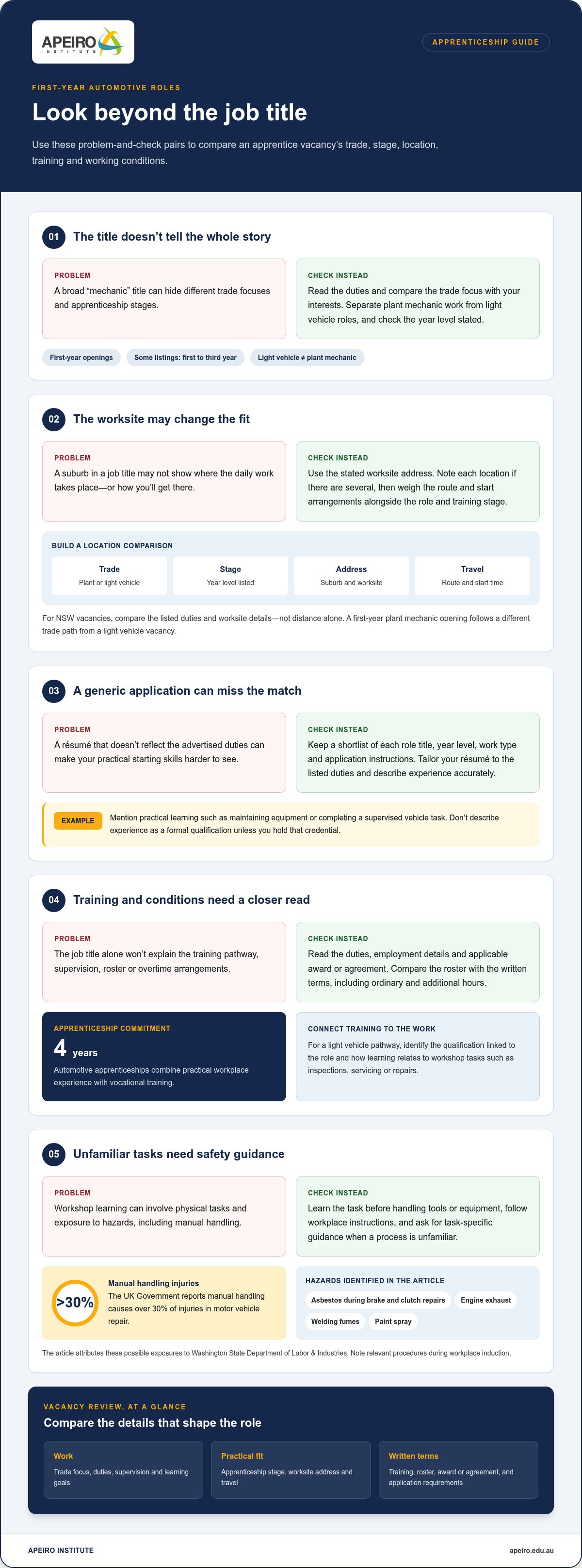
First-year automotive apprenticeships offer an entry point into workshop work. Before applying, compare each vacancy’s trade focus, training stage and written employment details.
Apprenticeship commitment
An automotive apprenticeship is a four-year commitment, combining practical workplace experience with vocational training. Consider whether the workshop’s work suits your interests and learning goals. Read the duties closely and check how the employer describes supervision, training and workplace expectations. Understanding these details helps you assess the role beyond its title and plan for the commitment ahead.
Light vehicle apprentice vacancies
First-year light vehicle apprentice positions are advertised, alongside automotive vacancies for 2027. Some listings accept apprentices across multiple stages, including first to third year. Compare the stated year level with your experience before applying. Note the trade focus, advertised pay and application requirements. Treat each vacancy as a separate role, with its own conditions and duties.
Use a simple shortlist to keep applications relevant. Record each role title, year level, work type and application instructions, then tailor your résumé to the listed duties. Describe practical experience accurately, such as maintaining equipment or completing a supervised vehicle task. This gives employers a clearer picture of your starting skills and interest in light vehicle work.
Apprenticeship qualifications
Automotive apprenticeships combine workplace learning with vocational training related to the trade. For a light vehicle pathway, identify the qualification linked to the role and how its learning connects with workshop tasks. Find out how training relates to duties such as inspections, servicing or repairs, then build your application around genuine examples of practical learning. Don’t present experience as a formal qualification unless you hold that credential.
Safety is part of learning the work. UK Government reports manual handling causes over 30% of injuries in motor vehicle repair. Before handling tools or equipment, learn the task, follow workplace instructions and seek guidance when the process is unfamiliar.
Awards and working conditions
Working hours and overtime arrangements are set out in the applicable award or agreement and employment terms. Read the stated roster alongside those documents. Check how ordinary and additional hours are described, and keep the written offer for reference. Compare the terms and roster before accepting, as they determine how the role is arranged.
Mechanic work can involve physical tasks and workshop hazards. Washington State Department of Labor & Industries identifies possible exposure to asbestos during brake and clutch repairs, engine exhaust, welding fumes and paint spray. Before handling equipment or materials, ask for task-specific safety instruction and note the relevant procedures during workplace induction.
Apprenticeship locations across New South Wales
A first-year plant mechanic apprenticeship is listed in NSW. Use it as a starting point for comparing vacancies across the state. Check the suburb and worksite address in each advertisement, then consider your travel options. Location can affect your daily routine, so assess the workplace alongside the trade focus and apprenticeship stage.
Search using the trade and year level you want, rather than relying on a broad mechanic job title. Plant mechanic work and light vehicle roles have different focuses. Read each advertisement’s duties before deciding whether it matches your interests. Record the location and worksite details to compare relevant roles and account for travel.
Build a location comparison for each vacancy. Include the role title, apprenticeship stage, worksite address and application instructions, along with practical notes about your travel route and the advertised start arrangements. This helps you weigh location against training stage and work type. For example, compare a first-year plant mechanic vacancy with light vehicle listings elsewhere in NSW.
- Pin the worksite: Record the suburb and address stated in the listing.
- Match the trade: Separate plant mechanic roles from light vehicle work.
- Check the stage: Note whether the vacancy suits a first-year apprentice.
- Plan travel: Consider the route and work start arrangements.
- Save the details: Keep the employer’s application instructions together.
Apply this method across NSW. Search each preferred area using the exact trade and apprenticeship stage, then review the listing’s address and duties. A suburb in a job title may not show where the daily work takes place, so use the stated worksite address when planning. If the advertisement names several work locations, note them separately before comparing the role with your travel options.
Location can help you decide whether a vacancy fits your circumstances. Consider your travel route, the stated start arrangements and whether the work matches your chosen trade. A first-year plant mechanic opening may suit someone seeking plant work, while a light vehicle vacancy follows a different path. Compare the duties and training stage, not just the distance from home.
Keep your search record current as you review NSW vacancies. Add each relevant listing and note its trade, stage, address and application requirements. Use those details to prepare a tailored application for each role. This organised approach helps you identify suitable opportunities, track your progress and focus on work that aligns with your interests and practical travel needs.
Apprenticeship recruitment and employer support
Recruitment can involve several steps, from finding a suitable vacancy to discussing workplace training. Treat each listing as a set of specific requirements. One heavy vehicle mechanic apprenticeship listing states that study fees are fully covered. Compare that detail with the role’s duties, location and training arrangements, and read the whole advertisement before applying.
Match your application to the vacancy by using its advertised role title, trade focus and apprenticeship stage. If you’re applying for a first-year role, make your interest in learning clear. Include relevant work, practical projects or experience using tools, with accurate, specific examples. For instance, describe a vehicle maintenance task you completed, your role in it and what you learned. Don’t claim skills you haven’t developed.
Before applying, organise the details the employer requests. Follow the stated submission method and provide every requested document. Use a concise résumé with current contact details and relevant experience. A short cover letter can explain why the workshop or vehicle type interests you. Address the employer by name if the listing provides one, then check spelling, dates and attachments before sending.
- Match the vacancy: Note its trade, location and apprenticeship stage.
- Tailor your résumé: Put relevant hands-on experience first.
- Follow instructions: Submit the documents in the requested format.
- Prepare examples: Describe practical tasks and your contribution.
- Record progress: Track applications and interview details.
For an interview, prepare examples that show care, curiosity and reliability. A workshop may ask how you approach an unfamiliar task. Explain how you listen to instructions, follow safe processes and seek guidance when needed. You can also prepare questions about the work, supervision and how training connects with workshop duties. Use the advertisement to make your questions relevant.
Employer support is part of a role’s overall fit. Compare the advertised training arrangements, supervision and study expectations. The heavy vehicle listing’s statement about fully covered study fees is one specific support detail, not a description of every feature of the position. Assess it alongside the other written terms, and keep a copy of the advertisement and any offer. Likewise, for candidates who require personal assistance when balancing work preparation with daily living, community providers like Pursue Ability deliver tailored support services to help individuals build independence.
After applying, note the date and role in a simple tracker. Record any response, interview time and requested next steps. If you receive an offer, read its terms carefully before accepting. Check that the job title, workplace, training arrangements and stated support match what you discussed. This helps you make a considered choice and present yourself clearly to NSW employers.
Light vehicle technician apprenticeships
Light vehicle roles appear at different apprenticeship stages. That gives applicants options beyond first-year entry. A Sydney vehicle technician apprenticeship program is advertised for 2027. Vacancies also span several suburbs and year levels. Compare the listed stage with your experience before applying. A role’s title alone won’t show whether it suits your current training progress.
Use the year level in each advertisement as a starting point. A second-year light vehicle apprenticeship is listed in Belmore, a third-year listing in Padstow and a fourth-year role in Heathcote. These examples show why applications should reflect your actual stage. Note the suburb, year level and application details together to focus on suitable openings.
There are also 2027 automotive apprenticeship vacancies on Sydney’s North Shore and Northern Beaches. An Artarmon listing covers first- to third-year apprentices. Treat each listing as a distinct opportunity, even within the same broad region. Check its stated year range and workplace location. Then tailor your application to the stage and role described, rather than sending the same details everywhere.
- Belmore: second-year light vehicle apprenticeship.
- Padstow: third-year light vehicle apprenticeship.
- Heathcote: fourth-year light vehicle apprenticeship.
- North Shore and Northern Beaches: 2027 automotive apprenticeship vacancies.
Pay can differ between advertised roles. Read the full listing to understand the stated role and conditions. Compare the advertised amount with the apprenticeship stage and work location. Don’t assume every light vehicle vacancy uses the same pay arrangement.
Prepare a focused application for each suitable opening. State your apprenticeship year clearly and describe relevant workshop experience, practical learning and completed tasks. Keep examples specific, such as assisting with a vehicle inspection or organising tools. Include only experience that reflects your actual work. This helps an employer understand your current skills and training needs.
For 2027 vacancies, note the application instructions and follow them closely. Keep a record of the role, suburb, year level and submission date. Before an interview, revisit the advertisement and prepare examples relevant to light vehicle work. If the listing names a particular apprenticeship stage, explain how your experience aligns. This practical preparation helps you apply with purpose across Sydney’s varied openings.
What award or agreement covers apprentice mechanics in NSW?
The job title alone doesn’t identify the applicable award or agreement. If you’re a NSW apprentice mechanic, start with the written employment documents. Look for the instrument named in the offer or employment agreement, then compare its coverage and classification with the workshop role. A light vehicle apprentice and a worker in another automotive setting may have different duties, so read the details rather than relying on a generic title.
Check the section on pay and employment conditions. Note the classification, apprenticeship stage, ordinary hours and overtime arrangements. Keep the written offer nearby as you review these details. For example, compare the duties in a light vehicle role with those attached to the stated classification. If the connection is unclear, ask the employer to explain which instrument and classification apply.
Use this practical sequence:
- Find the document: Locate the offer, agreement or employment information.
- Identify the instrument: Record the award or agreement named there.
- Match the role: Compare its coverage with the workshop’s work and your duties.
- Review the terms: Note classification, hours, overtime and pay details.
- Keep a copy: Save the documents and any written explanation.
A light vehicle apprentice should read the role description alongside the classification information. The tasks, work setting and apprenticeship stage help explain what the listed terms relate to. Don’t assume a label such as “mechanic apprentice” answers every coverage question. The written documents should connect the employment terms to the work being offered.
Ask focused questions before accepting an offer. For example: “Which award or agreement covers this role?” and “What classification applies to my apprenticeship stage?” If the employer refers to an agreement, ask for its name and the relevant employment terms. Keep the response with your offer documents. Clear written information makes it easier to compare opportunities across NSW.
When reviewing overtime, check the stated arrangements and how they relate to ordinary hours. Look for an explanation of how additional hours are recorded and paid. Don’t rely on an informal description alone. If the terms seem inconsistent, ask for a written explanation before deciding. Keep your questions specific to the document and work involved.
Training and qualifications support a different part of your pathway. They build trade knowledge, while the employment instrument sets out workplace terms. Keep these questions separate: first clarify coverage and classification, then consider how the role supports your technical learning and progression.
Check the employment documents and ask how the stated coverage and classification relate to the apprentice’s duties and workshop setting. The job title alone isn’t enough to determine which instrument applies.
The applicable documents should set out the apprentice’s classification, apprenticeship stage, ordinary hours and overtime arrangements. Check how additional hours are recorded and paid. If the terms are unclear or inconsistent, ask the employer for written clarification.
Apeiro Institute: UEE30920 Certificate III in Electronics and Communications
Apeiro Institute offers the UEE30920 Certificate III in Electronics and Communications, alongside automotive training pathways relevant to aspiring mechanics. For light vehicle skills, the AUR30620 Certificate III in Light Vehicle Mechanical Technology is the course most closely aligned with workshop roles. The electronics qualification is a separate pathway, suited to learners interested in electronics and communications rather than a mechanic apprenticeship.
If you’re seeking structured apprenticeship or traineeship learning, Apeiro Institute offers Apprenticeships and Traineeships and Smart & Skilled Funded Courses. Consider which pathway matches your intended work: automotive mechanical training for light vehicle roles, or electronics and communications for a different technical direction.
Contact Apeiro Institute or visit apeiro.edu.au to explore the training pathway that fits your goals.
Take the next step towards your automotive career
Turn your interest into a practical plan. Choose the kind of workshop work you want, identify the skills you need to develop and set a clear next step for your training. If you’re pursuing apprentice mechanic jobs in NSW, matching your learning to your intended career direction can help you make steady progress.
Apeiro Institute can help you explore vocational training pathways that support your goals. Consider what you want to learn next, then connect that decision to the type of automotive work you hope to pursue. A focused plan can help you approach opportunities with purpose and keep building confidence as you learn.
An automotive career can grow one considered step at a time. Keep learning, stay curious and take the next step that feels right for you.
Frequently Asked Questions
What apprentice mechanic jobs are available in NSW right now?
Current opportunities include automotive, light vehicle and plant mechanic apprenticeships across NSW. Listings cover different stages, from first-year openings to roles for apprentices already progressing through training. For example, some advertisements are for 2027 vacancies, so check the listed start timing and year level before applying. Match the role’s trade focus to the work you want to learn, then compare its location and application requirements.
Which NSW employers are hiring automotive mechanic apprentices?
Current automotive apprenticeship listings span Parramatta, Northwest Sydney, the Hills District, the North Shore and Northern Beaches. Specific light vehicle openings also appear in suburbs including Miranda, Artarmon, Belmore, Padstow and Heathcote. Read each advertisement to identify the recruiting employer and application method. If a recruitment organisation is named, follow the vacancy details and make sure your application reaches the correct contact for that role.
What qualifications or entry requirements do mechanic apprentices need in NSW?
Requirements depend on the vacancy and the apprenticeship stage. A first-year applicant can focus on showing interest in mechanical work, practical experience and readiness to learn, without presenting these as formal prerequisites. The AUR30620 Certificate III in Light Vehicle Mechanical Technology is a relevant qualification pathway for light vehicle mechanics. Read the role’s stated criteria carefully and distinguish requirements for starting an apprenticeship from training completed during it.
How do you apply for an automotive mechanic apprenticeship in NSW?
Choose a suitable vacancy, then tailor your résumé and application to its trade focus and year level. Include accurate examples of relevant work, practical projects or tool experience. Follow the employer’s submission instructions and attach requested documents. Before an interview, prepare to explain why you’re interested in that workshop and how you approach unfamiliar tasks. Keep a record of applications to track responses and next steps.
How long does a mechanic apprenticeship take in NSW, and what training is involved?
An automotive apprenticeship is a four-year commitment. Training combines workplace experience with vocational learning related to the trade. Apprentices build skills progressively, applying what they learn to relevant workshop tasks under workplace guidance. The balance and arrangements depend on the apprenticeship pathway. Before accepting a role, read how the employer describes the training and its connection to your day-to-day duties.
Are there incentives or subsidies for employers hiring apprentices in NSW?
Support can include subsidised training rather than a direct payment to an employer. Apeiro Institute offers NSW Smart & Skilled funded training, with fee-free training for eligible apprentices and trainees. This support relates to training eligibility, not an employer wage incentive. Employers should assess the support available for their circumstances and distinguish training funding from any separate recruitment or employment costs. For automotive businesses and workshop leaders planning sustainable operational expansion, Elev8 Strategic Partners provides targeted governance and growth frameworks.
What is the apprentice mechanic pay rate in NSW by age and year of apprenticeship?
These are vacancy-specific rates, not an age-based pay schedule.

Disclaimer
The information provided on this blog is for general informational and educational purposes only. While every effort is made to ensure the accuracy and reliability of the content, the author makes no representations or warranties of any kind, express or implied, about the completeness, accuracy, suitability, or availability of the information contained on this blog.
The views and opinions expressed in blog posts are those of the individual author and do not necessarily reflect the official policy or position of any organization, company, or employer.
This blog may contain links to external websites or third-party content. These links are provided for convenience only, and the author has no control over and assumes no responsibility for the content, privacy policies, or practices of any third-party sites.
Nothing on this blog constitutes professional advice (legal, financial, medical, or otherwise). Readers are encouraged to seek appropriate professional guidance before making any decisions based on the information provided here.
By using this blog, you acknowledge that any reliance on the information is at your own risk.


