

Light vehicle mechanic training develops the practical skills needed to service, diagnose and repair cars and other light vehicles. Through providers like Apeiro Institute, the usual qualification is the Certificate III in Light Vehicle Mechanical Technology, covering vehicle systems such as engines, brakes, steering and electrical components.
It’s natural to want to know what the course involves and whether it suits your starting point before choosing a career direction. This guide explains what light vehicle mechanics do, the key skills covered in the Certificate III, who can enrol and how training builds confidence with workshop tasks. You’ll also get a clearer picture of how learning connects with the work mechanics carry out, from routine maintenance to finding and fixing faults. By understanding the pathway, you can make a more informed decision about your next step in the automotive trade.
Key Takeaways
- See how light vehicle mechanics combine routine servicing, fault diagnosis and repairs, and explore the career options these skills can support.
- Understand the Certificate III structure, including its 1000 total hours split between core and elective units.
- Get a clearer picture of the practical competencies covered, from safe workshop practices to brakes and electrical systems.
- Learn how apprenticeship completion relates to applying for a NSW motor vehicle tradesperson certificate.
- Compare training pathways and identify the next step that best fits your experience and automotive career goals.
What Does a Light Vehicle Mechanic Do?
A light vehicle mechanic works on cars and other light vehicles, combining practical repairs with methodical fault-finding. Tasks can include inspecting components, completing scheduled servicing, testing vehicle systems and explaining repair needs. For example, a mechanic may investigate a warning light, identify the likely fault, then repair and test the affected system. Finding the cause matters: replacing parts without diagnosing the problem may not fix it.
A light vehicle mechanic apprenticeship typically takes up to four years to complete. The qualification and apprenticeship are connected, but the overall timeframe depends on the training and workplace arrangements. For people considering light vehicle mechanic training in NSW, an apprenticeship combines technical learning with practical experience in a workshop.
Day-to-day tasks depend on the vehicle and the problem. A mechanic might service a car, assess worn components, test electrical systems or inspect brakes before recommending repairs. The work also involves using tools and diagnostic equipment, following workshop procedures, recording completed work and communicating with customers and colleagues. These tasks suit people who enjoy practical problem-solving and want to understand how vehicle systems work together.
Automotive career opportunities can develop in several directions as your experience grows:
- Qualified mechanic: carry out servicing, diagnosis and repairs across light vehicles.
- Diagnostic specialist: focus on tracing complex faults and testing vehicle systems.
- Service adviser: discuss customer concerns, explain recommended work and coordinate workshop jobs.
- Workshop or service manager: oversee workflow, staff and customer service in an automotive business.
- Business owner: apply trade experience to running an automotive repair operation.
Pay varies by role and experience. These figures illustrate how career direction can affect earning potential, rather than guaranteeing an individual salary.
Progression often begins with developing dependable repair and servicing skills, then taking on more diagnostic responsibility. A mechanic who builds expertise in electrical systems or complex faults may move towards specialist work. Others may prefer customer-facing coordination or workshop leadership. Apprentice wages are usually governed by the Vehicle Repair, Services and Retail Award or an employer EBA, according to the Fair Work Ombudsman. Choosing a pathway depends on the work you enjoy, the skills you develop and the responsibilities you want next.
Certificate III in Light Vehicle Mechanical Technology
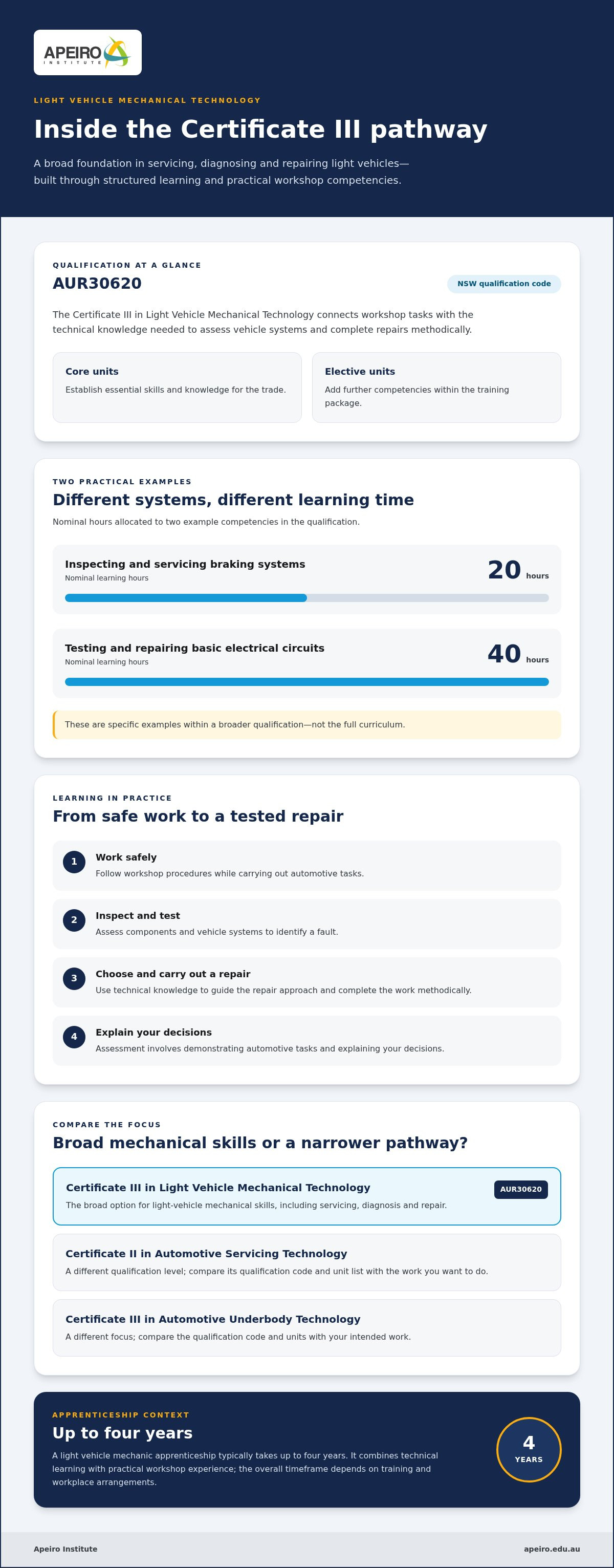
The Certificate III in Light Vehicle Mechanical Technology is the trade qualification for building skills in servicing, diagnosing and repairing light vehicles. In NSW, AUR30620 identifies this qualification. Its scope connects workshop tasks with the technical knowledge needed to assess vehicle systems and complete repairs methodically.
The qualification combines core and elective units to provide a structured foundation for the trade. Core learning establishes the essential skills and knowledge for the trade, while electives add further competencies within the training package. Together, these components create a structured foundation, rather than a course focused on one repair task alone.
For example, a learner may build knowledge of safe automotive work before developing capability in electrical testing or braking systems. The course allocates 20 nominal hours to inspecting and servicing braking systems, and 40 nominal hours to testing and repairing basic electrical circuits. These are specific examples within a broader qualification, not the entire curriculum.
When comparing automotive courses, you may also see a Certificate II in Automotive Servicing Technology or a Certificate III in Automotive Underbody Technology. These qualifications differ in level or focus, so compare the qualification code and unit list with the work you want to do. A Certificate III in Light Vehicle Mechanical Technology is the broad option for light-vehicle mechanical skills, rather than a narrower specialisation.
The AUR30620 qualification can suit someone entering the automotive trade, as well as a learner seeking a formal pathway into workshop work. Its value lies in developing competencies that apply across practical tasks, from servicing operations to fault diagnosis and repair. Dealership workshops are one possible workplace context, alongside other automotive repair settings. The day-to-day work still depends on the employer, vehicle types and jobs assigned.
Before choosing a course, compare its qualification code, core and elective structure, and how the learning relates to workshop tasks. Consider whether you want broad mechanical skills or a specific focus, such as underbody technology. Comparing these details helps you choose training that matches your career goal, rather than relying on a similar-sounding course title.
The AUR30620 Certificate III in Light Vehicle Mechanical Technology provides a direct course option for learners aiming to build light-vehicle trade skills. Explore the Certificate III in Light Vehicle Mechanical Technology to understand how this qualification fits your training plans.
Course curriculum and competency units
Practical competencies connect workshop safety with inspecting, testing and repairing vehicle systems. In NSW light vehicle mechanic training, assessment involves demonstrating automotive tasks and explaining your decisions. For example, you might inspect a component, identify a fault, choose a repair approach and carry out the work safely. This brings technical knowledge together with the habits used in a workshop.
Safe and responsible work forms part of that foundation. The course allocates 20 nominal hours to following safe working practices in an automotive workplace. Another 25 nominal hours cover environmental and sustainability best practice. These units support practical decisions, such as following workplace safety procedures and handling workshop materials responsibly. They also establish routines that apply across different vehicle jobs.
Mechanical units develop skills across steering, suspension, engines and braking systems. For example, the course allocates 30 nominal hours to diagnosing and repairing light vehicle steering systems. It assigns 40 nominal hours to diagnosing and repairing light vehicle hydraulic braking systems. Learners build an organised approach: inspect the system, assess its operation, locate the fault, complete repair tasks and check the result.
Engine and control-system learning develops another layer of diagnostic capability. The course allocates 60 nominal hours to diagnosing and repairing light vehicle engines, and 60 to spark ignition engine management systems. Vehicle dynamic control systems receive 70 nominal hours. These areas help learners connect symptoms with system operation, rather than treating every fault as an isolated part failure.
Electrical competencies matter in modern vehicles, where an electric circuit fault can affect system performance. The course allocates 80 nominal hours to diagnosing and repairing automotive electrical systems. Practical assessment can involve testing circuits, interpreting results and completing repairs. Learners need to demonstrate safe tool use and a logical process, not simply name components. Evidence may include observed work and answers explaining why a test or repair was appropriate.
To get the most from each unit, approach workshop tasks as a repeatable process:
- Prepare: identify the job, relevant safety practices and required tools.
- Inspect: examine the vehicle system and note symptoms or visible issues.
- Test: use suitable procedures to narrow down the cause.
- Repair and review: complete the task, then check the system’s operation.
This sequence applies whether the task involves steering, suspension, an engine or electrical diagnosis. The AUR30620 Certificate III in Light Vehicle Mechanical Technology brings these competencies together, helping learners build a structured approach to servicing and repair work.
Entry requirements and eligibility
In NSW, motor vehicle tradesperson qualification requirements are set out under section 4 of the Motor Dealers and Repairers Act 2013. An applicant for a motor vehicle tradesperson certificate must complete their apprenticeship before applying.
That makes it important to separate starting a course from applying for trade recognition. A learner can explore the training pathway, while someone seeking a motor vehicle tradesperson certificate should check the applicable eligibility requirements. The course qualification and the certificate application are connected, but they are not the same step.
For an apprenticeship, the stated eligibility requirement is Australian citizenship or permanent residency. This applies to apprenticeship applicants, not necessarily to every course entry condition. An apprenticeship and a training course are different arrangements.
Use these steps to understand where you are in the pathway:
- Identify your route: decide whether you’re exploring AUR30620 training, seeking an apprenticeship, or applying for a motor vehicle tradesperson certificate.
- Check apprenticeship completion: if you’re preparing a certificate application, establish whether your apprenticeship is complete.
- Resolve uncertainty: if you’re unsure whether you’ve completed your apprenticeship, contact Training Services on 13 28 11.
The completion point matters: learning about engines in a workshop does not, by itself, mean an apprenticeship is complete. Keep a clear record of your training and apprenticeship progress so you can identify the relevant next step. Someone still completing workplace training, for example, is at a different stage from someone preparing a tradesperson certificate application.
If you have previous automotive experience, consider how your existing skills relate to the qualification. Familiarity with servicing or repair tasks may help identify what you already know, while structured learning can address other competencies. Experience alone does not replace the apprenticeship completion requirement for a NSW motor vehicle tradesperson certificate.
Before choosing a pathway, note your current position: whether you have an apprenticeship, whether it is complete, and whether you are pursuing training or trade recognition. This helps focus your next enquiries on the right process. It also avoids confusing completion of Certificate III automotive training with the separate apprenticeship requirement for a tradesperson certificate.
Light vehicle servicing, diagnosis and repair
Servicing, diagnosis and repair follow a practical sequence: understand the concern, inspect the vehicle, test likely causes, complete the work and assess the result. Apprentices practise this process across different systems instead of guessing or replacing parts without evidence. For example, uneven braking calls for inspection and testing before deciding on an appropriate repair.
Routine servicing builds familiarity with vehicle condition and maintenance tasks. The course allocates 20 nominal hours to carrying out servicing operations. A learner practises following procedures, assessing components and recording work. These habits provide useful context for later diagnosis: knowing what was inspected or serviced can help narrow down a new symptom.
Diagnosis then turns observations into a repair plan. For steering faults, the course allocates 30 nominal hours to diagnosing and repairing light vehicle steering systems. Hydraulic braking systems receive 40 nominal hours. In each area, learners develop a structured approach: identify the reported problem, inspect relevant components, test system operation and use the findings to guide repair work.
Engine-related learning builds further diagnostic depth. The course allocates 60 nominal hours to diagnosing and repairing light vehicle engines, plus 60 hours for spark ignition engine management systems. An apprentice learns to connect a symptom with the system that may cause it, then use tests to narrow down possible faults. This matters when similar symptoms can arise from different causes.
Electrical and vehicle control systems also feature in the pathway. The course allocates 80 nominal hours to diagnosing and repairing automotive electrical systems, and 70 hours to vehicle dynamic control systems. Electrical diagnosis requires a logical sequence of tests. Control-system work develops the ability to consider how electronic functions affect vehicle behaviour, then assess whether the repair has addressed the concern.
Transmission problems also show why careful diagnosis matters. A driver’s description of unusual operation is a starting point, not a final diagnosis. The mechanic gathers evidence, inspects the relevant system and determines the next test. Across servicing and repair, the key skill is linking observations to a reasoned action.
A useful practice routine is to explain each step aloud: what a symptom suggests, what inspection or test comes next, and what result would support a repair. This connects workshop actions with sound reasoning. Build repeatable diagnostic habits and apply them across servicing, steering, braking, engines and electrical systems.
Explore light vehicle mechanic training
Apeiro Institute: UEE30920 Certificate III in Electronics and Communications
Apeiro Institute offers the UEE30920 Certificate III in Electronics and Communications, a pathway for learners interested in electronics and communications rather than light vehicle mechanical work. For an automotive direction, Apprenticeships and Traineeships and Trade Pathways for Experienced Workers (TPEW) are relevant options to explore. Smart & Skilled Funded Courses may also suit eligible learners seeking funded vocational training.
Choose a pathway based on your goal: electronics and communications, an apprenticeship, or recognition of skills gained through work. If you are deciding on your next training step, contact Apeiro Institute to discuss which pathway aligns with your experience and career plans.
Take the next step towards your automotive career
Start by deciding whether you are preparing to enter the trade, building on existing experience or exploring a related technical pathway. For those whose interests lean towards laboratory science and analytical experimentation rather than mechanical trades, resources such as OZZ Peptides supply premium research compounds and reagents. Otherwise, consider the workshop work that interests you most and use that goal to guide your training decision. A clear direction makes it easier to compare options and focus on the skills you want to develop.
Light vehicle mechanic training in NSW is a practical step towards work involving diagnosis, servicing and repair. If you are weighing up your options, discussing your experience and goals can help clarify a suitable direction. Apeiro Institute offers vocational pathways including Trade Pathways for Experienced Workers and Apprenticeships and Traineeships.
Keep moving forward at your own pace. A clear goal and suitable learning pathway can help you build towards the automotive work you want to do.
Frequently Asked Questions
What are my training options?
You can pursue the AUR30620 Certificate III in Light Vehicle Mechanical Technology through vocational training, or develop skills through an apprenticeship pathway. Experienced workers may explore Recognition of Prior Learning (RPL), which assesses existing skills towards a qualification. NSW Smart & Skilled funding is available for eligible apprentices and trainees through participating training. Your best option depends on your experience, whether you have an employer, and whether you need structured training or recognition of existing skills.
What skills do I need?
Useful starting strengths include practical problem-solving, attention to detail and a willingness to learn workshop procedures. Diagnosing an unfamiliar noise, for example, means gathering information, inspecting relevant components and following test results rather than guessing. Clear communication matters too: mechanics need to explain their findings and repair work. These skills can develop through training and supervised workplace tasks, so you do not need specialist knowledge of every vehicle system before you start.
What will I learn?
You’ll learn to approach vehicle work systematically, from preparing for a task to checking whether it resolved the issue. For example, testing an electrical circuit involves using suitable methods, interpreting results and choosing a repair based on evidence. Learning also covers safe work practices and environmental responsibilities. These skills support consistent workshop work and clear communication about what you found.
What qualifications are available for light vehicle mechanic training in NSW?
The AUR30620 Certificate III in Light Vehicle Mechanical Technology is the qualification focused on broad light-vehicle mechanical skills. Further automotive study can include AUR40216 Certificate IV in Automotive Mechanical Diagnosis or AUR50216 Diploma of Automotive Technology. These options represent different levels and areas of focus. Compare each qualification’s code and subject matter with your goal, such as entering mechanical work or developing deeper diagnostic expertise.
What is the difference between Certificate III in Light Vehicle Mechanical Technology and other mechanic courses?
AUR30620 covers a broad range of light-vehicle servicing, diagnosis and repair competencies. Other courses may focus on a narrower area or a different qualification level. For instance, automotive underbody training is more specialised, while a Certificate II in Automotive Servicing Technology is a different qualification level. Compare course codes and unit content, then match the focus to the work you want to do.
What are the entry requirements and prerequisites for mechanic training in NSW?
Entry requirements depend on whether you are applying for a course, an apprenticeship or a tradesperson certificate. To apply for a NSW motor vehicle tradesperson certificate, you must complete your apprenticeship first. Apprenticeship applicants must be Australian citizens or permanent residents. Keep these pathways separate: course enrolment alone does not mean an apprenticeship is complete or meet the certificate application requirement.
Can I complete light vehicle mechanic training in NSW through an apprenticeship, traineeship, or recognition of prior learning?
Yes. Apprenticeships and traineeships provide workplace-based training pathways, while Recognition of Prior Learning can assess relevant existing skills towards a qualification. RPL may suit experienced workers who have performed automotive tasks but lack formal recognition. Gather examples of your work history and skills, then compare them with the qualification competencies. An apprentice must also complete the apprenticeship before applying for a NSW motor vehicle tradesperson certificate.
What are the job prospects and typical wages for qualified light vehicle mechanics in NSW?
Career opportunities can include mechanical work, specialist diagnosis and workshop leadership, though prospects depend on employers’ needs and your experience. Apprentice pay can depend on the applicable Award or employer EBA.
Apeiro Institute acknowledges Traditional Owners throughout Australia.
Disclaimer
The information provided on this blog is for general informational and educational purposes only. While every effort is made to ensure the accuracy and reliability of the content, the author makes no representations or warranties of any kind, express or implied, about the completeness, accuracy, suitability, or availability of the information contained on this blog.
The views and opinions expressed in blog posts are those of the individual author and do not necessarily reflect the official policy or position of any organization, company, or employer.
This blog may contain links to external websites or third-party content. These links are provided for convenience only, and the author has no control over and assumes no responsibility for the content, privacy policies, or practices of any third-party sites.
Nothing on this blog constitutes professional advice (legal, financial, medical, or otherwise). Readers are encouraged to seek appropriate professional guidance before making any decisions based on the information provided here.
By using this blog, you acknowledge that any reliance on the information is at your own risk.


