

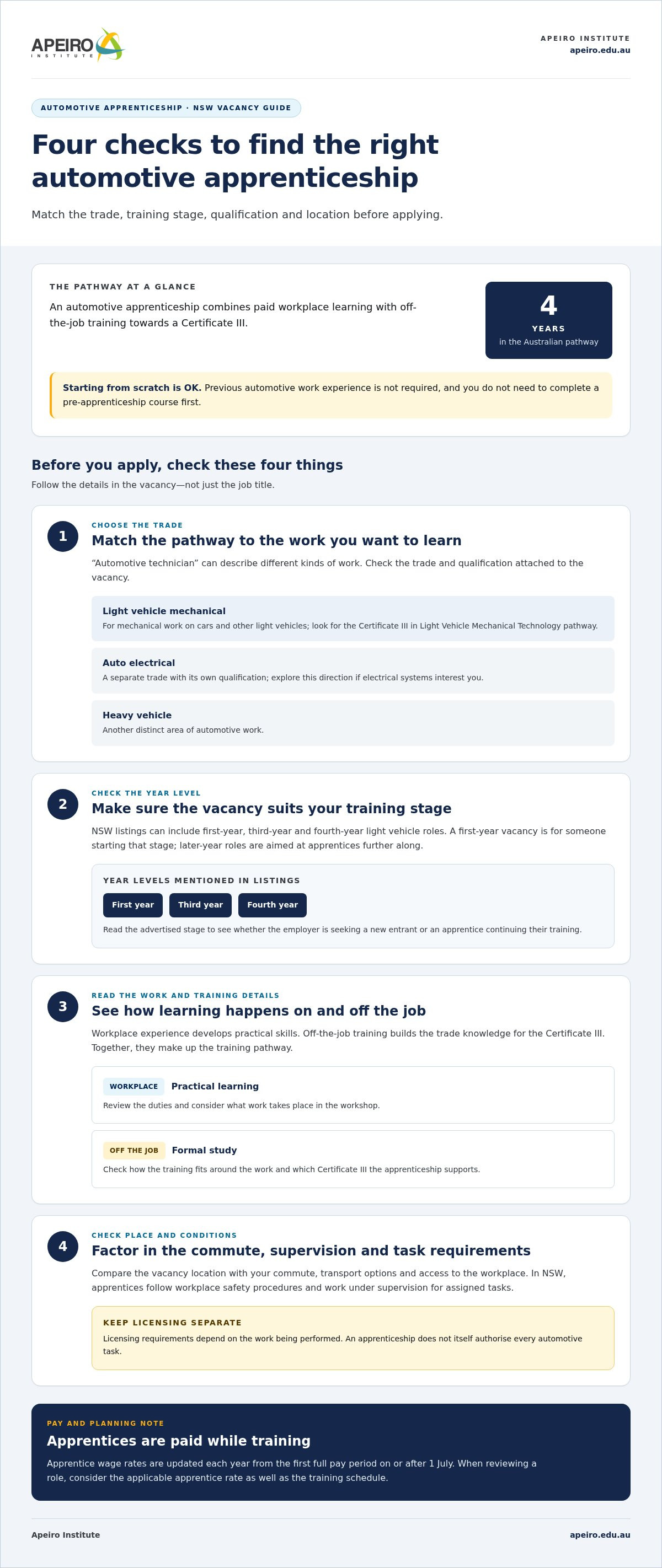
You can apply for an automotive technician apprenticeship without previous automotive work experience, and you don’t need to complete a pre-apprenticeship course first. Through providers like Apeiro Institute, the apprenticeship combines paid work with off-the-job training towards a Certificate III over four years. It’s a practical way to enter the trade, even if you’re starting from scratch.
You might assume you need workshop experience before applying. In practice, an interest in vehicle maintenance and a willingness to learn can be a good starting point. The apprenticeship lets you build job skills as you train.
This guide explains how automotive apprenticeship training works, what shapes the time commitment, and how to search for paid vacancies. It also covers preparing an application, distinguishing automotive trades and deciding whether a pre-apprenticeship course suits your goals.
Key Takeaways
- An automotive apprenticeship is a four-year commitment that combines paid work with off-the-job training towards a Certificate III.
- You can apply without previous automotive work experience, and a pre-apprenticeship course isn’t required.
- Vacancies differ by trade, year level and location, so learn how to narrow your search across NSW.
- Automotive mechanic and auto electrician apprenticeships lead to separate trades and qualifications; identify the pathway that fits your goals.
- See how training options, including apprenticeships and traineeships, can support your next step into vocational learning.
How long is an automotive apprenticeship?
An automotive light vehicle apprenticeship is a four-year commitment in Australia. It combines workplace learning with off-the-job training towards the Certificate III in Light Vehicle Mechanical Technology. Along the way, apprentices develop practical mechanical skills for working on light vehicles and the trade knowledge needed for the qualification.
Vacancy listings at different stages illustrate how apprenticeships progress. NSW listings can include first-year, third-year and fourth-year light vehicle roles, for people beginning or continuing their training. Check the advertised year level to see which stage the employer is seeking.
When comparing vacancies, note the year level, location and trade. A first-year role is for someone starting that stage, while a later-year vacancy is aimed at an apprentice further along. Consider the commute, transport options and access to the workplace when comparing opportunities across NSW.
“Automotive technician” can refer to different kinds of work, so check the qualification before applying. A light vehicle mechanic apprenticeship follows the light vehicle pathway. Auto electrical work is a separate trade with its own qualification, and heavy vehicle work is another distinct area.
Knowing the difference helps you choose a direction. For mechanical work on cars and other light vehicles, look for a light vehicle mechanic apprenticeship and its Certificate III pathway. If you’re more interested in electrical systems, search for auto electrician roles. Match the vacancy title and qualification to the work you want to learn.
Compare, for example, a first-year listing with a third-year listing. Both might be light vehicle apprenticeships, but they represent different training stages. Read the duties and qualification details, and check whether the listing requires applicants to be at a particular stage. That helps you judge whether the vacancy suits your current position.
The Certificate III pathway combines trade knowledge with practical workplace experience. As training progresses, apprentices apply what they learn and develop their light vehicle mechanical skills. Before applying, compare the vacancy’s duties with the qualification it supports. This helps you decide whether the role matches your interests and career direction.
The Certificate III in Light Vehicle Mechanical Technology is the relevant qualification to explore for this pathway. Use the listed trade and year level to focus your search. That simple check helps separate light vehicle mechanic opportunities from heavy vehicle and auto electrician pathways, so you can target roles that suit your goals.
Automotive apprenticeship duration and paid training
In Australia, an automotive apprenticeship is a four-year commitment that combines paid work with off-the-job training towards a Certificate III. In NSW, apprentices follow workplace safety procedures and work under supervision for assigned tasks. Licensing requirements depend on the work being performed.
Apprenticeship duration
The four-year pathway gives apprentices time to develop trade knowledge through structured training and practical workplace experience. It’s a useful guide for planning, but the apprenticeship involves progress through learning stages, not simply time at work. Check a vacancy’s year level and training qualification to see whether it suits a new entrant or someone continuing an apprenticeship.
Duration is only one part of the commitment. Workplace learning and off-the-job training both contribute to progress towards the Certificate III. Read the qualification and stage listed for a vacancy together, rather than judging the opportunity by its job title alone.
Paid workplace training
Automotive apprentices are paid while completing their apprenticeship. They combine workplace experience with off-the-job training towards a Certificate III. Practical work develops skills in a real setting, while off-the-job study builds the knowledge required for the qualification.
Apprentice wage rates are updated each year from the first full pay period on or after 1 July. When reviewing employment details, pay attention to the applicable apprentice rate and how the job combines paid work with training. The wage arrangement and training schedule are distinct details, so consider both when planning your week and budget.
Training structure
The four-year apprenticeship combines on-the-job learning with off-the-job training. Workplace tasks give apprentices opportunities to apply what they learn under supervision, while off-the-job study develops the knowledge underpinning the Certificate III. Together, these make up the training pathway.
To understand a role, compare its practical duties with the training information. Consider what work takes place in the workshop, how off-the-job learning fits around it and which Certificate III the apprenticeship supports. These details give you a clearer picture of the commitment before you apply.
Workplace safety is part of learning the trade. Follow site procedures, work under the supervision provided for assigned tasks, and ask questions before attempting unfamiliar work. Licensing is separate from the apprenticeship’s duration and training structure. Requirements depend on the work being done, so an apprenticeship does not itself authorise every automotive task.
Across Australia, paid work combined with formal training provides a structured route into automotive work. In NSW, use vacancy details to compare the year level, qualification and training arrangement. These practical details help you assess whether a position suits your current stage and career direction.
Apprenticeship employers and locations across NSW
An apprenticeship brings together workplace learning and formal automotive training. In NSW, compare the work, trade and training arrangement, rather than judging a vacancy by its title alone.
Registered training organisations deliver the formal training linked to an apprenticeship. The provider depends on the qualification and training arrangement. Check the vacancy or apprenticeship information for the qualification and provider, then compare them with the trade you want to learn. This clarifies how workplace learning and formal training fit together.
Employers provide the setting for practical learning. Depending on the vacancy, this could be an automotive workshop, vehicle repair business or another automotive workplace. Read the listed duties to understand the work involved. Light vehicle mechanical work, for example, follows a different pathway from body repair or plant mechanics.
Location still matters when comparing NSW opportunities, even when listings don’t name the same kind of workplace. Consider your commute, transport options and access to the employer’s site. Also account for travel associated with off-the-job training. These practical details can help you decide whether a role fits your routine as well as your trade interests.
Vacancy examples can clarify the difference between trade and training stage:
- A second-year automotive body repair vacancy represents an apprentice continuing training.
- A first-year plant mechanic vacancy is for a different trade pathway.
- A first-year automotive body repair vacancy offers another example of an entry-stage role.
These examples show why both trade and year level matter. Body repair and plant mechanics are different from light vehicle mechanical work, and the year level signals the apprentice’s training stage. Compare both details with your current position and intended trade before applying.
Use a repeatable search process to narrow your options. First, choose the trade that matches the work you want to learn. Then filter vacancies by NSW location and year level, and read the employer’s duties and training information. This helps distinguish relevant roles from vacancies that use broad automotive terms for different kinds of work.
For each suitable listing, record the employer, trade, year level and training provider. Compare the advertised tasks with the qualification linked to the apprenticeship. Body repair and light vehicle mechanical work, for example, follow different training pathways, even when both roles are in automotive workplaces.
Finally, consider how workplace duties and formal training fit together. Review the work, location and provider information as a whole. This gives you a practical way to compare NSW apprenticeship employers and identify vacancies that match the trade you want to pursue.
Automotive apprenticeship vacancies in NSW
NSW vacancies vary by trade, training stage and workplace location. Listings for 2027 include automotive apprenticeship opportunities across several locations. Use those details to focus your search and identify roles that match your preferred pathway.
Start by choosing the trade you want to pursue. Searching for terms such as “light vehicle mechanic apprentice” can help separate mechanical roles from body repair or plant mechanic vacancies. Read each listing’s title and duties closely: an automotive vacancy does not necessarily involve light vehicle mechanical work.
Next, compare the advertised year level with your current position. Listings can include first-year, second-year, third-year and fourth-year opportunities. A first-year vacancy is for someone starting that stage, while later-year roles are aimed at apprentices further along. Make sure the advertised stage fits your circumstances before applying.
Location is another practical filter. NSW listings can identify a suburb, postcode and trade, giving you a way to assess the commute. For example, compare the travel involved in reaching a metropolitan workshop with the journey to a workplace farther from home. Consider transport options and how work travel fits around off-the-job training.
Use a repeatable search routine:
- Choose a trade title that reflects your intended work.
- Filter results by NSW location and apprenticeship year.
- Read the duties, workplace location and training details.
- Save roles whose trade and stage match your plans.
For each vacancy you save, note the employer, suburb, trade and year level. Keeping these details together makes it easier to compare roles in different locations and tailor your application to the workplace and duties, rather than sending the same generic response to every employer.
Before applying, check whether the vacancy is for a new entrant or an apprentice continuing their training. The listed year level can help clarify this. Then tailor your application to the actual work: highlight your interest in body repair for a body repair role, or in vehicle servicing and mechanical work for a light vehicle position.
Vacancies for 2027 show that NSW opportunities cover more than one trade and training stage. Use the listing details to avoid applying for a role simply because it says “automotive”. A qualified automotive technician follows a defined training pathway, so the vacancy’s trade and qualification details should align with your career goal. Keep your search focused, compare each role carefully and apply where the listed stage and work match your direction.
Prior experience and pre-apprenticeship courses
You generally don’t need previous automotive technician experience to apply for an apprenticeship. A pre-apprenticeship course isn’t required either. School leavers and career changers can apply for entry-level vacancies without first working in a workshop or completing a separate preparatory course.
Experience can still help you explain your interest. You could mention practical tasks you’ve tried, such as maintaining a bicycle or helping with basic vehicle care. Be specific about what you did, and don’t present informal experience as professional mechanical training or a qualification.
Show that you’re ready to learn with a specific example of following instructions, solving a practical problem or working reliably with others. A part-time job, school project or hands-on hobby can help illustrate these qualities. Link your example to the vacancy’s duties instead of relying on a general claim that you’re motivated.
A pre-apprenticeship course may suit someone who wants structured exposure before applying, but it isn’t a compulsory step into the trade. Consider what you want from it: a clearer sense of the work, introductory learning or more confidence discussing the pathway. Weigh that benefit against applying directly for an apprenticeship and learning through the job.
Use these steps to decide which route fits your current position:
- If you’re ready to apply, look for vacancies marked for a new entrant.
- If you want a preview of trade learning, explore relevant introductory study.
- If you have practical experience, describe it accurately in your application.
- If you’ve already completed formal training, name the qualification clearly.
There’s no upper age limit on starting an Australian apprenticeship. Mature applicants can draw on previous work habits, customer service or transferable practical skills while applying for an entry-level role. For example, experience organising tasks in another job may support your application, but it doesn’t replace the automotive training and assessment required for the trade.
Keep experience, course preparation and qualifications distinct. A short course or personal project may help you explore automotive work, but neither makes you a qualified mechanic. An apprenticeship combines employment with formal training. Check the vacancy’s trade and year level, then explain why that pathway suits your goals. If you’re new to mechanical work, be clear about your starting point and how you approach learning.
Apeiro Institute: UEE30920 Certificate III in Electronics and Communications
Apeiro Institute offers the UEE30920 Certificate III in Electronics and Communications for learners interested in communications and electronics training. This qualification is a different pathway from an automotive mechanical apprenticeship, so consider whether it matches your career direction.
For structured vocational training, Apeiro Institute offers apprenticeships and traineeships, as well as NSW Smart & Skilled funded courses. Experienced workers can explore Trade Pathways for Experienced Workers (TPEW). Each option suits a different work or learning situation, so begin with the trade and qualification you want to pursue.
For light vehicle mechanical training, focus on automotive qualifications and apprenticeship vacancies that match that trade. Choose the electronics and communications course when that field aligns with your goals.
Contact Apeiro Institute to discuss the training pathway that suits your goals.
Take the next step towards your automotive career
Choosing an automotive technician apprenticeship in NSW starts with identifying the work you want to learn and preparing to apply. You don’t need to have your whole career mapped out. A clear interest in the trade and a focused application can help you take the next step.
Apeiro Institute offers Apprenticeships and Traineeships, as well as Trade Pathways for Experienced Workers (TPEW). Its UEE30920 Certificate III in Electronics and Communications is a separate study option for people interested in that field. Consider which direction best matches your goals, then explore the relevant training pathway.
Every skilled career begins with a decision to explore what’s possible. Take the next step at your own pace and keep building towards work that interests you.
Frequently Asked Questions
Can I get an apprenticeship without experience?
Yes. Previous automotive technician experience generally isn’t needed to apply. Show practical interest and reliable work habits with a specific example, such as a school project where you followed instructions, solved a problem or worked safely with tools. Describe your experience accurately: maintaining a personal vehicle can demonstrate interest, but it isn’t formal trade experience.
Do you accept applicants part-way through a current apprenticeship?
Apprentices already in training can apply for vacancies advertised at their current stage. Check the year level in the role description and prepare details of your training, completed units and workplace experience. If you’re applying for a later-stage position, explain what you’ve completed and what remains. The employer assesses your application against the vacancy’s requirements.
Do you need a driver’s licence to be able to start an apprenticeship?
Whether you need a driver’s licence depends on the vacancy’s duties and the employer’s criteria. A workshop repair role may have different requirements from a position involving vehicle movements or travel between work sites. Read the listing for licence conditions and consider how you’ll get to work and training. If driving is listed as a duty, state your licence status accurately in your application.
How much does an apprentice mechanic earn?
Pay depends on factors such as the apprenticeship stage, applicable employment conditions and the role. Apprentice wage rates are updated each year from the first full pay period on or after 1 July. Compare the rate and conditions stated for a specific vacancy rather than relying on a general figure. Also consider how paid work fits with the off-the-job training schedule when planning your budget.
How much does it cost to do an apprenticeship?
Training costs depend on the funding arrangement and eligibility. Eligible NSW apprentices and trainees can access fee-free training through Apeiro Institute’s NSW Smart & Skilled funded training. This applies to eligible training, not necessarily other expenses related to work or travel. Check the funding information relevant to your circumstances and distinguish training fees from personal costs such as transport or work clothing.
What are the essential criteria I must meet to apply?
Start with the vacancy’s criteria, as employers set requirements for each role. Check the trade, location, year level and any listed skills or documents. Tailor your application to explain your interest and give examples of reliability, teamwork or practical problem-solving. Include relevant qualifications and records of completed units so the employer can understand your training and experience.
What is the typical recruitment timeline?
Recruitment timing depends on the employer’s process and the vacancy’s start arrangements. Use the listing’s closing date and application instructions to plan. Prepare your résumé, referee contact details and relevant training records before applying. Keep track of your applications and respond promptly to interview requests. A complete application helps the employer assess your fit.
What qualifications and entry requirements are needed for an automotive technician apprenticeship in NSW?
For an automotive technician apprenticeship in NSW, the light vehicle pathway leads towards the Certificate III in Light Vehicle Mechanical Technology. You can apply without previous automotive work experience or a pre-apprenticeship course. Employers may set role-specific criteria, so read each vacancy carefully. If you’ve completed training, include the details; if you’re new to the trade, show your interest and readiness to learn.

Disclaimer
The information provided on this blog is for general informational and educational purposes only. While every effort is made to ensure the accuracy and reliability of the content, the author makes no representations or warranties of any kind, express or implied, about the completeness, accuracy, suitability, or availability of the information contained on this blog.
The views and opinions expressed in blog posts are those of the individual author and do not necessarily reflect the official policy or position of any organization, company, or employer.
This blog may contain links to external websites or third-party content. These links are provided for convenience only, and the author has no control over and assumes no responsibility for the content, privacy policies, or practices of any third-party sites.
Nothing on this blog constitutes professional advice (legal, financial, medical, or otherwise). Readers are encouraged to seek appropriate professional guidance before making any decisions based on the information provided here.
By using this blog, you acknowledge that any reliance on the information is at your own risk.


