

Finding the best automotive apprenticeship opportunities can start with a light vehicle pathway: workplace learning paired with a formal qualification through a Registered Training Organisation like Apeiro Institute. The right fit depends on the work you want to do and the experience you’re bringing with you, with flexible study options available no matter where you are located.
It’s natural to want a clear picture before committing to a trade, especially if you’re changing careers or weighing up apprenticeship options. This guide explains automotive apprenticeship pathways, what light vehicle training involves and how career changers can approach the transition. You’ll also learn how to compare vacancies at different stages and choose a next step that suits your goals.
Key Takeaways
- Identify whether an automotive apprenticeship could fit your career change and how your existing experience may shape your next step.
- Understand how workplace learning and a formal qualification fit together in NSW apprenticeship programs.
- Explore the light vehicle pathway and the kinds of practical skills it can help you develop.
- Learn how first-year and later-stage vacancies differ, so you can focus on opportunities that match your experience.
- Get a clearer picture of the eligibility factors to consider and the training options available through Apeiro Institute.
Automotive apprenticeships for career changers
A career change into automotive trades can begin with an entry-level apprenticeship or a pathway that recognises existing skills. When considering an NSW apprenticeship contract, review the qualification, duties, training arrangements, pay terms, hours and progress records. Watch for unclear supervision or duties that don’t align with the training.
Career progression pathways
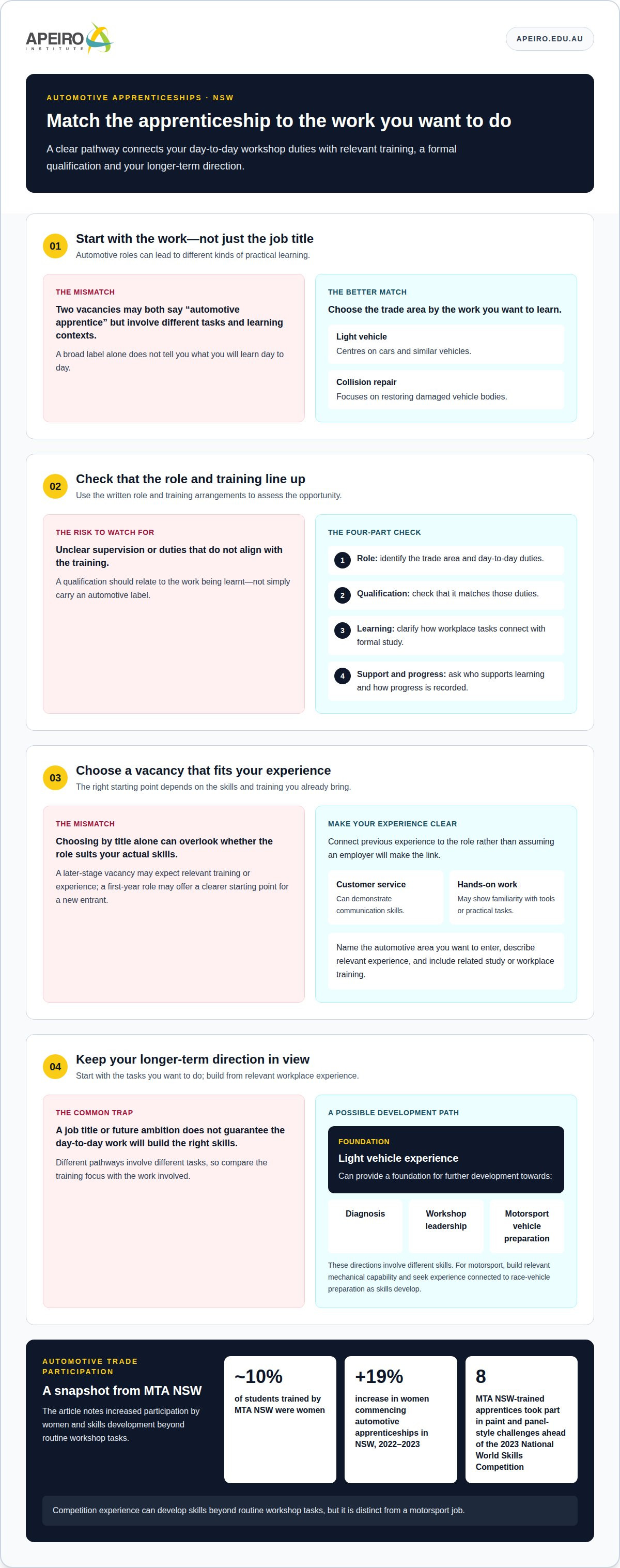
Start by choosing the work you want to do, then look for an apprenticeship that supports that goal. Light vehicle experience can provide a foundation for other automotive roles, while further development may lead towards diagnosis, workshop leadership or motorsport vehicle preparation. These paths involve different skills, so consider the tasks you want to do day to day.
Automotive trades are becoming more visible to women. Women represented approximately 10% of students trained by MTA NSW, while women commencing automotive apprenticeships in NSW increased by 19% between 2022 and 2023. Apprentice mechanic Katrina Nilsson was 21 when profiled, after about three or four workshops initially rejected her.
MTA NSW-trained apprentices also competed in paint and panel-style challenges ahead of the National World Skills Competition in 2023. Eight apprentices took part. This shows one way apprentices can develop skills beyond routine workshop tasks, although competition experience is distinct from a motorsport job. For motorsport, build relevant mechanical capability first and seek experience connected to race-vehicle preparation as your skills develop.
Trade qualifications
A formal qualification gives structure to the skills developed at work. Apprentices and trainees complete formal qualifications through a Registered Training Organisation of their choice. For a career changer, the qualification’s subject and training content should match the trade duties in the workplace.
Discuss how workplace tasks connect with training and how progress is recorded. For example, if your daily duties focus on vehicle servicing, understand how those tasks support the qualification rather than assuming every workshop role offers the same experience. Existing experience may also support a pathway for experienced workers, particularly when it relates to your intended trade. Keep your qualification goal in view as your responsibilities expand.
Paid apprenticeship pathways
A paid apprenticeship combines employment with structured trade learning. Before accepting a position, read the written terms and understand the role, pay arrangements, hours, training responsibilities and how workplace progress will be reviewed. These details help you judge whether the opportunity fits your commitments and career plans.
Changing careers can mean balancing training with existing responsibilities. Ask how work and formal learning fit together, and consider whether the role offers practice in the skills you want to build. A later-stage vacancy may suit someone with relevant training or experience, while a first-year role may offer a clearer starting point for a new entrant. Match the opportunity to your actual skills, not just the job title.
Automotive apprenticeship programs in NSW
The best automotive apprenticeship opportunities in NSW connect your chosen trade with relevant workplace learning and a formal qualification. First identify the automotive work you want to do, then compare the program’s training focus with the duties involved.
NSW apprenticeship program options
Automotive apprenticeship options lead towards different kinds of workshop work. For example, a light vehicle role centres on cars and similar vehicles, while collision repair focuses on restoring damaged vehicle bodies. These are distinct pathways, so identify the tasks you want to learn before comparing vacancies or training arrangements.
Apprentices and trainees complete formal qualifications through a Registered Training Organisation of their choice. The qualification should relate to the work being learnt, not simply carry an automotive label. Someone interested in diagnosing faults, for instance, should look for training aligned with diagnostic tasks, while a prospective body repairer needs a pathway suited to repair work.
Use these steps to assess a program:
- Identify the trade area and day-to-day tasks described in the role.
- Match those tasks with the formal qualification and training plan.
- Clarify how workplace learning and formal study connect.
- Consider whether the pathway supports your longer-term career direction.
This comparison helps distinguish a training pathway from a job title. Two vacancies may both say “automotive apprentice” yet offer different workplace tasks and learning contexts. A clear connection between the role and qualification gives you a practical basis for choosing among the best automotive apprenticeship opportunities in NSW.
Eligibility requirements
Eligibility depends on the program and position. Employers and training arrangements may consider your readiness for the role, the work involved and your ability to take part in formal learning. Career changers can make applications clearer by connecting previous experience to the role. Customer service work can demonstrate communication skills, while hands-on work may show familiarity with tools or practical tasks.
Make your application focused and specific. Name the automotive area you want to enter, describe relevant experience and explain why the duties appeal to you. Include the title and skills gained from any related study or workplace training. These details help an employer assess your fit without assuming every applicant has the same background.
Before accepting a position, compare the written role with the proposed training. Check that the duties, qualification and learning arrangements form a coherent pathway. Ask how progress is documented and who supports workplace learning. A mismatch, such as a role focused on unrelated tasks, can make it harder to develop skills relevant to the qualification.
For example, if you’re aiming for diagnostic work, look for a role that develops relevant mechanical knowledge rather than relying on the word “automotive” alone. Matching your experience, training needs and intended direction helps you assess whether a program belongs among the best automotive apprenticeship opportunities in NSW.
Automotive light vehicle apprenticeships
Light vehicle training is a pathway into work on cars and similar vehicles. Choose it if you want your trade learning centred on this vehicle category rather than trucks, diesel systems or vehicle electrical work.
Automotive apprenticeships can lead into light vehicle, heavy vehicle, diesel or auto electrical trades. These are distinct pathways, so match the training and workplace tasks to the vehicles and systems you want to work with.
A light vehicle mechanic’s training connects with the work performed in the role. A vacancy might involve routine servicing, mechanical repairs or fault-finding, but the title alone won’t reveal how those tasks are balanced. Read the role description alongside the qualification title and training arrangements. Together, they give you a clearer picture of the skills the pathway is intended to develop.
If you’re drawn to cars and general mechanical work, light vehicles may suit you. Someone more interested in large transport vehicles could explore heavy vehicle or diesel pathways instead. Auto electrical work has a different focus. This distinction matters because one workshop can involve several types of work, while an apprenticeship qualification focuses on a particular trade outcome.
Assess a light vehicle opportunity by considering:
- Vehicle focus: Does the role centre on light vehicles, or cover a different category?
- Workplace tasks: Are the advertised duties relevant to the skills you want to learn?
- Training alignment: Does the qualification connect with the role’s practical work?
- Future direction: Does this pathway support your goal, such as general mechanical work or later diagnostic study?
These questions help you compare vacancies beyond their job titles. For example, two roles involving cars may differ in the balance of servicing, repairs and diagnostic tasks. Look for a clear connection between the duties and formal training, then consider whether that learning fits your career plans.
Light vehicle training can provide a foundation for further automotive learning. A mechanic who wants to develop diagnostic skills may later consider advanced study in automotive mechanical diagnosis. That is a separate progression step, not a reason to assume every apprenticeship includes advanced diagnostic training. Keeping the stages distinct helps you choose a suitable starting point.
For a focused pathway, the Certificate III in Light Vehicle Mechanical Technology is directly relevant to light vehicle training. Compare its focus with the work you want to pursue, whether that means servicing cars, developing broader mechanical skills or building towards further automotive study.
First-year and later-stage apprentice vacancies
A first-year vacancy suits someone starting formal automotive trade training. A later-stage vacancy may suit an apprentice with relevant workplace experience who has completed part of a qualification. Match your current skills and training progress to the position’s stated stage.
For a first-year role, focus your application on practical strengths and why you’ve chosen the trade. If you’ve maintained your own vehicle, completed relevant study or worked with tools, give specific examples. Explain what you did, learnt and how it connects with the advertised duties. Don’t present informal experience as a completed qualification.
Later-stage vacancies call for a clear account of your progress. Include the qualification you’re undertaking, the training you’ve completed and the automotive tasks you’ve performed. Describe experience with servicing or repairs only if you’ve done that work. This helps an employer compare your experience with the role’s duties and identify further learning needs.
Before applying, use this short comparison:
- Stage: Does the vacancy state first-year or later-stage?
- Experience: Do the listed duties match your current skills?
- Training: Can you explain your qualification progress accurately?
- Fit: Does the role support the automotive work you want to pursue?
A job title alone may not explain the expected starting point. Two automotive apprentice vacancies, for example, may describe different tasks despite both involving workshop work. Read each description for the work area, responsibilities and training expectations. If the advertisement names a qualification, use its exact title in your application and explain how your experience relates.
Prepare a concise résumé that separates paid work, informal mechanical experience and completed training. A career changer might highlight transferable skills, such as following procedures or communicating with customers, and give a concrete example of each. An existing apprentice should clearly list completed training and relevant tasks. Keep dates and qualification details consistent across your résumé and application.
Follow the vacancy’s application instructions. Address the employer’s requested criteria, attach the requested documents and state your preferred stage. For a later-stage position, say what you’ve completed and what remains in your training. For a first-year role, explain why you’re ready to begin structured workplace learning.
Compare opportunities by fit, not stage alone. A first-year position with duties suited to your goals may be a better fit than a later-stage opening requiring experience you haven’t gained. Relevant prior training may make a later-stage role worth considering. Matching your background and the advertised work to the qualification helps you apply with confidence.
The social impact report lists 0% as the first person in their household to complete a trade. When describing your own background, keep personal circumstances separate from your evidence of skills and training. Focus on what you have completed, what you can do and how it aligns with the vacancy.
What are the eligibility requirements for an automotive apprenticeship in NSW?
No single checklist suits every automotive apprenticeship. In NSW, assess your eligibility against the vacancy’s stated criteria and the training attached to the role. Distinguish formal entry requirements from an employer’s selection preferences.
Start with the advertisement. Identify any required experience, study, workplace availability or documents, then compare each point with your background. A vacancy might welcome beginners but still expect applicants to explain their interest in automotive work. Another role may ask for relevant experience because its duties suit someone further along.
Use a simple application check before applying:
- Role criteria: Note each requirement stated in the vacancy.
- Training fit: Match the qualification and learning arrangements to the role.
- Your evidence: Gather relevant study records and describe practical experience accurately.
- Work expectations: Consider whether the duties and schedule suit your circumstances.
- Application details: Follow the employer’s instructions and provide requested documents.
For career changers, transferable experience can strengthen an application without replacing trade training. A retail worker might describe helping customers explain a problem, while a warehouse worker could give an example of following a process carefully. Connect each example to the advertised role. Don’t describe informal vehicle maintenance as professional mechanical experience.
If you have previous automotive training, state exactly what you completed and where. Records of completed units or related work can help an employer understand your starting point. Keep the qualification title, dates and duties consistent across your résumé and application. This is particularly useful when applying for a vacancy beyond entry level.
Eligibility and selection are related but not identical. Meeting the stated entry criteria means your application can be considered; the employer may also assess how your experience fits the role. Strong customer service skills may suit a workshop environment, for example, while a vacancy focused on practical mechanical tasks may prioritise evidence of hands-on ability.
Before accepting an offer, compare the written position details with the proposed training. Confirm that the role, qualification and learning arrangements describe the same pathway. If an advertisement says “automotive apprentice” but gives little detail about duties, seek clarity through the application process before deciding. A clear match helps you understand what you’re committing to and prepare for the work ahead.
For international applicants, distinguish course entry criteria from the requirements of a particular job. Training eligibility alone doesn’t establish eligibility for employment. Read the relevant course and vacancy requirements separately, then prepare the documents each requests. This avoids assumptions based on a course description or job title.
Apeiro Institute: Apprenticeships and Traineeships
Apeiro Institute offers apprenticeships and traineeships for learners considering vocational training alongside their career plans. If you’re comparing training pathways or have previous trade experience, explore the option that best matches your starting point.
Trade Pathways for Experienced Workers (TPEW) may suit workers whose existing skills and experience relate to a trade pathway. Smart & Skilled Funded Courses are another option for eligible learners exploring vocational study in NSW. Each pathway serves a different purpose, so consider your experience and the qualification you want to pursue.
Apeiro Institute also offers the UEE30920 Certificate III in Electronics and Communications, a qualification in a different trade area from automotive. For automotive apprenticeship questions, contact Apeiro Institute to discuss the training pathway that aligns with your goals.
Take your next step towards an automotive career
Turn your interest into a clear training direction. Consider the automotive tasks you want to learn, the experience you bring and the qualification that fits your goal. These choices can help you assess the best automotive apprenticeship opportunities in NSW and build a practical plan.
Apeiro Institute offers Apprenticeships and Traineeships, Trade Pathways for Experienced Workers (TPEW), and the UEE30920 Certificate III in Electronics and Communications. These options serve different training needs, so consider which pathway aligns with your experience and career direction. For automotive-focused study, explore the light vehicle pathway discussed in this guide.
Starting a trade journey is a meaningful step, whether you’re entering the industry or bringing experience from another career. A thoughtful choice can give your next stage direction.
Keep moving towards work that interests you. Your next step can begin with a clear conversation about your goals.
Frequently Asked Questions
What automotive apprenticeships are available in NSW?
NSW automotive pathways include light vehicle, heavy vehicle, diesel and auto electrical trades. The right option depends on the vehicles and systems you want to work with. Light vehicle training, for example, suits someone aiming to work on cars, while diesel pathways focus on diesel-powered equipment and vehicles. Apprentices complete a formal qualification alongside workplace learning, with the qualification aligned to their chosen trade.
Which NSW employers offer the best automotive apprenticeships?
There isn’t one best employer for every apprentice. A suitable workplace offers duties aligned with your trade and qualification, and a clear connection between practical work and formal learning. If you’re applying for a light vehicle role, look for relevant vehicle tasks rather than relying on the job title alone. Consider the responsibilities, training arrangements and learning support when deciding whether a position fits your goals.
How long do automotive apprenticeships take in NSW, and what training providers deliver them?
The time depends on the qualification and how workplace and formal training are arranged and completed. Apprentices undertake their qualification through a Registered Training Organisation of their choice. Apeiro Institute is an RTO and offers AUR30620 Certificate III in Light Vehicle Mechanical Technology. This provides a light vehicle training option; the qualification’s training plan sets out the learning requirements and progress for the individual apprenticeship.

Disclaimer
The information provided on this blog is for general informational and educational purposes only. While every effort is made to ensure the accuracy and reliability of the content, the author makes no representations or warranties of any kind, express or implied, about the completeness, accuracy, suitability, or availability of the information contained on this blog.
The views and opinions expressed in blog posts are those of the individual author and do not necessarily reflect the official policy or position of any organization, company, or employer.
This blog may contain links to external websites or third-party content. These links are provided for convenience only, and the author has no control over and assumes no responsibility for the content, privacy policies, or practices of any third-party sites.
Nothing on this blog constitutes professional advice (legal, financial, medical, or otherwise). Readers are encouraged to seek appropriate professional guidance before making any decisions based on the information provided here.
By using this blog, you acknowledge that any reliance on the information is at your own risk.


