

An apprenticeship isn’t the only way to start working in automotive, but it is essential for some roles. Pursuing an automotive technician career pathway can begin without one; however, obtaining a motor vehicle tradesperson certificate for automotive repair work requires an apprenticeship and the listed qualification. The right route depends on the work you want to do and the skills you already have.
It’s understandable to wonder whether a non-traditional start will count, especially if you have hands-on experience in another trade or industry. This Apeiro Institute guide explains what an apprenticeship involves, when it may not be essential for entry and how transferable skills and prior learning can inform your next step.
You’ll also see how light vehicle mechanical qualifications fit into the pathway, which related automotive roles you could explore and how to choose a practical direction. Whether you’re starting fresh or building on experience, these options can help you plan a clearer route into automotive work.
Key Takeaways
- Understand when you may enter automotive work without an apprenticeship, and when NSW certification requirements make one essential.
- Identify how experience from related work could support your pathway and what evidence may help demonstrate your skills.
- Explore the different automotive career maps to find roles that match your interests and strengths.
- See how career progression can vary between larger and smaller employers, and what that could mean for your next move.
- Learn where light vehicle mechanical qualifications and Trade Pathways for Experienced Workers may fit into your plans.
Can I get it without completing an apprenticeship?
There’s no single total for apprenticeship fees, tools and other costs. Course charges, required hand tools and protective workwear depend on the training arrangement and employer requirements, including which items the employer supplies.
In NSW, the answer depends on the work you plan to do. Automotive certifications aren’t always mandatory for mechanics, but a motor vehicle tradesperson certificate has specific requirements. NSW Fair Trading requires applicants to complete an apprenticeship and the listed qualification to obtain the certificate. The certificate is required for automotive repair work that affects a vehicle’s mechanical operation or structure. A repair business also needs a licence.
That distinction matters when planning a first role. Some people may begin automotive work without already holding a trade qualification, while regulated repair work has a higher threshold. Finishing Year 10 is identified as the baseline education requirement for becoming a mechanic in Australia. An apprenticeship combines on-the-job training with classroom learning, so students build practical skills alongside structured study.
An apprentice’s experience changes across learning settings. In a workshop, they apply classroom concepts to vehicle tasks under workplace supervision. In class, they develop the technical knowledge that supports those tasks. A trainee also combines work and training, although the qualification and job duties depend on the pathway. For example, vehicle servicing and diagnosis may call for different training.
Registered Training Organisations deliver structured learning and nationally recognised qualifications in Australia. This gives students a way to develop skills, whether they’re preparing for an apprenticeship or building knowledge for a related role. Training alone doesn’t replace NSW’s apprenticeship requirement for a motor vehicle tradesperson certificate.
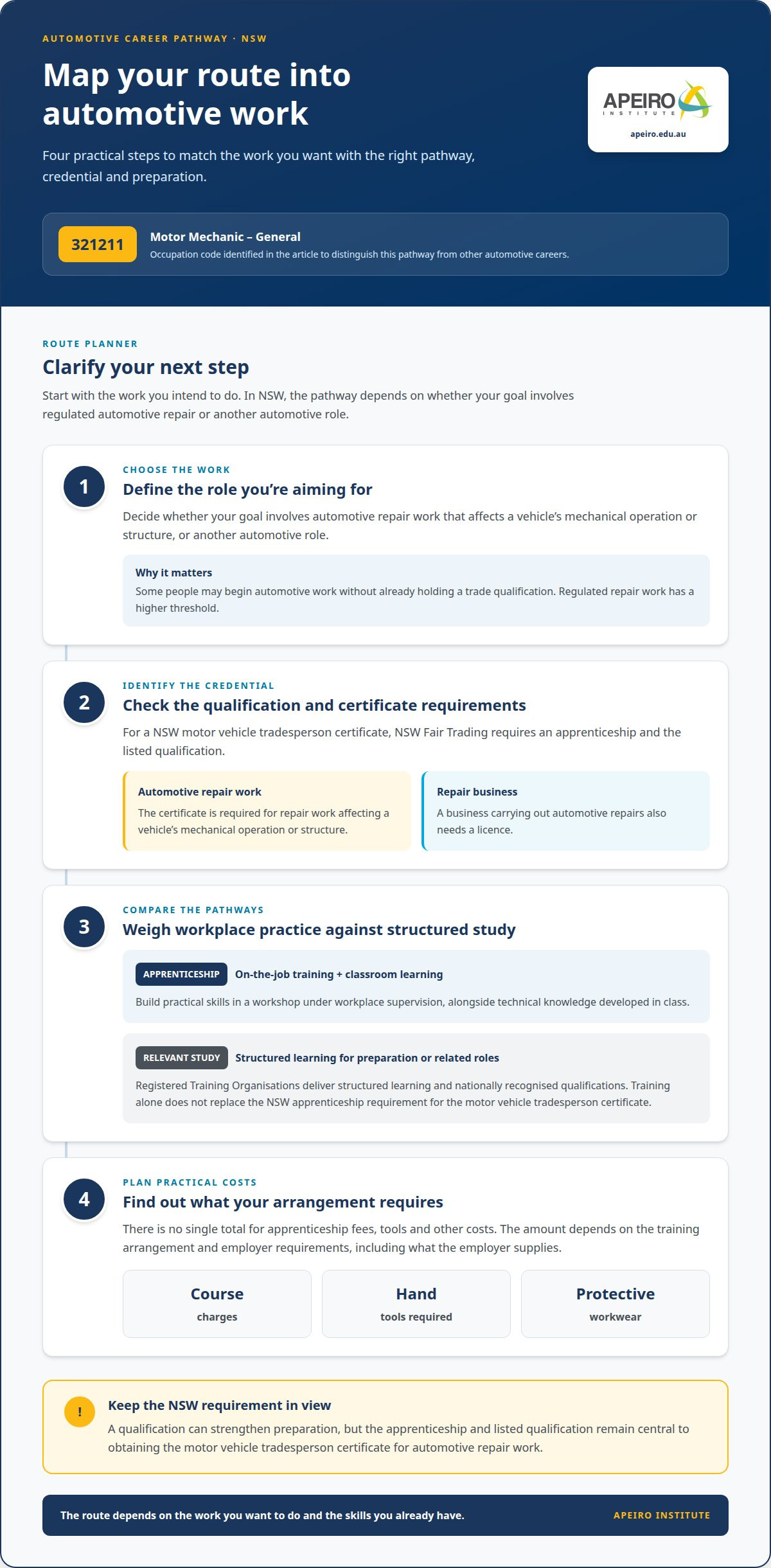
Use these steps to clarify your route:
- Choose the work: Decide whether your goal involves regulated automotive repair or another automotive role.
- Identify the credential: Match the role with its qualification and any certificate requirement.
- Compare the pathways: Consider an apprenticeship’s mix of workplace practice and classroom learning, or relevant study before applying.
- Plan practical costs: Establish which tools, clothing and training charges apply to your arrangement.
The occupation code 321211 identifies Motor Mechanic - General. It can help distinguish that pathway from other automotive careers. A qualification can strengthen preparation, but the apprenticeship and listed qualification remain central to obtaining the NSW tradesperson certificate for automotive repair work.
Costs may include course charges, required hand tools and protective workwear. The total depends on the training arrangement and employer requirements, including which items the employer supplies.
Transferable skills and experience
Experience in another trade or hands-on role can give you useful starting skills. Automotive work draws on careful observation, practical problem-solving and accurate record-keeping. For example, a maintenance worker who follows service procedures may already understand why each step matters. Those strengths can support learning, but they don’t automatically replace automotive training or demonstrate competence in specific tasks.
Consider the work you’ve actually done, rather than relying on job titles. A warehouse technician might have used hand tools, followed safety procedures and recorded faults. A machinery operator may have noticed unusual sounds, reported faults and followed maintenance instructions. These examples show relevant work habits, but vehicle-specific diagnosis and repair skills still need to be learned and assessed for your intended role.
Evidence makes your experience easier to assess. Useful material shows what you did, how you did it and how independently you worked. For example, a maintenance log might record equipment checks, faults found and actions taken. A supervisor’s statement could describe your role in a repair. Dated work samples, training records and task checklists can add context when they relate directly to the skills you’re claiming.
For an RPL application, one suggested item is a 2-minute video demonstration of your work. A short recording might show you completing a task, using tools appropriately and explaining your process. Keep the demonstration focused on your own contribution. Avoid presenting a team result as solely your work, and explain any limits on what the footage shows.
Organise evidence around individual skills rather than a broad claim such as “good with tools”. A clearer example describes measuring a component, identifying a fault and recording the result. Include the task, your actions and the outcome. Remove confidential workplace details before sharing a record.
Experience can come from automotive work or related fields, but each skill needs relevant evidence. Someone with electrical experience, for instance, may be able to demonstrate safe tool use and systematic fault-finding. That doesn’t establish competence across every vehicle system. Matching evidence to the skill being assessed makes gaps easier to identify and the next learning step more practical.
Use this simple evidence plan:
- List tasks: Record practical duties, tools used and procedures followed.
- Choose examples: Select work records or demonstrations that show your own actions.
- Connect skills: Explain how each example relates to automotive tasks.
- Note learning needs: Identify vehicle-specific skills your experience doesn’t yet cover.
This approach helps separate transferable strengths from automotive competencies you still need to develop. It also gives an RPL assessment clearer evidence to consider, but past experience alone doesn’t guarantee a qualification.
Automotive technician career maps
An automotive career map sets out roles, related skills and possible directions. The Automotive Career Pathways project includes an Automotive Technician map under occupation code 351131. Use it to compare roles by their day-to-day work, not just their titles. A technician focused on vehicle systems may follow a different path from someone working with parts, tyres or body repairs.
Physical demands and risks depend on the task and workplace. Automotive work can involve standing, bending, handling tools, working around vehicles and exposure to hot or noisy equipment. Safe practice means following workplace procedures, using task-appropriate protective equipment and working within your training and supervision. For example, lifting a component or working near a moving vehicle calls for careful preparation.
The project’s maps cover a range of pathways, including:
- Automotive Technician: occupation code 351131.
- EV Technician: occupation code 351434, focused on electric vehicle work.
- Diesel Technician: occupation code 351433.
- Motor Vehicle Parts and Accessories Fitter (General): occupation code 899431.
- Motor Vehicle Parts Interpreter: occupation code 631432.
- Vehicle Detailer: occupation code 811531.
- Panelbeater: occupation code 351331, and Vehicle Painter, code 351631.
- Automotive Electrician: occupation code 351231.
- Tyre Fitter: occupation code 899434, and Vehicle Body Builder, code 351531.
Automotive work extends beyond general mechanical repairs. A parts interpreter, for instance, helps select suitable vehicle components. A panelbeater focuses on damaged vehicle bodies, while a vehicle painter works on their finish. Comparing these tasks can help you choose a direction that suits your interests and practical strengths.
Specialisations can shape what you learn next. Hybrid and electric vehicle work focuses on vehicle systems and their electrical complexities. Heavy vehicle mechanics work on heavy-duty trucks and equipment, not only diesel-engined vehicles. These distinctions matter when deciding which systems, vehicle types and technical knowledge you want to develop.
Use a career map as a planning tool, not a promise of a particular job sequence. Start with a role that interests you, identify its core tasks, then compare related roles. For example, experience with electrical systems may make the Automotive Electrician or EV Technician maps worth exploring. Consider the work environment and physical demands as well as the technical focus.
Automotive technologies continue to develop. Workshops, advanced courses and practical opportunities to expand your knowledge can help you keep pace. A career map gives you a starting point for identifying relevant skills and choosing your next learning step.
Career progression at larger and smaller employers
Employer size can shape how an automotive technician’s work is organised. The Automotive Career Pathways project identifies occupation code 351151 among roles whose maps distinguish careers at larger and smaller employers. This comparison helps you think beyond job titles. It highlights how responsibilities, team structures and opportunities to build experience can differ between workplaces.
A larger employer may divide workshop duties among specialist teams. One technician might focus on diagnostics, while another handles servicing or a particular vehicle system. This structure can offer a clearer view of specialist work, but technicians may build expertise in a narrower set of tasks before taking on broader responsibilities.
A smaller workshop may involve a wider mix of daily tasks. A technician might move between routine servicing, fault investigation and customer updates. This can provide exposure to different parts of workshop operations. Progression, however, may depend on the tasks available and how the business organises its work.
Neither setting guarantees a faster or better career path. Compare the learning and responsibility each role offers. For example, a position that includes supervised diagnostic work could develop different skills from one focused on routine maintenance. Consider how the workplace allocates tasks, supports learning and recognises growing capability.
Use these practical factors to compare roles:
- Task range: Does the role cover varied repairs or focus on particular systems?
- Supervision: Who provides guidance when a task is unfamiliar?
- Progression: What responsibilities could follow as your skills develop?
- Team structure: Will you work alongside specialists or across several workshop functions?
- Learning opportunities: Can you build knowledge through practical tasks and further study?
For example, someone interested in diagnostic work could compare two jobs by asking what fault-finding tasks each includes. A broad role may offer exposure to multiple systems, while a specialist team may provide repeated practice in one area. Compare the experience and responsibility involved, not employer size alone.
Progression can also involve moving into coordination or technical leadership. These steps require more than repair skills. Clear communication, accurate work records and supporting colleagues can become important as responsibilities grow. A technician who explains a fault clearly to a service adviser, for instance, helps others understand the repair process.
Career maps can help frame these comparisons, but they aren’t a fixed promotion ladder. Use the Automotive Technician map and occupation code 351151 to consider how work may differ across employer sizes. Then assess which setting best matches the tasks you want to learn and the responsibilities you’re ready to build towards.
Light vehicle mechanical qualification
A light vehicle qualification provides structured learning for people aiming to work on cars and similar vehicles. In NSW, the Automotive Technician pathway lists course codes AUR 31120 and AUR 31121. These codes identify qualifications associated with that pathway. Check both the code and full qualification title when planning your training, as course names can sound similar while referring to different credentials.
AUR30620 Certificate III in Light Vehicle Mechanical Technology is a qualification option for developing skills in light vehicle mechanics. It can form part of an automotive technician career pathway in NSW for someone building towards workshop work. The course’s training requirements define the competencies learners develop and demonstrate, so use the full qualification details to understand its focus.
Keep the pathway codes distinct from the qualification offered here. AUR 31120 and AUR 31121 appear in the Automotive Technician pathway information. AUR30620 is the Certificate III in Light Vehicle Mechanical Technology. Don’t assume these codes refer to the same course or are interchangeable. Matching the code and title helps you make a better-informed training choice.
Start by connecting the work you want to do with the learning you need. Someone interested in light vehicle servicing may need a different next step from someone aiming to develop diagnostic skills. Your experience matters too: a new entrant may need foundational learning, while an experienced worker may want to formalise existing skills.
Use these points to assess whether a qualification fits:
- Course identity: Check the full title and code, such as AUR30620.
- Work focus: Link the qualification to the vehicle tasks you want to pursue.
- Starting point: Consider whether you’re entering the field or extending prior experience.
- Next learning goal: Decide whether you want to develop towards diagnosis or broader automotive technology.
Further study can support a move towards more specialised learning. AUR40216 Certificate IV in Automotive Mechanical Diagnosis has a diagnostic focus. AUR50216 Diploma of Automotive Technology offers a further automotive study option. These are distinct qualifications, so consider how their focus relates to your current skills and intended responsibilities.
For an automotive technician career pathway in NSW, a qualification is one part of the plan, not the whole route. Both your intended work and your training matter. For regulated automotive repair work, the apprenticeship and qualification requirements discussed earlier still apply. Choose study that fits your intended role rather than relying on a course title alone.
Explore the Certificate III in Light Vehicle Mechanical Technology
Apeiro Institute: Trade Pathways for Experienced Workers (TPEW)
Apeiro Institute offers Trade Pathways for Experienced Workers (TPEW) for people bringing practical trade experience to their next learning step. If you’ve worked with tools, equipment or technical tasks, TPEW is one pathway to consider alongside your automotive career goals. Your experience can help shape a suitable training direction.
For a structured entry into the trade, Apeiro Institute also offers Apprenticeships and Traineeships. Smart & Skilled Funded Courses are another option for eligible learners. These pathways serve different circumstances, so consider whether you’re building experience, formalising existing skills or starting a trade qualification.
Contact Apeiro Institute to discuss a pathway that fits your experience and automotive goals.
Choose a next step that fits your experience
Planning an automotive technician career pathway in NSW starts with identifying the skill you need to develop next. Decide whether you need foundational light vehicle training, a diagnostic focus or a way to build on practical experience. Then connect that choice to the work you want to do, rather than trying to map every possible role at once.
If your experience is already substantial, consider whether a pathway for experienced workers suits your situation. If you’re beginning a trade, structured training can help you build skills alongside workplace learning. Apeiro Institute also offers UEE30920 Certificate III in Electronics and Communications, a separate qualification for learners interested in electronics and communications rather than light vehicle mechanics.
A useful next step is to describe your current experience, the tasks you want to learn and the role you’re aiming for. Apeiro Institute can help you consider a training direction suited to those goals.
Your next step doesn’t need to map your whole career. Start with the skill you want to build, then keep moving forward with purpose.
Frequently Asked Questions
Do automotive technicians need a licence in New South Wales?
A motor vehicle tradesperson certificate is required for automotive repair work that affects a vehicle’s mechanical operation or structure. NSW Fair Trading requires applicants for the certificate to complete an apprenticeship and the listed qualification. A repair business also needs a licence. For example, a technician carrying out work that affects a vehicle’s mechanical operation must meet the tradesperson certificate requirements, not rely on general workshop experience alone.
What qualifications do you need to become an automotive technician in NSW?
For a motor vehicle tradesperson certificate, the stated requirements are an apprenticeship and the listed qualification. The Automotive Technician pathway information names course codes AUR 31120 and AUR 31121. Check the exact course title and code for the qualification you plan to study, as course codes identify specific training. Registered Training Organisations can provide nationally recognised qualifications, which give learners a structured way to develop and demonstrate vocational skills.
How long does an automotive technician apprenticeship take in NSW?
The time required depends on the apprenticeship and training arrangement, including its qualification requirements and workplace learning plan. Apprentices combine practical work with classroom learning, developing skills on the job while completing formal study. Discuss the expected training sequence with the apprenticeship and training parties before starting. This helps you understand how workplace tasks and course requirements fit together, without assuming one duration suits every arrangement.
What does the NSW Certificate III in Light Vehicle Mechanical Technology cover?
The Certificate III in Light Vehicle Mechanical Technology focuses on skills for light vehicle mechanical work. The qualification title indicates its vehicle focus, while the course requirements define the competencies learners must demonstrate. For example, someone aiming for workshop servicing work should consider how the course learning relates to those duties. Compare the qualification’s exact title and code with your intended pathway rather than assuming similarly named courses are identical.
What licences or registrations are required to work as an automotive technician in NSW?
The requirements depend on the work being performed. Automotive repair work affecting a vehicle’s mechanical operation or structure requires a motor vehicle tradesperson certificate, and the repair business needs a licence. These are separate requirements: an individual technician’s certificate doesn’t replace the business licence. Opening a repair business, for instance, involves meeting the business-licensing requirement as well as ensuring technicians undertaking regulated repair work hold the relevant certificate.
What career pathways and specialisations are available for automotive technicians in NSW?
Career options include general automotive technician work, electric vehicle and diesel specialisations, automotive electrical work, panelbeating, vehicle painting, tyre fitting and parts roles. The Automotive Career Pathways project assigns occupation codes to mapped roles, including EV Technician code 351434 and Diesel Technician code 351433. To narrow your options, compare the tasks involved: electrical systems, heavy vehicles, vehicle bodies and parts each call for different interests and technical development.
How can automotive technicians in NSW progress to become a workshop manager or start a repair business?
Build towards greater responsibility by developing technical judgement, communication, accurate work records and the ability to coordinate tasks. These skills support progression into team coordination or workshop management. Starting a repair business also involves a separate licensing requirement: repair businesses need a licence in NSW. Treat technical and operational responsibilities as distinct steps, and understand the certification requirements for repair work before taking on regulated jobs.
What fees, tools and other costs do automotive apprentices in NSW have to pay?
There’s no set total. Costs may include course charges, required hand tools and protective workwear. The amount depends on the training arrangement and employer requirements, including which items the employer supplies.

Disclaimer
The information provided on this blog is for general informational and educational purposes only. While every effort is made to ensure the accuracy and reliability of the content, the author makes no representations or warranties of any kind, express or implied, about the completeness, accuracy, suitability, or availability of the information contained on this blog.
The views and opinions expressed in blog posts are those of the individual author and do not necessarily reflect the official policy or position of any organization, company, or employer.
This blog may contain links to external websites or third-party content. These links are provided for convenience only, and the author has no control over and assumes no responsibility for the content, privacy policies, or practices of any third-party sites.
Nothing on this blog constitutes professional advice (legal, financial, medical, or otherwise). Readers are encouraged to seek appropriate professional guidance before making any decisions based on the information provided here.
By using this blog, you acknowledge that any reliance on the information is at your own risk.


