

A light vehicle mechanic’s work is about more than fixing what’s broken. Apprentices learn to service and repair cars, utes and vans, and build skills in diagnostics and safety checks while working towards a Certificate III in Light Vehicle Mechanical Technology. A light vehicle mechanic apprenticeship near me typically takes 36 to 48 months, depending on how quickly the apprentice completes the required competencies.
If you’re interested in hands-on work, you’ll want a clear picture of the role and how to get started. Entry requirements depend on the apprenticeship pathway and your circumstances, so understanding the options can help you plan your next move.
This guide covers what light vehicle mechanics do, how apprenticeships work, how long training takes and how to find listings in Australia. You’ll also learn what to compare so you can choose a practical next step towards a career in automotive mechanical work.
Key Takeaways
- See how light vehicle mechanics work across different vehicle systems, from routine servicing to diagnosing faults.
- Understand the entry pathways and workplace expectations that can shape your apprenticeship options.
- Learn what to look for in apprenticeship listings, including the role, training arrangement and employment conditions.
- Get a clearer picture of how competency progress and probation affect the apprenticeship timeline.
- Explore how Apeiro Institute’s Apprenticeships and Traineeships and AUR30620 Certificate III in Light Vehicle Mechanical Technology relate to your next step.
What Does a Light Vehicle Mechanic Do?
Light vehicle mechanics service and repair cars, utes and vans. Their work can involve engines, gearboxes, clutches and brakes. A light vehicle has an authorised mass no greater than 4.5 tonnes Gross Vehicle Mass and can seat no more than 12 adults. These limits help distinguish light vehicles from heavier vehicles in automotive work.
Diagnosis is another important part of the job. A mechanic investigates a reported problem, checks the relevant systems and identifies what needs attention. For example, a reported braking issue may lead to an inspection of brake components and their condition. Safety checks can also reveal issues that affect how the vehicle operates.
The apprenticeship qualification for this trade is the Certificate III in Light Vehicle Mechanical Technology. Apprentices develop practical automotive skills and work towards this certificate through workplace experience and training. The qualification connects day-to-day workshop tasks with the technical knowledge needed to service and repair light vehicles. It provides a structured pathway into the trade.
Apprentices learn under the guidance of qualified, experienced technicians. A supervisor can demonstrate a task, explain the tools involved and oversee the apprentice’s practice. For example, an apprentice might observe a component inspection before carrying out related work under supervision. This support helps develop sound work habits as well as mechanical skills.
Training covers different vehicle systems and faults, not just one repeated repair. An apprentice may learn to approach a service task, use diagnostic information and complete checks before a vehicle is returned to its owner. The work varies by workshop and vehicle. Over time, apprentices build competence in the tasks covered by their qualification.
Government support depends on the state or territory and the apprentice’s eligibility. These figures describe the government contribution, not the apprentice’s wages.
Related automotive qualifications can support further development after a light vehicle certificate. Someone who already holds a light vehicle mechanical qualification may take an Automotive Electrical Apprenticeship to keep their skills current as automotive technology changes. This pathway can add electrical skills alongside mechanical training, including knowledge relevant to newer vehicle systems.
The Certificate III is a practical starting point for people aiming to work in light vehicle mechanics. It combines supervised workplace learning with a defined qualification, and further training can build on that foundation. Understanding the role, the certificate and related pathways can help you decide whether workshop-based automotive work suits your goals.
Apprenticeship entry requirements
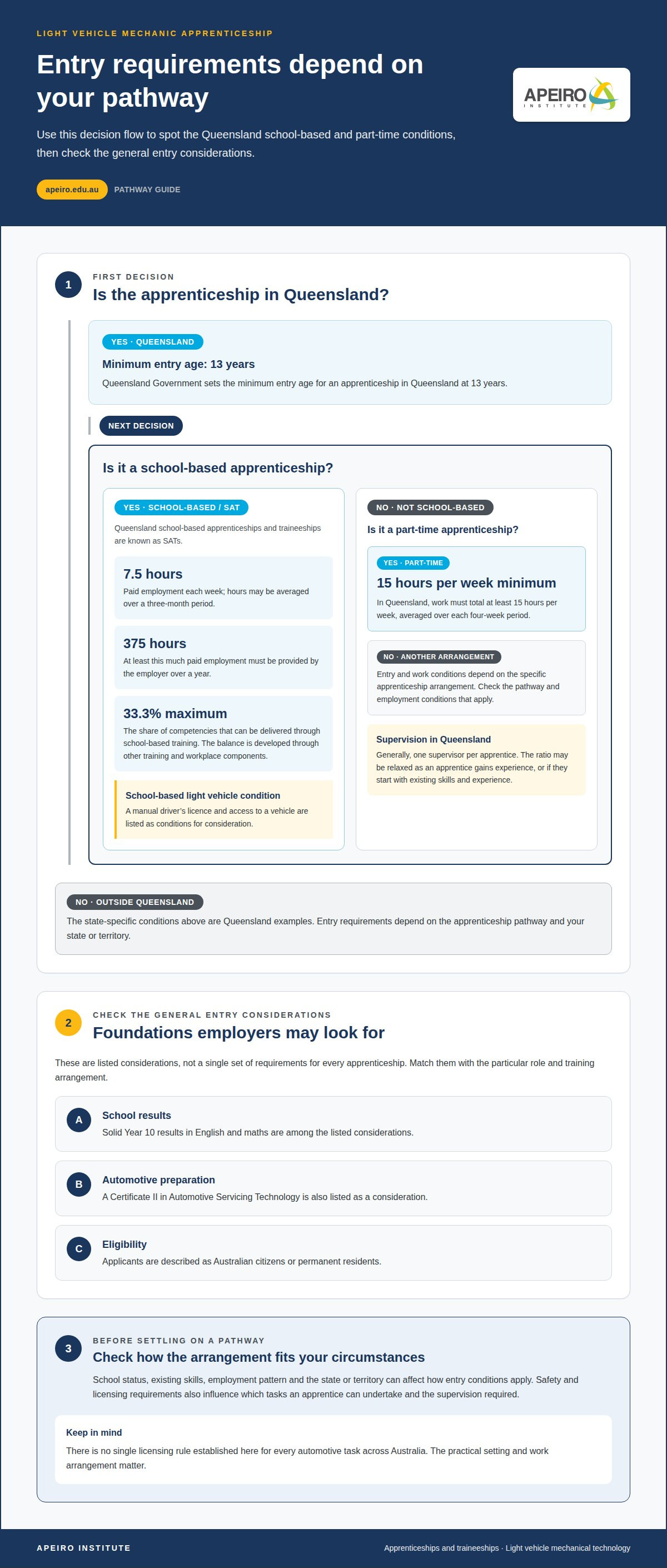
Entry depends on the apprenticeship arrangement, your preparation and the state or territory. School-based and part-time pathways also have specific work and training conditions.
Entry Skills and Requirements
Entry skills and requirements are the study, eligibility and practical foundations used to begin an apprenticeship. They matter because employers need to match a candidate’s readiness with the role and training arrangement. In Australia, listed considerations include solid Year 10 results in English and maths, and a Certificate II in Automotive Servicing Technology. Applicants are also described as Australian citizens or permanent residents. Requirements can differ between pathways, so consider these alongside the particular employment arrangement.
Employer Supervision Requirements
Employer supervision means an apprentice learns and works under a qualified, experienced technician. This matters because a supervisor can guide practical tasks as the apprentice’s responsibilities grow. Queensland generally accepts one supervisor per apprentice. That ratio may be relaxed as an apprentice gains experience or if they start with existing skills and experience. Supervision therefore depends on the apprentice’s capability, not just the number of people in a workshop.
Safety Risks and Licensing Requirements
Safety and licensing requirements affect which tasks an apprentice can undertake and the supervision required. For a school-based light vehicle apprenticeship, a manual driver’s licence and access to a vehicle are listed as conditions for consideration. There is no single licensing rule established here for every automotive task across Australia. The practical setting and work arrangement are important context.
Queensland’s school-based apprenticeships and traineeships are known as SATs. A school-based apprentice must complete 7.5 hours of paid employment each week, which may be averaged over a three-month period. The employer must provide at least 375 hours of paid employment over a year. These requirements help connect school commitments with regular workplace experience.
Training also has a defined school-based limit in Queensland: delivery through school-based training is capped at 33.3% of the competencies. The balance is developed through the apprenticeship’s other training and workplace components. This makes the work arrangement a key part of planning, especially for students balancing school, paid work and automotive training.
Queensland Government sets the minimum entry age for an apprenticeship in Queensland at 13 years. For part-time apprentices in Queensland, work must total at least 15 hours per week, averaged over each four-week period. These distinct age and work conditions show why the specific pathway matters. An applicant’s school status, existing skills and employment pattern all affect how entry requirements apply.
Automotive light vehicle apprenticeship listings
Apprenticeship listings describe the workplace role and training arrangement. Look beyond the job title: a light vehicle mechanic role may involve servicing, repairs, diagnostics or a mix of workshop duties. Check the listing for information about the employer, location, employment type and related qualification. These details help you assess whether the opportunity suits your goals and circumstances.
Compare listings by looking for practical details such as:
- Workplace: note the location and whether the workshop’s work matches your automotive interests.
- Employment arrangement: identify whether the role is full-time, part-time or school-based.
- Training: look for the qualification and how workplace learning fits the apprenticeship.
- Tasks: check whether the description mentions servicing, diagnosis, maintenance or repair.
- Pay information: note the stated rate, apprentice stage and any Award reference.
Wages depend on factors such as age, school completion and progress through the apprenticeship. These are indicative Award figures, not a promise of what every listing pays. Apprentice Award wages increase each year as the apprentice progresses.
Pay figures for qualified workers offer a separate point of comparison. They are not apprentice wages, and actual pay depends on the role and employment arrangement. Keep this distinction in mind when comparing an apprenticeship listing with a qualified automotive position.
A completed apprenticeship can open several career paths. You could work as a light vehicle mechanic, then develop experience in diagnostics, mechanical overhauls or restorations. Other options include small motors mechanic, workshop foreman or manager, or business owner. Each path draws on different skills: workshop leadership involves coordinating work, while diagnostics focuses on identifying faults. As vehicle technology develops, ongoing learning can help mechanics adapt.
Use listings to understand the first role, rather than decide your entire career. A servicing-focused position can build a different foundation from one involving complex repairs. Compare the tasks, training and employment conditions, then consider how each opportunity fits your longer-term direction.
Light vehicle mechanic duties
Light vehicle mechanics help keep cars, utes and vans operating through maintenance, diagnosis and repair. They may work on petrol, diesel, electric and hybrid vehicles. Because the systems differ, the technician’s approach depends on the vehicle and fault. Apprentices develop these skills through practical work and training in vehicle mechanical technology.
A repair often starts with understanding the reported problem. The technician then uses diagnostic procedures to identify where attention is needed. For example, an engine management warning may call for electrical diagnostics on the engine management system. Test results guide the next step, rather than relying only on a symptom or guess.
Maintenance is also part of the role. A mechanic checks vehicle systems and components, then identifies work needed to keep the vehicle in service. Safety checks help assess whether an issue needs attention before the vehicle is returned. The checks and repairs depend on the vehicle and what an inspection reveals.
Light vehicle technician apprentices may gain experience with several vehicle types and systems, including:
- Petrol and diesel vehicles: maintenance and repair tasks across their mechanical systems.
- Electric and hybrid vehicles: work involving vehicle systems that differ from conventional petrol or diesel models.
- Engine management: electrical diagnostics to investigate system faults.
- Safety checks: procedures that help identify vehicle issues requiring attention.
These examples describe areas of work, not a fixed sequence for every vehicle. A technician selects diagnostic procedures to suit the issue and vehicle. An apprentice’s duties develop as they build skills and take on tasks under workplace supervision, connecting training with real workshop work.
Clear communication supports the technical work. A mechanic needs to understand the reported symptoms and explain the work identified. For instance, a driver may describe a warning light or a change in vehicle performance. The technician considers this information alongside diagnostic procedures and checks to determine the next repair or maintenance step.
Apprentices learn that one concern can involve several stages: understand the reported symptom, assess the relevant system, carry out diagnostics and complete appropriate checks. The process varies with the vehicle and findings. That variety is one reason automotive work combines hands-on repairs with careful fault-finding and attention to safety.
As vehicle technology develops, mechanics may work on conventional, electric and hybrid vehicles. A broad foundation in maintenance, diagnostics and safety checks helps apprentices understand this range. The role combines practical tasks and problem-solving, with each repair applying technical knowledge to a specific vehicle issue.
Apprenticeship duration and probation
A light vehicle mechanic apprenticeship in Australia typically takes 36 to 48 months. The timeframe depends on how quickly the apprentice completes the required competencies. This means the calendar period and demonstrated progress both matter. An apprentice builds capability across the qualification’s tasks, then completion follows once the competencies have been achieved. Steady participation in workplace learning and training supports progress through those requirements.
Queensland sets a nominal term of 48 months for its Automotive Mechanic (Light Vehicle) apprenticeship. “Nominal” describes the listed term, while the broader Australian timeframe can vary with competency progress. The two figures serve different purposes: one is Queensland’s stated apprenticeship term, and the other is the typical national duration. Comparing them helps explain why listings or training arrangements may describe timeframes differently.
Competency-based progress considers an apprentice’s development as well as time served. Skills grow through training and workplace tasks, from routine maintenance to more involved diagnosis and repair. For example, an apprentice may need to demonstrate a task consistently before moving on to more complex work. Progress can reflect learning needs, task exposure and opportunities to practise relevant skills.
In Queensland, the probation period for this apprenticeship is 90 days. That period is separate from the nominal 48-month term and the overall competency requirements. It marks an early stage of the apprenticeship, not the full training period. Keeping those timeframes distinct helps applicants understand the initial employment arrangement without mistaking probation for the qualification’s completion timeline.
Apprentices can use these milestones to plan their learning. Early workplace experience introduces workshop routines and supervised tasks. Further training and practical experience build capability across the qualification. Progress may cover mechanical systems and electrical diagnostics, depending on the work and competencies being developed. Knowing the next required competency can make the pathway clearer, even when the overall time differs between apprentices.
For someone comparing opportunities, check how a listing describes the apprenticeship term, probation and training. A Queensland listing may refer to the 48-month nominal term and 90-day probation, while the national typical duration is 36 to 48 months. Those details aren’t interchangeable. They describe different parts of the pathway, and competency completion remains central to finishing the apprenticeship.
Understanding the time commitment can help you decide whether this training pathway fits your plans. Explore apprenticeship and traineeship options.
Apeiro Institute: Apprenticeships and Traineeships
Apeiro Institute offers Apprenticeships and Traineeships and the AUR30620 Certificate III in Light Vehicle Mechanical Technology. If you’re planning to enter the trade, this qualification aligns with the training pathway discussed in this guide. Experienced workers can also explore Trade Pathways for Experienced Workers (TPEW) as a route relevant to their existing skills.
When you’re ready to connect your automotive career goal with formal training, consider the available pathways. The right starting point depends on whether you’re beginning an apprenticeship or bringing relevant experience to your next step.
Contact Apeiro Institute to discuss your light vehicle training pathway.
Take the next step towards your automotive career
Choosing an apprenticeship is also a decision about how you want to learn and develop. If you’re searching for a light vehicle mechanic apprenticeship near you, look for a pathway that connects your career goal with relevant training and practical experience. If you already have trade experience, another route may better recognise the skills you’ve built.
Apeiro Institute offers Apprenticeships and Traineeships, Trade Pathways for Experienced Workers (TPEW), and UEE30920 Certificate III in Electronics and Communications. These options support different vocational directions, including experienced workers seeking a trade pathway and learners pursuing electronics and communications. Consider which pathway best matches your current experience and the work you want to pursue.
You don’t need to plan every stage of your career before taking the first step. A focused conversation can help you explore a training pathway that fits your direction.
Keep building towards the work that interests you. Your next step can start with a clear goal and the right training direction.
Frequently Asked Questions
How do I get into this trade?
Start by identifying suitable automotive apprenticeship roles and the training arrangement attached to each. The employer provides the workplace setting, where an apprentice develops practical skills under qualified supervision. Read role descriptions for the tasks, employment type and qualification pathway. If you have previous mechanical experience, consider how it could inform your next training step. Choose a pathway that connects the work you want with the skills you need to build.
Want to find out more?
Contact Apeiro Institute to discuss automotive training pathways and your next step. If you’re new to the trade, ask about Apprenticeships and Traineeships and the light vehicle qualification. If you already have relevant work experience, ask about Trade Pathways for Experienced Workers (TPEW). A conversation can help you identify a direction that suits your current skills and career goals, without assuming every learner needs the same pathway.
What is the nearest light vehicle mechanic apprenticeship in my area?
The nearest opportunity depends on where you live and which employers have vacancies. To find a light vehicle mechanic apprenticeship near you, narrow listings by area and search related titles such as automotive apprentice or light vehicle mechanic apprentice. Then compare the workplace location, duties, employment arrangement and training pathway. A nearby listing is most useful when its work and training also fit your plans.
Which employers and TAFE providers offer light vehicle mechanic apprenticeships near me?
Local automotive workshops and other vehicle service employers may advertise apprentice roles, while training providers deliver related training. Employers and providers vary by area and current vacancies, so listings can help you identify specific opportunities. Read each advertisement to find out which employer is hiring, what training arrangement applies and whether a provider is named. Apprenticeships are not all linked to the same provider or workplace.
What are the entry requirements and qualifications for an automotive mechanic apprenticeship in Australia?
Entry expectations depend on the pathway and employer, while the trade qualification is a Certificate III in Light Vehicle Mechanical Technology. Queensland’s minimum apprenticeship entry age is 13 years, according to Queensland Government. Employers may also consider a candidate’s readiness for workshop tasks and ability to participate in training. For school-based pathways, work and study arrangements have specific conditions, so the apprenticeship structure matters as well as the qualification.
What is the typical apprenticeship duration and training schedule?
A light vehicle mechanic apprenticeship typically takes 36 to 48 months, with progress linked to completing competencies. Training combines workplace learning with the requirements of the qualification, while the weekly pattern depends on the apprenticeship arrangement. For example, a school-based pathway combines school commitments with paid employment and training. In Queensland, the nominal term for the Automotive Mechanic (Light Vehicle) apprenticeship is 48 months, with a 90-day probation period.
What is the apprentice mechanic pay rate by year and age under the relevant award?
Indicative weekly Award wages depend on apprentice circumstances, including age and whether Year 12 was completed. Award wages increase each year as apprentices progress.
What qualification does a light vehicle mechanic apprenticeship lead to?
A light vehicle mechanic apprenticeship leads to the Certificate III in Light Vehicle Mechanical Technology. Apeiro Institute offers this qualification as AUR30620 Certificate III in Light Vehicle Mechanical Technology. The certificate recognises training in the light vehicle mechanical trade and provides a foundation for developing automotive skills. After qualifying, you can build experience in roles such as light vehicle mechanic or pursue further development in areas such as diagnostics, depending on your career direction.

Disclaimer
The information provided on this blog is for general informational and educational purposes only. While every effort is made to ensure the accuracy and reliability of the content, the author makes no representations or warranties of any kind, express or implied, about the completeness, accuracy, suitability, or availability of the information contained on this blog.
The views and opinions expressed in blog posts are those of the individual author and do not necessarily reflect the official policy or position of any organization, company, or employer.
This blog may contain links to external websites or third-party content. These links are provided for convenience only, and the author has no control over and assumes no responsibility for the content, privacy policies, or practices of any third-party sites.
Nothing on this blog constitutes professional advice (legal, financial, medical, or otherwise). Readers are encouraged to seek appropriate professional guidance before making any decisions based on the information provided here.
By using this blog, you acknowledge that any reliance on the information is at your own risk.


