

AUR30620 can lead to work as a light vehicle mechanic or technician, with career options in automotive service and repair, fleet maintenance and mining. If you’re asking what jobs you can get with AUR30620, common starting points include workshop roles focused on maintaining and repairing cars, utes and light commercial vehicles. The qualification is nationally recognised in Australia.
It’s natural to want to know not just where the qualification can take you, but how far you can progress. With experience and further study, light vehicle technicians can develop towards diagnostic work or workshop supervision. This guide outlines the roles graduates can pursue, the workplaces that employ them and the pathways that can support your next career step.
Key Takeaways
- Explore the range of settings for light vehicle technicians, from automotive workshops to fleet maintenance and mining.
- See how practical experience can support a move towards vehicle diagnostics or workshop supervision.
- Compare common graduate roles to identify which kind of automotive work best matches your interests.
- Understand how qualification pathways and any role-specific requirements relate to the automotive jobs you’re considering.
- Use the career pathways in the article to plan a next step, whether you’re starting out or building on existing experience.
Industries employing qualified light vehicle technicians
AUR30620 prepares learners for light vehicle mechanical work across automotive retail, service and repair. The strongest fit depends on the vehicles a workplace maintains and the tasks its technicians perform.
Automotive Employment Industries
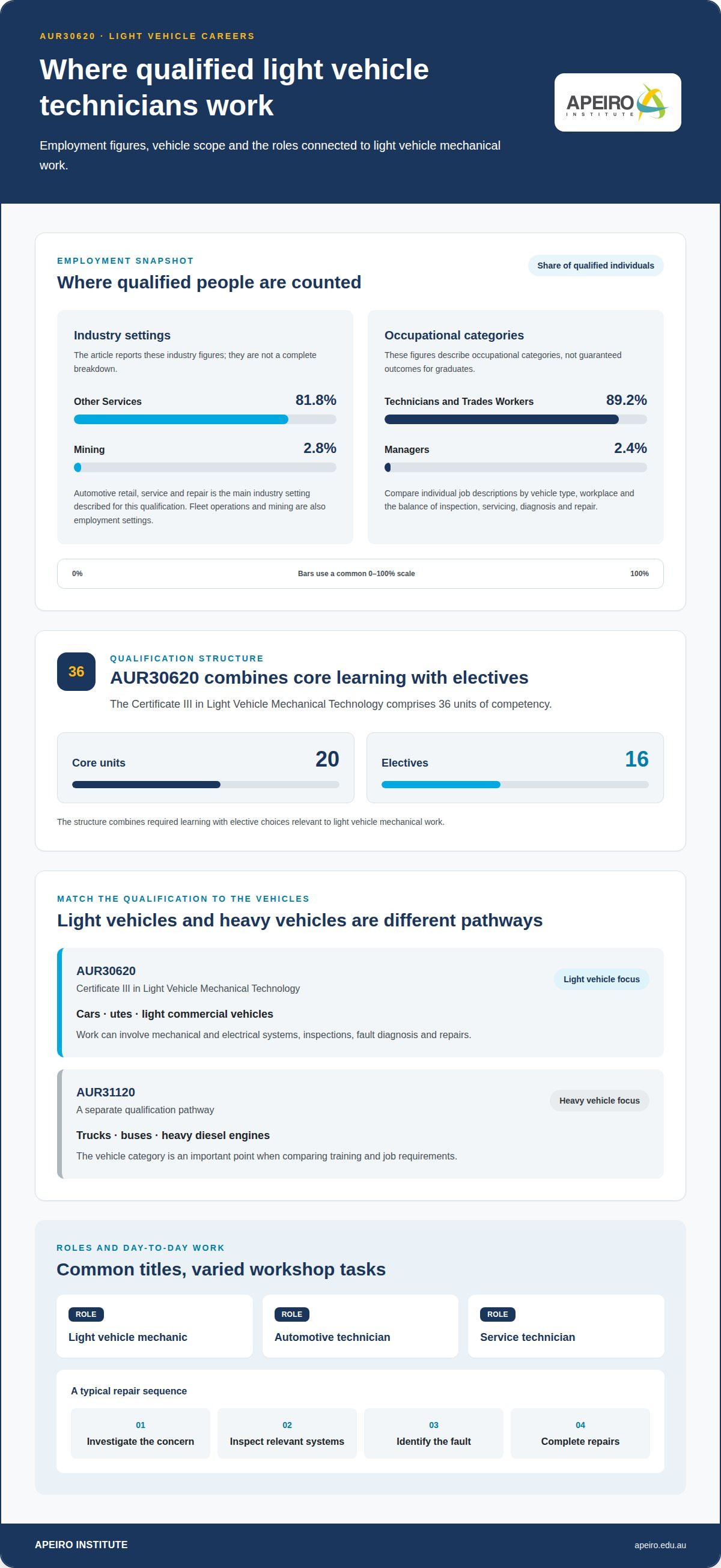
Automotive retail, service and repair is the main industry setting for this qualification. Workshops may service customer vehicles, while fleet operations maintain vehicles used for business tasks. Mining is another employment setting, although it represents 2.8% of qualified individuals. The industry figures list Other Services as employing 81.8% of qualified individuals, so consider the workplace’s day-to-day vehicle needs when exploring roles.
Mechanic and Technician Job Roles
Light vehicle mechanic, light vehicle technician and motor mechanic are related job titles for people working on cars, utes and light commercial vehicles. The work can involve mechanical and electrical systems, inspections, fault diagnosis and repairs. The qualification covers broad tasks across a variety of light vehicles, rather than heavy vehicles such as trucks and buses. That distinction helps match training to the vehicles a role involves.
The AUR30620 Certificate III in Light Vehicle Mechanical Technology comprises 36 units of competency: 20 core units and 16 electives. This structure combines required learning with elective choices relevant to light vehicle mechanical work. Its scope includes cars, utes and light commercial vehicles. By contrast, AUR31120 covers trucks, buses and heavy diesel engines, making the vehicle category an important point when comparing pathways.
In a workshop, a technician may investigate a customer’s concern, inspect the relevant systems, identify a fault and complete repairs within their role. For example, a vehicle problem involving electrical components calls for a different diagnostic focus from a mechanical fault. Accurate diagnosis helps guide the repair process. The qualification relates to this varied work across the automotive retail, service and repair industry.
Employment data also helps show where qualified people work. Technicians and Trades Workers occupations account for 89.2% of qualified individuals, while managers account for 2.4%. These figures describe occupational categories, not a guaranteed outcome for each graduate. A practical next step is to compare job descriptions by vehicle type, workshop setting and the balance of inspection, servicing, diagnosis and repair.
For Queensland apprentices and trainees, the minimum age is 13 years, unless otherwise stated, according to Queensland Government. This age rule concerns entry to apprenticeship and traineeship pathways; it does not change the vehicle scope of AUR30620. Prospective workers can use the qualification’s light vehicle focus to identify suitable roles and workplaces, then build experience around the systems and repair tasks those jobs involve.
Career progression into diagnostics and workshop supervision
AUR30620 can provide a starting point for an Australian automotive career, with further learning opening pathways towards diagnostics. Apprentices can progress to a Certificate IV in Automotive Mechanical Diagnosis. This next qualification builds on vehicle mechanical technology skills and focuses on identifying faults systematically. It suits technicians who want to investigate complex problems, rather than concentrate mainly on routine servicing and repairs.
Diagnostic work starts with gathering evidence from the vehicle before deciding what may be causing a fault. A technician might review symptoms, inspect relevant systems, use diagnostic equipment and interpret the results. An electrical fault, for instance, can require a different testing process from a mechanical problem. Good diagnostic practice means following the evidence, recording findings clearly and checking whether the repair addressed the reported issue.
With experience, technicians may progress towards workshop supervision. A supervisor’s responsibilities can include coordinating jobs, supporting technicians and keeping work moving through the workshop. To prepare for this step, develop clear communication, sound repair judgement and the ability to explain priorities. These skills help with assigning work, addressing workflow issues and supporting consistent service across a team.
Further automotive study can support different career goals. The Certificate IV in Automotive Mechanical Diagnosis is relevant to diagnostic specialisation, while the Diploma of Automotive Technology offers another pathway for developing automotive knowledge. A nationally recognised qualification records the training completed, while practical experience shows how skills are applied on the job. Consider the role that interests you, then match further learning to its day-to-day responsibilities.
Typical salary ranges vary by role: diagnostic technicians earn A$95,000-A$140,000+ per year, while workshop supervisors earn A$100,000-A$140,000+ per year. These figures show different career directions, not an automatic pay increase from completing a qualification. The work undertaken, experience and position all matter. A useful progression plan is to build diagnostic capability, take on broader workshop responsibilities, then pursue training that supports the next role. That approach keeps each step connected to the work you want to do.
Jobs available to AUR30620 graduates
Graduates may pursue hands-on automotive roles focused on maintaining, inspecting and repairing light vehicles. Common job titles include light vehicle mechanic, automotive technician and service technician. Titles vary between employers, so read the duties carefully: one role may focus on scheduled servicing, while another involves fault-finding and more complex repairs. Comparing the tasks with your training and interests helps you identify suitable positions.
Employment figures offer a broad view of the opportunities. Technicians and Trades Workers occupations account for 89.2% of qualified individuals, while 2.4% are employed as managers. These categories describe the work people do, rather than a guaranteed outcome for each student. A graduate starting in a workshop can build practical competency through real repair tasks, then develop towards more specialised responsibilities as experience grows.
Typical annual salary ranges differ by job title:
- Light vehicle mechanic: A$75,000-A$95,000+ per year.
- Automotive technician: A$80,000-A$110,000+ per year.
- Diagnostic technician: A$95,000-A$140,000+ per year.
These figures describe typical role ranges, not a fixed starting salary. The duties, the technician’s experience and the workplace all shape a position. Diagnostic technician work may suit someone who develops further diagnostic skills, and differs from general mechanical servicing.
Job advertisements can clarify what different titles mean in practice. Check whether the employer emphasises routine maintenance, mechanical repairs, electrical fault diagnosis or a mix of tasks. A workshop role covering varied servicing and repairs, for example, may suit someone seeking broad light vehicle experience. A position centred on identifying faults may appeal to someone interested in diagnostic work. Match the duties to your strengths to give each application a clear focus.
A nationally recognised qualification provides a formal record of completed training, while practical competency shows how you apply that learning to vehicle work. In an application, give an example relevant to the role: describe a service or repair task you have practised, the checks you followed and how you approached the fault. Keep your example tied to the advertised duties. This makes your experience clearer than a general statement about your interest in automotive work.
As your career develops, compare opportunities by the skills they require. A mechanic role can build broad repair experience; an automotive technician position may cover a wider mix of tasks; diagnostic work centres on investigating faults. These distinctions can help you choose a suitable first role and plan further learning towards a specialisation.
Workshop and fleet maintenance work
Workshop and fleet roles offer different ways to apply light vehicle mechanical skills. In a repair workshop, technicians work on vehicles brought in by individual customers or businesses. Fleet maintenance focuses on vehicles operated by one organisation. This shapes daily priorities: a workshop may handle varied repair requests, while a fleet team helps keep the organisation’s vehicles serviceable.
Workshop duties may include routine servicing, inspecting reported faults and repairing cars, utes or light commercial vehicles. A technician might assess a vehicle’s reported concern, identify the affected system, carry out the repair and record the work. These tasks call for sound mechanical skills and clear communication. Accurate job records also help other technicians understand what has been done and what may need attention later.
Fleet mechanics maintain vehicles used for work, such as a company’s cars, utes or light commercial vehicles. The role can involve scheduled maintenance as well as responding to faults that affect a vehicle’s use. Prioritising work means understanding which vehicles need attention and communicating their repair status. Fleet mechanics in Australia have a typical salary range of A$80,000-A$120,000+ per year. The range is specific to the occupation, rather than a guaranteed outcome for every worker.
Compare job descriptions by the workplace and vehicles involved. A workshop advertisement may emphasise customer service and a varied mix of repairs. A fleet position may focus more on maintenance records, coordinating vehicle availability and consistent servicing. Both settings can involve mechanical and electrical systems, but their workflows differ. These details help you decide whether you prefer varied customer vehicles or ongoing work with a commercial fleet.
A Certificate III in Light Vehicle Mechanical Technology provides relevant learning for work on light vehicles. An apprenticeship can connect formal training with practical workplace experience, giving students opportunities to develop skills through real tasks. For an employer, evidence of completed competency and relevant hands-on experience can help show how a graduate approaches servicing and repair. If you already have automotive experience, recognition of prior learning may be a pathway to have existing skills assessed against a qualification.
Before applying, identify the tasks you want to perform and match them to the role. Check each advertisement for vehicle types, servicing duties, repair work and record-keeping responsibilities. Then use examples from training or workplace experience to explain your skills. If you’re interested in commercial fleet work, highlight maintenance tasks and organised job records. If you prefer a varied workshop role, focus on different repair activities and customer concerns.
What additional licences or qualifications are needed for automotive mechanic jobs in Australia?
For light vehicle mechanical work, AUR30620 is the relevant Certificate III qualification. The available qualification facts do not establish one additional licence that every automotive mechanic must hold. Separate job requirements relate to the duties involved, so distinguish a formal licence from further training that supports a specialisation.
AUR30620 has no formal entry requirements. Completing the qualification develops skills for work on light vehicles, while an apprenticeship can combine training with workplace experience. These are training pathways, not additional licences. For a mechanic role involving servicing and repairs, check how the position describes its duties and required credentials rather than assuming every job has the same conditions.
Diagnostic work may be a direction for further learning after light vehicle experience. It supports a progression towards identifying and analysing vehicle faults. It is additional study, not a licence that applies automatically to every mechanic position. A technician interested in this direction can build on light vehicle experience and pursue diagnosis-focused learning as a distinct career step.
Further study can provide another pathway for developing broader automotive knowledge. Consider the work you want to do before choosing additional study:
- For general light vehicle mechanical work, focus on the Certificate III qualification and relevant practical skills.
- For fault-finding responsibilities, consider diagnosis-focused further training.
- For broader automotive knowledge, explore whether diploma-level study aligns with your career direction.
These are possible pathways, not a universal checklist of credentials for every Australian mechanic.
Job advertisements may specify particular duties or credentials, or place greater emphasis on experience and demonstrated skills. Read each advertisement for the actual requirements. A workshop position focused on servicing, for example, differs from a diagnostic role investigating complex faults. This distinction helps you decide whether further study supports the work you’re targeting.
A qualification and a licence are not interchangeable. A qualification records training, while a licence grants permission for particular work where a licensing requirement applies. The pathways described here relate to automotive qualifications and do not establish requirements for every state, territory, task or employer. Check the position’s stated requirements, then match your training to its duties.
For experienced workers, Apeiro Institute’s Recognition of Prior Learning service assesses existing skills against a qualification. It may suit you if you’ve performed automotive tasks and want formal recognition of your competency. Recognition depends on an assessment of your evidence and does not automatically provide a separate licence. This assessment can help you understand whether further learning may be needed for your chosen career direction.
Apeiro Institute: AUR30620 Certificate III in Light Vehicle Mechanical Technology
Apeiro Institute offers the AUR30620 Certificate III in Light Vehicle Mechanical Technology for learners preparing for light vehicle mechanical careers. If you’re starting out, this qualification aligns with the workshop, service and repair roles covered in this guide. Apprenticeships and Traineeships provide another training pathway, while Trade Pathways for Experienced Workers (TPEW) may suit people building on existing trade experience.
Your next step depends on your experience and career direction. Consider whether you’re entering the automotive field, undertaking an apprenticeship, or seeking a pathway that recognises prior trade experience. This can help you identify which option fits your goals.
Contact Apeiro Institute to discuss the AUR30620 qualification and the pathway that suits your circumstances.
Choose a pathway that fits your next move
Understanding what jobs you can get with AUR30620 can help you set a practical career direction. Your next move might be building experience in a workshop, strengthening existing trade skills or choosing further automotive study. Focus on the work you want to do and the learning that supports it, then take one manageable step towards that goal.
Apeiro Institute offers Apprenticeships and Traineeships and Trade Pathways for Experienced Workers (TPEW), alongside the UEE30920 Certificate III in Electronics and Communications. These options serve different learning needs, so consider which pathway best matches your experience and interests.
Your automotive career can develop over time. Choose a pathway that suits your experience and goals, then keep building towards the work you want to do.
Frequently Asked Questions
Is AUR30620 a Nationally Recognised Qualification?
Yes. AUR30620 is a nationally recognised qualification in Australia. It provides a formal record of vocational training in light vehicle mechanical technology, which can help employers understand the field of study you completed. Recognition of the qualification doesn’t itself guarantee employment or replace experience relevant to a particular position. For applications, connect your training to the duties listed, such as servicing, repair or fault investigation.
What job could it help me get?
AUR30620 can support applications for light vehicle mechanic, light vehicle technician and automotive technician roles. For example, a graduate might apply to a workshop that services cars and utes, or pursue a position with duties involving inspections and repairs. Job titles vary between employers, so read the responsibilities carefully. The tasks in the advertisement will show whether the role suits your practical training and career interests.
What Career Pathways Are Available After AUR30620?
After completing AUR30620, you can build experience in light vehicle servicing and repair, then consider further automotive study. A technician drawn to fault-finding could pursue the Certificate IV in Automotive Mechanical Diagnosis. Other longer-term directions include taking on broader workshop responsibilities or studying towards the Diploma of Automotive Technology. Choose based on the tasks you want to develop, rather than treating any single pathway as compulsory.
What is the AUR30620 Certificate III in Light Vehicle Mechanical Technology?
AUR30620 is a vocational qualification for learning the skills used in light vehicle mechanical work. Its focus is cars, utes and light commercial vehicles, rather than heavy vehicles. For a prospective student, that scope is useful when deciding whether the training matches the vehicles and workshop tasks they want to pursue. It provides structured learning and assessment towards competency in the qualification’s automotive work area.
What jobs can you get with AUR30620 in Australia?
In Australia, graduates may apply for light vehicle mechanic, automotive technician or service technician roles. For anyone considering what jobs they can get with AUR30620, the duties matter as much as the title: a service role may focus on scheduled maintenance, while another position may include investigating reported faults. Look for the vehicle types and tasks specified by each employer, then tailor your application to relevant training and experience.
What job titles and duties are covered by AUR30620?
Relevant job titles include light vehicle mechanic, light vehicle technician and motor mechanic. Typical duties may include inspecting vehicles, servicing them, identifying faults and carrying out mechanical repairs. The balance varies by position. One employer may need someone for routine servicing, while another seeks a technician to investigate customer-reported problems. Compare the duties with the training and skills you can demonstrate.
Does AUR30620 qualify you to work as a light vehicle mechanic in Australia?
AUR30620 is the relevant vocational qualification for light vehicle mechanical work and can support applications for mechanic positions. It records training in the occupation’s light vehicle area, but it isn’t a promise of employment or a universal licence for every automotive task. Employers set role requirements according to the work involved. Read each position description and consider how your completed training and practical experience match its duties.
Which Australian industries and employers hire people with AUR30620?
Potential workplaces include automotive service and repair businesses, vehicle workshops, fleet maintenance teams and mining operations. Employers may service customer cars, maintain commercial vehicles or support an organisation’s fleet. The setting shapes daily priorities: a customer workshop handles varied repair requests, while fleet maintenance focuses on vehicles used by one organisation. Consider which environment and vehicle types best match the experience you want to build.

Disclaimer
The information provided on this blog is for general informational and educational purposes only. While every effort is made to ensure the accuracy and reliability of the content, the author makes no representations or warranties of any kind, express or implied, about the completeness, accuracy, suitability, or availability of the information contained on this blog.
The views and opinions expressed in blog posts are those of the individual author and do not necessarily reflect the official policy or position of any organization, company, or employer.
This blog may contain links to external websites or third-party content. These links are provided for convenience only, and the author has no control over and assumes no responsibility for the content, privacy policies, or practices of any third-party sites.
Nothing on this blog constitutes professional advice (legal, financial, medical, or otherwise). Readers are encouraged to seek appropriate professional guidance before making any decisions based on the information provided here.
By using this blog, you acknowledge that any reliance on the information is at your own risk.


