

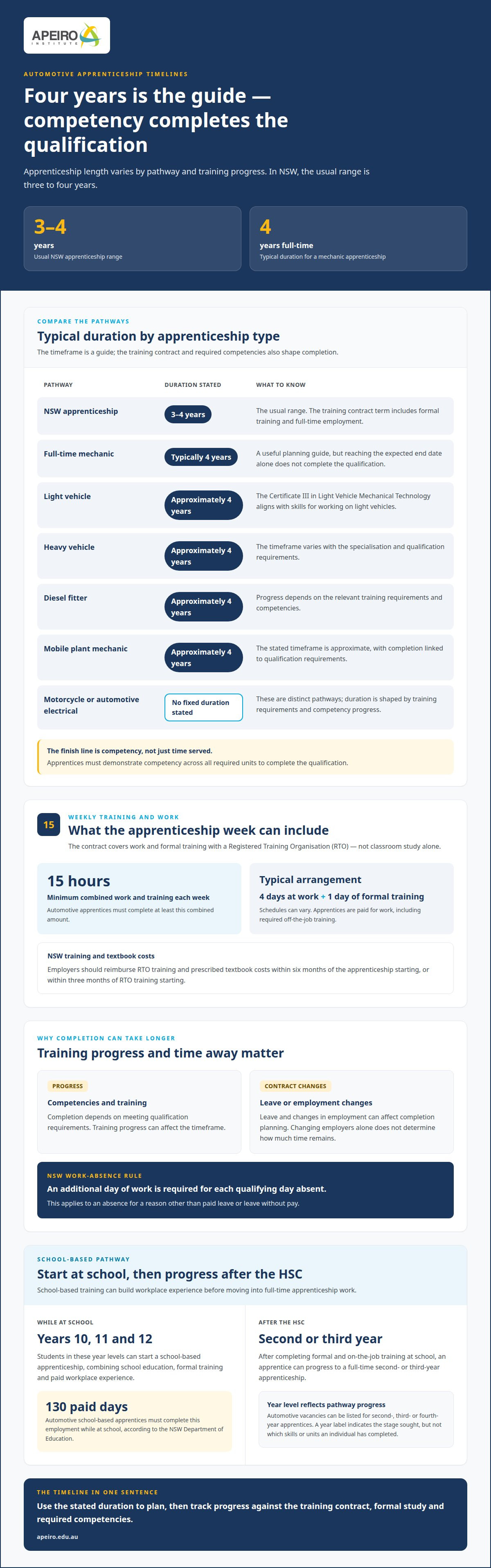
An automotive apprenticeship usually takes three to four years, with a full-time mechanic apprenticeship typically taking four years. How long an automotive apprenticeship takes can also depend on completing the required training and demonstrating competency, not just reaching the expected end date, whether you are studying with Apeiro Institute in New South Wales or across other regions.
It’s natural to want a clear timeline before committing to a trade. The usual duration gives you a helpful starting point, while your work and training arrangements shape how you progress towards the qualification.
This guide explains apprenticeship year levels, how school-based training can affect progression, and where automotive qualifications fit into the journey. It also covers how workplace experience and formal study combine, helping you understand the commitment and consider a pathway that suits your circumstances.
Key Takeaways
- A full-time mechanic apprenticeship typically takes four years, while the usual NSW apprenticeship range is three to four years.
- Progress depends on completing the required training and demonstrating competency, not only on reaching the expected end date.
- School-based apprenticeships can help eligible students build experience before moving into a later apprenticeship year after school.
- Automotive apprenticeships generally lead to a Certificate III in the chosen specialisation, combining workplace learning with formal study.
- Automotive school-based apprentices must complete 130 paid employment days while at school, according to the NSW Department of Education.
How Long is a Mechanic Apprenticeship?
A full-time mechanic apprenticeship typically takes four years, while apprenticeships in NSW usually take three to four years. The actual timeframe depends on the training contract and completion of the qualification’s required competencies.
Typical apprenticeship duration
A mechanic apprenticeship is a paid workplace training pathway that commonly runs for four years full-time. This timeframe can help you plan your education, work commitments and progress towards a trade career.
Automotive apprenticeships are competency-based, so reaching the expected end date alone does not complete the qualification. You must demonstrate competency across all required units. Treat four years as a useful guide, with completion also dependent on meeting the qualification requirements.
Calculating apprenticeship duration
The duration of an NSW apprenticeship refers to the training contract term, which includes formal training and full-time employment. It covers both learning at work and study with a Registered Training Organisation (RTO), not just classroom education.
How many hours per week do automotive apprentices work and study in NSW? Apprentices must complete at least 15 hours of combined work and training each week. A typical arrangement is four days at work and one day of formal training, although the schedule can vary.
Apprentices are paid for work, including attendance at required off-the-job training. Wage amounts depend on the applicable employment arrangements, so there is no single figure for every apprentice. In NSW, employers should reimburse RTO training and prescribed textbook costs within six months of the apprenticeship starting, or within three months of RTO training starting.
Automotive apprenticeship timeframes
Automotive apprenticeship timeframes vary according to the vehicle specialisation and qualification requirements. Light vehicle, heavy vehicle, diesel fitter and mobile plant mechanic apprenticeships each take approximately four years.
Motorcycle and automotive electrical apprenticeships are distinct pathways, with duration shaped by their training requirements and competency progress. For a light vehicle pathway, the Certificate III in Light Vehicle Mechanical Technology aligns with skills for working on light vehicles. The qualification focus helps explain which trade skills the apprenticeship develops.
Changes that affect completion time
Leave and changes in employment can affect how long an apprentice takes to complete the training contract. Can an automotive apprenticeship take longer than the standard term in NSW? Yes. Competency requirements, training progress and absences can all affect completion.
In NSW, an apprentice who misses work for a reason other than paid leave or leave without pay must work an additional day for each day absent. Changing employers does not by itself establish how much time remains. The duration is tied to the contract, formal training and employment, so keeping training progress connected to the contract helps clarify the pathway forward.
What happens if an automotive apprentice changes employer or takes leave in NSW? The contract timeframe includes formal training and full-time employment, and qualifying work absences require additional days. These details can affect completion planning, particularly when employment arrangements change during the apprenticeship.
Apprenticeship year levels and opportunities to continue an apprenticeship
In NSW, students in Years 10, 11 and 12 can start a school-based apprenticeship. This pathway lets a student combine school education with formal training and paid workplace experience. It can also create a route into full-time apprenticeship work after the HSC, rather than requiring every apprentice to begin full-time from the outset.
A school-based apprentice who completes formal and on-the-job training while still at school can progress to a full-time second- or third-year apprenticeship after finishing the HSC. The year level reflects progress through the apprenticeship pathway. Starting at school can help students build skills and experience before moving into full-time employment.
Year levels also appear in automotive job advertisements. The MTA NSW directory includes light vehicle apprentice vacancies listed as second or third year, as well as vacancies listed as second, third or fourth year. These examples show that opportunities can suit apprentices part-way through training, not only those seeking a first-year position.
For an apprentice looking to continue, a vacancy that names a year level gives a useful indication of the experience sought. A second-year listing and a fourth-year listing describe different stages of an apprenticeship. The role still needs to match the apprentice’s trade pathway and progress, since a year label alone does not show which skills or training units are complete.
School-based training and full-time employment are different arrangements within an apprenticeship journey. Completing training at school can make progression into a later year possible after the HSC, but the pathway depends on the formal training and workplace experience completed. For example, a student who has completed school-based automotive training may move into a full-time second- or third-year apprenticeship.
- At school: Students in Years 10, 11 and 12 can undertake a school-based apprenticeship.
- After the HSC: Completed school-based training can support progression into a full-time second- or third-year apprenticeship.
- In automotive vacancies: MTA NSW directory listings include second-, third- and fourth-year opportunities.
These year levels show how an apprenticeship can continue as a student’s circumstances change from school to full-time work. They also explain why an automotive apprenticeship does not always start at first year: school-based progress and vacancies for later-year apprentices can provide different entry points into continued training and employment.
Automotive qualifications
Automotive mechanic apprenticeships generally lead to a Certificate III qualification in the chosen specialisation. The qualification gives structure to the learning, while the specialisation identifies the type of automotive work the training relates to. For someone choosing a career direction, that distinction matters: a light vehicle pathway and a heavy vehicle pathway focus on different parts of the industry.
A qualification consists of required units, and apprentices must demonstrate competency across them. The expected apprenticeship term is not the only measure of progress. Completion depends on meeting the competency requirements, so the certificate recognises completed learning, not simply time spent in employment.
Specialisation is a practical choice, not just wording on a certificate. Light vehicle, heavy vehicle, motorcycle and automotive electrical pathways relate to different types of vehicles or work. Your interests can help guide your choice, while the qualification’s focus indicates the skills and knowledge the training is intended to develop.
- Light vehicle: A pathway focused on light vehicles and their automotive work.
- Heavy vehicle: A specialisation aligned with heavy vehicles.
- Motorcycle or automotive electrical: Distinct areas within the automotive trade.
A Registered Training Organisation connects formal education with workplace learning. It delivers formal off-the-job study, while paid on-the-job training helps apprentices build experience in an employment setting. Both contribute to the apprenticeship, but completing the qualification requires demonstrating the competencies.
This connection helps explain why two apprentices in the same specialisation may progress at different rates. They are working towards the same qualification outcome, but each must demonstrate competency across the required units. A calendar date alone does not show whether the learning requirements have been met.
When comparing an automotive qualification with another level of study, keep the purpose in mind. A Certificate III is the qualification level generally associated with completing an automotive mechanic apprenticeship in a chosen specialisation. Further automotive study can build on trade knowledge, but it is separate from the apprenticeship’s Certificate III outcome and does not replace its competency requirements.
To understand how a qualification supports your next step, consider three things together: the specialisation, its required units, and how formal training connects with workplace learning. For example, someone interested in light vehicle work can focus on a qualification linked to that specialisation and track progress through demonstrated competency. This makes the certificate a clear record of completed trade training, rather than time alone.
What is the standard duration of a light vehicle mechanic apprenticeship in NSW?
A light vehicle mechanic apprenticeship in NSW takes approximately four years. Although apprenticeships in NSW usually take three to four years, light vehicle apprenticeships are among those described as approximately four years. This gives you a practical timeframe for planning work, formal training and progress towards an automotive qualification.
The four-year duration is a guide, not a countdown to automatic completion. Automotive apprenticeships are competency-based, so apprentices must demonstrate competency across all required qualification units. Reaching the expected end of the term does not replace those requirements. Progress involves both completing the apprenticeship and showing that you meet its training standards.
For light vehicle work, the apprenticeship generally leads to a Certificate III in the chosen automotive specialisation. The qualification defines the learning outcome, while the apprenticeship combines it with workplace experience. For example, an apprentice may develop skills on light vehicles at work while completing the formal training linked to the qualification.
The standard duration also gives you a sense of the commitment involved. A full-time apprenticeship combines employment and training across the contract term; it is not a course completed only in a classroom. Formal off-the-job study sits alongside practical workplace experience. Their scheduling can shape your week, while competency progress determines completion.
When comparing a light vehicle apprenticeship with another automotive pathway, consider both the specialisation and expected timeframe. Light vehicle, heavy vehicle, diesel fitter and mobile plant mechanic apprenticeships each take approximately four years. Similar durations do not mean the work or qualification focus is identical: each pathway relates to its own automotive specialisation.
- Expected timeframe: Approximately four years for a light vehicle mechanic apprenticeship.
- Broader NSW range: Apprenticeships usually take three to four years.
- Completion requirement: Demonstrate competency across the required qualification units.
- Qualification outcome: Mechanic apprenticeships generally lead to a Certificate III in the chosen specialisation.
Use the approximate four-year timeframe to plan your career direction, while keeping in mind what it represents. The expected term is a useful reference point, but demonstrated competency determines whether you have completed the qualification requirements. If you are choosing light vehicle work, consider both the training commitment and the practical skills involved, not just the calendar duration.
Completion still depends on demonstrating competency across all required qualification units, rather than simply reaching the nominal duration. The MTA NSW directory includes automotive light vehicle apprentice vacancies listed as 2nd or 3rd Year, and as 2nd, 3rd or 4th year.
A diesel mechanic apprenticeship advertised in Mount Thorley, NSW, is described as lasting 4 years. NSW qualification duration estimates use 20 hours of class time per week.
What are the training and workplace requirements for an automotive apprenticeship in NSW?
An automotive apprenticeship combines paid workplace learning with formal off-the-job study through a Registered Training Organisation (RTO). Both contribute to the training contract, so apprentices need to plan for work, study and the travel or scheduling involved in attending training.
Attendance at formal training is mandatory and counts as paid time for Australian mechanic apprentices. In NSW, most apprentices attend TAFE one day a week and work four days a week. This common arrangement links classroom learning with practical tasks at work, where apprentices develop and apply trade skills.
The weekly minimum is 15 hours of combined work and training for apprentices in NSW. That is a minimum, not a standard full-time week. The exact balance can vary, but the key requirement is that both employment and formal training contribute to the apprenticeship.
School-based apprentices have a different pattern because they combine school with paid work and training. The annual training commitment for school-based apprentices in NSW is between 100 and 180 days, depending on the industry. For automotive school-based apprentices, the NSW Department of Education says they must complete 130 paid employment days while at school. Those days provide workplace experience alongside school study.
Starting age and school progress also shape the pathway. In NSW, an apprentice must have completed Year 10 or be 17 years old to begin, whichever happens first. An apprentice under 18 cannot be required to work overtime unless they choose to. These rules are relevant when arranging a workable roster around school, employment and training commitments.
Training costs are another practical consideration. In NSW, the employer should reimburse RTO training and prescribed textbook costs within six months of the apprentice starting the apprenticeship, or within three months of starting RTO training. This explains when those costs should be reimbursed during training.
- Workplace: Paid employment provides on-the-job learning.
- Formal study: Required RTO training is mandatory and paid time.
- School-based pathway: Automotive apprentices complete 130 paid employment days while at school.
- Weekly participation: NSW apprentices complete at least 15 combined work and training hours each week.
These requirements show why an apprenticeship is more than a qualification course: it connects employment, formal training and practical experience under a training contract. Understanding the weekly or school-based structure can help you see how learning fits around your existing commitments.
Apeiro Institute: Apprenticeships and Traineeships
Apeiro Institute offers apprenticeships and traineeships for people considering vocational training alongside employment. Once you understand the usual apprenticeship timeframe and training commitments, you can explore whether a structured training pathway suits your career plans.
Experienced workers may also consider Trade Pathways for Experienced Workers (TPEW), while Smart & Skilled Funded Courses provide another vocational study option. Apeiro Institute also offers UEE30920 Certificate III in Electronics and Communications for learners whose interests extend to electronics and communications.
The right next step depends on your experience and the qualification you want to pursue. If you’re ready to discuss your training options, contact Apeiro Institute.
Turn your automotive interest into a career plan
Knowing how long an automotive apprenticeship in NSW can take gives you a starting point for planning, but the next decision is whether the pathway suits you. Consider the automotive work you want to pursue and how workplace learning and formal study could fit alongside your other commitments.
A clear direction can make a training pathway easier to understand. Think about the skills you want to develop, the work environment that interests you and the next step towards your goal. You do not need to map out your entire career before exploring your options. A conversation can help you identify a practical starting point.
Your automotive career can begin with one considered step. Keep building towards the work that motivates you.
Frequently Asked Questions
How long will it take to complete this qualification?
For a light vehicle mechanic apprenticeship leading to a Certificate III, allow approximately four years as a full-time timeframe. The apprenticeship and qualification are connected, but completion depends on meeting the required competency outcomes. Finishing the expected contract period does not by itself mean every unit is complete. Your training progress and demonstrated skills determine whether you have met the qualification requirements.
What training will I receive during the program?
You’ll combine practical automotive work with formal training through a Registered Training Organisation. For example, a light vehicle apprentice may learn workplace tasks and complete related off-the-job study as part of the training pathway. The qualification’s units guide the skills assessed, while workplace experience provides opportunities to apply them. The learning focus follows the automotive specialisation, such as light vehicle mechanical work.
How long does an automotive apprenticeship take in NSW?
In NSW, a full-time mechanic apprenticeship typically takes four years, while the usual apprenticeship timeframe is three to four years. Light vehicle, heavy vehicle, diesel fitter and mobile plant mechanic apprenticeships each take approximately four years. Treat the expected period as a planning guide: the training contract, specialisation and competency requirements all shape your pathway. School-based training can also affect the year level you enter after school.
Can prior experience or qualifications shorten an automotive apprenticeship in NSW?
Prior experience or qualifications may be assessed for recognition, but they do not automatically shorten an apprenticeship. Recognition of Prior Learning considers evidence of skills and knowledge against the relevant requirements. For example, an experienced worker’s practical automotive skills can be assessed, and a previous qualification may support an assessment of relevant learning. Any recognition and its effect on your training plan depend on the assessment.
How does competency-based progression affect apprenticeship duration in NSW?
With competency-based progression, completion depends on demonstrating the required skills and knowledge, not just reaching the nominal end of the apprenticeship. For example, an apprentice may reach the expected end date but still need to complete or demonstrate particular qualification units. Year levels describe progress through the pathway, while earning the final qualification requires meeting its competency outcomes.

Disclaimer
The information provided on this blog is for general informational and educational purposes only. While every effort is made to ensure the accuracy and reliability of the content, the author makes no representations or warranties of any kind, express or implied, about the completeness, accuracy, suitability, or availability of the information contained on this blog.
The views and opinions expressed in blog posts are those of the individual author and do not necessarily reflect the official policy or position of any organization, company, or employer.
This blog may contain links to external websites or third-party content. These links are provided for convenience only, and the author has no control over and assumes no responsibility for the content, privacy policies, or practices of any third-party sites.
Nothing on this blog constitutes professional advice (legal, financial, medical, or otherwise). Readers are encouraged to seek appropriate professional guidance before making any decisions based on the information provided here.
By using this blog, you acknowledge that any reliance on the information is at your own risk.


