

A light vehicle mechanic’s work is about more than replacing parts. An AUR30620 apprenticeship combines practical workshop experience with training in vehicle servicing, diagnosis and repair, and typically takes up to four years to complete. Apprentices build their skills while working under supervision, progressing towards more complex tasks as their capabilities develop.
If you’re considering this trade, it’s reasonable to want a clear picture of the day-to-day work and how training fits around a job. This guide explains what light vehicle mechanics do, what the AUR30620 qualification covers and how workplace supervision supports your learning. It also outlines the apprenticeship contract modes available in Australia, so you can understand how the work and training arrangements may fit your circumstances.
Key Takeaways
- See how light vehicle mechanics combine servicing, fault diagnosis and repairs across a range of vehicle systems.
- Get a clearer picture of the practical skills covered in AUR30620, including safe work practices and automotive electrical systems.
- Understand how workplace supervision supports an apprentice as they build skills and take on more complex tasks.
- Learn what to consider when comparing full-time, part-time and school-based apprenticeship arrangements in Sydney.
- Explore how an apprenticeship and the AUR30620 qualification can support your next step towards a light vehicle mechanic career.
Automotive mechanical skills and training
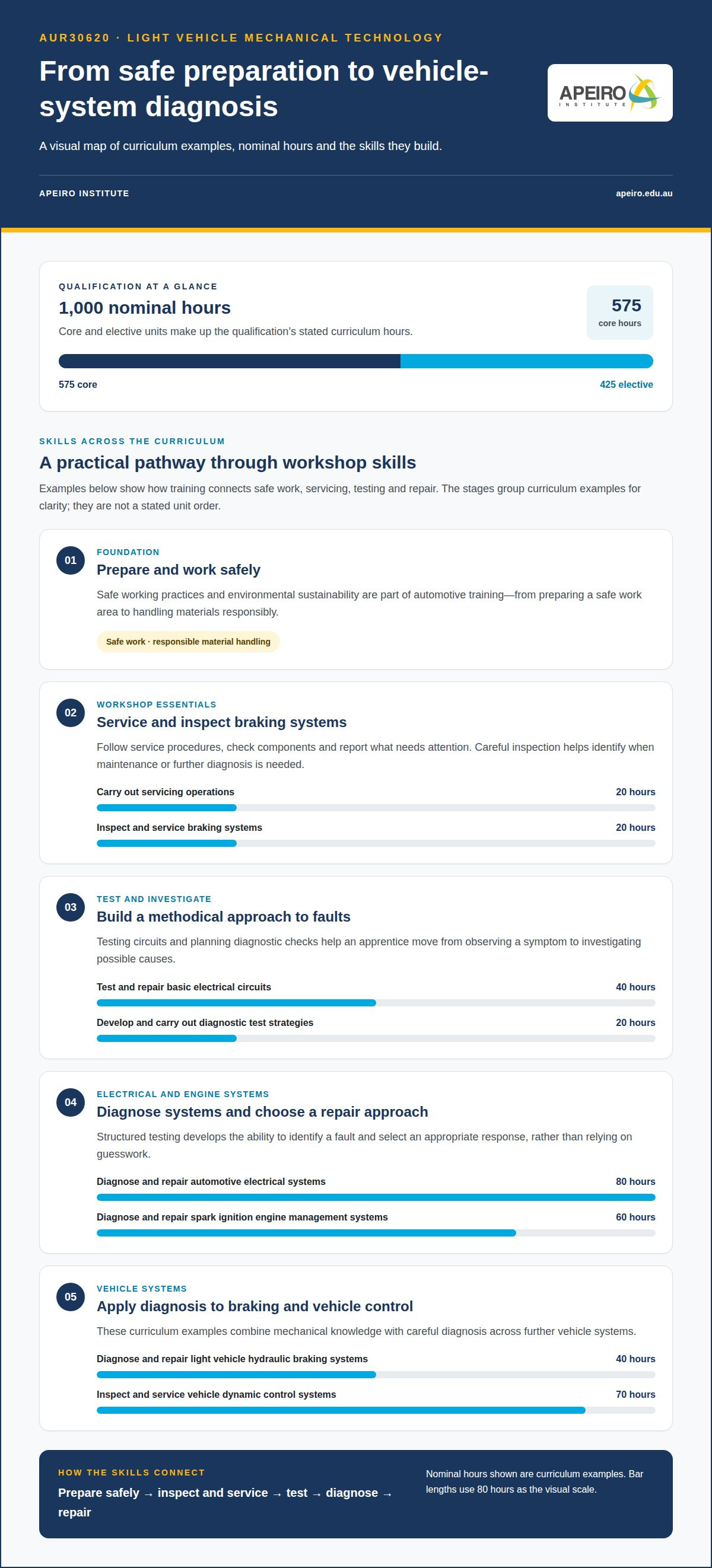
Light vehicle mechanical training develops practical skills in vehicle servicing, diagnosis and repair. In a workshop, this might mean investigating a braking concern, testing an electrical circuit and identifying the fault before replacing a component. Apprentices also learn safe work practices and a methodical approach to diagnosis, rather than relying on guesswork.
The curriculum gives environmental and safety practices a defined place in automotive work. The curriculum covers environmental sustainability and safe working practices as part of automotive training. These skills apply during everyday workshop tasks, from handling materials responsibly to preparing a safe work area before a repair.
Servicing and braking provide early examples of core mechanical competencies. The curriculum lists 20 nominal hours for carrying out servicing operations and another 20 for inspecting and servicing braking systems. A mechanic may check components, follow service procedures and report what needs attention. For braking faults, accurate inspection helps identify whether a system needs maintenance or further diagnosis.
Other units build confidence with vehicle systems that need structured testing. The curriculum lists 40 nominal hours for testing and repairing basic electrical circuits, and 80 for diagnosing and repairing automotive electrical systems. It also includes 20 nominal hours for developing and carrying out diagnostic test strategies. Together, these skills help an apprentice move from observing a symptom to testing possible causes and choosing a repair approach.
Engine management and vehicle control add further depth. The curriculum lists 60 nominal hours for diagnosing and repairing spark ignition engine management systems, 40 for diagnosing and repairing light vehicle hydraulic braking systems, and 70 for inspecting and servicing vehicle dynamic control systems. These examples show why automotive work combines mechanical knowledge with careful diagnosis.
After completing the qualification, possible career options include light vehicle mechanic, automotive technician and service technician roles. Duties may centre on routine servicing, mechanical repairs, electrical diagnosis or a combination of workshop tasks. Further study can support progression into specialised diagnostics or broader automotive technology roles. The pathway depends on the skills developed and the work an employer needs.
For someone considering an AUR30620 apprenticeship, the key is to connect workshop experience with competency development. Each task can build towards a broader skill set: safe preparation, inspection, testing, diagnosis and repair. That practical progression helps learners understand not just what a component does, but how its condition affects vehicle operation.
What Does a Light Vehicle Mechanic Do?
A light vehicle mechanic inspects, services and repairs vehicles, then explains the work carried out. A typical job may involve clarifying a reported concern, assessing the vehicle’s condition and recording findings. Mechanics use tools and diagnostic equipment to investigate faults instead of replacing parts without evidence. Clear records also show what was repaired and what may need attention later.
The AUR30620 Certificate III in Light Vehicle Mechanical Technology develops these capabilities through a combination of core and elective units. Its curriculum has 575 nominal hours of core units and 425 nominal hours of elective units, for 1,000 total nominal hours. This training gives learners a structured foundation in vehicle mechanical technology, while electives allow coverage of additional automotive skills. The qualification supports practical work across servicing, inspection and repair.
Duties depend on the vehicle and the reported problem. A service may involve checking components against the required procedure, completing maintenance and documenting the result. A repair may begin with a symptom, such as a warning light or a change in vehicle performance. The mechanic gathers evidence, identifies the cause and completes appropriate work within their training and capability.
The work also calls for communication and organisation. Mechanics need to understand a customer’s description, keep track of inspection results and explain technical findings in plain language. Accurate information helps the workshop team see what has been tested and what action followed. This combination of hands-on work and problem-solving is central to light vehicle mechanical practice.
For Australian earnings, the supplied salary guide gives an average of A$1,405 per week for a full-time, non-managerial role at the adult pay rate, before tax or salary sacrifice. Separately, a qualified light vehicle mechanic typically earns between A$80,000 and A$90,000 per year in 2026. These figures describe different measures, so they shouldn’t be treated as interchangeable: one is a weekly guide, while the other is an annual range.
Completing the qualification can prepare learners for mechanic and automotive technician work, with experience shaping the tasks they take on. People interested in building these capabilities can explore the Certificate III in Light Vehicle Mechanical Technology as a training pathway. The qualification focuses on practical automotive work, while each workshop’s vehicles and jobs influence the skills used day to day.
AUR30620 qualification and apprenticeship status
AUR30620 is the code for the Certificate III in Light Vehicle Mechanical Technology, a nationally recognised vocational qualification. It provides a formal outcome for people developing skills in the automotive industry. Its status matters: an apprentice is completing workplace learning and training, while a qualified mechanic has completed the required assessment for the certificate.
An apprenticeship combines employment with structured training. The apprentice develops skills at work and completes training and assessment through a registered training organisation (RTO). Workplace tasks offer opportunities to practise, while the RTO supports learning and assesses whether the required competencies have been demonstrated. For example, an apprentice may practise a procedure at work, then provide evidence of performing it competently.
The qualification can also be studied through other pathways, including traineeship, on-campus, online, blended and recognition of prior learning (RPL). These options suit different circumstances. An apprenticeship is relevant to someone combining paid work with training; RPL may suit an experienced worker who can demonstrate existing skills. The pathway affects how learning is organised, but the credential sought remains AUR30620.
The RTO plays a central role in training and assessment. It organises the learning that leads to the qualification, while workplace tasks let apprentices apply practical skills. Assessment focuses on evidence of competence, such as completing a task correctly and following the required process. Completing a unit records progress towards the full certificate, not completion of the entire qualification.
Supervision supports safe, progressively independent work. An apprentice can receive instructions, observe a task, practise with guidance and take on more responsibility as their skills develop. For example, a supervisor might demonstrate an inspection process before the apprentice performs it and discusses the result. The level of oversight should reflect the task and the apprentice’s demonstrated capability.
For a learner anywhere in Australia, it helps to distinguish the training qualification from the employment arrangement. AUR30620 identifies the certificate; an apprenticeship describes a work-and-training pathway towards it. A qualified workplace supervisor supports practical learning, while the RTO manages formal training and assessment. Those roles work together, but they are not interchangeable: completing workplace tasks alone does not establish that the certificate has been awarded.
A useful way to track progress is to consider three stages: learn the task, practise it with suitable guidance, then demonstrate the required competency in assessment. This clarifies how workplace experience and RTO training contribute to qualification progress. It also distinguishes gaining experience in an automotive role from completing the formal Certificate III that recognises the relevant training and assessed skills.
Employer supervision requirements
To enrol in AUR30620 and register an apprenticeship in NSW, first arrange employment with an automotive employer, then choose an RTO delivering the qualification. The apprentice and employer organise the training and apprenticeship paperwork through the relevant NSW apprenticeship service.
Supervision connects workshop duties with training and assessment. A supervisor can explain a task, demonstrate the process, observe the apprentice’s work and give feedback. Before an apprentice inspects a vehicle system, for example, the supervisor can outline the procedure and explain when to pause and ask for help.
Good supervision reflects the task and the apprentice’s demonstrated skills. Someone new to a procedure may need close guidance, while an apprentice who has practised it successfully can take on more responsibility. Progression should reflect observed performance, not just time in employment. Clear instructions and feedback help the apprentice identify what to improve next.
Supervisors also connect workplace experience with the RTO’s formal training. They can identify suitable tasks for practice, discuss completed work and explain how daily duties relate to the Certificate III in Light Vehicle Mechanical Technology. Workplace guidance complements the process, while the RTO remains responsible for its training and assessment.
Useful skills for an apprentice include listening to instructions, explaining observations and following the agreed process. If a task differs from the training example, describe the difference before continuing. A vehicle might present a fault that calls for additional checks, for instance. Raising the change allows the supervisor to guide the next step safely.
The AUR30620 qualification has no formal academic entry requirements. That does not remove the practical need to arrange an apprenticeship employment setting and training pathway. An employer’s expectations for a role can vary, so applicants should understand the duties involved, the expected work arrangements and how training will fit around employment.
For a new starter in Sydney, a useful workplace learning sequence is straightforward:
- Discuss the task and any instructions with the supervisor.
- Observe a demonstration or review the relevant procedure.
- Complete the task with guidance appropriate to current skills.
- Review the result and note feedback for future practice.
These steps make supervision active rather than informal. The apprentice knows what to do, the supervisor can see how the work is progressing, and feedback becomes part of skill development. In an AUR30620 apprenticeship in Sydney, this workplace support works alongside provider training as the apprentice develops towards the qualification.
Full-time, part-time and school-based contract modes
In Australia, a light vehicle mechanic apprenticeship typically takes up to four years to complete. For an AUR30620 apprenticeship in Sydney, treat this as a broad duration guide, not a separate term for each contract mode. The time needed depends on completing the training and workplace requirements associated with the qualification.
A full-time arrangement combines regular employment with scheduled training. It may suit someone who can maintain a consistent weekly routine alongside work and study. In an automotive workshop, an apprentice can build practical experience through day-to-day tasks and continue related learning through their training program. The employment and training arrangements need to work together.
Part-time work offers a different balance: employment hours are reduced, but the apprentice still needs to progress through workplace learning and formal training. This may suit someone balancing work with other commitments. The employment contract and training schedule determine how the parts fit together. Do not assume that part-time work automatically adds a set number of months to an apprenticeship.
A school-based pathway combines secondary school study with paid employment and apprenticeship training. It can introduce automotive work before a student finishes school and connect classroom learning with workshop experience. The schedule needs to accommodate both school attendance and work. School-based arrangements have specific requirements, so rules in one state should not be assumed to apply in another.
Contract type is only one part of the decision. Consider whether you can attend work and training reliably, whether the employer can provide relevant tasks, and how the schedule fits your commitments. The workshop setting also shapes daily experience. A repair workshop, for example, may offer different tasks from an automotive retail service department, while electric vehicle work involves different systems from conventional servicing.
Before choosing an arrangement, map out the routine: work days, training sessions, travel time and school or other commitments. Then discuss how workplace duties and training will be coordinated. A clear plan can reveal clashes early, such as a training session overlapping with school or a busy period at the workshop.
Full-time, part-time and school-based modes are ways to organise employment and training, not different AUR30620 qualifications. The qualification remains Certificate III in Light Vehicle Mechanical Technology; the contract arrangement affects how work and learning fit together. For Sydney apprentices, the useful comparison is the routine each mode creates and whether it supports steady progress towards completion.
Apeiro Institute: Apprenticeships and Traineeships
Apeiro Institute offers Apprenticeships and Traineeships alongside the AUR30620 Certificate III in Light Vehicle Mechanical Technology. If you’re planning a light vehicle mechanic career, these offerings connect your training choice with the qualification and workplace pathway discussed in this guide.
The AUR30620 course is relevant if you want to build practical skills in vehicle servicing, diagnosis and repair. Experienced workers can also explore Trade Pathways for Experienced Workers (TPEW) to consider how their existing skills relate to a formal training pathway. For a different technical direction, Apeiro Institute also offers the UEE30920 Certificate III in Electronics and Communications.
Contact Apeiro Institute to discuss which training pathway aligns with your goals.
Take your next step towards automotive training
Choosing a training direction is a practical starting point for shaping your future in the automotive industry. If you’re considering an AUR30620 apprenticeship in Sydney, think about the work you want to develop towards and how training can support that goal. Your next step can be a conversation about the pathway that fits your interests and experience.
Apeiro Institute offers Apprenticeships and Traineeships, as well as Trade Pathways for Experienced Workers (TPEW) for people bringing existing trade skills. Its UEE30920 Certificate III in Electronics and Communications offers another vocational direction for learners interested in technical work beyond automotive mechanics. These options can help you consider which training pathway best matches your next career move.
A career can grow through continued learning. Take your next step at a pace that works for you, building practical skills towards goals that matter to you.
Frequently Asked Questions
What is the AUR30620 Certificate III in Light Vehicle Mechanical Technology apprenticeship?
It’s a work-and-training pathway towards the nationally recognised AUR30620 Certificate III in Light Vehicle Mechanical Technology. The apprentice develops automotive skills through employment and completes training and assessment with a registered training organisation. The qualification covers light vehicle work such as servicing, inspections, diagnosis and repair. An apprenticeship describes the training arrangement; AUR30620 is the qualification code and certificate title.
Which TAFE and registered training organisations offer AUR30620 in Sydney?
Apeiro Institute offers AUR30620 as a registered training organisation, RTO 45394. TAFE is one kind of training provider, while RTO describes an organisation registered to deliver vocational training and assessment. Compare the exact qualification code, delivery arrangement, location and workplace requirements when considering options. The relevant provider needs to deliver the qualification and support the training arrangement that applies to your apprenticeship.
What are the eligibility requirements for starting an AUR30620 apprenticeship in NSW?
AUR30620 has no formal academic entry requirements, but an apprenticeship also involves an employment arrangement. You’ll need an automotive employer and a training pathway connected to the qualification. For example, someone entering a workshop role should understand the job duties and how training fits alongside work. The apprenticeship contract mode and employer arrangements shape the practical requirements for starting in NSW.
What apprentice wages and pay rates apply in NSW for automotive apprentices?
Automotive apprentices are usually paid under the Vehicle Repair, Services and Retail Award or an employer enterprise bargaining agreement, according to the Fair Work Ombudsman.
What units, practical skills and assessments are included in AUR30620?
AUR30620 includes units relating to safe work, servicing, electrical systems, engine management, braking and diagnostic strategies. For example, a learner may need to show they can test a circuit, interpret results and carry out a repair procedure. Assessment checks demonstrated competence, not just attendance or familiarity with a task. Workplace evidence and training activities help show how knowledge applies to practical light vehicle work.
Can existing automotive experience or qualifications count toward AUR30620 credit or recognition?
Existing skills may be assessed through Recognition of Prior Learning (RPL), and relevant previous study may be considered for credit. Neither is automatic: an assessment of your evidence determines whether it meets the qualification requirements and how recognition affects your training plan. Work records, previous qualifications and evidence of completed tasks may help demonstrate relevant experience.
What jobs and career options follow completion of AUR30620 in Sydney?
Graduates can pursue light vehicle mechanic and automotive technician roles, with duties shaped by the employer and workshop. A new mechanic might start with scheduled servicing and take on more diagnostic or repair tasks as experience grows. Further study, including automotive mechanical diagnosis or automotive technology, can support continued skills development. The qualification provides a foundation for automotive work, but does not guarantee a particular job.
What are the differences between AUR30620 providers, delivery modes and locations in Sydney?
Training providers can differ in where and how learning takes place and how workplace practice connects with assessment. Depending on the arrangements, a course may include classroom, workshop, online or blended learning. Compare the schedule with your employment, consider whether the training location is practical, and look at how assessment relates to real workshop tasks. These details can help you decide whether the delivery arrangement suits your circumstances.

Disclaimer
The information provided on this blog is for general informational and educational purposes only. While every effort is made to ensure the accuracy and reliability of the content, the author makes no representations or warranties of any kind, express or implied, about the completeness, accuracy, suitability, or availability of the information contained on this blog.
The views and opinions expressed in blog posts are those of the individual author and do not necessarily reflect the official policy or position of any organization, company, or employer.
This blog may contain links to external websites or third-party content. These links are provided for convenience only, and the author has no control over and assumes no responsibility for the content, privacy policies, or practices of any third-party sites.
Nothing on this blog constitutes professional advice (legal, financial, medical, or otherwise). Readers are encouraged to seek appropriate professional guidance before making any decisions based on the information provided here.
By using this blog, you acknowledge that any reliance on the information is at your own risk.


