

The workshop is only part of the pathway: a recognised qualification matters too. To secure a mechanic apprenticeship across Australia, including in Sydney, NSW, you’ll need hands-on experience with an employer and formal training through a Registered Training Organisation (RTO). The relevant light vehicle qualification is the AUR30620 Certificate III in Light Vehicle Mechanical Technology.
It’s understandable to want clear answers before committing to a trade. You need to know where to apply, what eligibility involves and how workplace learning connects with your Certificate III through providers like Apeiro Institute. Apprentices and trainees gain practical experience through a host employer, while an RTO delivers the formal qualification.
This guide explains how to approach applications, what to consider when looking for an apprenticeship and how the training pathway works. It also covers the qualification and factors that can affect completion time, helping you plan your next step with more confidence.
Key Takeaways
- Understand how a light vehicle apprenticeship combines workplace experience with formal training towards a recognised qualification.
- Learn how to approach Sydney employers and present your interest in a practical, work-focused way.
- See what influences apprenticeship duration and how structured training fits around work.
- Find out how eligibility and previous mechanical experience can shape the opportunities suited to you.
- Explore how AUR30620 Certificate III in Light Vehicle Mechanical Technology fits into the automotive trade pathway.
Light vehicle mechanic apprenticeships
A light vehicle apprenticeship combines practical work with formal training. In Sydney, the pathway centres on learning with an employer and completing a recognised qualification through an RTO.
Light vehicle apprenticeship options
Light vehicle apprenticeships focus on cars and other light vehicles, rather than heavier commercial equipment. Roles vary by workshop, so consider the vehicles it services and the work you’ll encounter. One position may focus on routine servicing, while another includes diagnosing faults. Read each listing closely to understand its day-to-day focus.
Automotive apprenticeship vacancies
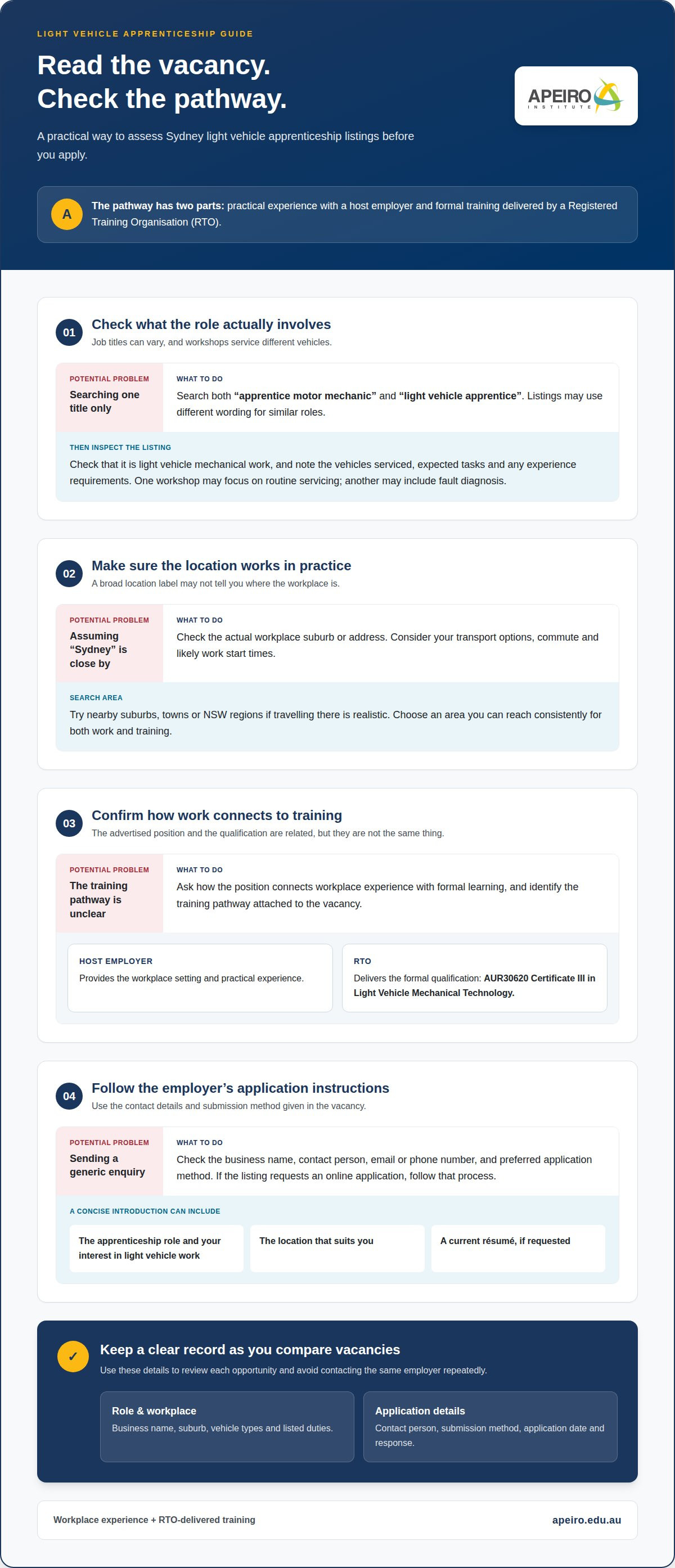
Automotive light vehicle apprenticeship vacancies appear under titles such as apprentice motor mechanic or light vehicle apprentice. Search using both phrases to find listings with different wording. Check the job description for the vehicle types, expected tasks, workplace location and application instructions. That range is not an apprentice-only pay figure.
Before applying, identify the training pathway attached to the vacancy. Apprentices and trainees complete formal qualifications through an RTO of their choice, while gaining real-world experience through a host employer in their chosen field. This means the employer provides the workplace setting, and the RTO delivers the formal learning. Ask how the position connects these two parts.
Use a simple process to assess each listing:
- Check that the role is for light vehicle mechanical work.
- Note the suburb and the vehicles the workshop services.
- Read the listed duties and any experience requirements.
- Follow the employer’s stated application steps.
For example, a vacancy focused on passenger vehicles may suit someone keen to learn servicing and fault diagnosis. A workshop with a different vehicle mix may offer other practical experience. The listing’s details help you decide whether the work matches your interests and the qualification you want to pursue.
When comparing opportunities, separate the advertised role from the training outcome. The job title describes the position; the qualification outlines the formal learning. An apprenticeship in Sydney, NSW, is a stronger fit when the employer’s work and the RTO-delivered training both support your light vehicle career direction. Keep those details in view as you review vacancies.
Apprenticeship locations and employer contact details
For a Sydney apprenticeship, start with the workplace location and application contact. NSW Smart and Skilled funded courses can support eligible apprenticeship and traineeship training. Employer incentives depend on the applicable program and arrangement.
Vacancies may be listed by suburb, workplace address or broader area. Search by role title and location, then check the actual workplace before applying. A listing labelled “Sydney” may still involve a long commute. Consider the location alongside your transport options and likely work start times.
Don’t limit your search to the suburb where you live. Include surrounding NSW locations if travelling there is realistic. Search results may use a town or region rather than “Sydney”, so try nearby place names that suit your commute. A practical search area is one you can reach consistently for work and training.
Employer contact details are usually included in the vacancy or application instructions. Look for the business name, contact person, application email or phone number, and preferred submission method. Follow the requested method. If the listing asks for an online application, an unsolicited message may not reach the person managing recruitment.
Before contacting an employer, prepare a concise introduction. State the apprenticeship role, your interest in light vehicle work and the location that suits you. Attach a current résumé if requested. Name the suburb in your message and ask about the application process, rather than sending a generic enquiry.
- Record the business name and workshop suburb.
- Note the listed contact person and application method.
- Tailor your message to the advertised role.
- Keep a record of the date and response.
Keep a record of your applications so you can follow up without contacting the same employer repeatedly. If a vacancy names a recruitment contact, address that person directly. If it gives only a general business email, use a clear subject line such as “Light vehicle apprenticeship application”. Keep your message professional and brief.
For a career in Australia’s automotive trade, location affects more than your daily commute. It can shape how easily you attend workplace training and manage the practical demands of the role. Compare each workshop’s location with its listed duties and application details. A suitable vacancy needs to fit both your training direction and your ability to travel regularly.
For funding, distinguish training support from employer incentives. Smart and Skilled relates to eligible training, while employer support depends on the relevant programme. Don’t assume every vacancy includes the same financial assistance. Funding depends on the qualification, your eligibility and current program availability, and must be confirmed before enrolment.
Eligible apprentices may receive support for their training through NSW Smart and Skilled funded courses. Employer incentives depend on the applicable program and arrangement.
The page reports that 0% of apprentices are in paid employment, without specifying the survey population or measurement period; treat the figure cautiously when assessing opportunities.
Apprenticeship duration and structured training
There isn’t one fixed completion time for every light vehicle apprenticeship. The timeframe depends on the qualification requirements, training plan, workplace practice and progress through assessment. An apprentice develops practical skills at work while completing structured learning with an RTO. These parts need to progress together.
The training plan provides a practical way to understand the pathway. It sets out the learning and assessment expected for the qualification. At work, an apprentice can practise relevant tasks under supervision. Through training, they build the knowledge needed to explain and demonstrate those tasks. This connects workshop experience with formal assessment.
For example, a learner may practise inspecting a vehicle, then develop their understanding of the inspection process through structured learning. Assessment considers whether the required knowledge and skills have been demonstrated. One task alone doesn’t represent the whole qualification. Progress depends on completing all required learning and assessment.
To understand the training schedule, clarify these points before starting:
- Training plan: identify the qualification and planned learning.
- RTO delivery: understand when and how formal training takes place.
- Workplace practice: ask how daily duties connect with training.
- Assessment: find out how practical skills and knowledge are assessed.
- Progress reviews: understand how completed learning is recorded.
These steps make the expected commitment clearer. If a workshop offers limited opportunities to practise a particular task, the training plan and workplace discussions can help identify how that skill will be developed. Regular communication between the apprentice, employer and RTO supports a shared understanding of progress.
Completion timing can also reflect how quickly an apprentice gains experience and meets assessment requirements. A learner who hasn’t yet practised a relevant task may need more workplace experience before demonstrating it. Training schedules, work opportunities and assessment readiness all affect progress. The qualification requirements remain the reference point.
Keep a record of completed training and practical experience as the apprenticeship progresses. Use scheduled reviews to discuss what you’ve achieved, what remains and where further practice is needed. For example, an apprentice can raise a learning topic that hasn’t yet come up in their workshop duties. This gives the employer and RTO a specific point to address.
A structured apprenticeship involves more than time spent in a workshop. It combines planned learning, practical experience and assessment towards a qualification. Understanding these elements helps you discuss the training pathway and the factors that shape your completion timeframe.
The Aboriginal Civil Construction Design Traineeship has a duration of Two-and-a-half years and includes a Certificate IV in Civil Construction Design. This is a separate program example, not a stated duration for a light vehicle apprenticeship. For the light vehicle pathway, the qualification requirements and training plan remain the reference points for expected learning, workplace practice and assessment.
Apprenticeship eligibility and experience
Eligibility depends on the individual vacancy and its duties. Start by separating essential requirements from preferred experience. A light vehicle workshop may value practical interest, reliability and willingness to learn. The advertisement tells you which criteria apply to that particular role.
Previous workshop experience can help, but it isn’t the only relevant background. Maintaining a family vehicle or completing a school automotive project, for example, can give you practical examples to discuss. Describe what you did, the tools involved and how you followed instructions. Don’t present informal experience as a formal qualification.
Some automotive listings target applicants at a particular apprenticeship stage. A field service mechanic opportunity, for example, was aimed at 3rd- or 4th-year mechanical apprentices. That example shows why the year level matters: an experienced apprentice vacancy may not suit someone seeking an entry-level position. Read the title and requirements before preparing an application.
Other mechanical trades can have different entry criteria. A diesel fitter apprenticeship listing required a valid C class driver’s licence and practical mechanical knowledge. Those requirements belong to that diesel fitter opportunity, not automatically to light vehicle apprenticeships. Use each vacancy’s own criteria rather than assuming one trade’s conditions apply to another.
For a light vehicle application, prepare examples that show safe, careful work and an interest in vehicles. A school project, supervised maintenance task or hands-on hobby can help explain your motivation. Be clear about your actual experience. If you haven’t completed a task independently, describe what you observed or practised instead.
Use this quick review before applying:
- Match the vacancy’s stated apprentice year with your current stage.
- Separate required licences from skills described as desirable.
- Choose examples that relate directly to the listed workshop duties.
- Explain your experience accurately, including supervised tasks.
- Note any training or experience the employer asks you to discuss.
Location can shape the examples you raise with an employer. For a vacancy in a particular suburb, you might explain how your travel arrangements support regular attendance. Keep the focus on the advertised role and your ability to meet its stated conditions. Don’t assume a suburb creates extra eligibility rules.
At interview, connect each answer to a real example. If asked about practical experience, describe a task, your role and what you learned. If you’re new to workshop work, explain why light vehicle mechanics interests you and how you approach learning. Clear, honest examples help an employer assess your fit against the vacancy’s criteria.
Apprentices gain practical experience through an employer in their chosen field. That workplace experience develops alongside formal training. If you already have substantial mechanical skills, an experienced-worker pathway may be more relevant than starting as a new apprentice. The right route depends on your background and the position’s requirements.
Certificate III automotive qualifications
The qualification to focus on is AUR30620 Certificate III in Light Vehicle Mechanical Technology. Its title identifies the light vehicle trade pathway. Match the code and full name against the qualification attached to an apprenticeship. This helps distinguish automotive training from courses for other trades or vehicle types.
A qualification code matters because similar course titles can describe different outcomes. AUR30620 is a Certificate III in light vehicle mechanical technology. AUR40216 is a Certificate IV in Automotive Mechanical Diagnosis, while AUR50216 is a Diploma of Automotive Technology. These credentials have different levels and titles, so they aren’t interchangeable names for one course.
For an apprenticeship applicant, the Certificate III provides the clearest match to light vehicle mechanical work. Read the vacancy alongside the training information. Compare the qualification code, full title and stated role. If an advertisement says “mechanic apprentice” but names another qualification, understand how that credential relates to the work before proceeding.
Apprentices combine learning with an employer and formal training through an RTO. The qualification gives formal learning a defined outcome, while workplace experience develops practical capability. A learner can connect training topics with tasks encountered at a vehicle workshop. Assessment relates to the qualification’s requirements, not simply time spent at work.
When reviewing a course, focus on details that clarify the pathway:
- Code and title: look for AUR30620 and its complete qualification name.
- Trade focus: confirm the wording refers to light vehicle mechanical technology.
- Training connection: understand how formal study sits alongside workplace learning.
- Assessment: identify how learning is assessed against the qualification.
- RTO: establish which organisation delivers the formal training.
These points help applicants discuss the course clearly with an employer. For instance, you can explain that you’re seeking training aligned with AUR30620, rather than describing your goal only as “automotive study”. The full qualification name also helps avoid confusion with automotive diagnosis or diploma-level study.
Use the Certificate III in Light Vehicle Mechanical Technology as the reference point when considering this specific pathway. Its title matches the light vehicle focus discussed here. Keep the credential distinct from related automotive qualifications, and connect it to the apprenticeship duties and training plan.
The key takeaway is straightforward: identify the exact qualification before comparing training pathways. AUR30620 names the light vehicle Certificate III, while AUR40216 and AUR50216 name different automotive credentials. Matching the code, title and apprenticeship focus gives you a clearer basis for your next decision.
Apeiro Institute: Apprenticeships and Traineeships
Apeiro Institute offers Apprenticeships and Traineeships for learners planning a vocational training pathway. If you’re organising formal training alongside an employer-based apprenticeship, this is a relevant next step to explore.
Experienced workers may also consider Trade Pathways for Experienced Workers (TPEW), while Smart & Skilled Funded Courses provide another training option. These pathways serve different needs, so your work experience and intended qualification help determine which is relevant. The UEE30920 Certificate III in Electronics and Communications is a separate qualification, not an automotive credential.
For a light vehicle mechanic pathway, focus on the qualification and training arrangement that match your intended trade. Contact Apeiro Institute to discuss its Apprenticeships and Traineeships and the pathway that fits your circumstances.
Take your next step towards the trade
Choosing a mechanic apprenticeship in Sydney, NSW, is a starting point, not the whole career plan. As you move forward, think about the kind of work you want to develop towards and how training can support that direction. A clear goal can help you explain your interests to an employer and stay focused as you build practical experience.
Apeiro Institute offers Apprenticeships and Traineeships, as well as Trade Pathways for Experienced Workers (TPEW). Its UEE30920 Certificate III in Electronics and Communications is a separate qualification, but may suit learners exploring another technical trade. Consider which path aligns with your experience and next career step.
Every skilled mechanic starts by choosing a direction and taking the next practical step. Keep building towards yours with confidence.
Frequently Asked Questions
What automotive mechanic apprenticeship qualifications are available in Sydney, NSW?
For a mechanic apprenticeship in Sydney, NSW, AUR30620 Certificate III in Light Vehicle Mechanical Technology is the qualification aligned with light vehicle work. Other automotive qualifications include AUR40216 Certificate IV in Automotive Mechanical Diagnosis and AUR50216 Diploma of Automotive Technology, with different focuses and outcomes. Compare the qualification named in a vacancy with its duties. The course code and full title help distinguish light vehicle training from other automotive study.
How long does a light vehicle mechanic apprenticeship take in Australia?
Completion time depends on the qualification requirements, training plan, workplace practice and progress through assessment. An apprentice may need more practice with a task before demonstrating the required skill. The planned sequence of training and assessment gives a more useful guide than a broad estimate. Discuss how progress is recorded and how workplace duties support the learning required for the qualification.
What are the eligibility requirements for a mechanic apprenticeship in NSW?
Eligibility criteria depend on the vacancy and its specific requirements. Read the advertisement for essential experience, licences or apprenticeship-stage expectations, then match your application to those points. If training is funded, eligibility is assessed for the particular qualification and training arrangement. Keep examples of relevant experience accurate, including whether tasks were completed independently or under supervision, so employers can assess your background against the role.
Where can I find mechanic apprenticeship vacancies in Sydney?
For a mechanic apprenticeship in Sydney, NSW, search online job listings and employer career pages using terms such as “light vehicle apprentice” and “apprentice motor mechanic”. Set alerts for suitable locations and review listings regularly, as vacancies can use different job titles. Follow each employer’s application instructions and keep a record of roles you’ve applied for. A tailored résumé and concise message about your interest can help make your application relevant.
What government incentives or financial support are available to NSW apprentices and employers?
Eligible apprentices may receive training support through NSW Smart and Skilled funded courses. Employer incentives depend on the applicable program and arrangement.
What are the career prospects and pathways after a mechanic apprenticeship in Sydney?
The relevant light vehicle qualification is AUR30620 Certificate III in Light Vehicle Mechanical Technology. The apprenticeship combines workplace experience with formal training through an RTO.

Disclaimer
The information provided on this blog is for general informational and educational purposes only. While every effort is made to ensure the accuracy and reliability of the content, the author makes no representations or warranties of any kind, express or implied, about the completeness, accuracy, suitability, or availability of the information contained on this blog.
The views and opinions expressed in blog posts are those of the individual author and do not necessarily reflect the official policy or position of any organization, company, or employer.
This blog may contain links to external websites or third-party content. These links are provided for convenience only, and the author has no control over and assumes no responsibility for the content, privacy policies, or practices of any third-party sites.
Nothing on this blog constitutes professional advice (legal, financial, medical, or otherwise). Readers are encouraged to seek appropriate professional guidance before making any decisions based on the information provided here.
By using this blog, you acknowledge that any reliance on the information is at your own risk.


