

Plan for four years if you’re considering a full-time UEE30920 apprenticeship: its nominal duration is 48 months. Through Apeiro Institute, the qualification can take between 12 months and 4 years, depending on the provider and study arrangement, so the contract mode matters.
Starting out doesn’t require formal academic entry qualifications for the Certificate III in Electronics and Communications. You can consider full-time, part-time and school-based pathways, each with different training and work arrangements. Understanding how the options fit around school, employment and your goals can make the decision easier.
This guide explains the apprenticeship duration, who can apply, what school-based training involves and how the available contract modes differ. You’ll also learn how the qualification can lead towards work with electronic equipment and communications systems, and where to take your next step if you’re ready to build skills in the trade.
Key Takeaways
- A full-time apprenticeship has a nominal duration of 48 months, while the study arrangement can affect how long the qualification takes.
- The qualification has no formal academic entry requirements, making it worth exploring if you’re ready to develop practical trade skills.
- Full-time, part-time and school-based contract modes offer different ways to combine training with work or school.
- School-based apprentices need to complete at least 180 days in paid employment during school.
- Learn how electronics and communications training can prepare you for work with electronic equipment and communications systems.
What is a Certificate III in Electronics and Communications?
UEE30920 is the qualification code for the Certificate III in Electronics and Communications. It develops vocational skills for work involving electronic equipment and communication systems. An apprenticeship combines formal training with workplace learning, connecting course assessment to an employment setting.
Qualification overview
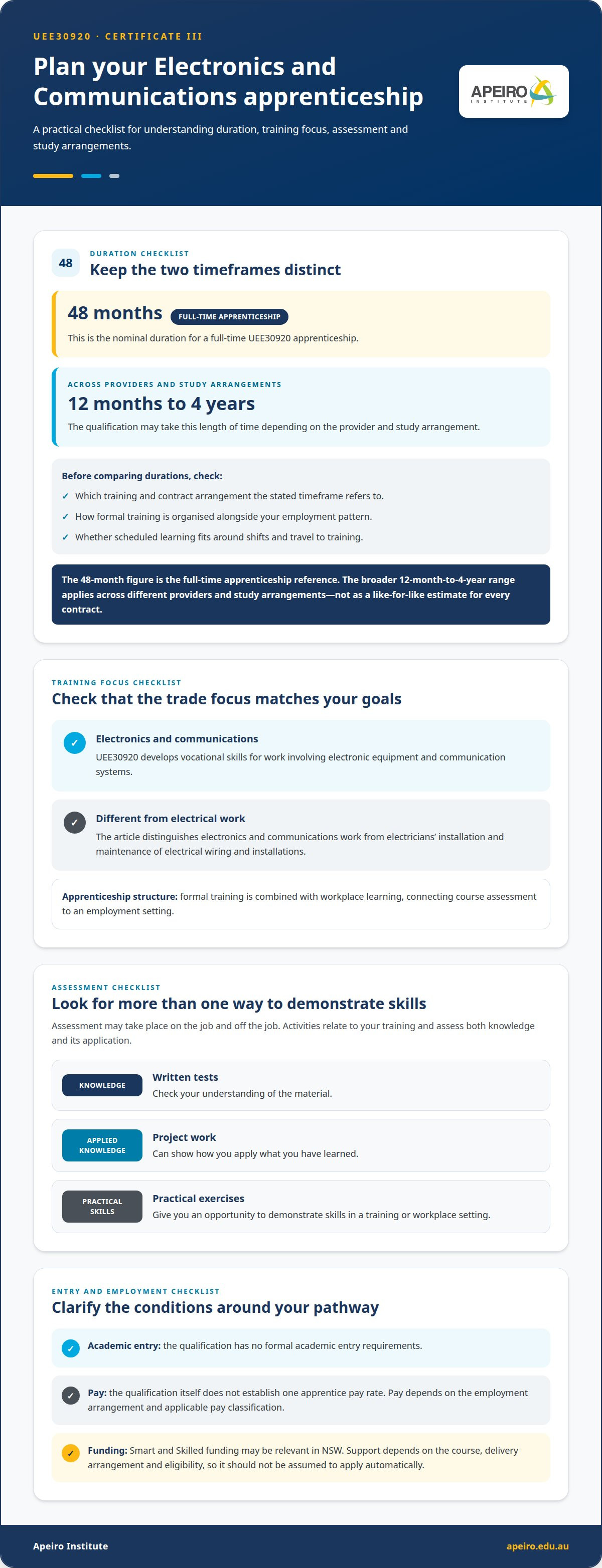
The qualification’s focus helps distinguish it from electrical work. Electronics and communications technicians work with electronic equipment and communication systems, while electricians install and maintain electrical wiring and installations. If you’re considering a UEE30920 apprenticeship in NSW, compare the course focus with the work you want to pursue. That distinction can help you decide whether this training aligns with your intended trade direction.
Apprenticeship duties
Apprentices develop skills through workplace learning and formal training. Their duties depend on the employer’s work and the tasks included in their training. Assessment may include written tests, project work and practical exercises, both on and off the job. These methods assess what learners know and how they apply it, rather than relying on a single type of task.
Practical assessment helps you demonstrate what you’ve learned. A project, for example, can assess how you apply knowledge, while a written test checks your understanding. A practical exercise gives you an opportunity to demonstrate skills in a training or workplace setting. Assessment activities relate to your training, so it’s useful to understand the approach before starting.
How does UEE30920 compare with other electronics or telecommunications apprenticeships in NSW? It is specifically the Certificate III in Electronics and Communications, with a focus on electronic equipment and communication systems. That focus differs from electrical work involving wiring and installations.
What are the apprentice wages and pay rates for UEE30920 in NSW? There is no single rate established by the qualification itself. Pay depends on the employment arrangement and applicable pay classification, which form part of the apprentice’s employment terms.
Which NSW training providers deliver UEE30920 through an apprenticeship? An RTO delivers the formal training component within the apprenticeship arrangement. The provider and delivery arrangement depend on the training pathway available to the apprentice.
What NSW and Australian government subsidies or incentives are available for UEE30920 apprentices? Smart and Skilled funding may be relevant in NSW, but support depends on the course, delivery arrangement and eligibility. Consider funding as a separate part of planning, rather than assuming it applies automatically.
For learners weighing up a UEE30920 apprenticeship in NSW, the practical question is whether the qualification’s systems focus matches their intended work. The combination of workplace learning and formal assessment offers a way to develop and demonstrate relevant skills.
Apprenticeship duration
A full-time UEE30920 apprenticeship in NSW has a nominal duration of 48 months. Across different providers and study arrangements, the qualification can take between 12 months and 4 years.
Those timeframes describe different training contexts. The 48-month figure is the nominal term for a full-time apprenticeship, while the 12-month-to-4-year range covers the qualification across study arrangements. If you’re planning work and study, first identify which arrangement the published duration describes.
Nominal duration is a planning reference, not a personalised completion date. The timeframe depends on the provider and study arrangement. A learner in one study arrangement, for example, may follow a different schedule from someone in a full-time apprenticeship. Compare like-for-like arrangements to make duration information useful.
A UEE30920 apprenticeship in NSW also combines work and formal training. Consider how scheduled learning fits around your employment pattern, including shift commitments and travel to training. The arrangement determines how training is organised alongside workplace experience, so the course duration alone doesn’t show how each week will be structured.
Completion involves more than counting calendar months. Assessment may include written tests, project work and practical exercises, both on and off the job. These activities help demonstrate the skills developed through training. A project or practical exercise, for example, may require time beyond regular workplace duties.
When comparing options, keep the apprenticeship term separate from the qualification’s broader course timeframe. A full-time UEE30920 apprenticeship in NSW uses the 48-month nominal duration as its reference. The 12-month-to-4-year range relates to the qualification across provider and study arrangements, so it shouldn’t be treated as an alternative estimate for every apprenticeship contract.
Before choosing a pathway, clarify the arrangement and how formal training will fit alongside employment. Then consider how workplace learning and assessments fit the schedule. This gives you a more practical planning picture than course duration alone and helps you compare options on the same basis.
If you’re considering a UEE30920 apprenticeship in NSW, use the 48-month nominal term to understand the full-time pathway. The course timeframe may differ according to the provider and study arrangement. Keeping those details distinct helps you set expectations around work, training and completion.
Entry age and education requirements
The Certificate III in Electronics and Communications has no formal academic entry requirements. A specific school qualification is therefore not a formal academic prerequisite. However, this does not answer every question about starting an apprenticeship: course entry and an employment-based training arrangement are separate considerations.
Keep those considerations distinct. Academic entry relates to the qualification, while age relates to the apprenticeship pathway and your circumstances. A school student considering a school-based apprenticeship, for example, is looking at a different arrangement from someone pursuing workplace training after leaving school. The qualification’s academic entry position is the same in either case.
School-based apprenticeships have a specific course milestone: students must complete Stage 1 of the Certificate III in Electronics and Communications qualification. This gives school students a concrete training requirement to consider alongside their studies. It also shows why “no formal academic entry requirements” doesn’t mean there are no course components or training commitments to complete.
For adult applicants, the same distinction is useful. Previous academic credentials aren’t formal entry requirements for this qualification, but an apprenticeship still combines workplace learning with formal training. Consider how your current work situation fits the intended training arrangement. For someone entering through employment, workplace learning is part of the pathway.
Consider age in relation to the proposed apprenticeship arrangement, not as an academic qualification. A school-based pathway lets a student complete training while at school; a non-school-based arrangement is a different route. The key question is which pathway suits your circumstances and how its work and training components are organised.
Before choosing a pathway, use this simple sequence:
- Separate academic entry from apprenticeship arrangements. The qualification has no formal academic entry requirements.
- Identify whether you’re considering a school-based or non-school-based pathway.
- If you’re a school student, account for the Stage 1 completion requirement.
- Consider how workplace learning and formal training fit your current circumstances.
This approach helps avoid a common misunderstanding: having no formal academic entry requirements does not mean every apprenticeship arrangement is identical. For instance, a school student’s route includes the Stage 1 requirement, while another applicant may be considering a different employment and training setup. Focus on the actual pathway, rather than assuming age or prior schooling alone describes eligibility.
In short, the qualification sets no formal academic entry requirement, and school-based students have a Stage 1 milestone. Age and study background should be considered in the context of the apprenticeship arrangement you’re pursuing. That distinction gives you a clearer starting point for weighing the available pathways.
Career opportunities
The Certificate III in Electronics and Communications prepares learners for work involving electronic equipment and communication systems. This career direction differs from electrical work focused on installing and maintaining wiring and installations. Understanding the distinction can help you decide whether the qualification aligns with the work you want to pursue.
Electronics and communications technicians may work with the systems and equipment used in their employer’s operations. A role could focus on electronic equipment, communications systems or both. The exact work depends on the workplace and its technical needs. The qualification provides a foundation for the field, while workplace experience connects training with a particular role.
Before choosing a pathway, consider which equipment and systems interest you. An apprentice drawn to communications systems may want work involving that area, while someone interested in electronic equipment may prefer roles centred on those systems. These examples can clarify your interests, but they aren’t separate qualifications or guaranteed job outcomes.
The career distinction matters. Electronics and communications technicians work with electronic equipment and communication systems. Electricians install and maintain electrical wiring and installations. If your goal is electrical installation work, this qualification may not match it. If you’re interested in communications or electronic systems, it may be a more relevant training direction.
Employment arrangements can also shape your working week. Full-time workers in the electronics and communications industry work an average of 39.6 hours per week. That figure describes an industry average, not a set roster for every job. A specific workplace’s duties and schedule depend on its operations and employment arrangement.
As you explore career options, use these practical points to frame your decision:
- Identify the work focus. Decide whether electronic equipment or communication systems interest you most.
- Distinguish the trade areas. Compare electronics and communications work with electrical wiring and installations.
- Consider the workplace. Think about how an employer’s equipment and systems could shape the role.
- Discuss the work alongside training. An apprenticeship combines formal learning with workplace experience.
These points can help you discuss the work involved in an apprenticeship. Ask how training relates to the employer’s systems and the duties you’ll develop towards. That connection matters: a qualification builds skills, while the workplace provides a setting to apply and extend them.
Career opportunities after UEE30920 are centred on electronics and communications, rather than a promise of one specific job title. The qualification is a starting point for developing relevant skills and workplace experience. Consider your interests, the employer’s work and the qualification’s focus together when deciding whether this pathway suits your goals.
Full-time, part-time and school-based contract modes
In NSW, the contract mode affects how apprenticeship training fits around employment or school. Full-time and part-time arrangements centre on work and formal training. A school-based pathway combines school attendance with paid employment and vocational training.
A full-time arrangement makes the apprenticeship the main work-and-training commitment. It may suit someone able to organise their week around employment and scheduled learning. The nominal full-time term is 48 months, so consider the overall commitment alongside work duties and training requirements.
Part-time training can offer a different balance if your work commitments don’t suit a full-time arrangement. The duration depends on the provider and study arrangement. Compare the formal training schedule with your expected work pattern, including whether training days fit around regular shifts.
School-based apprenticeships follow a distinct NSW structure. Students complete two years of part-time training during school, then three years of full-time training after school. They must also undertake at least 180 days of paid employment during school. This pathway therefore continues beyond school, rather than ending when Year 12 is complete.
For eligible school students, an optional Industry-based Learning course offers an additional 4 units of HSC credit. That option can add a school-study benefit alongside the apprenticeship’s workplace and vocational training components. It’s separate from the formal training component, so consider each part when planning school commitments.
Use the practical differences below to compare arrangements:
- Full-time: Plan for a full-time work-and-training commitment and its nominal term.
- Part-time: Focus on how the provider’s training schedule fits your employment pattern.
- School-based: Account for the two school years, later full-time training and 180 paid employment days.
- HSC planning: Consider whether optional Industry-based Learning and its 4 HSC credit units suit your study plan.
A school student balancing classes and paid work, for example, needs to plan around minimum employment days and ongoing training. Someone already working may compare full-time and part-time arrangements against roster commitments. These examples show why the best-fitting mode depends on your circumstances.
Before choosing a mode, identify your main constraint: school attendance, work hours or formal training times. Then compare the contract’s work and learning schedule with that constraint. If you’re a school-based apprentice, include the transition to full-time training after school in your plan. Seeing the whole arrangement helps you understand the commitment involved.
Queensland school-based electrotechnology apprentices: off-the-job college training is limited to 8 weeks (40 days), with at least 10 days and no more than 20 days per 12-month period; paid workplace employment is 600 hours (80 days) each year; institutional training may deliver a maximum of 33.3% of competencies. Part-time release: at least 2 weeks and no more than 4 weeks, or an equivalent alternative format.
Apeiro Institute: UEE30920 Certificate III in Electronics and Communications
Apeiro Institute offers the UEE30920 Certificate III in Electronics and Communications for learners pursuing electronics and communications training. Its Apprenticeships and Traineeships offering is relevant if you’re looking to combine formal learning with workplace experience.
If you already have relevant industry experience, Trade Pathways for Experienced Workers (TPEW) may be a suitable pathway to explore. The right option depends on your current experience and the training route you’re pursuing. Contact Apeiro Institute to discuss which pathway best fits your goals.
Take the next step towards your trade pathway
Choosing a UEE30920 apprenticeship in NSW is a chance to shape a practical direction in electronics and communications. Your next step is to connect your career interests with the kind of workplace learning and training arrangement that suits your circumstances.
Consider the systems you want to work with and the experience you bring to the pathway. If you already work in the trade, an experienced-worker pathway may also be relevant. A conversation with Apeiro Institute about your goals can help you identify a useful direction for your training.
When you’re ready to discuss your options, contact Apeiro Institute about apprenticeships.
Each considered step can bring your career plans into sharper focus. Keep building towards work that matches your interests and skills.
Frequently Asked Questions
How Long Is the Apprenticeship?
A full-time UEE30920 apprenticeship has a nominal duration of 48 months. The course timeframe can range from 12 months to 4 years, depending on the provider and study arrangement. For example, a part-time arrangement may follow a different schedule from a full-time apprenticeship. Check that any duration you’re comparing refers to the same type of training pathway, so you can plan work and study realistically.
What is the UEE30920 Certificate III in Electronics and Communications?
UEE30920 is a vocational qualification focused on electronics and communications work. It relates to electronic equipment and communications systems, rather than electrical wiring and installations. The code identifies the qualification, while the certificate describes its level and field. For example, someone interested in communications systems can use this focus to consider whether the training aligns with their intended work before pursuing an apprenticeship.
What are the entry requirements for a UEE30920 apprenticeship in NSW?
The qualification has no formal academic entry requirements. That answers the academic requirement, but an apprenticeship also involves an employment and training arrangement. For example, a school student follows a school-based pathway, while someone entering through work may have a different arrangement. School-based apprentices must complete Stage 1 of the qualification. Consider the pathway itself, not just your previous schooling, when assessing your next step.
What units and practical skills are covered in UEE30920?
UEE30920 develops skills for electronics and communications work, with learning demonstrated through assessment and practical exercises. Assessment can include written tests, project work and practical exercises, both on the job and off the job. For example, a learner may show understanding in a written test and apply skills in a practical task. The precise unit selection forms part of the qualification’s training plan.
What jobs and licensing requirements follow a UEE30920 apprenticeship in NSW?
The qualification can support a career direction involving electronic equipment and communications systems. Possible roles depend on an employer’s work and the skills you develop during training. This is distinct from an electrician pathway focused on electrical wiring and installations. Licensing requirements relate to the specific work undertaken, so don’t assume this certificate authorises electrical installation work. Match your intended duties with the requirements relevant to that work.

Disclaimer
The information provided on this blog is for general informational and educational purposes only. While every effort is made to ensure the accuracy and reliability of the content, the author makes no representations or warranties of any kind, express or implied, about the completeness, accuracy, suitability, or availability of the information contained on this blog.
The views and opinions expressed in blog posts are those of the individual author and do not necessarily reflect the official policy or position of any organization, company, or employer.
This blog may contain links to external websites or third-party content. These links are provided for convenience only, and the author has no control over and assumes no responsibility for the content, privacy policies, or practices of any third-party sites.
Nothing on this blog constitutes professional advice (legal, financial, medical, or otherwise). Readers are encouraged to seek appropriate professional guidance before making any decisions based on the information provided here.
By using this blog, you acknowledge that any reliance on the information is at your own risk.


