

You don’t need to move to a major city to start building a career in automotive work. Apeiro Institute helps learners across the country, while a motor mechanic apprenticeship combines paid, on-the-job learning with formal training, taking around 4 years to complete in Australia.
Finding a motor mechanic apprenticeship in regional NSW can take patience, especially when vacancies differ by location and training arrangement. It helps to understand how workplace learning fits alongside your day-to-day work and what financial assistance may be available.
This guide explains how to search for apprenticeship vacancies, what to expect from practical training and study, and how to consider support with training costs. You’ll get a clearer picture of the steps and options involved in working towards a light vehicle mechanic qualification.
Key Takeaways
- Learn where to look for automotive apprenticeship listings and how to narrow your search to light vehicle roles.
- Understand how workplace learning and formal training fit together, and what flexibility can mean in an apprenticeship.
- See how a light vehicle mechanic pathway differs from a general interest in automotive work.
- Explore the types of financial assistance that may be available and the factors that can affect eligibility.
- Find out what qualification an apprenticeship can lead to and where training options such as Apprenticeships and Traineeships may fit.
Automotive light vehicle apprenticeship listings
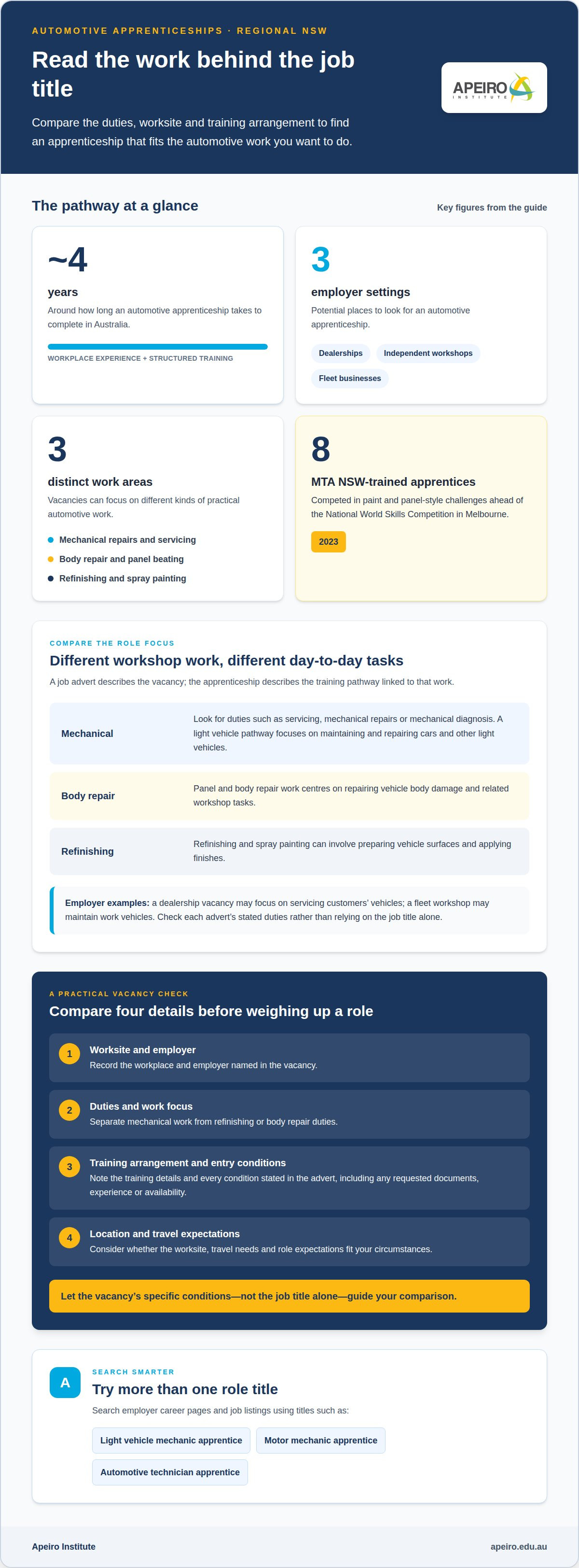
Automotive apprenticeship vacancies can involve mechanical repairs, vehicle servicing, panel work or refinishing. Start by matching the role’s daily tasks and training focus to the automotive work you want to do.
NSW apprenticeship vacancies and programs
Search employer career pages and job listings using several role titles, such as “light vehicle mechanic apprentice”, “motor mechanic apprentice” and “automotive technician apprentice”. Compare the location, duties and training arrangement for each vacancy.
A vacancy advertises a job; an apprenticeship describes the training pathway linked to work. Read both aspects together. A workshop role focused on servicing and mechanical repairs differs from one centred on body repair or paint preparation.
Potential employers include dealerships, independent repair workshops and fleet maintenance businesses. A dealership vacancy, for example, may focus on servicing customers’ vehicles, while a fleet workshop may maintain work vehicles. Check the advert for the worksite, duties and travel expectations before deciding whether the role suits you.
Automotive refinishing and spray painting, body repair and panel beating are related but distinct fields. They involve practical skills such as preparing vehicle surfaces, repairing body damage and applying finishes. Compare these duties with mechanical roles to identify the kind of workshop work that interests you.
Apprenticeship eligibility requirements
Entry requirements depend on the vacancy and its apprenticeship training arrangement. Read the listing for its conditions, work location and role expectations, then consider whether the opportunity suits your circumstances.
Before applying, note any documents, experience or availability requested in the advert. Consider whether the workshop duties match your interests and career goals. A role involving mechanical diagnosis, for example, has a different focus from spray painting or panel repair.
Use a simple comparison to keep options clear:
- Record the worksite and employer named in each vacancy.
- Separate mechanical work from refinishing or body repair duties.
- Note the training arrangement and every entry condition stated.
- Prioritise roles whose tasks and travel requirements fit your plans.
This approach helps you narrow down options without assuming every employer uses the same criteria. Let the vacancy’s specific conditions, rather than the job title alone, guide your next step.
Eight MTA NSW-trained apprentices competed in paint and panel-style challenges ahead of the National World Skills Competition held in Melbourne in 2023, offering an example of these specialisations in a competition setting.
Flexible, workplace-based apprenticeship training
Automotive apprenticeships in Australia combine practical workplace experience with structured training. They take around 4 years to complete, so the training arrangement matters throughout the apprenticeship, not just at enrolment.
Workplace learning connects skills with real workshop tasks. An apprentice might practise vehicle inspection procedures at work, then build related knowledge through formal learning. The balance depends on the training arrangement and the apprentice’s progress. Understanding how the parts fit together helps apprentices plan for work responsibilities and study requirements.
Training can include individual guidance, giving an apprentice the chance to discuss a task, receive feedback and practise areas that need attention. For example, they might review a diagnostic process after a workshop task. Clear feedback helps connect workplace experience with the knowledge developed through training.
Ask how training activities relate to workshop duties. A light vehicle apprentice focused on servicing, for instance, needs learning that supports those tasks. Regular progress conversations can clarify what the apprentice has practised, what needs more attention and how upcoming training relates to workplace duties.
Vacancies by year of training
Some vacancy descriptions state the training year sought. Treat this as a guide to the employer’s intended candidate, rather than assuming every apprentice starts at the same stage. A later-stage role may expect experience with relevant workshop tasks, while an entry-level position may suit someone beginning the pathway.
Compare the stated training year with the duties and training arrangement. A vacancy that names a particular year and lists diagnostic work, for example, gives more context than its title alone. This helps you assess whether your experience matches the position’s expectations.
Training across NSW and the ACT
For apprentices considering work across regional NSW or near the ACT border, the worksite and training arrangements affect daily travel. A vacancy in a regional centre may involve different travel needs from one closer to home. Map the work and training locations, as well as required attendance, before weighing up the position.
Ask how workplace tasks, formal training and feedback are coordinated across locations. If work and training are in different towns, travel time may shape your weekly routine. The arrangement should make clear where each activity takes place and how progress is monitored throughout the apprenticeship.
Because the pathway spans around 4 years, discuss how training will connect with changing workplace tasks over time. A clear plan can help you understand what to expect from each stage and how practical experience supports your development as a light vehicle mechanic.
Light vehicle mechanic apprenticeships
A light vehicle mechanic apprenticeship focuses on maintaining and repairing cars and other light vehicles. It combines practical workshop experience with training in automotive knowledge. For example, an apprentice may learn to identify a vehicle concern, follow a diagnostic process and explain the repair approach to a supervisor.
This pathway suits people interested in how vehicle systems work, not just those who enjoy driving. Workshop duties may include scheduled servicing, mechanical repairs and fault diagnosis. Working with different makes and models can help apprentices become familiar with varied components and repair situations as they gain experience.
Check the duties listed for the role. A vacancy centred on servicing may offer a different day-to-day experience from one focused on fault diagnosis. Consider the vehicles the business works on, the workshop tasks described and how practical training connects with those tasks. This helps you judge whether the apprenticeship fits your interests.
Training links workplace experience with the knowledge needed to understand automotive systems. A practical task involving a vehicle’s braking system, for instance, can lead to learning about its components and operation. Apprentices develop through practice, guidance and feedback, not classroom learning alone.
The formal qualification matters too. The AUR30620 Certificate III in Light Vehicle Mechanical Technology is a relevant qualification for this pathway. Its title identifies the light vehicle focus, helping distinguish it from qualifications centred on other automotive specialisations. Read the qualification details alongside the vacancy, so the training aligns with the work you want to learn.
Before committing to a role, use these points to assess whether it suits you:
- Workshop focus: Check whether the listed work centres on servicing, repairs or diagnosis.
- Vehicle range: Note whether the employer describes the types of vehicles handled.
- Learning connection: Look for a clear relationship between workshop duties and formal training.
- Guidance: Understand how feedback and support fit into day-to-day workplace learning.
A light vehicle pathway differs from panel beating and automotive refinishing. Those fields focus on vehicle body repair or paintwork, while light vehicle mechanics focus on mechanical work. This distinction matters when comparing adverts with similar automotive titles. A panel role, for example, may not provide the mechanical experience you’re looking for.
For a career in regional NSW, start by matching the job duties to the qualification. The vacancy’s location, workshop focus and training arrangement together show what the apprenticeship involves. This gives you a clearer basis for choosing a light vehicle role that supports your goals.
Apprenticeship financial assistance
For a motor mechanic apprentice in NSW, minimum pay depends on age, apprenticeship year and the employment conditions covering the role. There is no single rate for every apprentice. Compare the relevant age and year categories when estimating expected pay.
Financial assistance can affect more than training fees. Build a simple budget for costs involved in starting and completing an apprenticeship. For example, list course-related expenses separately from everyday costs, then identify which items affect your ability to attend work and training.
Consider these categories when planning:
- Training: identify course charges and any assistance that applies to them.
- Travel: account for journeys between home, the workshop and training location.
- Tools and equipment: note any items required for the role or learning activities.
- Living costs: plan around regular expenses while earning apprentice wages.
For an apprentice in regional NSW, travel can affect the budget. The workshop and training location may be in different towns. Estimate regular journeys and include them alongside other weekly expenses to get a clearer view of the cost of attending work and training.
Separate assistance for training from general income support. They serve different purposes and may have different eligibility conditions. A course-related subsidy, for example, may apply to training costs, while other assistance may relate to travel or living expenses. Keep each option distinct in your budget.
Eligibility often depends on the program and the apprentice’s circumstances. Relevant details may include the training pathway, employment arrangement, location and expense type. Write these down before comparing support options. This makes it easier to see which costs an option addresses and what information an application requires.
Record expected expenses and any assistance already accounted for. If a training cost is covered, remove it from the amount you budget to pay yourself. If travel remains your responsibility, list it separately. This helps prevent counting the same expense twice.
Apprentice pay and financial assistance are separate parts of your planning. Use the wage category that matches the apprentice’s age and year, then build a budget around the actual work and training arrangement. Someone travelling from a nearby town, for example, may need a different travel budget from someone living close to the workshop.
These steps won’t produce one figure that suits every apprentice. They help you understand how age, apprenticeship year, training costs and travel affect your own budget. Consider wage calculations alongside support options to assess the financial side before committing.
NSW motor mechanic apprenticeship qualifications
A light vehicle mechanic pathway is associated with the AUR30620 Certificate III in Light Vehicle Mechanical Technology. The code identifies the qualification, while “light vehicle” describes its automotive focus. In NSW, check that the apprenticeship training arrangement matches this qualification and the mechanical work you want to learn.
The certificate is a formal qualification, not simply a record of time spent in a workshop. Apprentices develop practical skills at work and complete structured training towards the qualification. For example, vehicle servicing experience should connect with learning relevant to light vehicle mechanical technology.
Read the qualification name and code together. “Certificate III” identifies the qualification level, “Light Vehicle Mechanical Technology” names its subject area, and “AUR30620” is its code. Those details help distinguish this pathway from automotive qualifications focused on diagnosis or broader technology.
Before starting, compare the qualification attached to the apprenticeship with the vacancy’s duties. A role involving mechanical servicing and repairs should align with a light vehicle qualification. If the advert emphasises spray painting or panel beating, its practical focus differs from mechanical technology.
As training progresses, track how workplace learning relates to the formal qualification. A discussion with a trainer or supervisor can connect a workshop task with the skill being developed. For instance, a repair task can prompt questions about the vehicle system and the reasoning behind the work.
The qualification also provides a clearer way to describe your training when discussing future career options. Naming AUR30620 is more precise than saying only that you completed a motor mechanic apprenticeship. It identifies the light vehicle field, which can help employers understand the focus of your training.
When reviewing an apprenticeship, use these details to understand its qualification outcome:
- Course code: confirm whether the pathway names AUR30620.
- Qualification title: check that it says Certificate III in Light Vehicle Mechanical Technology.
- Work focus: compare mechanical duties with the qualification’s light vehicle focus.
- Training connection: understand how workplace experience supports formal learning.
A qualification title alone doesn’t describe every task you’ll perform. The employer’s workshop, assigned duties and training arrangement shape the experience. Two light vehicle roles, for example, may involve different vehicle types or repair tasks. Considering both the qualification and vacancy gives you a fuller picture.
For a regional NSW applicant, the key is alignment: the training should match the light vehicle career you’re pursuing. AUR30620 Certificate III in Light Vehicle Mechanical Technology gives that pathway a specific name and code to discuss as you consider an apprenticeship.
Explore light vehicle mechanic training
Apeiro Institute: Apprenticeships and Traineeships
Apeiro Institute offers Apprenticeships and Traineeships for people exploring vocational training pathways. If you’re researching a regional NSW motor mechanic apprenticeship, discussing your training options is a practical next step. You can talk about how an apprenticeship pathway relates to your career goals and existing experience.
For experienced workers, Trade Pathways for Experienced Workers (TPEW) may suit those looking to build on skills gained in the workplace. Smart & Skilled Funded Courses are another option to explore when considering vocational study. Each offering has a different purpose: the right starting point depends on whether you’re beginning an apprenticeship, building on work experience or exploring funded training.
Contact Apeiro Institute to discuss which training pathway aligns with your next step.
Take the next step towards your automotive career
A motor mechanic apprenticeship in regional NSW can be the beginning of a longer skills journey. As your experience grows, consider which capabilities you want to build next and how further vocational training might support your direction. For experienced workers, Trade Pathways for Experienced Workers (TPEW) offers a pathway to consider. Apeiro Institute also offers UEE30920 Certificate III in Electronics and Communications, alongside its Apprenticeships and Traineeships.
Your next step may be to clarify which training pathway fits your goals or discuss how existing work experience could shape your options. A focused conversation can help turn your research into a practical plan for learning and career development.
Keep building towards the work you want to do. Each practical step can bring your career goals into clearer focus.
Frequently Asked Questions
How do I find and apply for a motor mechanic apprenticeship in regional NSW?
Search vacancies using your preferred town and terms such as “light vehicle mechanic apprentice”. Compare the duties, location, training arrangement and entry conditions in each advert. For example, distinguish mechanical repair roles from panel beating or spray painting positions. Prepare the requested documents and follow the application instructions. Before accepting a position, make sure its work focus and qualification pathway align with your career goal.
Which regional NSW employers, dealerships and workshops are recruiting automotive apprentices?
Recruitment changes across regional NSW, so there is no single permanent list of employers with vacancies. Dealerships, independent workshops and fleet maintenance businesses may advertise apprentice roles at different times. Focus your search on towns you can travel to, then review current vacancy details. Compare the workshop tasks and training information rather than relying on the employer type or job title alone.
What are the fees, tools and other costs for an automotive apprenticeship in NSW?
Costs depend on the training arrangement and what the workplace or course requires. Budget items may include training fees, tools or equipment, travel between home, work and training, and everyday living expenses. An apprentice travelling from another town, for example, may need a different plan from someone living near the workshop. Separate course charges from work-related costs and clarify which expenses apply to your apprenticeship before budgeting.
How long does a light vehicle motor mechanic apprenticeship take in NSW?
A light vehicle motor mechanic apprenticeship in NSW takes around 4 years to complete. The pathway combines workplace experience with formal training, so plan for both work and study across that period. For example, consider how training attendance fits with your workshop schedule and travel arrangements. Your training plan should connect the practical duties you perform with the qualification you’re working towards.
What support or incentives are available for apprentices and employers in regional NSW?
NSW Smart and Skilled funding may support eligible apprenticeship training, depending on the qualification, your eligibility and current program availability. Funding for the exact qualification requires an individual assessment and is not guaranteed. Apprentices and employers can also discuss how workplace-based training fits the role and training plan. For example, they can consider how formal learning relates to the apprentice’s regular workshop duties.

Disclaimer
The information provided on this blog is for general informational and educational purposes only. While every effort is made to ensure the accuracy and reliability of the content, the author makes no representations or warranties of any kind, express or implied, about the completeness, accuracy, suitability, or availability of the information contained on this blog.
The views and opinions expressed in blog posts are those of the individual author and do not necessarily reflect the official policy or position of any organization, company, or employer.
This blog may contain links to external websites or third-party content. These links are provided for convenience only, and the author has no control over and assumes no responsibility for the content, privacy policies, or practices of any third-party sites.
Nothing on this blog constitutes professional advice (legal, financial, medical, or otherwise). Readers are encouraged to seek appropriate professional guidance before making any decisions based on the information provided here.
By using this blog, you acknowledge that any reliance on the information is at your own risk.


