

Automotive apprenticeship listings can suit people at different stages, including first-, second- and third-year apprentices. Explore light vehicle and first-year mechanic roles, then compare their duties and training pathways.
It’s understandable to want a clear starting point. The right role should match your experience, interests and longer-term plans. This guide explains where to look, what light vehicle training can involve and how formal study fits alongside workplace learning.
You’ll also learn what to consider when comparing roles and how recruitment support and an automotive qualification can help you move forward. Whether you’re starting out or partway through an apprenticeship, knowing what to look for can clarify your next steps.
Key Takeaways
- Look for light vehicle apprenticeship listings across Parramatta and nearby Sydney suburbs, and compare roles by location and the experience level they suit.
- Light vehicle training combines practical skills with theoretical knowledge for maintaining and repairing vehicles.
- Choose a pathway that fits your interests, job prospects and longer-term career goals.
- Apprentices and trainees complete formal qualifications through a Registered Training Organisation of their choice.
- Explore apprenticeship and traineeship options alongside relevant vocational training to plan your next step.
Automotive light vehicle apprenticeship listings
Automotive listings can suit new starters and apprentices progressing through training. Compare each role’s duties, advertised apprenticeship year and training arrangements to identify opportunities that fit your plans.
Light vehicle mechanic pathways
Light automotive mechanic and light vehicle mechanic listings focus on maintaining and repairing light vehicles. One listing was open to 1st, 2nd and 3rd Years, offering an example for applicants at different stages. Read the position description for its stated year level, duties and experience expectations. A first-year applicant can focus on entry-level roles, while a progressing apprentice can look for a vacancy matching their current stage.
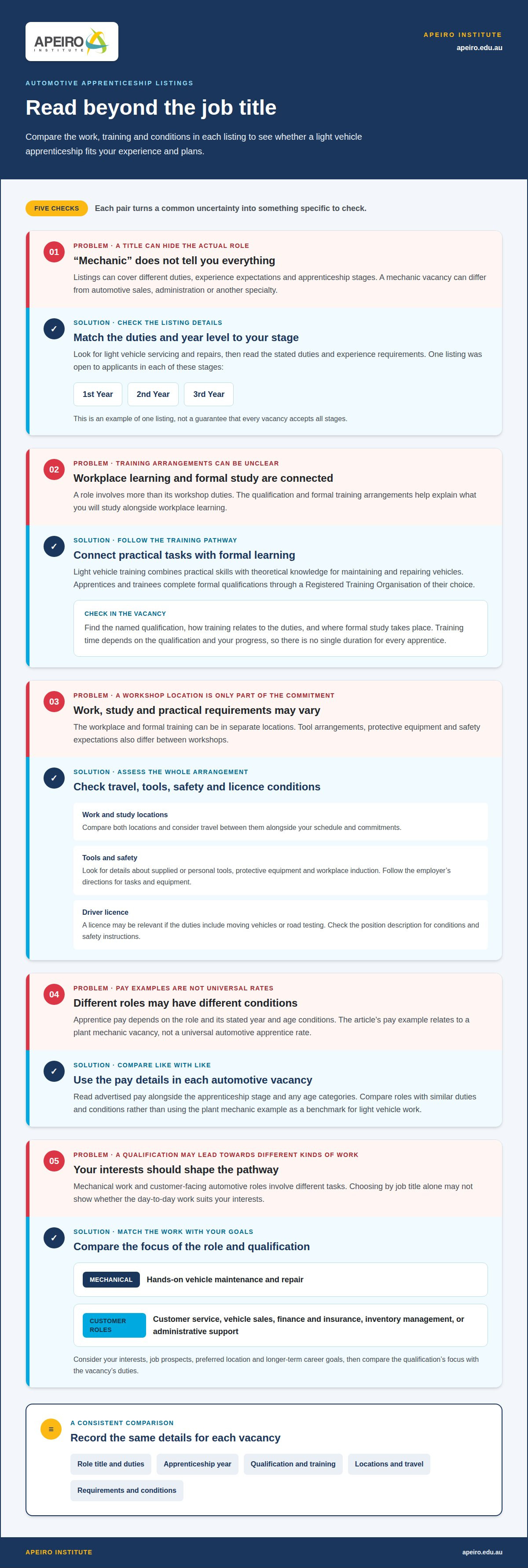
Use the role title as a starting point, not the whole decision. Check whether the listing focuses on light vehicle servicing and repairs, then consider the responsibilities and training pathway. This helps distinguish a mechanic apprenticeship from roles in sales, administration or another automotive specialty. Shortlist roles that match your experience and the work you want to learn.
Light vehicle mechanical training
Light vehicle mechanical training develops practical skills and theoretical knowledge for maintaining and repairing light vehicles. Workplace tasks connect learning with service and repair work, while formal study builds related knowledge. Check the qualification named in each listing and how its training relates to the role. This can help you judge whether the pathway suits your goal of working as a mechanic.
An apprenticeship combines workplace learning with formal training through a Registered Training Organisation. The time required depends on the qualification and your training progress, so there’s no single duration for every apprentice. Training includes practical and theoretical learning related to light vehicle maintenance and repair. Identify the qualification named in the listing and consider how it connects to the advertised duties.
Tools, licences and safety requirements
Tool arrangements and safety expectations vary between workshops. Check each listing for information about supplied tools, personal tools, protective equipment and workplace induction. Follow the employer’s directions for tasks and equipment. A driver licence may be relevant if duties include moving vehicles or road testing, so consider the listed responsibilities when assessing licence requirements.
For example, a workshop servicing role may involve different duties from a role that includes vehicle collection. Read the position description for licence conditions and safety instructions. This gives you a clearer picture of the practical requirements without assuming every workshop has the same arrangements.
Pay rates by year and age
Apprentice pay depends on the role and its stated year and age conditions. This example relates to a plant mechanic vacancy, not a universal automotive apprentice rate or a full breakdown by age and year.
For each automotive vacancy, read the advertised pay information alongside the apprenticeship stage and any age categories. Compare like-for-like roles rather than treating the plant mechanic example as a benchmark for light vehicle work. The duties, year level and conditions in each listing help you understand the opportunity.
Apprenticeship and traineeship recruitment and support
Apprenticeship listings connect workplace roles with formal training. Apprentices and trainees complete qualifications through a Registered Training Organisation of their choice. Entry criteria vary by vacancy, so use the stated prerequisites to assess your fit and identify any experience or study required.
Training location options
Consider both the workplace and formal training locations before applying. A role may involve separate places for work and study, affecting your regular travel and schedule. Compare the stated arrangements with your commitments to decide whether the training pathway is practical. The role’s duties and qualification matter as much as location.
For example, check whether the listing describes workplace learning and where formal study takes place. These details help you understand the commitment before accepting an opportunity. Include travel between training and work in your assessment, rather than judging a role solely by the workshop’s location.
Current apprentice and trainee listings
Vacancies can cover different apprenticeship years, trades and workplace responsibilities. One listing was open to 1st, 2nd and 3rd Years, showing that some opportunities can suit applicants at different stages. Read beyond the title: identify the duties, experience expectations, qualification and application requirements before deciding whether to apply.
Record each suitable vacancy’s role title, year level, duties and training pathway. Compare these details with your experience and preferred work. A mechanic vacancy, for example, differs from a trainee role focused on customer service or administration. A consistent shortlist helps you focus on roles that match your interests.
Matching training with career goals
Start with the work you want to do. If you enjoy hands-on mechanical tasks, you may prefer a workshop pathway. If you’re interested in customer interaction, consider automotive sales and administration, which can cover customer service, vehicle sales, finance and insurance, inventory management and administrative support.
Consider your interests, job prospects, preferred location and longer-term career goals when comparing options. Decide whether you’re drawn to vehicle repairs or to supporting customers through sales and administrative tasks. Then compare each qualification’s focus with the vacancy’s duties. A good match connects your study with the work you want to pursue.
Automotive apprenticeship types
Light vehicle apprenticeships focus on maintaining and repairing light vehicles. Heavy vehicle pathways centre on a different vehicle category, while auto electrical apprenticeships focus on automotive electrical work. Panel beating involves repairing damaged body panels, preparing surfaces, applying and matching paint, and finishing repairs.
These trades develop different skills, so compare each vacancy’s duties with your interests. Panel repair and paint finishing differ from light vehicle mechanical work. Automotive sales and administration is another pathway, focused on customer service and business tasks rather than workshop repairs. Check the duties and qualification together before deciding which roles to pursue.
Weigh your interests, job prospects, preferred location and long-term career goals when comparing an automotive apprenticeship. Considering these factors together can help you judge whether the pathway suits the work you want and where you hope your career will lead.
Apprenticeships in nearby Sydney suburbs
Expanding your search beyond Parramatta can reveal more automotive apprenticeship opportunities across the wider region. While Apeiro Institute supports learners nationwide, a suitable role may be outside your immediate suburb, so assess its workplace location alongside the duties and training arrangements. For example, compare a Parramatta vacancy with one elsewhere in the metropolitan area. Aim for a practical match, not simply the closest listing.
Start by defining a realistic travel area around home, study and other regular commitments. Search automotive apprenticeship listings across that area using suburb names and role titles. Include terms such as light vehicle mechanic, automotive apprentice and first-year apprentice. An apprenticeship needs to fit your routine as well as your career direction. A role that looks suitable on paper may involve a less convenient commute.
For each opportunity, note the suburb, role title, listed year level and main duties. These details help you compare vacancies consistently. A listing in Parramatta might describe different responsibilities from one elsewhere in Sydney, even if both use similar job titles. Read the full description before deciding. Check whether the work interests you and whether the stated experience level matches your current stage.
Training arrangements matter too. Apprentices and trainees complete formal qualifications through a Registered Training Organisation of their choice, such as Apeiro Institute. Consider how the training location fits with the workplace. A convenient workshop, for example, may still involve regular travel to a separate training venue. Compare both locations before shortlisting a role, rather than judging the opportunity by its suburb alone.
Listings can change, so make each search purposeful. Revisit suburbs within your travel area and look for newly advertised roles. Record when you reviewed each vacancy, then prioritise listings with clear duties, location details and a stated training pathway. This helps you distinguish current opportunities from vacancies you've already considered and follow up promptly when a role fits.
- Broaden your search: include Parramatta and other Sydney suburbs within your practical travel area.
- Compare the full role: review duties, year level, workplace location and training arrangements together.
- Keep a shortlist: record each vacancy's suburb and review date to organise your next steps.
Location is only one part of the decision. Compare the work with your interests, career plans and the qualification involved. If a role requires travel between a workshop and training venue, include both journeys in your assessment. A clear comparison helps you focus on opportunities that fit your routine and the automotive work you want to pursue.
First-year apprentice mechanic roles
A first-year mechanic role offers a starting point for people entering automotive trades. Parramatta listings can include different apprenticeship stages, so look specifically for vacancies marked first year. One local listing also accepted 2nd and 3rd Years, showing why checking the advertised level matters. A role’s title alone may not tell you which applicants it suits.
School leavers and career changers can use listing details to assess the work. Look for references to light vehicle servicing, maintenance and repairs. These duties indicate a mechanical focus rather than automotive sales or administration. Compare the tasks with your interests, then decide whether the workplace and training pathway match your plans.
Before applying, use a short process to organise your search:
- Search Parramatta and nearby Sydney suburbs for first-year mechanic vacancies.
- Record each role’s location, listed duties and apprenticeship year.
- Compare the entry information and qualification pathway across suitable roles.
- Prepare an application that responds to the listed duties and requirements.
This approach helps distinguish a genuine first-year opportunity from a vacancy aimed at an apprentice with existing experience. A listing open to several apprenticeship years may still suit a new starter, but its stated duties and requirements matter. Focus on the role’s wording rather than assuming every mechanic vacancy follows the same pattern.
Formal training is part of the apprenticeship pathway. Apprentices complete qualifications through a Registered Training Organisation of their choice, combining workplace learning with study. For a light vehicle mechanic career, consider whether the training relates to maintaining and repairing light vehicles. The Certificate III in Light Vehicle Mechanical Technology is a relevant qualification to explore alongside suitable vacancies.
Consider how the role could support your longer-term direction, too. A first-year position focused on light vehicle work may provide a foundation for further automotive study. If you’re interested in vehicle fault-finding, you could later explore how a more advanced diagnosis qualification fits your goals. Let the advertised duties guide your immediate choice, then consider how training can support your next career step.
Make a final comparison across three points for each vacancy: the work, the location and the qualification. A Parramatta role with suitable mechanical duties may suit you better than a closer listing outside your preferred area of automotive work. Check the application instructions and respond to the specific role. A focused search helps identify first-year opportunities that align with your interests and plans.
Automotive apprenticeships in Sydney and surrounding areas
Searching across Sydney can reveal options beyond one suburb, but a wider search needs structure. Start with Parramatta as your base, then add nearby areas you can realistically travel to. Compare each role’s location with its workplace duties and training arrangements. This keeps your search focused on suitable opportunities rather than simply collecting job titles.
Build a location shortlist before reviewing vacancies. Include suburbs that fit your regular travel and study commitments. For every listing, record its suburb, role title, apprenticeship stage and stated duties. Then compare these details side by side. A light vehicle mechanic opportunity in one area may suit your interests better than a closer role with different automotive tasks.
Use several search terms to find relevant listings. Try combinations such as “automotive apprentice”, “light vehicle mechanic” and “first-year mechanic” with Parramatta or another suburb. Read each advertisement carefully, since similar titles can describe different responsibilities. Note whether the position involves mechanical work, automotive administration or another trade. The task list is more informative than the title alone.
Training arrangements also affect how practical a Sydney-wide opportunity feels. Apprentices and trainees complete formal qualifications through a Registered Training Organisation of their choice. Consider how the training location fits with the workplace and your travel routine. A role involving travel between separate locations, for example, may need more planning than one based around a single area. Include both places in your comparison.
Keep your shortlist current by recording when you reviewed each vacancy. When you return to your search, check whether the role is still open and whether its details have changed. Reassess the location, apprenticeship stage and duties together. This gives you a clearer basis for deciding which application deserves attention, especially when Sydney-wide results include roles with different training and work focuses.
Use these comparison points for each opportunity:
- Location: note the suburb and how the workplace fits your regular travel.
- Work: identify the mechanical or other automotive skills described.
- Training: record the qualification pathway and training location.
- Fit: compare the role’s stage and duties with your experience and career direction.
A broader search works best when each additional suburb has a clear reason for inclusion. Add an area because it suits your routine or its advertised work matches your interests. Then assess the listing against the same points as Parramatta roles. This consistent approach helps you compare opportunities across Sydney without losing sight of the training and skills you want to develop.
Apeiro Institute: Apprenticeships and Traineeships
Apeiro Institute offers Apprenticeships and Traineeships for people planning vocational training alongside workplace learning. If you’re comparing automotive roles around Parramatta, consider how the qualification and training pathway fit the work you want to do. Apprentices complete formal qualifications through a Registered Training Organisation of their choice, so understanding the study component is part of choosing your next step.
For experienced workers, Trade Pathways for Experienced Workers (TPEW) may help formalise existing trade skills. Smart & Skilled Funded Courses are another option to explore when considering vocational study in NSW. Each pathway serves a different training need, so focus on the one that aligns with your experience and career direction.
Contact Apeiro Institute to discuss your training pathway.
Take your next step towards a mechanic career
Choosing an automotive apprenticeship in Parramatta is a practical start, but your first role can also shape what you learn next. As you consider opportunities, think about the skills you want to build and the work you’d like to take on over time. A clear career direction can help you make thoughtful decisions as your experience grows.
You don’t need to map out every stage now. Focus on finding a suitable starting point, then use your training and workplace experience to guide future choices. If you’re ready to discuss how vocational training can support your plans, Apeiro Institute can help you explore the next step.
Keep moving forward at a pace that works for you. Your next opportunity can be the beginning of a rewarding automotive career.
Frequently Asked Questions
What automotive apprenticeship roles are available in Parramatta, NSW?
Parramatta opportunities can include light vehicle mechanic apprenticeships, with listings for different experience stages. Depending on the vacancy, automotive pathways may also cover panel beating, auto electrical work, or sales and administration. When considering an automotive apprenticeship in Parramatta, compare the advertised duties with your interests. Vehicle repair work differs from customer service or vehicle sales.
Are there government incentives or support programs for automotive apprentices and employers in NSW?
NSW Smart and Skilled funded training may support eligible students undertaking an eligible qualification. Funding depends on the qualification, individual eligibility and current program availability, and requires an individual assessment before enrolment. Apeiro Institute offers Smart & Skilled Funded Courses, but funding or fee-free training isn’t guaranteed. Employers can also consider apprenticeship and traineeship training arrangements; these are distinct from a cash incentive or employer payment.
Where can I find current automotive apprenticeship vacancies near Parramatta?
Search current job listings using terms such as “automotive apprentice”, “light vehicle mechanic apprentice” and “first-year mechanic”, paired with Parramatta or nearby suburbs. Review each advertisement for closing information, workplace location, duties and application method. Check listings regularly because vacancies can change. Before applying, tailor your application to the role’s stated tasks and include relevant experience, such as school automotive study or workshop exposure, if applicable.

Disclaimer
The information provided on this blog is for general informational and educational purposes only. While every effort is made to ensure the accuracy and reliability of the content, the author makes no representations or warranties of any kind, express or implied, about the completeness, accuracy, suitability, or availability of the information contained on this blog.
The views and opinions expressed in blog posts are those of the individual author and do not necessarily reflect the official policy or position of any organization, company, or employer.
This blog may contain links to external websites or third-party content. These links are provided for convenience only, and the author has no control over and assumes no responsibility for the content, privacy policies, or practices of any third-party sites.
Nothing on this blog constitutes professional advice (legal, financial, medical, or otherwise). Readers are encouraged to seek appropriate professional guidance before making any decisions based on the information provided here.
By using this blog, you acknowledge that any reliance on the information is at your own risk.


