

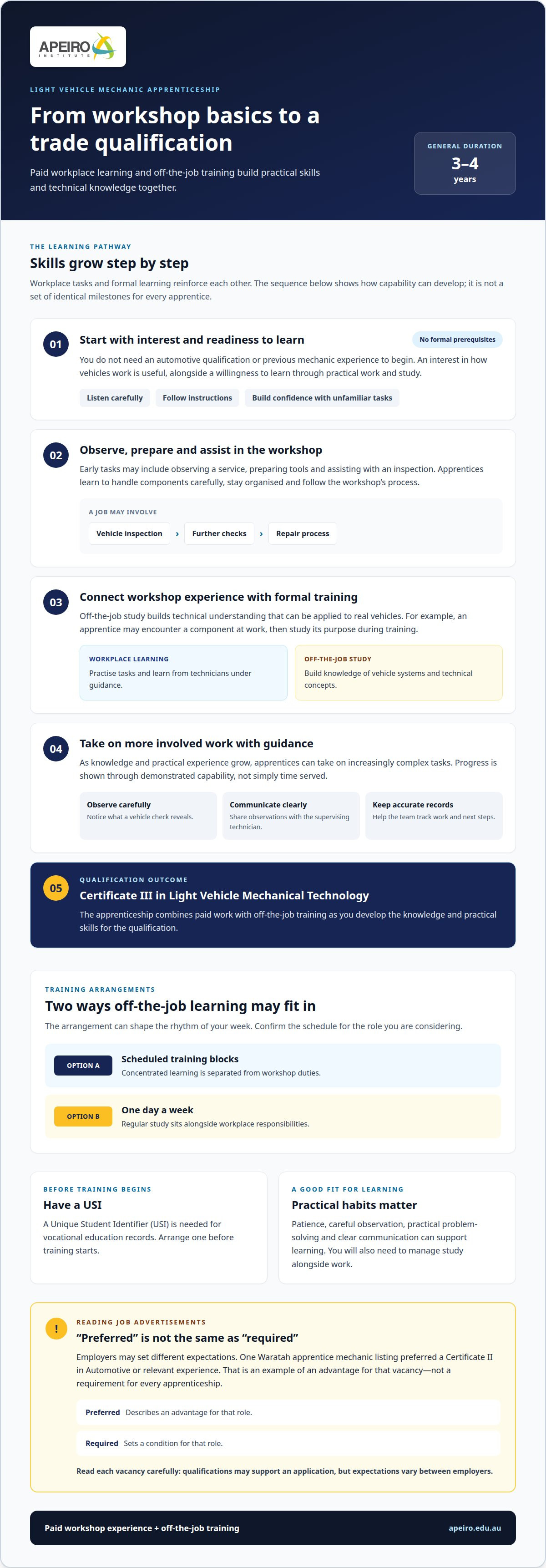
A trade qualification is the goal, but an apprenticeship is where you build the practical skills to earn it. A light vehicle mechanic apprenticeship generally takes three to four years, combining paid work with off-the-job training. It leads to a Certificate III in Light Vehicle Mechanical Technology.
If you’re keen to work with vehicles but unsure what the training involves or whether you need experience first, those are sensible things to consider. This guide explains what apprentices do, how workplace learning fits alongside formal training, and which qualifications or experience may be relevant. You’ll also get a clearer picture of the pathway, so you can decide whether it suits your goals and what to explore next.
Key Takeaways
- Understand how paid workshop experience and off-the-job training work together throughout an apprenticeship.
- Get a clearer picture of the practical responsibilities and learning progression involved in training as a light vehicle mechanic.
- See how automotive qualifications and relevant experience can strengthen an application, while recognising that employers may set different preferences.
- Learn how Certificate II-level study may be relevant when applying for an apprenticeship, and how qualifications relate to mechanic roles.
Apprentice technician duties and requirements
A light vehicle apprentice develops practical workshop skills alongside formal training. The role combines workplace learning with off-the-job study, which may take place in scheduled blocks or one day a week.
Apprentice technician duties
In a workshop, an apprentice learns how technicians inspect, maintain and repair light vehicles. A task might involve observing a service, preparing tools, then assisting with an inspection. With experience, apprentices take on more work under guidance. They also learn to follow instructions, handle components carefully and keep their work organised.
Each job can involve different systems and steps. A vehicle inspection, for example, may lead to further checks before a repair begins. Apprentices learn to share observations with the supervising technician and follow the workshop’s process. Accurate records help the team track work and decide what needs attention next.
Training connects workshop tasks with technical knowledge. An apprentice might encounter a component at work, then study its purpose during off-the-job training. This makes classroom learning relevant to real vehicles. Ask what workshop tasks and training arrangements the role includes, so you understand how practical learning fits into the week.
Entry requirements and suitability
There are no formal prerequisites for starting a light vehicle mechanic apprenticeship, and you don’t need an automotive qualification to begin. Apprentices do need a Unique Student Identifier, or USI, for their vocational education records. Arrange one before training begins.
Suitability depends on your readiness to learn through both practical work and study. You’ll need to listen carefully, follow workshop instructions and build confidence with unfamiliar tasks. An interest in how vehicles work is useful, but prior mechanic experience isn’t the only way to begin. Expect to develop your skills step by step.
Consider how you approach practical problem-solving. A workshop task may call for patience, careful observation and clear communication with a technician. You’ll also need to manage study alongside your work responsibilities. Since off-the-job training may be delivered in blocks or one day a week, consider how each format fits your schedule.
Before accepting a position, clarify the practical learning and training arrangements. Find out how workplace tasks are introduced, who provides guidance and when off-the-job study takes place. These details show how learning and doing are balanced. Look for a role and training plan that support steady skill development.
How long is a light vehicle mechanic apprenticeship?
A light vehicle mechanic apprenticeship generally takes three to four years. This allows time to develop workplace skills and progress through off-the-job training. The learning journey involves more than counting calendar years: it means building knowledge, applying it to practical tasks and demonstrating progress as your skills develop.
Competency develops progressively. An apprentice might begin by learning how a workshop approaches a vehicle check, then build towards completing more involved tasks with guidance. Understanding a vehicle system, for example, makes its inspection steps more meaningful. As knowledge and practical experience grow together, apprentices can take on increasingly complex work.
The three-to-four-year timeframe is a general guide, not a set of identical milestones for every apprentice. Training arrangements, workplace experience and progress through learning activities all shape the journey. Regular study can connect technical concepts with tasks at work. Scheduled training blocks create a different rhythm, with concentrated learning separated from workshop duties.
Eligibility and duration answer different questions. There are no formal prerequisites for starting this apprenticeship, so you don’t need a previous automotive qualification to begin. You’ll still need to complete the training and workplace learning involved. The starting point can be a genuine interest in the trade, followed by a commitment to developing the required knowledge and practical skills.
When considering the timeframe, look at how training and work fit together. Ask how off-the-job learning is arranged and how practical experience supports each stage. An apprentice studying a vehicle system, for example, can connect that learning with relevant workshop tasks. This helps explain why the apprenticeship takes time: each part contributes to broader technical understanding.
Progress is best understood through demonstrated capability, not simply time served. Each learning activity provides a foundation for the next, while workplace tasks let apprentices practise and strengthen their skills. Keep track of training activities and discuss your progress with the people supporting the apprenticeship. This makes the learning journey easier to follow and highlights skills that still need development.
Plan for a multi-year commitment. The general duration is three to four years, with practical work and formal learning contributing to your progress. Focus on the training schedule, workplace opportunities and how competency develops over time. These details give you a clearer picture of the full apprenticeship journey.
Automotive qualifications and certificates
Automotive qualifications can show employers what training you’ve completed. They may help with an apprenticeship application, but job advertisements set different expectations. A Waratah apprentice mechanic listing preferred a Certificate II in Automotive or relevant experience. That preference doesn’t mean every apprenticeship requires Certificate II. It’s one example of how applicants can demonstrate an existing interest or foundation in the trade.
Read each vacancy carefully. “Preferred” describes an advantage, while “required” sets a condition for that role. A Waratah listing, for example, preferred Certificate II or relevant experience. A Broadmeadow motor mechanic role required a Certificate III in Light Vehicle Mechanical Technology or equivalent. These are criteria for different positions, not universal entry rules.
Certificate level also matters when comparing your current experience with a role. Certificate II in Automotive may be relevant to an apprentice application, as the Waratah example shows. Certificate III in Light Vehicle Mechanical Technology appeared as a requirement for the Broadmeadow mechanic role. “Or equivalent” indicates that role accepted an alternative, but the vacancy’s wording determines what counts for that position.
If you haven’t studied automotive subjects, relevant experience may still matter to an employer. A listing that accepts experience alongside a Certificate II is one example. Think about practical exposure that helps explain your interest, such as assisting with basic vehicle care or learning about components. Describe what you actually did, rather than presenting informal experience as a formal certificate.
Further automotive study can support a new career direction or build on existing knowledge. A Certificate IV in Automotive Mechanical Diagnosis, for example, signals a diagnostic focus in its title. A Diploma of Automotive Technology is another named qualification. Consider the work you want to pursue before choosing further study. The qualification title identifies its field, while the course details explain the learning involved.
Use a simple comparison when reviewing qualifications and vacancies. First, check whether the employer says a certificate is preferred or required. Next, note the named level and field, such as Certificate II in Automotive. Then compare the wording with your completed study and relevant experience. This helps you identify gaps without assuming every workshop expects the same background.
For applicants, the practical takeaway is to match your evidence to each role. A Certificate II may strengthen an application where it’s preferred, while a Certificate III or equivalent may be required for a qualified mechanic position. If you’re new to automotive work, focus on the apprenticeship’s stated entry criteria. Identify the qualification or experience that directly addresses those criteria.
General motor mechanic qualifications and experience
Mechanic vacancies can set different qualification and experience criteria. A Broadmeadow motor mechanic role required a Certificate III in Light Vehicle Mechanical Technology or equivalent, as well as one year of experience. These were requirements for that particular vacancy, not universal conditions for every mechanic position or apprenticeship.
Read each advertisement closely. Note whether a qualification is required, preferred or accepted as equivalent. Then identify any experience period and the type of work described. In the Broadmeadow example, both the qualification and one year of experience were required. Meeting only one criterion would not satisfy the complete wording.
For your application, connect your experience to the tasks named in the advertisement. Give a clear example of relevant work, training or vehicle-related experience. Be precise about your role and the skills you used. Don’t describe informal experience as a completed qualification. If your certificate has a different title, state it accurately rather than assuming it meets an employer’s equivalence requirement.
Light vehicles and heavy commercial vehicles are distinct work contexts. A vacancy’s wording indicates which vehicle type the employer needs a mechanic to work on. For example, assess a light vehicle role against its stated light vehicle qualification criteria. Don’t assume a qualification in one vehicle area automatically meets the requirements of a vacancy in another.
Compare the qualification title with the vehicle category and duties in the advertisement. If a role names Certificate III in Light Vehicle Mechanical Technology, address that requirement directly in your application. If it says “or equivalent”, explain the qualification or experience you believe is relevant. The employer’s stated criteria remain central to that role.
Apprentices and qualified mechanics apply at different career stages. An apprenticeship is a training pathway, while the Broadmeadow role sought a qualified mechanic with one year of experience. This helps explain why an advertisement for a qualified position may ask for more than an apprentice vacancy. Match your application to the level and responsibilities described.
Before applying, identify the vehicle category, required qualification, experience period and any wording about equivalent study. Then prepare evidence for each criterion. A practical example can explain relevant workshop experience, while your certificate details show completed study. This keeps your application focused and avoids overstating what your training covers.
For Newcastle applicants, the key distinction is the vacancy itself. A general mechanic position may require both a named Certificate III and prior experience, as the Broadmeadow example shows. An apprenticeship has a different purpose and entry pathway. Read the criteria in context, especially when comparing light vehicle work with heavy commercial vehicle roles.
How long does the apprenticeship take, and what certificate qualification is awarded?
A light vehicle mechanic apprenticeship generally takes three to four years. It combines paid workplace learning with off-the-job training. The qualification awarded is the AUR30620 Certificate III in Light Vehicle Mechanical Technology. Together, the practical and formal components build capability for light vehicle mechanical work. This gives you a clear qualification to work towards while developing skills on the job.
The three-to-four-year timeframe allows learning to develop progressively. An apprentice builds technical understanding while gaining practical workplace experience. Studying a vehicle system, for example, can explain why technicians follow particular inspection steps. Workplace tasks then provide opportunities to apply that understanding. Training and experience work together as parts of the pathway.
Off-the-job training may take place in scheduled blocks or one day a week. The format affects how study fits around work, but both approaches connect formal learning with practical experience. Block training concentrates study into set periods, while weekly study spreads it across the working routine. The qualification pathway includes both elements.
The Certificate III title identifies the qualification associated with this apprenticeship. AUR30620 is its training package code, and Light Vehicle Mechanical Technology names its field. Those details distinguish it from a Certificate II in Automotive or a Certificate IV in Automotive Mechanical Diagnosis. Each title and code points to a different qualification, so use the full name when discussing your training.
Progress towards the Certificate III involves developing and demonstrating skills over time. Completing a task once doesn’t automatically mean every related skill is secure. Apprentices need to build understanding, practise tasks and apply their learning in workplace settings. Knowledge gained during off-the-job training, for example, can help make a practical workshop activity easier to understand. This connects study with the qualification’s occupational focus.
As you plan, consider how the training schedule and workplace routine will fit together. Ask how off-the-job learning is delivered and how workplace experience supports progress. A schedule with weekly study may feel different from one using blocks. Either way, the apprenticeship remains a multi-year pathway, with the AUR30620 Certificate III as its qualification outcome.
For Newcastle learners, the practical answer is straightforward: plan for three to four years and work towards the AUR30620 Certificate III in Light Vehicle Mechanical Technology. Keep the complete qualification name and code together when reviewing training information. That helps distinguish the light vehicle pathway from other automotive certificates and clarifies the outcome you’re working towards.
Apeiro Institute: Apprenticeships and Traineeships
Apeiro Institute offers Apprenticeships and Traineeships for learners planning a trade pathway. For light vehicle mechanic training, the relevant qualification is AUR30620 Certificate III in Light Vehicle Mechanical Technology. It aligns with the qualification discussed above and gives you a clear training direction to explore.
If you already have substantial trade experience, Trade Pathways for Experienced Workers (TPEW) may be relevant to your next step. The right pathway depends on your experience and learning goals. Reviewing the qualification and pathway options can help you decide what to pursue.
Contact Apeiro Institute to discuss the light vehicle training pathway.
Take your next step towards the trade
Choosing a light vehicle mechanic apprenticeship, such as opportunities in Newcastle, NSW, is a practical commitment to learning through work and study. Before moving forward, think about the kind of workshop environment where you’d like to develop, and what support helps you stay on track. A clear goal can make the next decision easier.
Apeiro Institute offers Apprenticeships and Traineeships, Trade Pathways for Experienced Workers (TPEW), and UEE30920 Certificate III in Electronics and Communications. These pathways suit different training interests and experience. If automotive is your focus, keep your attention on the light vehicle qualification and the learning route that matches your goals.
Starting a trade pathway is a meaningful step. Build your knowledge progressively and shape your direction as you learn.
Frequently Asked Questions
Which employers and automotive workshops in Newcastle are hiring apprentices?
Apprentice vacancies change, so a location alone doesn’t confirm a workshop is hiring now. Examples associated with Newcastle include an apprentice listing in Waratah and a crane repair business seeking a second- or third-year apprentice mechanic. These represent different experience levels. Compare each vacancy’s location, year level and stated requirements, then tailor your application to the role advertised.
What qualifications and entry requirements are needed for a light vehicle mechanic apprenticeship in NSW?
There are no formal prerequisites for starting a light vehicle mechanic apprenticeship, though training requires a Unique Student Identifier, or USI. Employer preferences can still vary: a Waratah apprentice listing preferred a Certificate II in Automotive or relevant experience. Treat that as one employer’s preference, not a statewide entry rule. Read the vacancy carefully and distinguish preferences from stated requirements.
How do I apply for a light vehicle mechanic apprenticeship in Newcastle?
Start by matching your application to a specific apprentice vacancy. Prepare a concise résumé covering your education, relevant experience and interest in vehicle repair. Include practical examples, such as work experience or personal vehicle projects, and describe your contribution accurately. Follow the employer’s application instructions, provide the requested documents and note the position’s year level or closing date to respond to the correct opportunity.
Which TAFE or registered training providers deliver the light vehicle mechanic apprenticeship near Newcastle?
Apeiro Institute offers Apprenticeships and Traineeships and the AUR30620 Certificate III in Light Vehicle Mechanical Technology. For a Newcastle-based apprenticeship, the training arrangement needs to suit the qualification and the apprentice’s workplace. Consider how the provider’s delivery schedule fits the employer’s work routine, including the timing of off-the-job study. Confirming those details helps you understand how training and paid work will run together.
What are the apprentice mechanic pay rates in Australia by age and year of apprenticeship?
Apprentice pay depends on the applicable employment instrument, age classification, apprenticeship year and work arrangements. These factors affect the rate, so one figure won’t apply to every apprentice. Use the correct classification and age band when assessing a rate, and distinguish ordinary hours from overtime or allowances. Qualified mechanic earnings describe a different employment level, not an apprentice rate.
What government incentives or financial support are available to apprentices in NSW?
NSW Smart and Skilled funded training may be available, depending on the qualification, your eligibility and current program availability. An individual assessment is required before enrolment, and funding or fee-free places aren’t guaranteed. This training support is different from an apprentice payment or employer incentive. Base your budget on support confirmed for your specific training pathway, rather than assuming every apprentice receives the same assistance.
What tools, licences and other costs might a light vehicle mechanic apprentice need to cover?
Required tools, licences and other expenses depend on the workplace and the apprentice’s duties. Before buying equipment, clarify which items the employer supplies and which you need personally. A written list can help you budget for tools, transport or any role-specific licence. Avoid buying a complete tool set until you know the workshop’s requirements and what equipment is available.
What are the working conditions, risks, and career prospects for apprentice mechanics in Newcastle?
Apprentices combine paid workshop work with off-the-job training, usually in blocks or one day a week, and take on increasingly complex tasks under guidance. The apprenticeship generally takes three to four years and leads to a Certificate III in Light Vehicle Mechanical Technology; average pay for a fully qualified worker is approximately $1,622 a week before tax. The material gives no specific information about workplace risks.

Disclaimer
The information provided on this blog is for general informational and educational purposes only. While every effort is made to ensure the accuracy and reliability of the content, the author makes no representations or warranties of any kind, express or implied, about the completeness, accuracy, suitability, or availability of the information contained on this blog.
The views and opinions expressed in blog posts are those of the individual author and do not necessarily reflect the official policy or position of any organization, company, or employer.
This blog may contain links to external websites or third-party content. These links are provided for convenience only, and the author has no control over and assumes no responsibility for the content, privacy policies, or practices of any third-party sites.
Nothing on this blog constitutes professional advice (legal, financial, medical, or otherwise). Readers are encouraged to seek appropriate professional guidance before making any decisions based on the information provided here.
By using this blog, you acknowledge that any reliance on the information is at your own risk.


