

What is RPL for Electronics Technicians in Australia?
Recognition of Prior Learning (RPL) is a formal assessment process designed to acknowledge the skills and knowledge you’ve already gained through your work and life experience. For a seasoned electronics technician in Australia, it’s the most direct pathway to bridge the gap between your hands-on expertise and a formal, nationally recognised qualification.
- It offers a formal assessment of your existing skills, turning years of on-the-job problem-solving into tangible credentials.
- RPL closes the loop between 'know-how' and certification, validating your practical knowledge against national standards.
- It provides a significant time-saving benefit, allowing you to bypass classroom study for subjects you have already mastered in the workplace.
- The final outcome is a nationally recognised qualification—exactly the same as one earned through traditional study, because it certifies the same level of competency.
Why Experience Matters More Than Ever in 2026
The Australian workforce is increasingly valuing proven, practical skills over purely theoretical knowledge. In a rapidly evolving sector like electronics, where automation, advanced communications, and IoT technologies are reshaping the landscape, employers are looking for technicians who can hit the ground running. The concept of a 'fair go' is central here; RPL ensures that experienced workers get the formal recognition they deserve for their years of dedicated service and accumulated expertise.
The Difference Between Credit Transfer and RPL
It's important to understand the distinction between two common pathways. Credit transfer applies when you have completed units of study at another Registered Training Organisation (RTO) and want to apply those credits to a new qualification. In contrast, RPL is designed specifically for knowledge gained through work and life experience. At Apeiro Institute, we help you formalise trade experience into a qualification, assessing your real-world skills against the required competencies. For some candidates, a combination of both RPL and credit transfer can lead to an even faster and more streamlined certification process.
Why the UEE40720 Course is the Gold Standard for Technicians
The UEE40720 Certificate IV in Electronics and Communications is widely regarded as the premier qualification for technicians aiming to advance their careers in Australia. Achieving this certificate through RPL signifies a major step up, often moving a worker from an 'assistant' or 'fitter' role to a fully-fledged 'technician' level. This progression is not just a title change; it unlocks significant earning potential and opens doors to more senior roles across diverse industries, including telecommunications, medical electronics, industrial control, and renewable energy systems.
Key Competencies Covered in the UEE40720
This qualification centres on the high-level skills that define a senior technician. The RPL assessment will look for your demonstrated ability in areas such as complex fault-finding, diagnostic testing on intricate systems, and advanced circuit design and assembly. It also covers crucial knowledge of occupational health and safety (OHS) protocols and environmental standards that are non-negotiable in modern electronics workplaces. The work you already do—troubleshooting, repairing, and maintaining complex equipment—is exactly the kind of evidence an RPL assessor is looking for.
Advancing from Certificate III to Certificate IV via RPL
For technicians who already hold a Certificate III, the RPL pathway is an ideal way to level up their career without returning to the classroom. It allows you to use your advanced, on-the-job experience to demonstrate the higher-level competencies required for the Certificate IV. This is a core component of the 'Trade Pathways for Experienced Workers' (TPEW) approach, which focuses on validating the skills of senior tradespeople. Recognising your expertise is a crucial step, whether you're an electronics technician or a professional in another technical field like civil construction design.
Building Your Evidence Portfolio: Proving Your Electronics Expertise
The evidence portfolio is the heart of your RPL application. This isn't just about submitting a resume; it’s about providing concrete proof of your technical capabilities. For an electronics technician, this means gathering documents and media that showcase your skills in action. We encourage workers to start thinking like an assessor and begin 'collecting' evidence of their daily wins, which makes the formal application process much smoother.
Examples of powerful evidence include:
- Circuit diagrams you have designed, interpreted, or modified.
- Completed testing logs or commissioning reports.
- Photos or videos of completed circuit boards, installations, or complex repairs.
- Fault-finding reports detailing your diagnostic process.
Types of Evidence an Assessor Wants to See
A strong portfolio is diverse and well-documented. An assessor will be looking for a mix of evidence, such as:
- Workplace documents: Job cards, service reports, technical drawings, schematics, and maintenance schedules you have worked with or created.
- Third-party testimonials: Letters from supervisors, managers, or satisfied clients that confirm your technical skills and responsibilities.
- Video and photo evidence: Short, clear clips of you performing a diagnostic test, using specialised equipment, or explaining a complex repair.
Organising Your Portfolio for Success
How you present your evidence matters. The key is to centre your portfolio around the specific units of competency within the UEE40720 qualification. Clear labelling, a logical structure, and professional presentation will make the assessor's job easier and demonstrate your own organisational skills. At Apeiro Institute, our dedicated mentors guide you through this process, helping you organise your files and select the most impactful evidence to ensure a smooth and successful assessment.
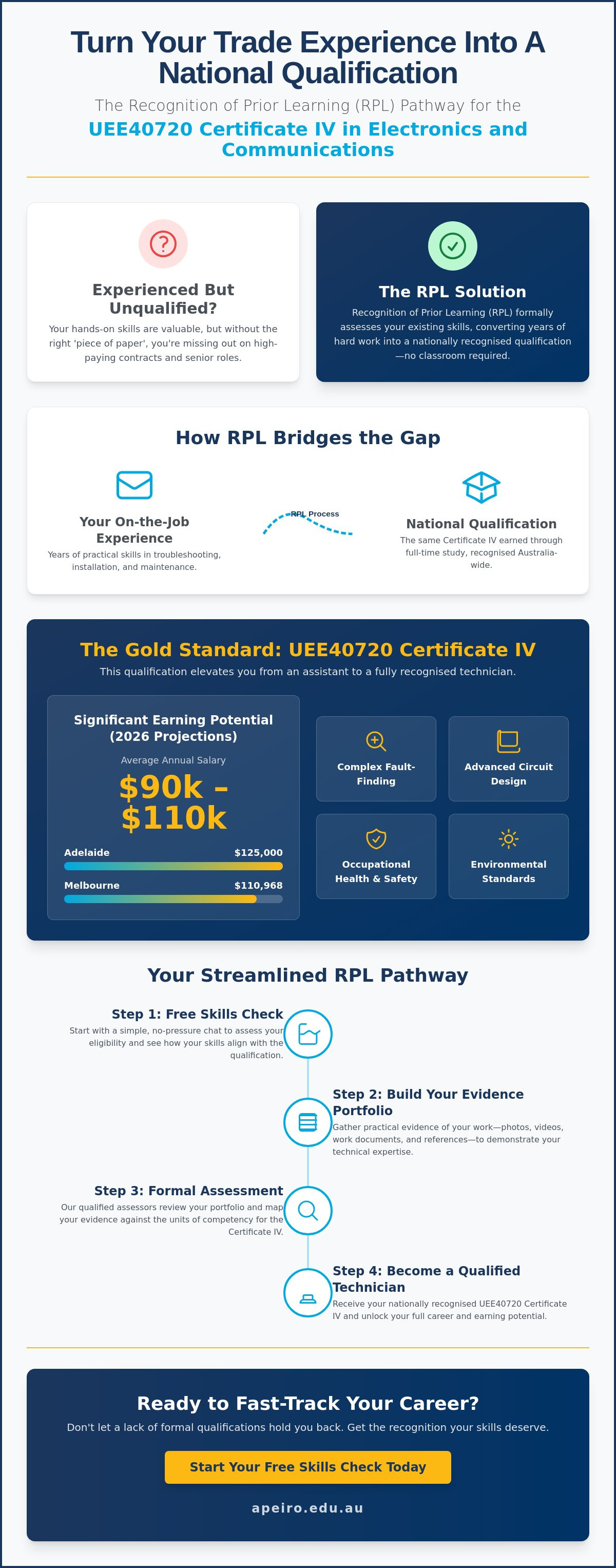
The Step-by-Step RPL Assessment Process for Skilled Workers
We understand that the thought of a formal assessment can be daunting. That’s why our process is designed to be supportive, transparent, and respectful of your experience. It's a professional collaboration, not an interrogation. The entire journey, from your first enquiry to receiving your certificate, is often measured in weeks, not the years required for traditional study.
Step 1: The Initial Skills Assessment
It all starts with a no-pressure, free skills check. One of our industry-expert assessors will review your work history and have a conversation with you about your career goals. This initial step helps confirm that the UEE40720 is the right qualification for you. If we identify any minor gaps in your knowledge, we'll outline a clear and simple plan for you to address them with targeted training.
Step 2: Evidence Collection and Submission
Once you're ready to proceed, you’ll move into the evidence-gathering phase. This is where you compile your work documents, photos, references, and other proof of your skills. You won't be doing this alone; you’ll have a dedicated mentor to help you get trade qualified with work experience. They will provide guidance to ensure your submission is fair dinkum and meets the rigorous standards set by the Australian Skills Quality Authority (ASQA).
Step 3: Technical Interview and Practical Observation
The final step typically involves a technical interview with your assessor. This is a professional conversation—a chance for you to have a yarn about your experience and for the assessor to verify your depth of knowledge. It’s a discussion between two industry peers, not a school exam. In some cases, a practical observation at your workplace may be arranged to see your skills in a real-world context.
Fast-Track Your Career with Apeiro Institute’s Trade Pathways
Choosing the right RTO is just as important as the qualification itself. Apeiro Institute is more than just a training provider; we are your dedicated mentor on the path to formal recognition. With a national reach and an unwavering focus on industry-relevant outcomes, we support skilled workers across Australia in achieving their professional goals. When you partner with us, you join a diverse and supportive community of learners dedicated to practical achievement.
The Apeiro Difference: Support Every Step of the Way
Our assessors are not just academics; they are industry veterans who have worked in the field and speak your language. They understand the challenges and opportunities you face every day. Our commitment is to make vocational education accessible, inclusive, and focused on practical outcomes that lead directly to career advancement and job security. We believe your experience is your greatest asset, and our role is to help you prove it.
Ready to Get Started?
Your years of hard work and expertise are valuable and deserve to be formally recognised. Don't let a lack of paperwork hold you back from senior roles, better pay, and greater career satisfaction. The next step is a simple, obligation-free conversation. Give your career the leg-up it deserves.
[Take the first step toward your UEE40720 qualification with a free skills check at Apeiro Institute.](https://www.apeiro.edu.au/tpew)

Disclaimer
The information provided on this blog is for general informational and educational purposes only. While every effort is made to ensure the accuracy and reliability of the content, the author makes no representations or warranties of any kind, express or implied, about the completeness, accuracy, suitability, or availability of the information contained on this blog.
The views and opinions expressed in blog posts are those of the individual author and do not necessarily reflect the official policy or position of any organization, company, or employer.
This blog may contain links to external websites or third-party content. These links are provided for convenience only, and the author has no control over and assumes no responsibility for the content, privacy policies, or practices of any third-party sites.
Nothing on this blog constitutes professional advice (legal, financial, medical, or otherwise). Readers are encouraged to seek appropriate professional guidance before making any decisions based on the information provided here.
By using this blog, you acknowledge that any reliance on the information is at your own risk.


