

Can you complete a Certificate III Individual Support traineeship and gain practical experience while you study? It may be a suitable pathway, but a traineeship and the qualification aren’t the same thing. A traineeship combines an employment arrangement with training, while CHC33021 Certificate III in Individual Support (Ageing and Disability) is the nationally recognised qualification you may work towards.
If you’re unsure how to find an employer, fit study around work or check whether you’re eligible, start by clarifying what each pathway involves. The right option depends on the employer, training provider and arrangements available to you, so ask specific questions before committing.
This guide explains how a Certificate III Individual Support traineeship can work, what to check about workplace requirements, training and possible funding, and how to explore your next steps. You’ll also find questions to ask an employer and training provider, including Apeiro Institute, which lists CHC33021. A traineeship place, employment and funding aren’t guaranteed, so confirm the details that apply to you before making plans.
Key Takeaways
- A traineeship links workplace learning with an employment arrangement; CHC33021 is the qualification you may study towards.
- For a Certificate III Individual Support traineeship, clarify who arranges the employer, training and enrolment before deciding on a pathway.
- Compare workplace-based learning with course-only study, including the employment commitments and study structure that suit your circumstances.
- Ask the RTO about course currency, entry requirements, assessment and practical learning requirements before enrolling.
- Apeiro Institute is RTO 45394 and lists CHC33021 Certificate III in Individual Support (Ageing and Disability); check directly whether a traineeship pathway is currently available for you.
What is a Certificate III Individual Support traineeship?
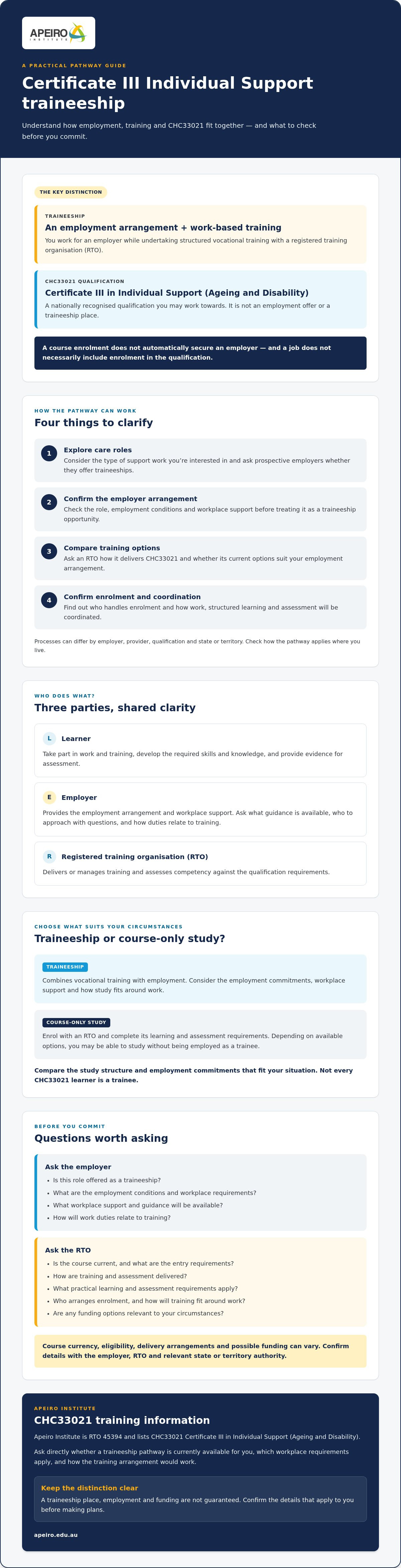
Course enrolment and a traineeship are related, but they aren’t the same. A traineeship is work-based training connected to an employment arrangement: you work for an employer while undertaking structured vocational training with a registered training organisation (RTO). Formal employment and training arrangements can vary by state or territory, so check how the pathway applies where you live.
CHC33021 Certificate III in Individual Support (Ageing and Disability) is a nationally recognised qualification, not an employment offer. Completing it doesn’t guarantee a job or a traineeship. Depending on the options available, you may be able to study the qualification without being employed as a trainee. Eligibility, delivery arrangements and possible funding can vary, so confirm your circumstances with the employer, RTO and relevant state or territory authority.
How does a traineeship differ from enrolling in a course?
With course-only study, you enrol with an RTO and complete its learning and assessment requirements. A traineeship combines vocational training with employment. Broadly, the learner takes part in both work and study, the employer provides the workplace and employment arrangement, and the RTO delivers or coordinates training and assessment. Not every CHC33021 learner is a trainee. Vocational education and training in Australia includes providers such as Technical and Further Education (TAFE), alongside registered private RTOs.
Before accepting a traineeship, ask who arranges enrolment, how training fits around work, and how workplace learning and assessment will be managed. A course enrolment doesn’t automatically secure an employer, and a job doesn’t necessarily include enrolment in the qualification.
What does CHC33021 Certificate III in Individual Support cover?
The qualification includes Ageing and Disability specialisations, with core learning and electives contributing to the selected training pathway. It focuses on the knowledge and practical capabilities needed to support people in individual care settings while working safely and respectfully. Check the current training package and the RTO’s course information for the specific units and assessment requirements.
Apeiro Institute lists the CHC33021 Certificate III in Individual Support (Ageing and Disability). If you’re considering a Certificate III Individual Support traineeship, ask whether this qualification is currently available through a traineeship arrangement that suits your circumstances, and what workplace requirements apply. This helps you distinguish a study option from an employment pathway.
How does a Certificate III Individual Support traineeship work?
A Certificate III Individual Support traineeship brings together employment and structured vocational training. A practical starting point is to explore care roles, ask prospective employers whether they offer traineeships, compare training options, then discuss enrolment and formal arrangements with the employer and RTO.
Before starting, check that the workplace duties, training and assessment align with the current qualification requirements. Ask the employer and RTO to explain how the arrangement will work day to day. Processes can differ by employer, provider, qualification and state or territory.
- Explore roles: Consider the type of support work you’re interested in and ask prospective employers whether they offer traineeships.
- Confirm the employer: Check the role, employment conditions and workplace support before treating it as a traineeship opportunity.
- Check training options: Ask an RTO how it delivers CHC33021 and whether its current options suit your employment arrangement.
- Discuss enrolment: Confirm who handles enrolment and how work, structured learning and assessment will be coordinated.
What do the learner, employer and RTO each do?
Your role is to take part in work and training, develop the required skills and knowledge, and provide evidence for assessment. The employer provides the employment arrangement and workplace support. Ask what guidance you’ll receive, who you can approach with questions, and how your duties relate to training. The RTO delivers or manages training and assesses your competency against the qualification requirements. Get each party’s responsibilities clear before starting, as arrangements can vary.
How is workplace learning assessed?
Assessment checks whether you can demonstrate the skills and knowledge required by the relevant units of competency. Depending on the RTO’s approach, it may involve workplace evidence, other assessment activities or trainer assessment. Ask what evidence you’ll need to provide, how feedback is given, and what support or further opportunities are available if you need help demonstrating a skill.
Check the qualification’s current details on the Australian Government’s CHC33021 training register. Then ask the RTO how those requirements will be met in your workplace and training arrangement. You can also review Apeiro Institute’s CHC33021 course information and enquire about current delivery options, eligibility and workplace requirements. A course enquiry can clarify training choices, but it doesn’t confirm an employer or traineeship place.
Is a Certificate III Individual Support traineeship right for you?
A traineeship may suit you if you want to learn in a workplace while completing structured training, and you have an employer and training arrangement that fit your circumstances. It isn’t automatically the best route for everyone. Course-only study may be more practical if you haven’t secured an employer or want to organise study separately from employment.
Keep the distinction in mind: a Certificate III Individual Support traineeship doesn’t automatically secure you a job, and employment doesn’t remove the study and assessment requirements. If the arrangement is paid, confirm the employment conditions with the employer. Don’t assume particular hours, ongoing work or a set completion time.
| What to compare | Traineeship | Course-only study |
|---|---|---|
| Employment | Linked to an employment arrangement. Confirm the role and conditions with the employer. | Course enrolment doesn’t itself provide employment. |
| Workplace learning | Learning may connect with your work duties, subject to the training and assessment arrangements. | Ask whether practical learning or placement is required and how it’s arranged. |
| Training delivery | Coordinated between the employer and RTO. Confirm how it fits alongside work. | Discuss available delivery options and study commitments with the RTO. |
| Questions to verify | Who supports you at work? How are training and assessment organised? | What practical requirements apply? What support and delivery options are available? |
What are the advantages and trade-offs of a traineeship?
Applying learning at work can help you connect course concepts with workplace tasks. The trade-off is managing employment and study commitments together. Before deciding, ask how you’ll access workplace guidance, communicate with your RTO and receive assessment feedback. A traineeship can combine work and learning, but it still requires time, communication and support.
Who might prefer course-based study instead?
If you don’t have an employer or traineeship opportunity, course-only study may let you explore the qualification without arranging employment first. Ask the RTO about practical learning or placement requirements, delivery options and any related arrangements. The official CHC33021 Certificate III in Individual Support listing can help you check qualification details, while the RTO can explain how its course pathway meets them. For a course enquiry, see Certificate III Individual Support: Ageing and Disability and ask about current delivery options and requirements.
How to prepare for a Certificate III Individual Support traineeship
Prepare for conversations with employers and training providers by checking that the qualification, workplace role and training arrangements fit together. Write down anything you need clarified. Requirements can vary, so confirm details for your circumstances rather than relying on assumptions about eligibility, funding or employment.
What should you ask an employer or training provider?
Use these questions to get clear answers before taking the next step:
- Employer: Is the role formally offered as a traineeship? What employment arrangements and workplace support apply?
- Training provider: Which RTO will deliver the training, and how will work, study and assessment be coordinated?
- Eligibility: What entry requirements or other conditions apply to me?
- Practical learning: Are workplace learning or placement requirements part of this pathway, and how are they organised?
- Costs and funding: What fees may apply, and are any funding options available for my circumstances? Where can I check current eligibility?
- Support: Who can I contact about training progress, feedback or challenges balancing work and study?
Check employment conditions with the employer and relevant official workplace information. Funding rules and eligibility can differ by state or territory, so verify them with the relevant government source and your RTO. A possible subsidy doesn’t confirm that your fees will be covered.
What should you check before enrolling?
Start with the qualification code and current details on the Australian Government’s National Training Register. Then ask the RTO how its proposed training and assessment cover the qualification requirements. Confirm entry requirements, assessment methods, practical learning arrangements and available support directly with the provider.
Consider whether the pathway fits your goals and existing commitments. Think about how you’ll manage work alongside scheduled learning and assessment, and whether the role offers relevant experience for the specialisation you’re considering. If you’re exploring further study, review the Diploma of Community Services course information and confirm current course details with Apeiro Institute.
Write down your questions before contacting a provider. Clear answers about the employer, training delivery, assessment and eligibility make it easier to compare options.
Enquire about CHC33021 training options
Explore CHC33021 training options with Apeiro Institute
Apeiro Institute is Registered Training Organisation 45394 and lists CHC33021 Certificate III in Individual Support (Ageing and Disability). If you’re considering a Certificate III Individual Support traineeship, ask whether Apeiro currently delivers the qualification through a traineeship arrangement that suits your circumstances. A listed course offering doesn’t confirm that a traineeship, employer or funded place is available.
What to confirm when enquiring about Apeiro’s course
Have your questions ready, especially if you’re comparing a traineeship with course-only study. Ask for details that relate to your situation:
- Delivery: What study options are currently available, and can workplace-based training be arranged for your circumstances?
- Workplace arrangements: Do you need to have an employer in place? If so, who confirms the employment and traineeship arrangements?
- Entry and practical learning: What entry requirements apply, and are there practical learning or placement expectations?
- Assessment and support: How is competency assessed, and what support can you access as you progress?
- Fees and funding: What fees apply to your enrolment, and might you be eligible for any current funding? Ask what conditions apply and verify funding details with the relevant state or territory authority.
Get clear information about delivery, eligibility, assessment and workplace requirements before deciding. Confirm employment conditions with the employer. Funding rules depend on the applicable program and your circumstances, so don’t assume that a course enquiry means you’ve secured a traineeship or that funding will cover your fees.
What could come after Certificate III in Individual Support?
If your interests develop towards broader community services work, further study may be worth exploring. Apeiro lists a Diploma of Community Services as a further-study option. Check how its current course details fit your goals, and ask the provider about entry requirements and available pathways. Further study can support your learning, but it doesn’t guarantee a particular role or career outcome.
If you’re unsure which route fits, contact Apeiro Institute to discuss CHC33021, current delivery options and questions about your circumstances. The conversation can help you identify what to check next, without committing you to an employment or funding outcome.
Take your next step towards care work
A Certificate III Individual Support traineeship combines employment with structured training. Course-only study may suit learners who don’t have an employer or prefer a separate study pathway. Neither option guarantees a job or funding, so check the details that apply to you before committing.
Start by confirming the current CHC33021 qualification information, then ask the employer and RTO how workplace learning, assessment and study will fit together. Check entry requirements, practical learning expectations, fees and any funding eligibility directly with the provider or relevant authority.
Apeiro Institute is Registered Training Organisation 45394 and lists CHC33021 Certificate III in Individual Support (Ageing and Disability). Apeiro also provides apprenticeships, traineeships and funded training, but specific course delivery, employer arrangements and funding availability must be confirmed for your circumstances.
You don’t need every answer before you enquire. Ask Apeiro Institute about its CHC33021 training options and the details you need to check for your circumstances.
Frequently Asked Questions
Can I complete a Certificate III in Individual Support as a traineeship?
Yes, it may be possible to complete CHC33021 through a traineeship, where an employment arrangement is linked with structured vocational training. A Certificate III Individual Support traineeship depends on an employer, an RTO and an available pathway that suits your circumstances. Ask the employer and provider whether they can coordinate the role, training and assessment, and confirm any eligibility or workplace requirements before making plans.
What is the difference between a Certificate III course and a traineeship?
A Certificate III course is study towards a qualification, while a traineeship combines employment with structured vocational training. In a course-only pathway, you enrol with an RTO and complete its learning and assessment requirements without necessarily being employed as a trainee. In a traineeship, the learner, employer and RTO have connected roles. Check how work, study, assessment and practical learning are organised for the specific pathway.
Do I need an employer before starting an Individual Support traineeship?
To take part in an employment-based traineeship, you’ll need an employer as part of the arrangement. Whether you must secure one before contacting or enrolling with an RTO depends on the provider’s process and the pathway available. Ask whether the role is formally offered as a traineeship, who coordinates enrolment and what employment conditions apply. If you don’t have an employer, ask about course-only study options instead.
How long does a Certificate III Individual Support traineeship take?
There isn’t one timeframe that applies to every learner. Duration can depend on the training arrangement, RTO, employment circumstances and applicable jurisdiction. Ask the provider for the expected timeframe for your specific pathway, including how training and assessment are scheduled and what may affect progress. Confirm the details before enrolling, rather than relying on a duration quoted for a different course or traineeship arrangement.
Do traineeships cover the cost of Certificate III in Individual Support?
Not necessarily. A traineeship doesn’t automatically mean your training costs are fully covered. Funding may depend on the state or territory, the program available and your individual eligibility. Ask the RTO what fees apply and whether any funding options may suit you. Then check current conditions with the relevant government authority. Get confirmation before making financial decisions, as eligibility and support can change between programs and circumstances.
What jobs can I apply for after CHC33021 Certificate III in Individual Support?
CHC33021 may support applications for roles such as aged care worker, personal care assistant, disability support worker or home care worker. Completing the qualification doesn’t guarantee a job, and individual employers may have additional role requirements. Check job advertisements carefully and ask employers about the skills, checks or experience they expect. Your chosen specialisation and the types of support work that interest you can also guide your search.
Can I study Certificate III in Individual Support without a traineeship?
Yes, a traineeship isn’t the only way to study CHC33021. You can ask an RTO about course-only enrolment and current delivery options, even if you haven’t secured an employer. Before enrolling, confirm entry requirements, assessment methods and whether practical learning or placement applies to that pathway. Apeiro Institute lists CHC33021 Certificate III in Individual Support (Ageing and Disability), so contact the provider to check options for your circumstances.

Disclaimer
The information provided on this blog is for general informational and educational purposes only. While every effort is made to ensure the accuracy and reliability of the content, the author makes no representations or warranties of any kind, express or implied, about the completeness, accuracy, suitability, or availability of the information contained on this blog.
The views and opinions expressed in blog posts are those of the individual author and do not necessarily reflect the official policy or position of any organization, company, or employer.
This blog may contain links to external websites or third-party content. These links are provided for convenience only, and the author has no control over and assumes no responsibility for the content, privacy policies, or practices of any third-party sites.
Nothing on this blog constitutes professional advice (legal, financial, medical, or otherwise). Readers are encouraged to seek appropriate professional guidance before making any decisions based on the information provided here.
By using this blog, you acknowledge that any reliance on the information is at your own risk.


