

Before choosing a course, it helps to know whether you’re looking for training or an employment-based pathway. If you’re considering an Aged care traineeship CHC33021, check whether there’s an employer and a traineeship arrangement, who will deliver the training, and whether funding may apply to you.
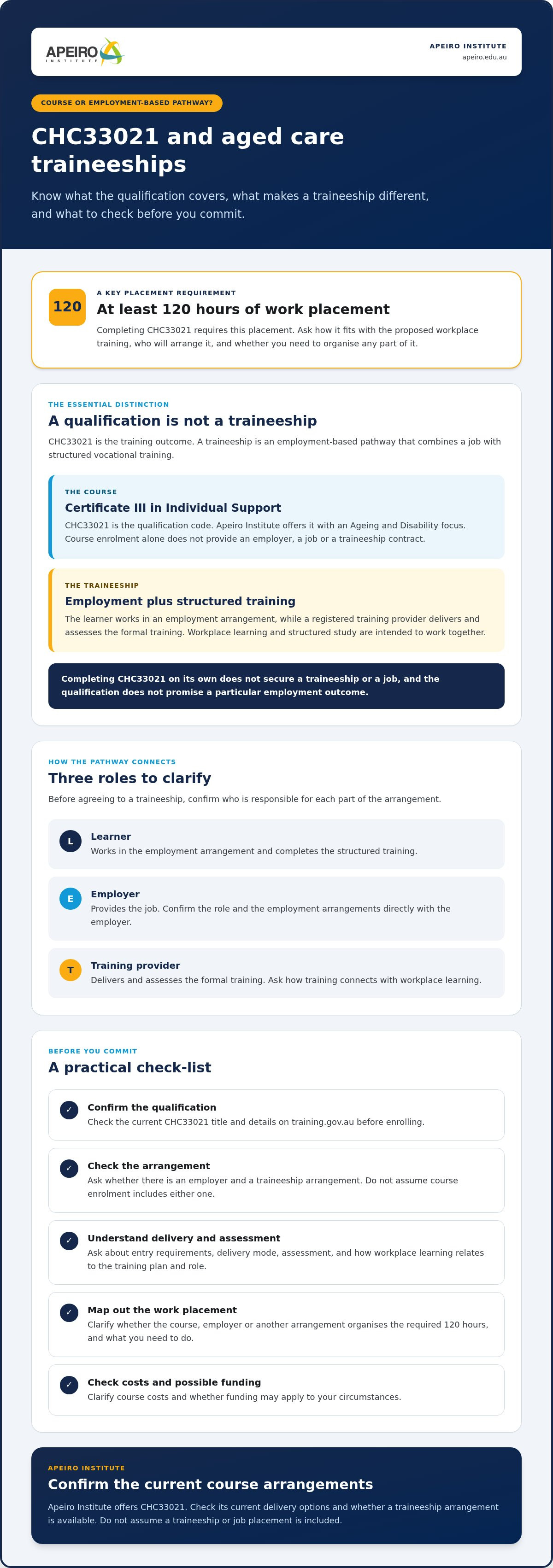
A traineeship combines employment with structured vocational training. Completing CHC33021 on its own doesn’t secure a traineeship or a job. The qualification is the Certificate III in Individual Support (Ageing and Disability), and achieving it requires at least 120 hours of work placement. Ask how that placement requirement fits with the proposed workplace training and whether you need to organise any part of it.
This guide explains how CHC33021 may fit an aged care traineeship, what to ask a prospective employer and training provider, and what to check about delivery, workplace learning and funding before you commit. Apeiro Institute offers CHC33021, but contact the provider to confirm its current delivery options and whether a traineeship arrangement is available. By the end, you’ll have a practical checklist for deciding what to ask next.
Key Takeaways
- CHC33021 is the Certificate III in Individual Support (Ageing and Disability), which may form part of an aged care traineeship.
- An Aged care traineeship CHC33021 involves more than course enrolment. Confirm the employment arrangement and how training will be delivered.
- Check the qualification’s current details on training.gov.au, then ask about entry requirements, delivery mode, assessment and workplace learning.
- Before committing, clarify course costs and whether any funding applies to your circumstances.
- Apeiro Institute offers CHC33021. Ask about its current course arrangements without assuming a traineeship or job placement is included.
What is an aged care traineeship with CHC33021?
CHC33021 is the code for the Certificate III in Individual Support. Apeiro Institute offers the qualification with an Ageing and Disability focus. The code identifies a nationally recognised vocational qualification, not a job or employment arrangement. Before enrolling, check the current qualification title and details on training.gov.au, the national register for training products.
A qualification is the training outcome; a traineeship is an employment-based pathway that combines a job with structured vocational training. That distinction matters: course enrolment alone doesn’t provide an employer, a job or a traineeship contract.
What does CHC33021 mean in an aged care context?
The qualification is designed to prepare learners for individual support work, including in aged care settings. It provides a training framework for developing relevant knowledge and skills, but completing it doesn’t promise a particular role or employment outcome. For a broader overview of the sector, see Aged care in Australia.
You can explore Apeiro Institute’s Certificate III in Individual Support (Ageing and Disability). If you’re comparing courses, check the current training.gov.au listing as well, then ask the provider to explain how its delivery and assessment arrangements match the qualification requirements.
How is a traineeship different from studying the course?
In a traineeship, three parties have connected but distinct roles: the learner works in an employment arrangement, the employer provides the job, and a registered training provider delivers and assesses the formal training. Workplace learning and structured study are intended to work together. Someone studying CHC33021 without an employer may be completing the course, but enrolment alone doesn’t make them a trainee.
Before agreeing to an Aged care traineeship CHC33021, ask who your employer and training provider will be, how workplace learning connects with your formal training, and what arrangements apply to your role. Employment terms and training requirements depend on the specific agreement and jurisdiction, so confirm them directly with the employer and provider. Apeiro Institute offers CHC33021, but check whether it currently delivers the qualification through a traineeship arrangement.
What skills and learning can CHC33021 cover for aged care work?
CHC33021 provides a vocational learning pathway for people preparing for individual support work, including in aged care settings. Check the exact scope and requirements against the current CHC33021 Certificate III in Individual Support listing on the Australian Government’s training register before you enrol.
In practical terms, CHC33021 is intended to help learners develop knowledge and skills for providing individual support. The current qualification listing and provider can clarify the training requirements. Treat the course as preparation, not a promise of a particular job or an indication that every graduate will suit every aged care role.
What should learners expect from the training?
Training may bring together formal learning and practical experience, helping learners connect concepts to support work. For example, a learner might consider how to communicate respectfully with an older person or adapt support to their preferences. These are general examples, not a confirmed list of units or assessment tasks. Check the current core and elective requirements, and ask the provider how learning and assessment are organised.
Delivery arrangements can vary. A training plan should set out what you’ll study, how you’ll be assessed and whether workplace learning forms part of your course. If you’re considering an Aged care traineeship CHC33021, ask how the plan relates to the role and workplace. Confirm whether the 120 hours of work placement are organised through the course, the employer or another arrangement, and what you need to do to complete them. Don’t assume every learner follows the same schedule or completes practical learning in the same setting.
What qualities matter in aged care support work?
Respect and patience matter in everyday interactions. A person may want to make choices about their routine or prefer information explained in a particular way. Listening carefully, communicating clearly and treating each person with dignity can help support their preferences.
Reliability matters too. Respecting privacy means handling personal information discreetly, while following workplace procedures means checking the right process rather than guessing when you’re unsure. Training can contribute to preparation, but suitability also depends on the role and its expectations. Consider whether this kind of person-centred work aligns with your strengths and values.
To understand the course details Apeiro Institute currently lists, review its CHC33021 course information and ask the provider about delivery, assessment and work placement arrangements.
Is a CHC33021 aged care traineeship paid, and does it guarantee a job?
A traineeship may involve paid work, but enrolling in CHC33021 doesn’t automatically make you an employee or trainee. The key difference is whether you have an actual employer and an agreed traineeship arrangement alongside your training. Without that employment relationship, you’re studying the qualification, not undertaking a paid traineeship.
Confirm the arrangement directly with the employer before assuming the role is paid. Ask what employment terms apply, how training fits around your work, and who will deliver it. Pay and conditions can depend on the specific role and arrangement, so check the details with the employer and the relevant authority. The official CHC33021 qualification details describe the training product, not a job offer or pay conditions.
When is a traineeship connected to paid work?
A traineeship is connected to employment when an employer offers you a role and the training is arranged as part of that pathway. Before accepting, ask for clear details about the job, training provider, work expectations and applicable employment conditions. Don’t assume that course enrolment, practical learning or a workplace placement means you’re employed or paid.
| Course enrolment | Traineeship arrangement |
|---|---|
| You enrol in training with a provider. An employer or job isn’t included just because you’re studying. | You have an employer relationship alongside structured training, with terms to confirm for your specific arrangement. |
| Ask what learning, assessment and any workplace requirements apply to the course. | Ask who employs you, how training is organised, and what pay and conditions apply. |
Can course enrolment guarantee an aged care job?
No. A qualification may support your preparation for individual support work, but employers make recruitment decisions separately. A training provider doesn’t guarantee a job or traineeship placement unless a specific, verified offer says so. Ask whether you’re being offered a vacancy, a traineeship contract or a course with workplace learning only. These are different arrangements.
If you’re exploring the Aged care traineeship CHC33021 pathway, get the employer and training details confirmed before committing to enrolment. Apeiro Institute offers the qualification, but check whether it currently delivers CHC33021 through a traineeship arrangement. You can review Apeiro’s CHC33021 course information and ask about current options.
How do you check whether an aged care traineeship suits you?
Take it one step at a time: clarify the job, confirm the training provider, check the course arrangements, then review costs and possible funding. This helps you distinguish an employment-based traineeship from course enrolment with no job attached. For an Aged care traineeship CHC33021, get answers from both the prospective employer and provider before you commit.
What should you ask a prospective employer?
Start by confirming whether the position is an actual traineeship and whether recruitment is open. Ask who will coordinate formal training and how workplace learning will fit your role. Make sure you understand the duties, supervision, employment terms and any selection requirements. If the employer can’t explain how the work and training arrangements connect, seek clarification before proceeding.
What should you confirm with the training provider?
Ask the provider to confirm the qualification’s current status and title, delivery mode, assessment approach and any workplace requirements. Check how the training plan will align with the proposed role, and whether the employer needs to take part in arranging or supporting workplace learning. Don’t assume that course details or requirements are identical across providers.
Discuss course fees and ask whether a subsidy may apply to your circumstances. Funding can depend on your state or territory, eligibility and the specific training arrangement. Ask what evidence the provider needs to assess eligibility, and confirm funding details with the relevant government authority before relying on them.
Pre-enrolment checklist:
- Is there a confirmed job, and is it specifically a traineeship?
- Who is the employer, and who will provide and coordinate the training?
- What duties, supervision and workplace learning are expected?
- What are the course delivery mode, assessment requirements and any workplace requirements?
- What fees apply, and has any funding eligibility been confirmed for your situation?
- Are the key employment and training arrangements clear before you enrol?
Keep the answers together so you can compare the employer’s offer with the provider’s training plan. Apeiro Institute offers the CHC33021 Certificate III in Individual Support (Ageing and Disability), but confirm its current delivery arrangements and whether the qualification is available through a traineeship. A clear conversation now can help you choose a pathway that fits your work and learning goals.
Explore CHC33021 course information
How can Apeiro Institute help you explore CHC33021?
Apeiro Institute offers the CHC33021 Certificate III in Individual Support (Ageing and Disability) and is a Registered Training Organisation, RTO 45394. If you’re considering an Aged care traineeship CHC33021, Apeiro is a provider to ask about the course and its current delivery arrangements. The course offering doesn’t, by itself, confirm that CHC33021 is available through a traineeship or that a job is included.
Contact the provider to clarify how the course currently runs and whether it fits your plans. Useful questions include:
- Is CHC33021 currently available through a traineeship, or through another study arrangement?
- What delivery mode and duration apply, and what are the entry requirements?
- How are assessments arranged, and are there workplace learning requirements?
- What fees apply, and could funding be available for my location and circumstances?
Ask for details that relate to your situation rather than relying on general funding or course information. Eligibility and funding can depend on your location and circumstances. Confirm directly with the provider and the appropriate funding authority whether this qualification is funded and what arrangements apply.
How can you move from interest to an informed decision?
Before contacting Apeiro, gather any information you have about a prospective employer, the role and the training you need. Note your work commitments and questions about eligibility, assessment or workplace requirements. Then compare the provider’s confirmed course arrangements with the employer’s proposed work and training plan. This makes unanswered questions easier to identify before you enrol.
If you’re considering further study later, the Diploma of Community Services may be worth exploring as a broader study pathway. It’s an optional progression idea, not a required next step.
You don’t need every detail worked out before making an enquiry. Ask Apeiro about its current CHC33021 course arrangements, then take time to confirm how they fit with any employment opportunity you’re considering.
Take your next step towards aged care work
The key is to separate the qualification from the job: CHC33021 is a training outcome, while a traineeship also requires an employment arrangement. Before enrolling, confirm the employer, training provider, course requirements and any funding that may apply to your circumstances.
Apeiro Institute is a Registered Training Organisation, RTO 45394, and offers the Certificate III in Individual Support (Ageing and Disability). Ask about current course arrangements directly, including whether the qualification is available through a traineeship. Don’t assume course enrolment includes a job or that funding applies.
You don’t need every answer before making an enquiry. Start by clarifying what you’re looking for, then compare confirmed options. With the right information, you can choose a next step towards individual support work with greater confidence.
Frequently Asked Questions
Is CHC33021 the qualification used for an aged care traineeship?
CHC33021 is the code for the Certificate III in Individual Support, with an Ageing and Disability focus offered by Apeiro Institute. An employer and training provider may arrange this qualification as part of a traineeship, but the course code alone doesn’t confirm that a traineeship is available. Check the current qualification listing and confirm the arrangement with both parties before enrolling. A traineeship includes employment as well as formal training.
Is an aged care traineeship with CHC33021 paid?
It can involve paid employment, but only if an employer offers you a job under an applicable employment arrangement. Enrolling in CHC33021 or completing workplace learning doesn’t automatically mean you’re employed or paid. Before accepting, ask the employer to explain the role, pay, conditions and how formal training fits into the arrangement. Check that the details are clear and relevant to your circumstances rather than assuming all traineeships have the same terms.
Can I study CHC33021 without an aged care traineeship?
You may be able to study CHC33021 without a traineeship, depending on the provider’s current course options and entry requirements. In that case, you’re undertaking training without a traineeship employment arrangement. The qualification requires a minimum of 120 hours of work placement. Ask your provider how placement is organised, what assessment involves and whether you need to arrange a suitable workplace yourself.
How long does a CHC33021 aged care traineeship take?
There isn’t one duration that applies to every CHC33021 course or traineeship. The timeframe can depend on the provider’s delivery plan, your training progress and the employment arrangement. Ask the provider for the course duration and expected study schedule, then confirm with the employer how training and workplace requirements fit around your role. Get expected start and completion dates in writing before committing, particularly if you’re balancing other work or caring responsibilities.
What are the entry requirements for a CHC33021 traineeship?
Entry requirements can vary between training providers and employers, so confirm them directly rather than relying on a general checklist. Ask the provider about course entry criteria, language or documentation requirements, and any workplace assessment conditions. Ask the employer about recruitment and role-specific selection requirements. Check both sets of requirements before enrolling, as meeting a provider’s course criteria doesn’t necessarily mean you’ll be selected for an employment position.
Does completing CHC33021 guarantee an aged care job?
No. Completing CHC33021 doesn’t guarantee employment, a traineeship or selection for a particular role. Employers make recruitment decisions separately, and course enrolment isn’t a job offer. The qualification may support your preparation for individual support work, but you’ll still need to meet the employer’s requirements. If you’re enrolling because you expect a job, ask whether a vacancy or traineeship contract is actually included and confirm the offer directly with the employer.
Can I get government funding for CHC33021?
Possibly, but funding depends on the state or territory, your eligibility and the provider’s approved course arrangements. Don’t assume CHC33021 is funded just because a provider offers other subsidised training. Ask whether funding applies to this qualification and your circumstances, then confirm eligibility, fees and conditions with the relevant government authority. Apeiro Institute offers funded training, but contact the provider to check whether funding is available for CHC33021 in your situation.

Disclaimer
The information provided on this blog is for general informational and educational purposes only. While every effort is made to ensure the accuracy and reliability of the content, the author makes no representations or warranties of any kind, express or implied, about the completeness, accuracy, suitability, or availability of the information contained on this blog.
The views and opinions expressed in blog posts are those of the individual author and do not necessarily reflect the official policy or position of any organization, company, or employer.
This blog may contain links to external websites or third-party content. These links are provided for convenience only, and the author has no control over and assumes no responsibility for the content, privacy policies, or practices of any third-party sites.
Nothing on this blog constitutes professional advice (legal, financial, medical, or otherwise). Readers are encouraged to seek appropriate professional guidance before making any decisions based on the information provided here.
By using this blog, you acknowledge that any reliance on the information is at your own risk.


