

Could a Government funded CHC33021 traineeship let you earn while you train, without taking on a study commitment that doesn’t fit your life? It may be possible, but funding depends on more than choosing the qualification. You’ll need to check your eligibility, whether the relevant pathway is approved and available, and how the workplace arrangements fit around training.
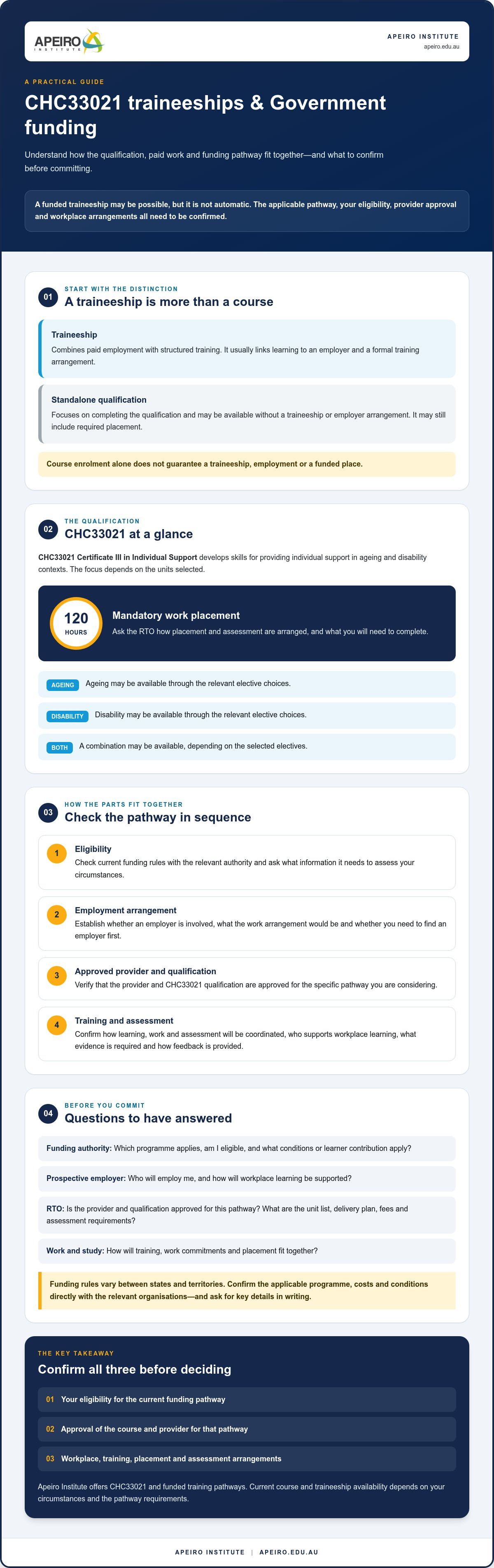
If you’re unsure how a traineeship differs from enrolling in a course, or how paid work and practical assessment fit together, you’re not alone. A traineeship combines paid employment with structured training, while the CHC33021 qualification is the learning component. Enrolling in the course alone doesn’t guarantee a traineeship, employment or a funded place.
This guide explains what to check before committing, what training and workplace participation may involve, and which questions to ask about current eligibility and availability. Funding rules vary between states and territories, so confirm the applicable programme, costs and conditions directly with the relevant organisations. With those details, you can decide which next step suits you.
Key Takeaways
- A Government funded CHC33021 traineeship depends on the applicable funding pathway, your eligibility and confirmed workplace arrangements.
- Understand how a traineeship differs from enrolling in the CHC33021 qualification alone before deciding which option suits you.
- Check your state or territory’s funding rules, including learner eligibility and whether the course and provider are approved.
- Before enrolling, ask the funding authority, prospective employer and RTO to confirm key conditions, fees and assessment requirements in writing.
- Apeiro Institute offers CHC33021 and funded training pathways. Contact the institute to check current course and traineeship availability for your circumstances.
What is a government-funded CHC33021 traineeship?
A Government funded CHC33021 traineeship brings together three separate things: the CHC33021 Certificate III in Individual Support, an employment and training arrangement, and a funding pathway that may help cover training costs for eligible learners. Having the qualification available doesn’t mean it’s automatically funded, and funding doesn’t secure a job or traineeship. The programme, your eligibility and the provider’s current approval all need to match.
In Australia, traineeships generally combine paid employment with structured vocational training. The Australian apprenticeships system includes both apprenticeships and traineeships. The details depend on the particular arrangement, including the employer, training provider and funding rules that apply in your state or territory.
What does CHC33021 cover?
CHC33021 is the Certificate III in Individual Support. It develops skills for providing individual support in ageing and disability contexts, with the qualification’s focus shaped by the units selected. Ageing, Disability, or a combination of both may be available through the relevant elective choices. The qualification includes a mandatory 120 hours of work placement. Ask the RTO how placement and assessment are arranged and what you’ll need to complete.
Before enrolling, check the unit list, assessment methods and delivery plan, as these details can vary between providers. Apeiro Institute offers the CHC33021 Certificate III in Individual Support. This course offering alone doesn’t confirm that a funded traineeship pathway is currently available. Completing the qualification also doesn’t guarantee a particular job or define the duties you may perform in every workplace.
How is a traineeship different from a standalone course?
A traineeship usually links learning to an employer and a formal training arrangement. You build skills through work while completing structured training and assessment with an RTO. Before agreeing to the arrangement, confirm who will employ you, how workplace learning will be supported and how training will fit around your work commitments.
A standalone course focuses on completing the qualification and may be available without a traineeship or employer arrangement. It can still include required placement, but access to training and the way you pay for it may differ. Government funding is a separate consideration: state and territory programmes set their own rules, and the course and provider must meet the relevant approval requirements. Ask the RTO and funding authority to confirm the pathway, your eligibility and any learner contribution before you commit.
How CHC33021 traineeship training and workplace learning fit together
A traineeship links training to work, but the way it’s organised depends on the employer, RTO and applicable funding pathway. The Australian Government’s What are Australian Apprenticeships guide explains how these arrangements combine paid work with structured training. For a Government funded CHC33021 traineeship, check each part rather than assuming a course place includes employment or funding.
Use this sequence to organise your enquiries:
- Confirm eligibility: Check the current funding rules with the relevant authority and ask what information it needs to assess your circumstances.
- Discuss employment: Establish whether an employer is involved, what the work arrangement would be and whether you need to find an employer first.
- Choose an approved RTO: Verify that the provider and qualification are approved for the specific pathway you’re considering.
- Agree on training: Confirm how learning, work and assessment will be coordinated, including who supports workplace learning.
- Understand assessment: Find out how you’ll demonstrate the required competencies, what evidence you’ll need and how you’ll receive feedback.
What might a CHC33021 trainee do during training?
You’ll learn knowledge and skills relevant to individual support in ageing and disability contexts, then demonstrate the required competencies through the RTO’s assessment process. Workplace practice gives you opportunities to apply learning in a real work setting. Assessment is how the RTO gathers evidence to judge whether you meet the required standard. Practical tasks and evidence must follow the current training package and RTO process, so ask how workplace learning is supervised and assessed.
Competency-based assessment means demonstrating that you can perform the required skills and apply relevant knowledge to the required standard. Ask the RTO how it assesses each competency, what evidence you’ll need and what support is available if you need another opportunity to demonstrate a skill.
What should learners confirm about time and study commitments?
Don’t assume there’s one schedule for every traineeship. Ask the RTO about delivery mode, expected independent study, assessment milestones and how training will fit around work. Ask the employer how rostered hours, supervised workplace learning and training activities will be coordinated. Confirm the expected duration and workplace requirements for your own arrangement before agreeing to enrol.
These details help you judge whether the commitment is manageable. If you’re exploring the qualification, review Apeiro Institute’s CHC33021 course information and ask the institute to confirm current delivery and traineeship availability for your circumstances.
Who may qualify for government-funded CHC33021 training?
There isn’t one funding rule that applies across Australia. States and territories run different programmes, with their own eligibility criteria, approved qualifications and provider requirements. Start by identifying which programme applies to you, then check whether it covers the exact course and training arrangement you’re considering.
Use this checklist to guide your enquiries. A “yes” on one point doesn’t confirm overall eligibility.
| Check | What to confirm |
|---|---|
| Location of funding | Which state or territory programme applies, and whether you meet its residency conditions. |
| Learner eligibility | Whether citizenship or residency status, age, previous qualifications or other study history affect your eligibility. |
| Employer arrangement | Whether the funding pathway requires an employer or formal traineeship arrangement, and whether your work situation meets its conditions. |
| Course and provider approval | Whether CHC33021 and your chosen RTO are currently approved for that specific funding pathway. |
What does funding eligibility depend on?
Funding eligibility and traineeship eligibility are separate checks. You might meet a programme’s requirements for subsidised training but still need to meet separate employment or traineeship conditions. Ask the funding authority about current residency, age, prior-study and employment rules, and request an answer based on your circumstances.
Check the qualification on training.gov.au’s CHC33021 listing, then confirm with the funding authority and RTO whether the course is approved for the pathway. Don’t rely on an old course listing or assume approval for one programme applies to another. Confirm any learner contribution and conditions before enrolling.
Is Smart and Skilled relevant to CHC33021?
Smart and Skilled is a New South Wales programme, not a nationwide funding scheme. Apeiro Institute delivers NSW Smart and Skilled funded training, but the information here doesn’t confirm that CHC33021 is currently covered through a specific funded traineeship pathway. Check the current subsidised qualification list and provider approval before treating it as an option.
For background on the NSW programme, see this Smart and Skilled funded courses guide. Then ask the funding authority and RTO to confirm the course code, pathway, eligibility and conditions in writing. That will help you compare options using details that apply to your circumstances.
How to check funding and traineeship suitability before enrolling
Before agreeing to enrol, get the key details from the funding authority, prospective employer and RTO. A Government funded CHC33021 traineeship depends on the specific pathway and your circumstances. A general statement that a course is “funded” may not confirm that this qualification and traineeship arrangement are covered.
Ask the RTO to confirm the exact course code, whether CHC33021 is currently offered through the specific funded traineeship pathway, and whether the provider is approved for it. Check delivery arrangements, assessment requirements, fees or learner contributions, and the documents needed to assess your eligibility. Ask who makes the eligibility decision and when you can expect it. Request the course and funding details in writing before enrolling.
Questions to ask an employer or funding authority
Find out whether you need an employer before starting a traineeship application, or whether the employer must formally support or register the arrangement. Ask which organisation makes the eligibility decision and what approvals or records are required. With the employer, discuss how rostered work, workplace supervision and training activities will fit together, and who to contact if those arrangements change.
Keep a simple verification checklist
Separate confirmed details from assumptions. Record written answers as they arrive and note what still needs checking.
- Confirmed in writing: Course code and qualification name; funding programme and current course and provider approval; eligibility outcome; employer and traineeship arrangements; learner contribution; delivery, assessment and workplace requirements.
- Still to verify: Any detail based only on a verbal estimate, an older webpage or a general description of funded training. Note who will confirm it and when you expect an answer.
If a key item is unconfirmed, pause before signing an enrolment agreement. In particular, clarify whether you need an employer first, whether the funded place applies to the traineeship rather than standalone study, and what happens if eligibility or approval isn’t confirmed. A written record makes it easier to compare options and judge whether the study and work commitments suit you.
Your next step towards a CHC33021 traineeship with Apeiro
Before enrolling, make sure four things line up: the funding pathway applies to you, you meet its eligibility requirements, the employer arrangement is clear, and the provider and course are approved for that pathway. A government funded CHC33021 traineeship isn’t confirmed simply because the qualification or a funding programme is available.
Apeiro Institute is an Australian RTO, RTO 45394, offering the CHC33021 Certificate III in Individual Support (Ageing and Disability), apprenticeships and traineeships, and NSW Smart and Skilled funded training. The information here doesn’t confirm that CHC33021 is currently funded through a specific traineeship pathway with Apeiro Institute. Review the CHC33021 qualification information, then ask the institute to confirm current course and funding availability for your circumstances.
What to prepare before making an enquiry
Preparing a few details can help you get clear answers. Note your relevant study history, employment details and questions about eligibility. Be ready to explain whether an employer is already involved or whether you still need to find one. Ask which funding body or programme applies to your circumstances, as rules can differ between programmes.
- Your study history: List relevant qualifications or previous training the funding authority may ask about.
- Your work situation: Note your current employment details and whether an employer is supporting a traineeship arrangement.
- Your questions: Ask about course availability, eligibility documents, assessment, learner contributions and which organisation confirms funding.
How to move forward without assuming funding
Treat an enquiry as a way to clarify your options, not as confirmation of a funded place. Ask Apeiro Institute to confirm in writing whether CHC33021 is currently available through the specific traineeship and funding pathway you’re considering. Check the course code, provider approval, funding conditions, any learner contribution, and what happens if eligibility or employer arrangements aren’t confirmed.
Once you have those details, compare the study and work commitments with your circumstances and decide whether to proceed.
Take your next step with confidence
A Government funded CHC33021 traineeship may be an option, but the qualification, traineeship arrangement and funding approval are separate things to confirm. Check which state or territory programme applies, whether you meet its eligibility requirements, whether an employer is involved and whether the RTO and course are approved for that pathway.
Apeiro Institute, RTO 45394, offers the CHC33021 Certificate III in Individual Support (Ageing and Disability) and delivers funded training and traineeships across vocational sectors. Confirm directly whether CHC33021 is currently available through a specific funded traineeship pathway. Ask for course availability, eligibility requirements, funding conditions and any learner contribution in writing before you enrol.
An enquiry can help you understand your options. It isn’t a guarantee of a funded place or employment, but it can give you clearer information to decide what suits your circumstances.
With the right checks in place, you can take your next step towards training with greater confidence.
Frequently Asked Questions
Is CHC33021 available as a government-funded traineeship?
It may be, but availability depends on the current funding programme, your eligibility, employer arrangements and RTO approval. A Government funded CHC33021 traineeship isn’t confirmed simply because CHC33021 or traineeships are offered separately. Check whether the exact qualification is approved through the pathway that applies to you, and ask the training provider and relevant funding authority to confirm current availability and conditions in writing before enrolling.
Who is eligible for a government-funded CHC33021 traineeship?
Eligibility depends on the rules of the state or territory funding programme and traineeship pathway. Your residency or citizenship status, age, previous study and employment situation may be relevant, but requirements differ. Ask the funding authority which programme applies to you and what evidence it needs. Also confirm separately with the provider whether you meet the requirements for the qualification and proposed traineeship arrangement.
Do I need an employer to start a CHC33021 traineeship?
A traineeship generally combines employment with structured vocational training, so an employer is usually part of the arrangement. Application steps and requirements depend on the relevant pathway. Before applying or enrolling, ask whether you need an employer in place first, who formalises the traineeship arrangement and how workplace learning will be supported. Enrolling in CHC33021 as a course alone doesn’t establish an employment or traineeship arrangement.
Is a government-funded CHC33021 traineeship free?
Not necessarily. Government funding doesn’t automatically mean there are no learner costs, and eligibility or fee conditions vary between programmes. Ask the funding authority and RTO whether a contribution applies, what concessions may be available and whether other course costs are relevant. Get the amount and conditions confirmed in writing for your specific enrolment before committing. Don’t assume a fee arrangement advertised for one programme applies to another.
How long does a CHC33021 traineeship take?
There isn’t one duration that applies to every CHC33021 traineeship. Timing can depend on the training plan, delivery arrangements, workplace participation and your progress through assessment. Ask the RTO for the expected study schedule and assessment milestones, and discuss how training will fit around work with the employer. Confirm the anticipated duration for your proposed arrangement before enrolling rather than relying on a general estimate.
Can I study CHC33021 without a traineeship?
You may be able to enrol in CHC33021 as a standalone course, depending on the provider’s current offerings and entry requirements. This differs from a traineeship, which generally connects employment with structured training. A standalone course may have different delivery, workplace and funding arrangements. Ask the RTO whether this option is available and clarify placement, assessment, eligibility and fee conditions before deciding.
Does Smart and Skilled fund CHC33021 traineeships across Australia?
No. Smart and Skilled is a New South Wales funding programme, not a nationwide scheme. Whether CHC33021 is currently included in an eligible funded pathway depends on current course approvals, provider approval and your circumstances. Apeiro Institute delivers Smart and Skilled funded training, but confirm directly whether CHC33021 is available through a specific funded traineeship pathway. Learners elsewhere in Australia should check the funding programme for their state or territory.
Contact Apeiro Institute to ask about CHC33021 course availability and confirm whether a traineeship and funding pathway may suit your circumstances.

Disclaimer
The information provided on this blog is for general informational and educational purposes only. While every effort is made to ensure the accuracy and reliability of the content, the author makes no representations or warranties of any kind, express or implied, about the completeness, accuracy, suitability, or availability of the information contained on this blog.
The views and opinions expressed in blog posts are those of the individual author and do not necessarily reflect the official policy or position of any organization, company, or employer.
This blog may contain links to external websites or third-party content. These links are provided for convenience only, and the author has no control over and assumes no responsibility for the content, privacy policies, or practices of any third-party sites.
Nothing on this blog constitutes professional advice (legal, financial, medical, or otherwise). Readers are encouraged to seek appropriate professional guidance before making any decisions based on the information provided here.
By using this blog, you acknowledge that any reliance on the information is at your own risk.


