

What if the only thing standing between you and a seat at the executive table isn't a lack of talent, but the absence of a specific piece of paper? Many mid-level managers feel stuck in a professional limbo; they have the runs on the board, yet they're overlooked for senior roles because they don't hold a formal postgraduate qualification. A Graduate Diploma of Business Management offers a streamlined, industry-aligned alternative to the long-winded academic routes that often feel disconnected from the daily grind of Australian business.
We understand that your time is your most valuable asset, and spending years on abstract theories isn't always the best investment. This 2026 buying guide will help you navigate the practical world of vocational training, where the focus remains on leadership execution and strategic growth. You'll discover how to leverage your existing expertise to gain a nationally recognised credential, compare the latest tuition costs across the country, and see how this qualification serves as a fast-track pathway into a Master of Business Administration (MBA).
Key Takeaways
- Understand why a Graduate Diploma of Business Management is the preferred AQF Level 8 qualification for professionals looking to bridge the gap between middle management and executive leadership.
- Discover how the 2026 focus on "Learning" management (BSB80120) equips you with practical skills in strategic innovation and organisational vision.
- Compare the benefits of vocational RTOs versus traditional universities to find a study pathway that fits your budget and professional schedule.
- Learn how to use the "Experience Pathway" and Recognition of Prior Learning (RPL) to qualify for enrolment based on your years of management expertise.
- Explore how this qualification provides a direct credit pathway to a Master of Business Administration (MBA), saving you significant time and tuition costs.
What is a Graduate Diploma of Business Management in 2026?
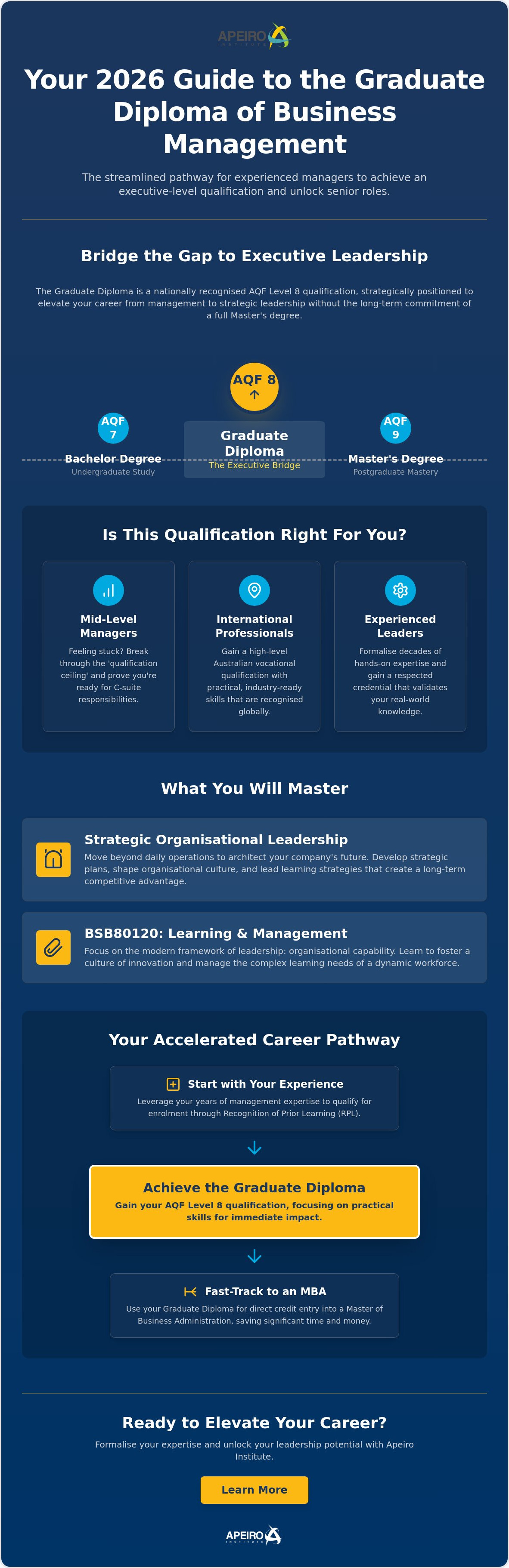
In the Australian education system, the Graduate Diploma of Business Management occupies a unique and powerful position. It's an AQF Level 8 qualification, which means it sits directly above a Bachelor degree and just below a Master's degree. For many professionals, it acts as a high-speed elevator for their career. If you've ever wondered, What is a Graduate Diploma?, it's essentially a postgraduate award designed for those who want to master a specific professional area without the multi-year commitment of a full Master's degree. In 2026, it's become the preferred bridge for talented managers who don't have a prior degree but possess years of real-world experience.
This qualification serves as a critical link in the Australian education hierarchy. It provides a sophisticated level of knowledge that is more advanced than undergraduate study but more focused on practical application than a traditional Master's. Because it focuses on high-level executive functions, it's highly regarded by employers who need leaders capable of driving organisational change immediately.
The BSB80120 Framework: Learning and Management
The modern version of this course, specifically the BSB80120 Graduate Diploma of Business Management (Learning) framework, represents a major shift in how we think about leadership. It's not just about managing people; it's about "Learning" and organisational capability. This means you'll focus on how a business grows its own knowledge and adapts to change. Unlike a standard Diploma or Advanced Diploma, which often focus on operational tasks, the Graduate Diploma asks you to think like an architect of the entire organisation. You'll learn to develop strategic visions and manage the complex learning needs of a modern workforce. It's about strategy, vision, and creating a culture where innovation isn't just a buzzword, but a daily practice.
Who Should Consider This Qualification?
Who is this for? It's perfect for mid-level managers who feel they've hit a "qualification ceiling." You might have the skills, but without that Level 8 credential, the C-suite feels out of reach. It's also an excellent choice for international students looking for high-level vocational programmes that offer practical, industry-ready skills that translate globally. Finally, if you're an experienced worker with decades of knowledge, this is your chance to formalise what you already know. You can use your existing expertise to secure a qualification that commands respect across every industry in Australia. It's a flexible, powerful way to prove you're ready for the next level of leadership.
Core Competencies: What You Will Master
Transitioning into executive management requires a significant mindset shift. You move away from daily operational tasks and begin focusing on high-level strategy. The Graduate Diploma of Business Management isn't about memorising academic textbooks. Instead, it's about mastering the specific levers that move an entire organisation forward. You'll learn to look beyond the next quarter and start building a sustainable future for your business. This involves a deep dive into strategic leadership, financial oversight, and the ability to influence stakeholders at every level of the corporate ladder.
Mastering these competencies ensures you aren't just a manager, but a visionary leader. In the current Australian market, businesses are looking for individuals who can integrate human resources strategy with financial goals to create a resilient workforce. By the end of your studies, you'll have the confidence to manage large-scale budgets and lead complex projects that drive real growth.
Strategic Organisational Leadership
Effective leadership in 2026 means being the architect of your company's culture and direction. You'll master the art of developing strategic plans that don't just sit on a shelf but actually guide daily operations across diverse departments. Whether you're leading a local team or managing staff across international borders, the focus is on organisational alignment. Within the BSB80120 context, strategic leadership is the ability to synthesise complex information and lead the development of organisational learning strategies that drive long-term competitive advantage. You can see how these units are structured in this Graduate Diploma of Business Administration course example, which mirrors the high-level expectations of modern Australian industry.
Operational Excellence and Change Management
The business landscape in 2026 is faster and more volatile than ever. To stay ahead, you must become an expert in change management. This means navigating the post-2025 reality where digital transformation is no longer a one-off project but a constant state of being. Consider a traditional manufacturing firm transitioning to AI-driven logistics. A graduate-level leader doesn't just buy the software. They manage the human element, optimise the new processes for sustainability, and ensure the workforce is ready for the shift. You'll learn to lead these transitions smoothly, ensuring operational excellence doesn't falter during times of upheaval.
Building these skills allows you to handle high-level stakeholder engagement with ease. If you're ready to start this journey, exploring the available pathways for experienced workers can help you see which competencies you might already possess through your professional history.
University vs. Vocational RTO: Choosing Your Study Pathway
Deciding between a university and a Registered Training Organisation (RTO) for your Graduate Diploma of Business Management is a choice between two very different educational philosophies. Universities often prioritise academic research and deep theoretical exploration. While this has its place, it can sometimes feel detached from the immediate needs of a fast-paced business environment. RTOs are designed specifically to bridge the gap between knowing a concept and actually doing it. They focus on execution and measurable outcomes that you can take back to your office the very next day.
Cost and time are also major factors for most professionals. Generally, university postgraduate programmes carry a higher price tag and require a more rigid commitment to a semester-based calendar. RTOs usually offer more competitive tuition structures and rolling intakes. This means you can start when it suits your career, not just when the university gates open. For a working professional in Australia, the flexibility of vocational training is often the deciding factor. Employers increasingly value this practical approach because it proves a candidate can handle real-world challenges, not just pass a written exam.
The Practical Edge of Vocational Training
Vocational training is built on the principle of competency-based learning. This means your assessments aren't just essays. Instead, you'll complete workplace projects that have direct relevance to your current role. You're learning from trainers who are active industry professionals, not just career academics. They understand the pressure of a 9-to-5 because they've lived it. If you're looking to formalise your skills while staying on the tools or in the office, exploring Trade Pathways for Experienced Workers can show you how practical experience is valued in the Australian system. It's about gaining credit for what you already do well.
Pathways to a Master of Business Administration (MBA)
A common misconception is that choosing an RTO limits your future academic options. In reality, it often does the opposite. A Graduate Diploma is a recognised AQF Level 8 qualification. This means it can provide significant advanced standing or credit towards a Master of Business Administration (MBA) at many Australian institutions. By completing your Graduate Diploma first, you can effectively test the waters of postgraduate study, gain a qualification quickly, and then decide if you want to invest the extra time into a full Master's. It's a strategic way to reduce both the total cost and the duration of your higher education journey. If you're still weighing up your options, you might also want to look at our Advanced Diploma Leadership and Management guide to see which level fits your current experience best.
Entry Requirements and Recognition of Prior Learning (RPL)
Many professionals assume that they cannot enrol in a Graduate Diploma of Business Management without first completing a three-year Bachelor degree. While traditional universities often stick to these rigid academic silos, the vocational sector in Australia offers a more inclusive approach. We recognise that leadership skills are often forged in the boardroom rather than the classroom. Because of this, many Registered Training Organisations (RTOs) provide an "Experience Pathway" for those who have spent at least five years in a documented management role. This ensures that talented leaders aren't held back by a lack of prior formal study.
For those taking the academic route, a completed Bachelor degree in any discipline is the standard entry point. However, regardless of your background, the goal remains the same: proving you have the foundational knowledge to succeed at an AQF Level 8 postgraduate level. If you're ready to see how your career history stacks up against these requirements, you can apply for an initial skills assessment to start your journey.
How RPL Can Shorten Your Study Time
Recognition of Prior Learning (RPL) is a powerful tool for the modern executive. It allows you to identify specific units of competency you've already mastered through your daily work. Instead of sitting through lectures on topics you've been practicing for a decade, you simply provide evidence of your expertise. This evidence might include position descriptions, strategic reports you've authored, or third-party testimonials from your colleagues. RTO assessors evaluate your portfolio of evidence against national standards to determine if your professional history matches specific course requirements. This process can significantly reduce your total study time and allow you to focus only on the skills you genuinely need to develop.
International Student Requirements
If you're an international student looking to study in Australia in 2026, there are several critical requirements to keep in mind. Following the June 2026 updates, the minimum overall IELTS score for a student visa has increased to 6.0. You must also satisfy the Genuine Student (GS) requirement, which focuses on your intention to complete the course and your financial capacity. Current regulations require applicants to show access to at least AUD $29,710 for one year of living costs. Balancing your studies with work is also a key consideration; students can currently work up to 48 hours per fortnight during the term. For a deeper look at your options, check out our guide on vocational courses for international students in Australia.
Elevate Your Career with Apeiro Institute’s Graduate Diploma
Choosing where to study your Graduate Diploma of Business Management is a decision that shapes your professional identity. At Apeiro Institute, we don't just provide a curriculum; we provide a launchpad. We've built our reputation as a leading Registered Training Organisation (RTO) by focusing on the individual journey of every student. Whether you're a local manager looking to break into the C-suite or an international student seeking a globally recognised qualification, our team is here to guide you through every step of the BSB80120 programme.
We understand that starting postgraduate study can feel like a massive undertaking. That's why our approach is student-centred from the very first enquiry. Our support staff and trainers work together to ensure you feel secure and confident as you balance your studies with your existing work and life commitments. With modern campus locations and flexible learning options, we make it possible for even the busiest professionals to succeed. You aren't just another enrolment to us; you're a partner in success.
The Apeiro Advantage
What sets us apart is the "Apeiro Advantage." Our training is delivered by experienced mentors who have spent years in the trenches of Australian business. They bring real-world scenarios into the classroom, ensuring your learning is always practical and immediately applicable. You'll also join a vibrant, diverse community. We're proud to host students from over 38 different nationalities, creating a rich networking environment where you can learn from global perspectives. Every unit of the Graduate Diploma of Business Management is designed to produce outcomes that the Australian job market actually demands. We focus on the skills that help you lead with authority and empathy.
Ready to Take the Next Step?
Moving your career forward shouldn't be a bureaucratic nightmare. We've simplified our application process to be as straightforward as possible for both local and international applicants. If you're concerned about the time commitment, we highly recommend booking a consultation to discuss your RPL eligibility. As we explored in the previous section, your existing management experience could significantly shorten your path to graduation. It's time to turn your expertise into a qualification that opens doors. Our team is ready to help you map out a study plan that fits your life and your goals.
Enquire about the Graduate Diploma of Business Management today and start your journey toward executive leadership.
Ready to Command the Executive Table?
The Graduate Diploma of Business Management is more than just a postgraduate award; it's a strategic investment in your professional authority. We've explored how this AQF Level 8 qualification bridges the gap between mid-management and the C-suite by focusing on practical leadership and organisational capability. Whether you're leveraging your career history through Recognition of Prior Learning (RPL) or using this course as a streamlined pathway to an MBA, the focus remains on real-world execution. You don't need to spend years on abstract theory when you can master the competencies that drive Australian business today.
As a provider of Nationally Recognised Training (RTO Code 45394; CRICOS Provider 03703M), Apeiro Institute is committed to your personal and professional growth. Our mentors are ready to help you formalise your expertise and gain the credentials you need to lead with confidence. You've already put in the hard work in the field; now it's time to secure the qualification that reflects your true potential. Start your executive journey with Apeiro Institute today and take that definitive step toward the next chapter of your career. We're here to support you every step of the way.
Frequently Asked Questions
What is the difference between a Graduate Certificate and a Graduate Diploma?
A Graduate Diploma is essentially a more in-depth version of a Graduate Certificate. While both are AQF Level 8 qualifications, a certificate usually consists of four units, whereas a Graduate Diploma typically requires eight. This extra study allows you to explore complex leadership strategies in much greater detail and provides a more comprehensive foundation for senior executive roles.
Can I study the Graduate Diploma of Business Management online?
Yes, you can certainly study the Graduate Diploma of Business Management online or through blended learning. Many RTOs provide flexible delivery options designed for busy professionals. This allows you to balance your executive training with your current 9-to-5 responsibilities without needing to attend a physical campus every week, making it an ideal choice for working managers.
Is the BSB80120 Graduate Diploma nationally recognised in Australia?
The BSB80120 qualification is fully nationally recognised across Australia. It's part of the Australian Qualifications Framework (AQF), which means it meets rigorous quality standards set by the government. Employers and universities nationwide respect this credential, ensuring your skills are portable across different states and industries, and providing a solid foundation for further Master's level study.
How long does it take to complete a Graduate Diploma of Business Management?
Most students complete the Graduate Diploma of Business Management in approximately one year of full-time study. However, the exact duration depends on your chosen study load and whether you're eligible for any credits. If you're a part-time student or if you successfully apply for Recognition of Prior Learning (RPL), your timeline might look quite different depending on your circumstances.
Do I need a Bachelor degree to enrol in a Graduate Diploma?
You don't always need a Bachelor degree to enrol in this postgraduate qualification. While academic entry is common, many vocational providers offer an "Experience Pathway" for talented leaders. If you have at least five years of relevant management experience, you may be eligible for enrolment based on your professional history alone, allowing you to bypass undergraduate study requirements.
What career roles can I apply for after graduating?
Graduation opens doors to high-level executive roles such as General Manager, Chief Executive Officer, or Strategic Operations Director. It prepares you for any role that requires a sophisticated understanding of organisational learning and leadership. It's the perfect credential for those aiming for the C-suite in large corporations, government departments, or non-profit organisations across Australia.
Is this course eligible for international student visas (CRICOS)?
This course is absolutely eligible for international student visas, provided you study with a CRICOS-registered provider. International students must maintain full-time enrolment and meet specific English language requirements, such as a minimum overall IELTS score of 6.0. It's a popular choice for global learners looking to gain Australian executive expertise while meeting their visa conditions.
Can I get credit for my previous work experience through RPL?
You can definitely receive credit for your previous work experience through the Recognition of Prior Learning (RPL) process. This involves providing evidence of your skills, such as work samples, reports, or references, to prove you've already mastered certain units. It's a fantastic way to acknowledge your existing expertise, avoid repeating known content, and speed up your graduation date.

Disclaimer
The information provided on this blog is for general informational and educational purposes only. While every effort is made to ensure the accuracy and reliability of the content, the author makes no representations or warranties of any kind, express or implied, about the completeness, accuracy, suitability, or availability of the information contained on this blog.
The views and opinions expressed in blog posts are those of the individual author and do not necessarily reflect the official policy or position of any organization, company, or employer.
This blog may contain links to external websites or third-party content. These links are provided for convenience only, and the author has no control over and assumes no responsibility for the content, privacy policies, or practices of any third-party sites.
Nothing on this blog constitutes professional advice (legal, financial, medical, or otherwise). Readers are encouraged to seek appropriate professional guidance before making any decisions based on the information provided here.
By using this blog, you acknowledge that any reliance on the information is at your own risk.


