

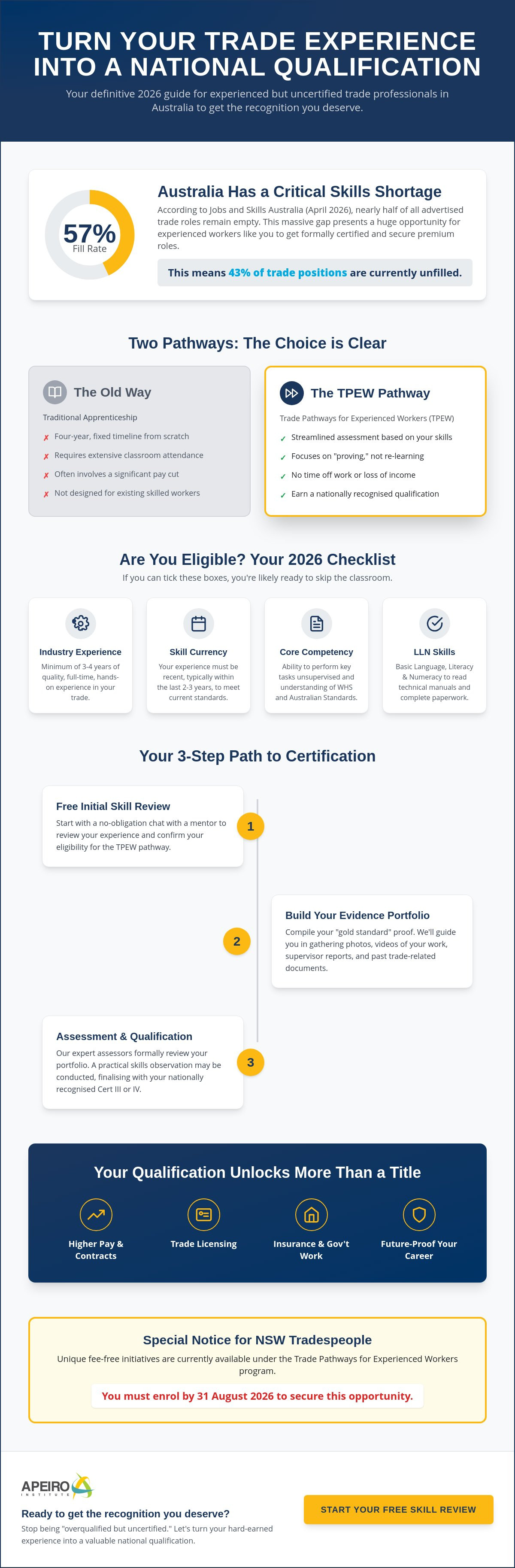
Did you know that nearly half of all advertised trade roles in Australia are currently sitting empty? According to Jobs and Skills Australia data from April 2026, the fill rate for trade positions is just 57 per cent. It’s a massive gap, especially when so many skilled workers are already on site every day, doing the job but lacking the formal certificate to prove it. If you’ve been looking for a way to get trade qualified with work experience, you’re in the right place at the right time.
We understand the frustration of being "overqualified but uncertified." You’ve put in the years, mastered the tools, and probably trained a few apprentices along the way. The thought of losing your income to attend full-time TAFE or getting tangled in the confusion of RPL and TPEW acronyms is enough to put anyone off. You deserve a pathway that respects your time and your existing expertise without forcing you back into a secondary school environment.
This article provides your definitive 2026 checklist for turning your hands-on history into a nationally recognised qualification. You'll learn how to navigate the assessment process, meet the latest state-based requirements, and finally secure the Cert III or IV you need to unlock higher-paying contracts and trade licensing.
Key Takeaways
- Discover how to get trade qualified with work experience by using the TPEW framework to bypass redundant classroom study.
- Identify the specific eligibility criteria for 2026, including the minimum years of industry experience required for a successful assessment.
- Learn how to build a "gold standard" evidence portfolio using photos, videos, and supervisor reports to prove your hands-on skills.
- Compare Certificate III and Certificate IV pathways to ensure your formal qualification aligns with your future career and licensing goals.
- Find out how a personalised mentoring approach and a free initial experience review can streamline your journey toward a national trade ticket.
Understanding Trade Pathways for Experienced Workers (TPEW)
For decades, the standard route to a trade ticket in Australia was a four-year apprenticeship. While that still works for school leavers, it doesn't make sense for someone who has already spent years on the tools. If you want to get trade qualified with work experience in 2026, the Trade Pathways for Experienced Workers (TPEW) framework is the most efficient route available. Unlike traditional apprenticeships that focus on teaching new skills from scratch, TPEW acknowledges that you already possess the expertise. It shifts the focus from "learning" to "proving."
TPEW is a streamlined assessment process for skilled individuals with at least 2-4 years of industry experience. This pathway is specifically designed to address the critical skills shortage currently facing the country. With trade position fill rates sitting at just 57 per cent as of April 2026, the Australian government and industry bodies have prioritised these pathways to get skilled workers formally recognised faster. When you choose this route, a Registered Training Organisation (RTO) like Apeiro Institute evaluates your current competency against the National Training Package. They look at what you can actually do on site, rather than how many hours you've sat in a lecture theatre.
The Role of Recognition of Prior Learning (RPL)
The core mechanism that makes these pathways possible is Recognition of Prior Learning (RPL). This is a formal assessment process that converts your years of "on-the-job" knowledge into credits toward a nationally recognised qualification. It effectively eliminates the need for repetitive classroom learning. If you can demonstrate that you already know how to diagnose an engine fault or install complex electronic communications systems, you don't need to sit through a module explaining it. In the eyes of the Australian Qualifications Framework (AQF), a certificate earned through RPL has the exact same legal standing and authority as one earned through a multi-year apprenticeship.
Why Formal Certification Matters in 2026
The landscape for tradespeople is changing rapidly. In 2026, being "good at your job" is no longer enough to secure the best contracts. Formal certification is now a baseline requirement for insurance eligibility and bidding on government projects. We are seeing a significant shift toward mandatory licensing in specialised fields, particularly in electronics and automotive diagnosis. For those working in New South Wales, the current Trade Pathways for Experienced Workers program offers a unique window; students must enrol by 31 August 2026 to take advantage of specific fee-free initiatives. Holding a formal ticket doesn't just prove your skills; it protects your livelihood and ensures you aren't locked out of higher-paying opportunities as regulations tighten across the states.
The Eligibility Checklist: Are You Ready to Skip the Classroom?
To get trade qualified with work experience, you need more than just a long history on the tools. It’s about proving you have the specific skills required by the National Training Package. While the general benchmark is three to four years of full-time experience, the quality and variety of your work are what assessors really look for. You don't necessarily need to have been an "official" apprentice, but you do need to show you've been performing the same tasks as a qualified tradesperson.
Currency is a critical part of the 2026 checklist. Industry standards change, so most Registered Training Organisations (RTOs) require your experience to be recent, typically within the last two to three years. If you’ve been out of the industry for a long period, you might find your evidence is considered "stale." Additionally, you'll need to meet basic Language, Literacy, and Numeracy (LLN) requirements. This isn't a university entrance exam; it’s simply to ensure you can safely interpret technical manuals, follow Australian Standards, and complete essential site documentation.
Self-Assessment: The "On the Tools" Audit
Before you start the formal process, it’s helpful to run a quick audit of your own skills. Ask yourself these questions:
- Can I complete all core tasks of my trade from start to finish without supervision?
- Do I have a solid grasp of current Australian Standards and WHS regulations?
- Am I confident using the latest diagnostic tools or specialised equipment in my field?
If you find you’re missing a specific skill, such as a particular type of welding or a modern electronic diagnostic technique, you don't have to start from scratch. You might only need "gap training" for that specific unit, allowing you to get trade qualified with work experience while only studying the small parts you actually need.
Employment Status and RPL Eligibility
Your employment status shouldn't be a barrier to recognition. Whether you are a full-time employee, a part-time worker, or even self-employed, your experience is valid. For self-employed tradies, evidence often includes tax records, client testimonials, and business invoices. If you have gained your experience overseas, Trades Recognition Australia provides the official framework for skill assessments, though a local RTO can often help you map those international skills to the Australian system.
Programs like the Trade Pathways for Experienced Workers (TPEW) have specific eligibility rules, such as being at least 21 years old and having a minimum of 12 months of experience within Australia. If you're feeling unsure about your specific situation, it's a good idea to speak with an expert advisor who can help you determine exactly where you sit on the eligibility scale.
The Evidence Portfolio: What You Need to Prove Your Skills
Building your evidence portfolio is the most critical step to get trade qualified with work experience. Think of it as your "paper apprenticeship." Since you aren't sitting in a classroom for four years, you need to compile a body of work that proves you've already mastered the required competencies. A well-organised portfolio allows an assessor to see your skills clearly, which often makes the difference between a fast approval and a request for more information.
The key is to think like an auditor. An assessor from an RTO like Apeiro Institute needs to verify that you've performed specific tasks to the national standard. They aren't just looking for a list of jobs; they want to see the quality, safety, and complexity of your work. By providing a mix of documents and visual proof, you create a rock-solid case for your qualification.
Documentary Evidence Checklist
Your paperwork provides the legal foundation for your application. It proves your history in the industry and confirms that you've been "on the tools" for the required time. To get trade qualified with work experience, you should gather the following:
- A current CV or resume: This should be detailed, highlighting specific projects, the machinery or tools you used, and your level of responsibility on each site.
- Reference letters: These must come from licensed tradespeople or past employers who can vouch for your technical abilities and work ethic.
- Employment records: Gather payslips, group certificates, or contracts that prove your years of service. For self-employed tradies, tax records and client invoices are essential.
- Training history: Include certificates from short courses, manufacturer-specific training, or even expired tickets that show your commitment to upskilling.
Practical Evidence: Showing, Not Just Telling
While documents are important, visual proof is the "gold standard" for 2026 assessments. Photos and videos of you on-site are incredibly persuasive. They show the assessor that you don't just know the theory; you can actually do the job safely and efficiently. Capturing "before and after" photos of your technical work is a great way to demonstrate your problem-solving skills.
Don't overlook the administrative side of site work. Records of "toolbox talks," site safety inductions, or risk assessment forms you've completed are excellent pieces of evidence. These show that you understand the modern Australian regulatory environment. Finally, be prepared for a technical interview or a practical observation. This is a supportive, one-on-one conversation with an assessor where you can explain your methods and demonstrate your knowledge of current Australian Standards. It’s your chance to let your years of experience shine through in a practical setting.
Selecting the Right Qualification for Your Career Goals
Choosing the right qualification is about more than just ticking a box. It’s about ensuring your ticket matches where you want to go in your career. If you want to get trade qualified with work experience, you must decide between a Certificate III and a Certificate IV. While a Certificate III serves as the foundational ticket for most trades, a Certificate IV is often the bridge to supervisory roles or specialised technical positions. In 2026, industry demand is particularly high in sectors like electronics, automotive technology, and civil construction design. Choosing a nationally recognised qualification ensures that your skills are valid in every Australian state.
The Australian Qualifications Framework (AQF) provides a clear structure for these levels. A Certificate III is typically the minimum requirement for a trade licence. However, many experienced workers find that a Certificate IV allows them to take on more responsibility, such as site supervision or complex technical diagnostics. This higher level of certification can be the key to winning larger contracts or moving into a management role. Always check that your chosen pathway is backed by a Registered Training Organisation (RTO) to ensure your certificate carries the weight you need in the workforce.
Electronics and Communications Pathways
The tech sector is evolving rapidly. For those working with advanced systems, the UEE30920 Certificate III in Electronics and Communications is a highly valued asset. This qualification covers the installation and maintenance of electronic equipment, which is essential for tech-heavy roles in the modern economy. If you are looking to move into a team leader position, you might consider how this certificate sets the stage for a Certificate IV. You can read more about this process in our guide on how to formalise trade experience into a qualification.
Automotive and Mechanical Certification
Experienced mechanics often find themselves doing the work of a qualified technician without the official recognition. Formalising your light vehicle expertise with the AUR30620 Certificate III in Light Vehicle Mechanical Technology is a smart move for career longevity. As vehicles become more complex, automotive diagnostics has become a massive growth area. Having a formal ticket allows you to specialise in these high-demand areas. For a deeper look at this specific trade, check out our article on RPL Automotive Australia.
Obtaining your certificate is the first major step toward a full trade licence. Once you have your nationally recognised certificate in hand, you can apply to the relevant state authority for your practitioner's licence. This opens the door to working independently and signing off on your own jobs. If you're ready to take the next step, you can view our full list of trade qualifications and check your eligibility for the TPEW program today.
How to Get Your Trade Certificate with Apeiro Institute
Choosing the right partner is the most important decision you'll make when you decide to get trade qualified with work experience. At Apeiro Institute, we don't just hand you a stack of forms and leave you to it. Our approach is built on personalised mentoring, where we act as a bridge between your current site experience and your future career goals. We understand that your time is valuable, so our process is designed to be as efficient and supportive as possible.
The journey begins with a free initial transcript and experience review. During this stage, our trade experts look at your work history, previous training, and current skills to determine exactly how much credit you can receive. This transparent review gives you a clear roadmap before you commit to the process. It’s a low-risk way to see just how close you are to your nationally recognised qualification.
Once we've identified your strengths, we move to the gap training phase. This is where the Apeiro approach truly shines. If there are specific units in the National Training Package that you haven't mastered yet, you only study those specific areas. You don't have to repeat the things you already do every day on the tools. Finally, after a thorough assessment of your evidence and any necessary gap training, we issue your qualification. Whether it's a Certificate III or IV, you'll walk away with a ticket that is respected across the Australian workforce.
Why Choose Apeiro for Your Trade Pathway?
We specialise in the Trade Pathways for Experienced Workers (TPEW) program, focusing specifically on the needs of mature-age workers. Our delivery is flexible, acknowledging that you have a job to do and a family to support. We offer a learning environment that is genuinely inclusive, with support for students from over 38 different nationalities. This diversity makes us a locally grounded but globally aware Registered Training Organisation that understands the unique challenges faced by skilled migrants and local tradies alike.
Start Your Certification Journey Today
Taking the first step is often the hardest part, but we've made it simple. You can book a consultation with our trade experts to discuss your specific situation and get answers to your questions about the RPL process. To speed up the turnaround, start gathering your basic documents like your current CV and any old training certificates now. For a deeper look at the entire process, you can read our 2026 step-by-step guide on how to get an RPL qualification in Australia. If you're ready to get trade qualified with work experience, we're here to guide you every step of the way.
Building a professional network is also key; for instance, many tradespeople in the region collaborate with ABC Pest Control Sydney to ensure their project sites remain safe and compliant with health standards.
Secure Your Future on the Tools
Your years of hands-on experience are your most valuable asset. By using the TPEW framework and building a strong evidence portfolio, you can skip the repetitive classroom hours and move straight to the assessment phase. Whether you are aiming for a Certificate III in Light Vehicle Mechanical Technology or a Certificate IV in Electronics and Communications, the path is clearer than ever in 2026. It’s time to stop being "uncertified" and start being recognised for the expert you already are.
When you choose to get trade qualified with work experience, you need a partner who understands the Australian industry. Apeiro Institute (RTO Code 45394) provides Nationally Recognised Training and specialises in experienced worker pathways. We are here to help you navigate the paperwork and bridge any skill gaps so you can focus on what you do best. Our team is dedicated to making your transition from experienced worker to qualified tradesperson as seamless as possible.
Take the first step toward a higher earning potential and the professional respect you’ve earned. Check your eligibility for a Trade Pathway with Apeiro Institute today and let’s get your trade ticket sorted. You’ve already done the hard work; now it’s time to get the certificate to prove it.
Frequently Asked Questions
Can I really get a trade qualification without doing an apprenticeship?
Yes, you can obtain a nationally recognised qualification through Recognition of Prior Learning (RPL) or the Trade Pathways for Experienced Workers (TPEW) program. These pathways are specifically designed for mature-age workers who have already spent years on the tools. Instead of a four-year training contract, your current skills are assessed against national standards to prove you are already competent in your trade.
How much work experience do I need for RPL in Australia?
Most Registered Training Organisations (RTOs) look for a minimum of three to four years of full-time experience in the industry. To get trade qualified with work experience through specific government-funded initiatives like TPEW, you typically need at least three years of experience, including at least 12 months worked within Australia. This ensures you are familiar with local safety regulations and Australian Standards.
How long does the RPL process take for an experienced worker?
The timeline depends largely on how quickly you can gather your evidence portfolio. Once you have submitted your photos, videos, and employment records, the assessment process usually takes between a few weeks and a couple of months. This is significantly faster than a traditional apprenticeship, as it focuses on verifying the skills you already use every day on site.
Will my RPL certificate be recognised by state licensing boards?
Yes, a certificate issued through RPL is identical to one earned through a standard apprenticeship. Because the qualification is issued by an RTO under the Australian Qualifications Framework (AQF), it carries the same legal weight. You can use your Certificate III to apply for a trade licence with state authorities like Fair Trading or the VBA, provided you meet their other licensing criteria.
What happens if there are gaps in my work experience or knowledge?
If an assessor identifies a "gap" in your competency, you won't need to redo an entire course. You will simply undertake gap training for those specific units of competency. This allows you to get trade qualified with work experience while only studying the modern techniques or regulations you haven't encountered yet. It is a practical way to ensure your skills are completely up to date.
Can I use overseas work experience to get trade qualified in Australia?
Overseas experience is highly valuable and can definitely be used as part of your RPL application. However, because Australian Standards and safety laws are unique, you will generally need to show some recent experience working in the Australian industry. This helps prove that you can apply your international expertise safely and effectively within the local regulatory environment.
How much does it cost to get trade qualified with work experience?
The cost varies depending on the level of the qualification and the specific RTO you choose. It is important to look for government-funded opportunities that may reduce the financial burden. For example, the NSW TPEW program is currently fee-free for eligible students who enrol by 31 August 2026, making it a highly accessible option for experienced tradies looking to formalise their tickets.
Is an RPL qualification viewed differently by employers than a standard certificate?
Employers generally view RPL qualifications very positively because they represent a worker with years of genuine, "real-world" experience. The certificate itself does not state that it was obtained via RPL; it is the same Certificate III or IV everyone else receives. Many site managers prefer hiring people who have proven their skills on the tools over someone who has only ever studied in a classroom.

Disclaimer
The information provided on this blog is for general informational and educational purposes only. While every effort is made to ensure the accuracy and reliability of the content, the author makes no representations or warranties of any kind, express or implied, about the completeness, accuracy, suitability, or availability of the information contained on this blog.
The views and opinions expressed in blog posts are those of the individual author and do not necessarily reflect the official policy or position of any organization, company, or employer.
This blog may contain links to external websites or third-party content. These links are provided for convenience only, and the author has no control over and assumes no responsibility for the content, privacy policies, or practices of any third-party sites.
Nothing on this blog constitutes professional advice (legal, financial, medical, or otherwise). Readers are encouraged to seek appropriate professional guidance before making any decisions based on the information provided here.
By using this blog, you acknowledge that any reliance on the information is at your own risk.


