
Why should you spend years in a classroom learning skills you've already mastered on the workshop floor? If you've been turning spanners for a decade but lack the formal certificate to prove it, you're likely missing out on higher pay grades and better job security. Through RPL automotive Australia, you can bypass unnecessary study and have your existing expertise officially validated against national standards.
It's a common frustration for many experienced mechanics who find themselves stuck in their current role despite having more knowledge than the qualified techs around them. We're here to help you change that. This guide explains how to transform your workshop experience into a nationally recognised Australian qualification through Recognition of Prior Learning. We'll explore the updated 2026 requirements for the AUR training package, highlight the fully funded Trade Pathways for Experienced Workers (TPEW) program, and show you how to gather the evidence needed to secure your trade certificate quickly.
Key Takeaways
- Discover how to convert years of hands-on workshop experience into a formal Australian qualification without the need for traditional, long-term study.
- Learn the specific evidence requirements for RPL automotive Australia to ensure your practical skills are accurately validated against national standards.
- Identify the most suitable career path by mapping your expertise to industry benchmarks like the AUR30620 Certificate III in Light Vehicle Mechanical Technology.
- Explore the benefits of the Trade Pathways for Experienced Workers (TPEW) program, including how it offers a streamlined route to becoming a qualified tradesperson.
- Understand the importance of partnering with an industry-aligned RTO to navigate the documentation process and meet all Australian licensing requirements.
Understanding RPL for the Australian Automotive Industry
You've spent years under the bonnet. You know every rattle and hum of a light vehicle engine and can diagnose a fault by sound alone. Yet, on paper, you might still be classified as an unskilled worker because you don't hold a formal trade certificate. This gap between your actual ability and your official status can hold your career back. The process of Recognition of Prior Learning (RPL) is designed specifically to fix this by acknowledging the expertise you've already built on the tools.
In the Australian automotive sector, RPL isn't a shortcut or a "easy out." It's a rigorous professional assessment. It aligns your hands-on skills with the Australian Qualifications Framework (AQF), ensuring that the certificate you earn carries the same weight and respect as one gained through a four-year apprenticeship. When you pursue RPL automotive Australia, you're choosing to have your workshop experience measured against national benchmarks. It's about proving you can do the job to a high standard, rather than sitting through classes for things you already do every day.
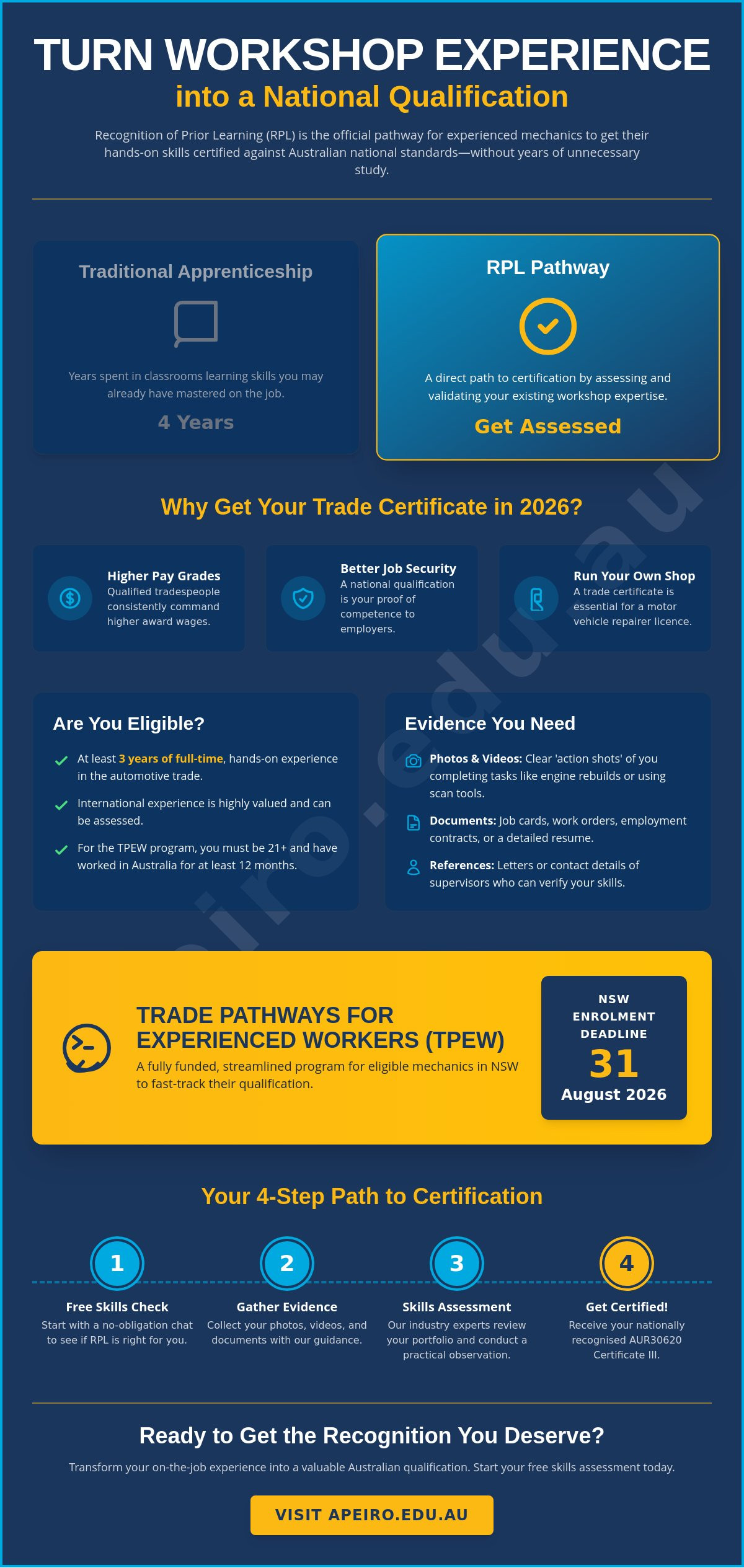
2026 is a pivotal year for this transition. With Australia's automotive manufacturing and repair sector generating over $14 billion in annual revenue, the demand for verified, high-level talent is at an all-time high. Major shifts in technology mean that "knowing your way around a car" is no longer enough for many employers. They need the security of a nationally recognised qualification to meet insurance and safety requirements. If you're in New South Wales, the 31 August 2026 enrollment deadline for the fully funded Trade Pathways for Experienced Workers (TPEW) program makes this the perfect time to act.
What is Recognition of Prior Learning?
RPL shifts the focus from learning to assessment. Instead of being taught how to use a scan tool or rebuild a transmission, you provide evidence that you're already doing it. Your skills are mapped against specific units of competency within a qualification like the AUR30620 Certificate III in Light Vehicle Mechanical Technology. This pathway is highly respected by Australian employers because it proves you have survived and thrived in real-world workshop environments. It shows you have the practical grit that classroom-only students often lack.
The Value of a Trade Certificate in 2026
Holding a formal qualification is becoming a non-negotiable requirement for career progression. As electric vehicles and autonomous systems become more common, licensing bodies are tightening their standards. A trade certificate is your ticket to obtaining a motor vehicle repairer licence, which is essential if you ever want to run your own workshop or sign off on official inspections. Beyond the legalities, there's a clear financial benefit. Qualified tradespeople in Australia consistently command higher award wages and have access to senior diagnostic roles that are closed to those without formal papers.
Evidence and Eligibility: Turning Workshop Experience into Proof
Proving you know your way around a workshop is about more than just showing a long list of previous employers. While years on the tools are the foundation, an assessor looks for "competence" rather than just "experience". Competence means you can perform a task to the specific safety and technical standards required by the Australian automotive industry every single time. When applying for RPL automotive Australia, your goal is to turn those years of muscle memory into a documented trail of professional success.
Modern technology has made this process much simpler. You don't need to rely solely on old paper records. Digital evidence, such as clear photos of a complex engine rebuild or a short video showing you diagnosing a fault with a scan tool, provides undeniable proof of your ability. These "action shots" from the workshop floor give assessors a direct window into your daily professional life. This makes it much easier to verify your skills without requiring you to step back into a classroom for months on end.
Who Qualifies for Automotive RPL?
To be successful, you generally need at least three years of full-time experience in the trade. For those looking at the TPEW program in 2026, you must be at least 21 years old and have worked in the industry for at least 12 months within Australia. If you've moved from overseas, your international experience is highly valuable. The Trades Recognition Australia framework ensures that skills gained abroad can be mapped against local standards, provided you can back them up with solid proof. It's a fantastic way for migrant workers to have their global expertise officially recognised in the Australian market through RPL automotive Australia.
Gathering Your Portfolio of Evidence
Your portfolio is your professional story. Start with a detailed resume that outlines your specific responsibilities, not just your job titles. You'll also need third-party reports from qualified supervisors who can vouch for your technical accuracy and reliability. Practical documents are the "gold standard" for these applications. These include:
- Completed job cards and service logs
- Diagnostic reports and fault-finding results
- Workshop invoices you've personally signed off
- Workplace health and safety (WHS) checklists and risk assessments
If you're unsure if your current paperwork meets the mark, you can check your eligibility for supported pathways to see how your specific experience aligns with national requirements.
Choosing the Right Automotive Qualification for Your Career Path
Choosing your qualification is a strategic decision. It's not just about getting "the papers"; it's about aligning your credentials with your future ambitions. Whether you want to be the go-to diagnostic expert or manage a fleet of workshops, the right choice in RPL automotive Australia can shave years off your career timeline. Organisations like the Australian Automotive Aftermarket Association emphasise the importance of maintaining high trade standards to ensure the industry remains competitive and safe. By matching your existing skills to the right level of certification, you ensure your career path is both legally compliant and professionally rewarding.
The Australian training package is structured to allow for clear progression. You don't have to guess where you fit; the units of competency are designed to mirror real-world workshop roles. Most qualifications consist of core units that everyone must master, alongside elective specialisations that let you tailor the certificate to your specific expertise, such as hybrid systems or advanced electronics. This flexibility means your final certificate actually reflects the work you do every day.
Certificate III in Light Vehicle Mechanical Technology (AUR30620)
The AUR30620 Certificate III in Light Vehicle Mechanical Technology is the undisputed industry benchmark. It's the essential foundation of the automotive world. This qualification covers the critical competencies every mechanic needs, from servicing engine systems and transmissions to mastering steering and suspension. Most importantly, it's the primary prerequisite for obtaining a motor vehicle repairer licence in most Australian states. If you're looking to formalise your basic trade skills, this is where your journey begins. It provides the legal and professional foundation required to work independently or lead a small team.
Advancing to Certificate IV and Diploma Levels
Once you've secured your trade certificate, your growth shouldn't stop there. For those who enjoy the "brain work" of complex fault-finding, the AUR40216 Certificate IV in Automotive Mechanical Diagnosis is the next logical step. It's designed for master technicians who want to specialise in advanced electronic systems and sophisticated diagnostic techniques.
If your goals are more focused on leadership or high-level technical analysis, the AUR50216 Diploma of Automotive Technology offers a pathway into management. This level focuses on business operations and the analysis of complex systems. The beauty of RPL automotive Australia is that you don't have to start from scratch. You can use RPL to "top up" your existing qualifications as you move into more senior roles. By providing evidence of your evolving responsibilities, you can gain these higher-level certifications based on the work you're already doing as a senior tech or foreman.
The TPEW Framework: A Streamlined Path for Experienced Tradespeople
For many veteran mechanics, the thought of returning to a classroom is enough to put off career progression indefinitely. This is where the Trade Pathways for Experienced Workers (TPEW) program changes the game. It is a specialised framework designed specifically for those who have spent years on the workshop floor but lack the formal papers to match their skills. Unlike traditional apprenticeships that take four years, TPEW acknowledges that you've already done the hard yards. It uses the principles of RPL automotive Australia to validate your existing knowledge while providing targeted support to fill any minor gaps in your competency.
If you are based in New South Wales, the timing for this pathway is critical. The TPEW program is currently fully funded by the NSW Government, but strict deadlines apply for the 2026 intake. To take advantage of this funding, you must enrol by 31 August 2026 and commence your training by 30 September 2026. This initiative is designed to address the nationwide skills shortage by helping experienced workers like you meet the same high standards as any traditionally trained tradesperson, ensuring the industry remains robust and safely regulated.
What is the Trade Pathways for Experienced Workers Program?
The TPEW program is not just a simple assessment; it's a blended professional journey. It differs from a standard RPL automotive Australia application by integrating "gap training" where necessary. If your evidence shows you are 90% of the way to a qualification but haven't worked on a specific type of modern braking system, the program allows you to complete just that small piece of learning. This ensures you reach 100% competency without repeating the things you can already do in your sleep. It's an efficient, respectful way to treat your years of industry tenure.
The Step-by-Step Assessment Journey
Your journey begins with an initial skills review. You'll sit down with an industry expert who understands the reality of workshop life. They won't just look at your resume; they'll discuss your daily tasks to see how they align with national units of competency. After this consultation, you'll submit your evidence portfolio, which is then mapped against the qualification requirements. To ensure your hands-on skills are current, the process often includes a practical observation or a technical interview. This replaces the need for traditional exams, focusing instead on your ability to perform the job to a professional standard.
Ready to see if your years on the tools qualify you for a fully funded pathway? Apply for the TPEW program today and take the first step toward your formal trade certificate.
Navigating Your Automotive Career with Apeiro Institute
Deciding to formalise your trade experience is a significant step toward a more secure professional future. While the process of gathering evidence and mapping skills might seem complex, you don't have to tackle it alone. At Apeiro Institute, we act as your expert guide, bridging the gap between your current workshop skills and the formal qualifications required by Australian industry standards. Our approach to RPL automotive Australia is built on a foundation of support, ensuring that your years of hard work are respected and accurately recorded.
We understand that as an experienced mechanic, your time is your most valuable asset. You can't afford to take weeks away from the workshop to sit in a lecture theatre. That's why our assessment process is designed to be as flexible as possible. By utilising digital evidence and workplace observations, we ensure that the evaluation of your skills happens in a way that minimises disruption to your daily life. It's a practical solution for busy professionals who need results without the traditional classroom commitment.
Why Choose a Registered Training Organisation (RTO)?
Choosing an RTO like Apeiro Institute is essential because it guarantees that your qualification is nationally recognised. In the Australian automotive sector, licensing bodies and employers only accept certificates issued by registered organisations that adhere to the strict standards of the Australian Qualifications Framework. This ensures that your trade certificate holds real value whether you're applying for a motor vehicle repairer licence or seeking a promotion. Our assessors are industry-current professionals who speak your language. They understand the nuances of a modern workshop and can help you identify exactly which parts of your daily routine translate into specific units of competency.
Getting Started with Your Free Skills Review
The first step in your journey is a no-obligation, free skills review. This initial conversation is designed to give you a clear picture of where you stand. To prepare, simply think about the core tasks you perform every day, from engine diagnostics to complex mechanical repairs. During this evaluation, our consultants will look at your industry tenure and help you determine which qualification level best suits your goals. We'll provide a clear roadmap of the evidence you'll need to provide, taking the guesswork out of the application process.
Don't let your years of expertise go unrecognised while the industry evolves around you. If you're ready to take the next step in your career, start your automotive RPL journey with Apeiro Institute today. Whether you're aiming for a trade licence or a management role, we're here to help you turn your workshop experience into a professional reality.
Take the Next Step in Your Automotive Career
Your years of hard work in the workshop have already made you an expert. Now it's time to make sure the rest of the industry sees it too. By choosing RPL automotive Australia, you aren't just getting a piece of paper; you're securing your professional future and opening doors to higher earning potential and official trade licensing. Whether you're looking to formalise your skills through the AUR30620 Certificate III or want to explore the specialised Trade Pathways for Experienced Workers (TPEW) program, the right support makes all the difference.
Apeiro Institute (RTO 45394) is committed to being your partner in this journey. Our industry-expert assessors understand the reality of your daily work and provide the nationally recognised training you need to succeed. We take the stress out of the documentation process so you can stay focused on what you do best. Don't let another year pass without the credentials you've already earned through your dedication and skill.
Get your free automotive skills assessment from Apeiro Institute today and start your journey toward a fully recognised trade qualification. We're ready to help you turn your workshop expertise into a lifelong career asset.
Frequently Asked Questions
Can I get an automotive RPL if I trained overseas?
Yes, you can certainly use overseas experience to apply for RPL automotive Australia. Many migrant workers successfully map their international skills against the Australian Qualifications Framework (AQF) to gain local recognition. You'll need to provide employment records, references, and photos of your work to show your skills meet current Australian standards.
How long does the automotive RPL process usually take?
The process is significantly faster than traditional study, often taking between 4 and 8 weeks. This timeline depends on how quickly you can gather your portfolio of evidence and the complexity of the qualification. Once your assessor reviews your documents and conducts any necessary interviews, your certificate is issued shortly after.
Do I need to attend any classes at a campus for RPL?
You usually don't need to attend campus for a standard RPL application. The process is designed to be completed remotely or at your current place of work. Assessors often use digital evidence like videos or may visit your workshop for a brief practical observation to verify your hands-on competency in a real-world setting.
What happens if I have experience but cannot prove it for a specific unit?
If you lack evidence for a specific unit, you can complete "gap training" to meet the requirement. This means you only study the specific areas where you have a skills gap rather than repeating the entire course. It's an efficient way to ensure you are 100% competent across all units of the qualification without unnecessary repetition.
Is an RPL qualification the same as a regular certificate?
Yes, an RPL qualification is exactly the same as one earned through a traditional apprenticeship. It is a nationally recognised document issued by a Registered Training Organisation (RTO) under the AQF. Employers and licensing bodies view it with the same authority because the assessment standards are identical regardless of the pathway.
How much does RPL automotive Australia cost compared to a full course?
RPL automotive Australia is typically more cost-effective than a full three or four-year course. Since you aren't paying for years of classroom tuition or materials, the costs are focused on the assessment and verification of your existing skills. This makes it a financially smart option for experienced workers looking to formalise their trade.
Can I apply for a trade licence immediately after getting my RPL certificate?
You can apply for your motor vehicle repairer licence as soon as you receive your Certificate III. The certificate serves as the formal proof of competency required by state licensing bodies. Once you have your papers, you've cleared the major educational hurdle needed to work as a qualified tradesperson or start your own business.
What kind of jobs can I get with a Certificate III in Light Vehicle Mechanical Technology?
A Certificate III in Light Vehicle Mechanical Technology opens doors to roles such as a light vehicle mechanic, service technician, or fleet maintenance officer. It also provides a foundation for specialising in areas like engine reconditioning or automotive electronics. With this qualification, you can work in dealerships, independent workshops, or mobile repair services across Australia.

Disclaimer
The information provided on this blog is for general informational and educational purposes only. While every effort is made to ensure the accuracy and reliability of the content, the author makes no representations or warranties of any kind, express or implied, about the completeness, accuracy, suitability, or availability of the information contained on this blog.
The views and opinions expressed in blog posts are those of the individual author and do not necessarily reflect the official policy or position of any organization, company, or employer.
This blog may contain links to external websites or third-party content. These links are provided for convenience only, and the author has no control over and assumes no responsibility for the content, privacy policies, or practices of any third-party sites.
Nothing on this blog constitutes professional advice (legal, financial, medical, or otherwise). Readers are encouraged to seek appropriate professional guidance before making any decisions based on the information provided here.
By using this blog, you acknowledge that any reliance on the information is at your own risk.


