

Your life experience is often more valuable to the disability sector than a long list of previous care roles. It's completely normal to feel a bit anxious about applying for a position when your resume doesn't mention support work, or to feel confused by the difference between an apprenticeship and a traineeship. You might even worry that you'll be rejected simply because you haven't stepped into a professional care environment before. However, the industry is currently looking for people with the right heart and a genuine willingness to learn on the job.
If you're searching for a disability support worker traineeship no experience required, you've already found the most direct path to a new career. This guide will show you exactly how to launch a rewarding professional journey while earning a steady wage from your very first day. We'll break down the "earn while you learn" financial model, help you choose the right Certificate III qualification for 2026, and show you how to find a training provider that acts as a mentor. By the end of this article, you'll have a clear, step-by-step roadmap to becoming a qualified support worker.
Key Takeaways
- Discover why the Australian care sector prioritises your personal values and life skills over previous industry work when hiring for new entry-level roles.
- Learn how to secure a disability support worker traineeship no experience required, allowing you to earn a legal wage while you study.
- Understand why the CHC33021 Certificate III in Individual Support (Ageing and Disability) is the essential benchmark for long-term career success in 2026.
- Identify the specific transferable skills and mandatory clearances, such as the NDIS Worker Screening, you need to prepare before applying.
- Explore how a supportive training provider like Apeiro Institute can guide you through the enrolment process and help you manage your study-work balance.
Breaking into Disability Support: Can You Start with No Experience in 2026?
Starting a career in disability support is about choosing a path of empowerment rather than just finding a job. In this role, you aren't just a helper. You are a Direct Support Professional, a person-centred advocate who assists individuals in achieving their personal goals and maintaining independence. In 2026, the Australian care sector is shifting its focus away from rigid resumes. Instead, providers are actively searching for people who possess the right heart and values. While technical skills can be taught, empathy and resilience are innate qualities that the industry values above all else.
The demand for new workers is higher than ever. With the continued expansion of the NDIS and an ageing population requiring specialised care, the sector is projected to need thousands of additional staff. This creates a unique opportunity for you. If you've been searching for a disability support worker traineeship no experience required, you're entering the market at exactly the right time. Your ability to listen, communicate, and show genuine care is far more important than a history of healthcare roles.
The "No Experience" Myth in the Care Sector
Many people hesitate to apply because they think they lack relevant history. This is a common misconception. In reality, your life experience is your greatest asset. Have you raised children? Have you cared for an elderly relative or worked in a busy hospitality environment? These roles teach you multitasking, patience, and conflict resolution. Employers view trainees as valuable "blank slates." They prefer to hire someone with a positive attitude and then provide the training needed to meet high industry standards. By starting as a trainee, you learn the "right way" from the beginning.
Traineeships vs. Direct Employment: Which is Better?
You might wonder if you should just apply for a casual job instead of a formal traineeship. While direct employment offers immediate work, a traineeship provides long-term career security. It's a structured pathway where you earn a legal wage while working toward a nationally recognised qualification, such as the CHC33021 Certificate III in Individual Support. This qualification is the industry benchmark. Without it, your career options might be limited later on. Working with a Registered Training Organisation (RTO) like Apeiro Institute ensures you have a mentor to guide your professional development, making the transition into care work feel safe and supported.
The Traineeship Model: Earning While You Learn in Australia
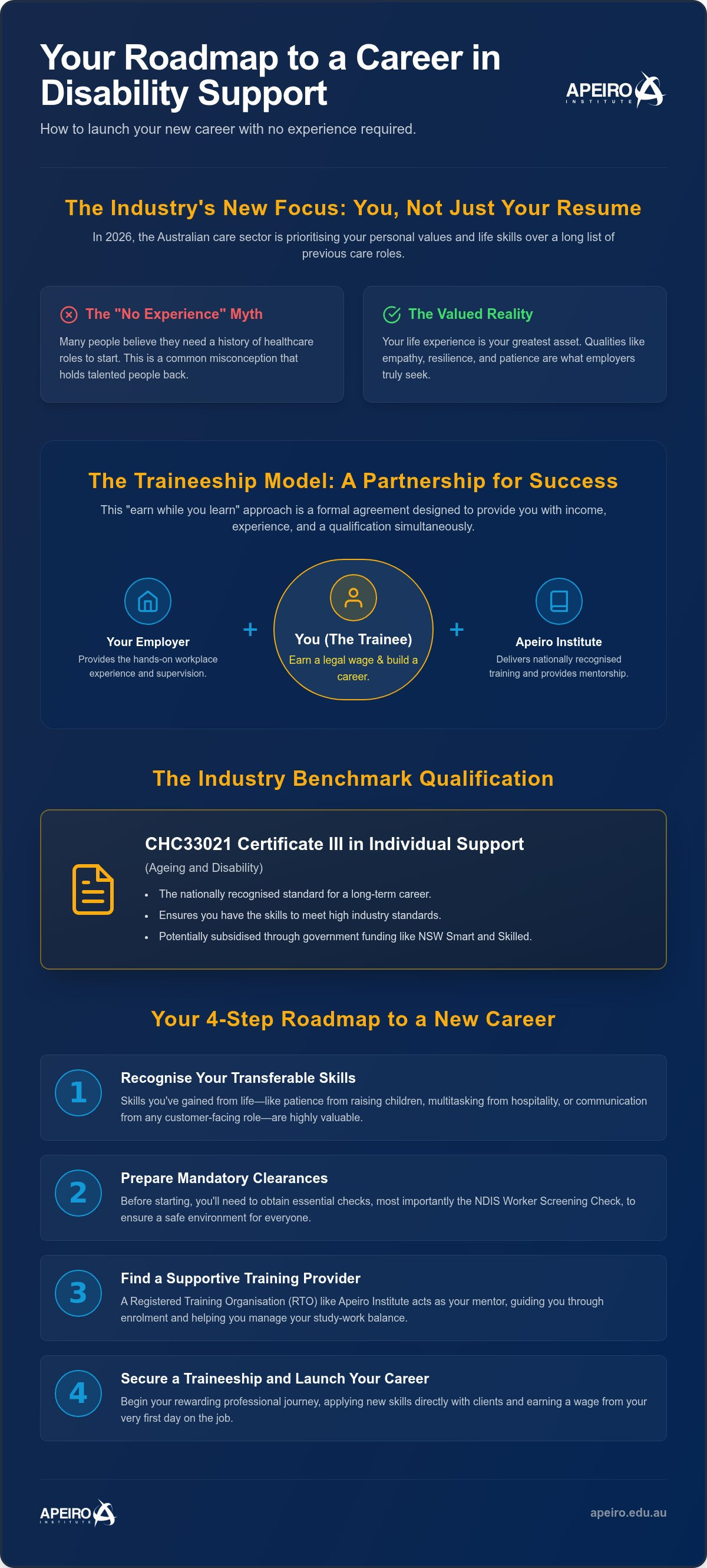
A traineeship is much more than a standard job entry point. It is a formal tripartite agreement between you, your employer, and Apeiro Institute. This structured partnership ensures that your development is monitored and supported from three different angles. Your employer provides the workplace and hands-on experience, while we handle the educational side to ensure you meet national standards. If you are launching a disability support worker traineeship no experience required, this model provides a safety net that balances your need for a steady income with the requirement for professional growth.
Under this arrangement, you earn a legal wage while working toward the CHC33021 Certificate III in Individual Support. This "earn while you learn" approach removes the financial barrier often associated with career changes. For many eligible students in New South Wales, the cost of training is further reduced through Smart and Skilled funded courses NSW. This means you could potentially complete your qualification with minimal out-of-pocket expenses while maintaining your financial independence.
How the Training Schedule Works
Your week is typically split between "on-the-job" practical work and "off-the-job" study. You'll spend the majority of your time at the workplace, applying new skills directly with clients under supervision. To support your theory, you'll use a dedicated learning portal to manage your studies alongside your shifts. Apeiro Institute trainers also visit your workplace regularly. These visits allow us to assess your progress in a real-world setting and ensure you feel confident in your daily tasks. It's a methodical way to build competence without feeling overwhelmed by a classroom-only environment.
Financial Incentives for Trainees
Financial security is a major benefit of the traineeship path. You are paid according to the National Training Wage, which generally increases as you progress through your units of competency. In high-demand sectors like disability support, the government often provides additional incentives to encourage new workers to enter the field. Beyond the immediate weekly pay, the real value lies in the long-term return on investment. Gaining a nationally recognised qualification in Australia sets you up for higher pay grades and more senior roles in the future. If you're ready to start, we can help you understand how our workplace-based training models fit your specific needs.
Essential Qualifications: Why the CHC33021 Certificate III is the Standard
In the Australian care industry, the CHC33021 Certificate III in Individual Support is the essential benchmark for quality care. While you can technically start a disability support worker traineeship no experience required, you'll need this qualification to progress and secure permanent roles. Apeiro Institute offers a dual specialisation in Ageing and Disability, ensuring you have the versatility to work across different care settings. This course isn't just a list of modules. It's a comprehensive framework that directly maps to the NDIS Quality and Safeguards standards. It ensures every trainee understands their legal and ethical responsibilities from day one.
The heart of this qualification is the concept of Person-Centred Care. Unlike traditional medical models that focus on what a person cannot do, this approach focuses on empowerment. You learn to support participants in making their own choices and living the life they want. It moves the role from being a "task-doer" to being a facilitator of independence. This mindset is what transforms a simple job into a meaningful career where you make a tangible difference in someone's daily life.
Core Units You Will Master
During your traineeship, you will master several critical units that form the backbone of professional support work. You'll learn how to facilitate community participation and social inclusion, helping clients connect with their local neighbourhoods and social groups. Another key focus is supporting independence while maintaining professional boundaries. This balance is vital for a healthy, respectful working relationship. Additionally, you will receive rigorous training in infection control and workplace health and safety (WHS). These skills ensure that you provide a safe environment for both yourself and the individuals you support.
Pathways Beyond the Certificate III
Completing your traineeship is only the beginning of your professional journey. Once you've earned your Certificate III, you can use it as a stepping stone toward higher-level qualifications. Many graduates choose to transition into a Diploma of Community Services Australia to broaden their expertise in case management or social advocacy. This pathway opens doors to specialised roles such as NDIS coordination or team leadership. A traineeship accelerates this journey because you already have the practical workplace hours that senior roles often require. It's a strategic move that builds a solid foundation for a long-term, impactful career in the community sector.
Steps to Landing Your First Traineeship with No Experience
Transitioning into a new field can feel daunting, but the path to a disability support worker traineeship no experience required is highly structured. Your first step is to audit your transferable skills. Think about the patience you've shown in previous roles, your resilience during busy shifts, and your ability to communicate clearly with diverse groups of people. These attributes are the foundation of quality care. Once you've identified these strengths, you need to secure your mandatory clearances. In 2026, having your NDIS Worker Screening Check and a National Police Check ready before you apply shows employers you are serious and ready to start immediately.
Targeting the right employers is also vital for your success. Not-for-profit organisations often have a strong focus on community values, while private providers might offer different types of specialised care environments. Researching these providers helps you align your personal values with their mission. Finally, partnering with a Registered Training Organisation (RTO) like Apeiro Institute acts as a powerful signal to potential employers. Finding a disability support worker traineeship no experience necessary is much easier when you show you've already taken the initiative to understand the training requirements and are committed to professional development.
Translating Your Resume for Care Work
If your background is in retail or hospitality, don't worry about the lack of "care" titles. Instead, focus on your reliability, empathy, and your history of following complex workplace procedures. Highlight times you've managed difficult situations or supported a team member. In your cover letter, explain how your previous experience has prepared you for the emotional and organisational demands of the sector. For example, the high-level customer service you provided in retail directly translates to the advocacy and person-centred support required in disability services.
Meeting the 2026 Compliance Standards
Compliance is a non-negotiable part of the Australian care sector. The NDIS Worker Screening Check is a national requirement that assesses whether a person poses a risk to participants. You can apply for this through your state or territory's worker screening unit. Additionally, maintaining a current First Aid and CPR certificate makes you a "low-risk" hire because you can handle emergencies from day one. Understanding the NDIS Code of Conduct before your interview is equally important. It demonstrates that you respect the rights, freedom of expression, and decision-making power of the people you will support.
Enrol in the Certificate III in Individual Support today
Choosing Apeiro Institute: Your Partner in Disability Support
Apeiro Institute is more than just a training provider. We act as your mentor and guide throughout the entire process of securing a disability support worker traineeship no experience required. Our student-centred approach to vocational education and training (VET) ensures that you are never just a number in a classroom. We understand that starting a new career path in 2026 involves more than just reading textbooks; it requires a supportive environment where your existing skills are recognised and built upon. We focus on creating a space where the prospect of starting a new educational journey feels attainable rather than intimidating.
If you are coming from a different industry, you'll benefit from an RTO that understands trade pathways for experienced workers. We specialise in helping people translate their previous work history into the care sector, ensuring your transition is smooth and professional. Our campuses are designed to be accessible and welcoming, with a focus on practical, industry-aligned outcomes that make you "job-ready" from your very first unit. Our trainers are deeply invested in your success. They provide the one-on-one guidance needed to help you complete your qualification while managing your workplace shifts and personal commitments.
A Community-Focused Learning Environment
We pride ourselves on our commitment to diversity. Our student body represents over 38 nationalities, creating a rich, inclusive atmosphere where everyone's background is valued. This global perspective is particularly useful in the Australian care sector, which serves a diverse range of participants with unique cultural needs. If you haven't been in a classroom for years, our personalised support services are here to help. We offer tailored assistance for students returning to study after a long break, ensuring you feel confident using our digital learning portals and completing your assessments. By bridging the gap between theory and the real-world Australian care sector, we prepare you for the actual challenges and rewards of daily support work.
Ready to Start Your Career Change?
Taking the first step toward a new career is a significant decision. We've made our application process for the CHC33021 Certificate III in Individual Support as straightforward as possible to reduce any stress. If you're ready to move from your current role into a more fulfilling path, our team is here to help you navigate the enrolment and funding options available to you. We encourage you to reach out for a personalised enrolment consultation to discuss how a disability support worker traineeship no experience necessary can work for your specific circumstances. It's time to turn your empathy into a professional qualification.
Enquire about our Community Services courses today
Take the First Step Toward Your New Career
Launching a career in the Australian care sector is a journey of both personal and professional growth. By now, you understand that your values and life experience are the most important tools you bring to the role. A disability support worker traineeship no experience required allows you to build a stable career while earning a legal wage from your very first day. You've seen how the CHC33021 Certificate III provides the essential foundation for person-centred care, and how the right training partner makes all the difference in your long-term success.
As a Smart and Skilled provider with industry-expert trainers, Apeiro Institute (RTO 45394) is here to ensure your transition is smooth and successful. We provide the nationally recognised training you need to move from an entry-level trainee to a qualified professional with total confidence. Your future in disability support starts with a single step toward empowering others and yourself.
The sector is waiting for passionate individuals like you to make a real difference. We look forward to supporting you as you turn your empathy into a lifelong career.
Frequently Asked Questions
Do I need a drivers licence to be a disability support worker trainee?
Most employers require a valid Australian drivers licence because a major part of the role involves community participation. You'll often need to transport participants to appointments or social events in a company vehicle or your own. While some residential or centre-based roles might not strictly require it, having your licence significantly increases your chances of securing a disability support worker traineeship no experience required. Always check the specific job description before applying.
How much does a disability support worker trainee earn with no experience?
Trainees are paid a legal wage under the National Training Wage while completing their qualification. As of late 2026, some enterprise agreements offer around $24.17 per hour for trainees. School leavers might start on a weekly rate of approximately $540.50. These rates generally increase as you complete more units of your Certificate III. It's a structured way to maintain financial independence while you transition into the care sector.
Can I do a disability support traineeship part-time in 2026?
Yes, you can complete a disability support traineeship on a part-time basis in 2026. This is a popular option for those balancing family commitments or other responsibilities. Both your employer and Apeiro Institute must agree to the part-time arrangement. While it might take slightly longer to complete your qualification compared to a full-time schedule, the flexibility allows you to remain employed while you gain your nationally recognised certification through our supportive training model.
What is the difference between aged care and disability support work?
While both roles fall under the CHC33021 Certificate III in Individual Support, they focus on different outcomes. Aged care primarily supports older Australians with age-related decline in residential or home settings. Disability support work focuses on empowering people of all ages to live independently and achieve personal goals. Our dual specialisation in Ageing and Disability ensures you have the skills to work confidently in both environments, depending on where your passion lies.
How long does a Certificate III traineeship usually take to complete?
A Certificate III traineeship typically takes between 12 and 24 months to complete. The exact duration depends on whether you are working full-time or part-time and how quickly you progress through your units of competency. Because it is workplace-based, you'll be learning and applying skills every day on the job. This hands-on approach often makes the training feel faster and more relevant than traditional classroom-only study models, leading to better long-term outcomes.
Is there government funding available for my disability support training?
Significant government funding is available for eligible students. In New South Wales, the Smart and Skilled program often provides fee-free traineeships for the CHC33021 qualification. This initiative aims to address the high demand for care workers by removing the financial barrier to entry. We can help you check your eligibility during an enrolment consultation to see if you can access these subsidised training pathways for your disability support worker traineeship no experience journey.
What happens if I already have a university degree but want to do a traineeship?
Having a university degree does not prevent you from starting a traineeship. In fact, many people with degrees in unrelated fields choose traineeships to gain practical, vocational skills. The traineeship focuses on hands-on competency that academic degrees often don't cover. It's an excellent way to formalise your entry into the disability sector while being paid to learn the specific industry standards required for NDIS compliance and person-centred support from an expert mentor.
What are the physical requirements for a disability support role?
Disability support is an active role that requires a reasonable level of physical stamina. You'll spend a lot of time on your feet, assisting participants with mobility or community access. Some roles may involve manual handling, such as helping someone in and out of a vehicle. You don't need to be an athlete, but you should be comfortable with physical activity. You will learn safe manual handling techniques during your Certificate III training to protect yourself.

Disclaimer
The information provided on this blog is for general informational and educational purposes only. While every effort is made to ensure the accuracy and reliability of the content, the author makes no representations or warranties of any kind, express or implied, about the completeness, accuracy, suitability, or availability of the information contained on this blog.
The views and opinions expressed in blog posts are those of the individual author and do not necessarily reflect the official policy or position of any organization, company, or employer.
This blog may contain links to external websites or third-party content. These links are provided for convenience only, and the author has no control over and assumes no responsibility for the content, privacy policies, or practices of any third-party sites.
Nothing on this blog constitutes professional advice (legal, financial, medical, or otherwise). Readers are encouraged to seek appropriate professional guidance before making any decisions based on the information provided here.
By using this blog, you acknowledge that any reliance on the information is at your own risk.


