

How many more years can your body handle the physical demands of site work before the daily grind starts to take its toll? It's a question many experienced workers face when they realise they want to stay in the industry but need a role that's easier on the joints and more sustainable for the long term. If you're ready to trade your steel-capped boots for a professional office role, the Diploma of Civil Construction Design is the technical bridge you've been searching for.
We understand that the idea of returning to study after years in the workforce can feel daunting, especially if you're feeling stuck or confused by complex Recognition of Prior Learning (RPL) processes. This guide is here to simplify that journey and provide the support you need. We'll show you how to turn your hard-earned on-site grit into professional authority, allowing you to transition into a civil designer or project manager role with absolute confidence.
You'll discover the latest salary benchmarks for 2026, how your existing experience can fast-track your qualification, and the steps to securing your future within Australia's $200 billion infrastructure pipeline. It's time to move into a career that offers higher earning potential and professional growth without the physical strain.
Key Takeaways
- Learn how the Diploma of Civil Construction Design (RII50520) acts as a technical bridge, allowing you to move from physically demanding site work into a professional design role.
- Discover the core competencies you will master, including site-specific work designs and industry-standard modelling software that meets current Australian Standards.
- Understand how Recognition of Prior Learning (RPL) can turn your years of on-site experience into credits, potentially fast-tracking your path to a qualification.
- Identify what to look for in a quality training provider, focusing on RTO registration and the real-world industry expertise of the assessors.
- Explore the 2026 career outlook, including updated salary benchmarks and high-demand sectors like renewable energy and urban renewal infrastructure.
What is the RII50520 Diploma of Civil Construction Design?
The Diploma of Civil Construction Design is a nationally recognised qualification that serves as the technical backbone of the RII Resources and Infrastructure Training Package. Known by its code, RII50520, this course isn't just about learning to draw lines on a screen. It's about developing the expertise to create site-specific work designs that ensure our infrastructure is safe, efficient, and sustainable. This role is a crucial bridge between high-level Civil engineering concepts and the practical, boots-on-the-ground reality of a construction project.
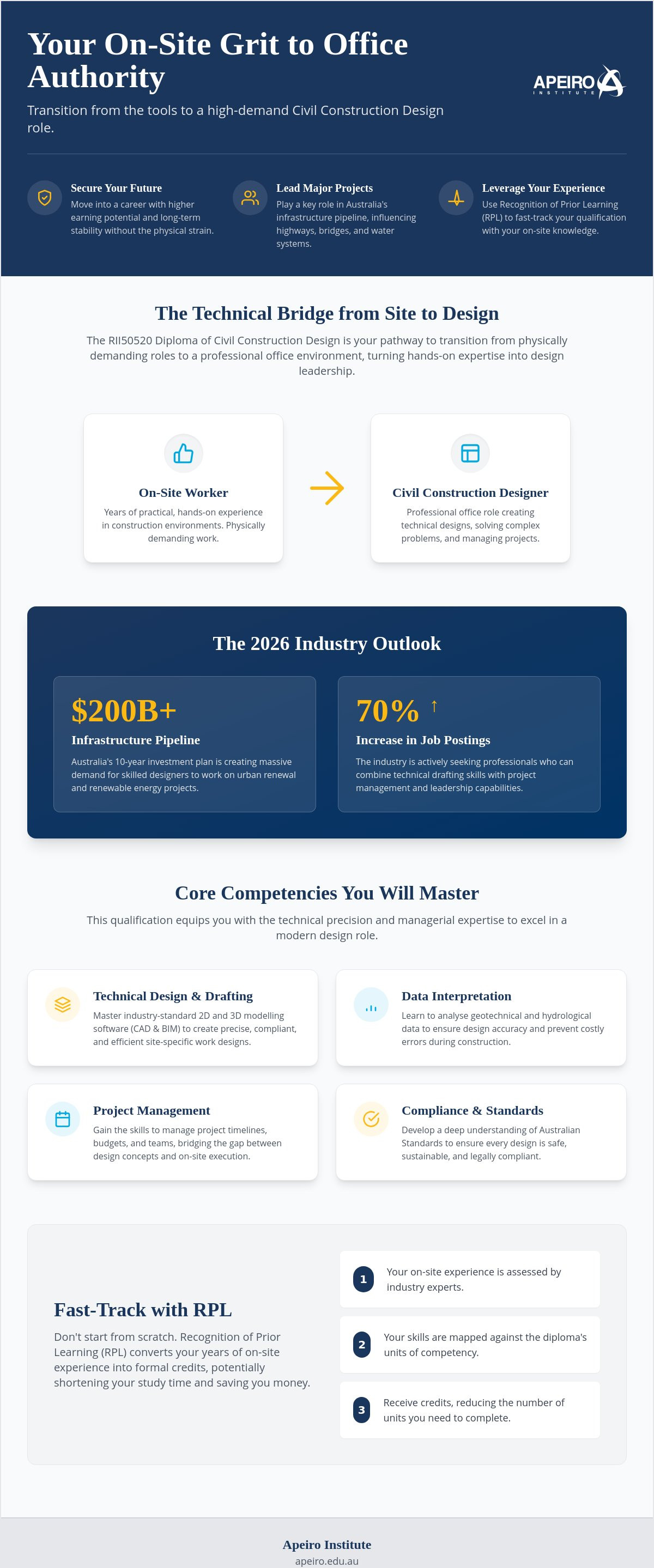
Why is 2026 such a pivotal year to get started? Australia is currently navigating a 10-year infrastructure pipeline valued at over $200 billion. With a reported 70% increase in engineering-related job postings, the industry is crying out for designers who can handle both technical drafting and managerial duties. You won't just be following instructions; you'll be using your judgement to solve complex problems and lead design teams. It's a role that requires a fine balance between technical precision and leadership responsibility, making you a highly valued asset in any project team. By mastering these skills, you position yourself as a key player in the urban renewal and renewable energy projects that are currently transforming the Australian landscape.
The Scope of Civil Construction Design
The projects you'll influence keep our cities functioning, ranging from major highways and bridges to railway networks and essential water management systems. It's vital to distinguish between a draftsperson and a designer. While a draftsperson focuses on the mechanics of a drawing, a civil construction designer takes responsibility for the design's integrity and compliance with Australian Standards. In the professional hierarchy, you'll work as a para-professional, providing essential support to engineers while maintaining a high degree of autonomy over your specific work designs.
Who Should Enrol in this Qualification?
This Diploma of Civil Construction Design is a perfect fit for site supervisors who have spent years managing crews and want to move into a professional office environment. It's also ideal for tradespeople looking to transition away from physical labour while retaining their valuable industry knowledge. If you have years of experience, you might want to explore Trade Pathways for Experienced Workers (TPEW) to see how your background can be recognised. International students also benefit, as the qualification leads to high-demand roles within Australia's growing infrastructure sector, providing a clear path to career progression and long-term stability.
Core Skills and Competencies You Will Master
Transitioning into a professional design role requires a shift in how you view a construction site. While your time on the tools gave you practical insight, the Diploma of Civil Construction Design equips you with the technical precision to translate that experience into compliant, high-quality blueprints. You'll move beyond simply understanding how a structure is built to master the "why" behind every specification, ensuring every project meets rigorous Australian Standards.
The curriculum focuses on developing site-specific work designs that are both functional and safe. This involves a deep dive into civil design principles, where you'll learn to solve complex infrastructure problems before a single shovel hits the ground. By mastering these competencies, you become the person who ensures a road's drainage system can handle a one-in-one-hundred-year flood event or that a bridge's structural integrity remains uncompromised under heavy freight loads. It's a career path that rewards analytical thinking and attention to detail.
Technical Design and Drafting
Modern construction relies heavily on Computer-Aided Design (CAD). Gone are the days of manual drafting; today, you'll master 2D and 3D modelling software to create digital twins of your projects. In 2026, proficiency in Building Information Modelling (BIM) and advanced 3D CAD platforms has become the non-negotiable standard for civil designers across the country. You'll also learn to interpret geotechnical and hydrological data. Understanding soil composition and water flow is essential for design accuracy, preventing costly errors during the construction phase.
Project Management and Compliance
Mastering the Diploma of Civil Construction Design involves more than just technical drawing. You must also become an expert in project management, specifically regarding costs, schedules, and Work Health and Safety (WHS) legislation. Designing with safety in mind is a legal and ethical requirement in Australia. You'll develop risk management strategies for large-scale projects, identifying potential hazards in the design phase to protect workers on-site later.
Sustainability is another major focus for 2026. According to the Civil Contractors Federation, the industry is seeing a massive shift toward "green construction." You'll learn to conduct environmental impact assessments and incorporate sustainable materials into your designs, meeting the growing demand for eco-friendly infrastructure. If you're already familiar with these site requirements, you might find that your existing knowledge qualifies you for Recognition of Prior Learning, helping you graduate sooner.
Fast-Tracking Your Career: RPL and Trade Pathways
If you've spent years managing crews or interpreting site plans, you've already mastered a significant portion of the RII50520 Diploma of Civil Construction Design. Recognition of Prior Learning (RPL) is the formal process of acknowledging the skills you've gained through work experience rather than traditional classroom study. Instead of sitting through lectures on topics you already know inside out, you provide evidence of your competency to an assessor. This approach respects your time and acknowledges that your career has been a classroom in its own right.
The benefits of the Trade Pathways for Experienced Workers (TPEW) model are particularly relevant for those wanting to move into design roles. This model is designed to streamline the transition by identifying exactly where your site-based knowledge overlaps with the technical requirements of the diploma. To make this work, you'll need to gather a portfolio of evidence. This typically includes site-specific work designs you've contributed to, photos of completed projects, references from licensed engineers, and detailed work logs that prove your involvement in complex infrastructure tasks. Organising these documents early can save you a significant amount of time during the enrolment phase.
The RPL Assessment Process
Your journey begins with a straightforward self-assessment. You'll look at the specific units of competency and evaluate where your strengths lie. Next, you'll work closely with a qualified assessor who will map your evidence against the Diploma of Civil Construction Design requirements. This collaborative process is about finding the most efficient path to your qualification. By successfully navigating RPL, you can significantly reduce your total tuition costs and shave months off your study time, allowing you to step into your new role much sooner.
Bridging the Gap: From Site to Design Office
While your site experience is invaluable, there are often technical gaps that require focused attention. For most transitioning workers, this involves mastering advanced 2D and 3D modelling software or learning the specific documentation standards required for government infrastructure tenders. We provide dedicated support systems to help you feel comfortable returning to a learning environment after years away. Whether it's one-on-one mentoring or flexible online modules, the goal is to ensure you have the confidence to handle the professional responsibilities of a civil designer without feeling overwhelmed by the change in pace.
Choosing the Right Training Provider in Australia
Selecting where to study for your Diploma of Civil Construction Design is a decision that shapes your entire professional transition. It's not just about getting a certificate; it's about finding a partner that understands the Australian infrastructure landscape. You need a Registered Training Organisation (RTO) that maintains high standards and provides the practical support necessary for a career shift. If you're an international student, ensuring the provider has CRICOS registration is essential for meeting your visa requirements while gaining a qualification respected by local employers.
The quality of your trainers is the most critical factor. They shouldn't just be academics; they need to be industry veterans who have managed real projects and navigated the complexities of Australian Standards. Look for a provider that offers flexibility to suit your current work-life balance. Whether you prefer the structure of face-to-face classes, the convenience of online learning, or a blended approach, the right RTO will offer pathways that respect your existing commitments. Support services are equally vital, especially for those returning to study after a long break or those moving to Australia to build a new life.
Key Questions to Ask an RTO
Before you enrol, it's important to dig deeper into how the training is delivered. Ask specific questions to ensure the RTO meets your needs:
- Software Access: Will you have access to industry-standard 2D and 3D modelling software during your studies, or will you need to purchase your own licences?
- RPL Support: What specific mechanisms are in place to help you document your site experience for Recognition of Prior Learning?
- Industry Alignment: How does the RTO ensure their curriculum and teaching methods stay updated with the latest changes to Australian construction regulations?
Funding and Subsidies
Investing in your future shouldn't be an overwhelming financial burden. Many students are eligible for government assistance to help manage the costs of their Diploma of Civil Construction Design. If you're based in New South Wales, you may be eligible for Smart and Skilled funding, which provides subsidised training for priority industries. For more details on how this works, check out our Smart and Skilled Funded Courses NSW: Your 2026 Guide. Additionally, VET Student Loans and flexible payment plans are often available to help you spread the cost of your education over time, making a professional career more attainable than ever.
Ready to see how your site experience can fast-track your new career? Contact us to discuss your trade pathway options today.
2026 Career Outcomes and Future Progression
Completing the Diploma of Civil Construction Design opens doors to a professional lifestyle that balances technical expertise with significant financial rewards. In 2026, the average annual salary for a Civil Designer in Australia sits between $100,000 and $120,000. This reflects the intense demand for skilled professionals who can navigate the nation’s $200 billion infrastructure pipeline. You aren't just getting a job; you're securing a future in high-growth sectors like renewable energy infrastructure and large-scale urban renewal. These projects require designers who understand both the technical requirements and the environmental responsibilities of modern construction.
Your career path doesn't stop at design. Many graduates find themselves moving into senior leadership or project management roles as they gain experience. The industry values the unique perspective of someone who understands both the digital model and the physical site. By staying committed to continuous professional development, you ensure your skills remain sharp as technology evolves. It's about building a sustainable career that grows alongside the industry's needs.
Job Roles for Diploma Graduates
The versatility of this qualification means you can pursue several distinct career paths. While a structural draftsperson focuses primarily on the technical drawings, a Civil Construction Designer takes on broader responsibilities for the overall design integrity. You might also find rewarding opportunities as a Civil Construction Site Officer or an Assistant Project Manager. In these roles, your technical knowledge helps bridge the gap between design and execution. Local governments and private consultancies frequently hire Technical Officers to oversee civil works and ensure compliance with municipal standards.
Advancing to the RII60520
Once you've established yourself in the industry, the next logical step is the Advanced Diploma of Civil Construction Design. This higher-level qualification prepares you for senior engineering support roles and complex design leadership. It builds on the foundation laid by your Diploma of Civil Construction Design, focusing on more intricate project management and advanced technical analysis. For a deeper look at this progression, read our Advanced Diploma of Civil Construction Design: Your RII60520 Guide for 2026. Taking this step demonstrates a commitment to your craft and positions you for the highest-tier roles in the civil sector. We are here to support you at every stage of this journey, from your first day of study to your transition into senior management.
Secure Your Professional Future in Civil Design
Transitioning from the physical demands of site work to a professional design role is one of the smartest moves you can make for your long-term career. We've explored how your years of boots-on-the-ground experience can be turned into credits through Recognition of Prior Learning, saving you both time and money. With Australia's infrastructure pipeline reaching new heights in 2026, there's never been a better time to step into a role that offers higher earning potential and a more sustainable lifestyle.
Getting started with your Diploma of Civil Construction Design doesn't have to be a solo journey. At Apeiro Institute (RTO 45394), we're specialists in RPL and Trade Pathways, helping you bridge the gap between your current skills and a nationally recognised qualification. Our supportive learning environment welcomes students from over 38 different nationalities, ensuring you have the expert guidance and community you need to succeed.
You've already done the hard work on-site; now it's time to let that expertise work for you in a professional setting. Take the next step today and enrol in the RII50520 Diploma of Civil Construction Design with Apeiro Institute. Your future in civil design is waiting, and we're ready to help you reach your goals.
Frequently Asked Questions
How long does it take to complete the Diploma of Civil Construction Design?
Completion times usually range from 12 to 24 months, depending on whether you study full-time or part-time. If you have significant industry experience, you can potentially finish much faster by applying for Recognition of Prior Learning. This flexibility ensures you can balance your studies with your current work commitments while you prepare for your new career.
Can I get my Diploma of Civil Construction Design through RPL?
Yes, you can obtain your Diploma of Civil Construction Design through the Recognition of Prior Learning (RPL) process if you have relevant site experience. You'll need to provide evidence such as site plans, project logs, and references to prove your competency in specific units. It's an excellent way to turn your hard-earned practical knowledge into a formal, nationally recognised qualification.
What are the entry requirements for the RII50520?
Most training providers require you to have completed Year 12 or an equivalent level of schooling. For international students, a minimum IELTS score of 5.5 or equivalent is generally necessary to ensure you can handle the technical documentation. While there aren't formal prerequisites for the RII50520 itself, having a background in the construction industry will give you a significant head start.
Is the Diploma of Civil Construction Design in demand in Australia?
Demand for this qualification is exceptionally high due to Australia's ongoing $200 billion infrastructure pipeline. As urban renewal and renewable energy projects expand, the Diploma of Civil Construction Design has become a vital credential for filling skilled labor shortages. Recent reports show a 70% increase in engineering-related job postings, highlighting the strong job security available to graduates.
What software will I learn during the course?
You'll master industry-standard 2D and 3D modelling software, with a primary focus on Computer-Aided Design (CAD) platforms. The course also covers Building Information Modelling (BIM) and data literacy, which are essential for modern civil projects. These digital skills allow you to create precise, compliant site-specific work designs that meet the latest Australian Standards for safety and efficiency.
Can I study the Diploma of Civil Construction Design online?
Yes, many Registered Training Organisations offer flexible online or blended learning options to suit working professionals. This means you can complete your theory and design projects from home while staying active in your current role. It's a practical solution for workers who want to transition into a design office without losing their weekly income during the study period.
What is the difference between this Diploma and an Engineering degree?
The Diploma is a vocational qualification focused on practical design and technical support, whereas an Engineering degree is a multi-year university program for professional engineers. This Diploma allows you to enter the workforce much faster as a para-professional or designer. It's the ideal path if you want to apply your technical skills directly to project designs and site management.
Are there government subsidies available for this course?
Yes, several government funding options and subsidies are available depending on your location and eligibility. In New South Wales, the Smart and Skilled program offers subsidised training for priority industries to help reduce your out-of-pocket costs. You may also be able to access VET Student Loans, which allow you to defer your tuition fees and pay them back through the tax system.

Disclaimer
The information provided on this blog is for general informational and educational purposes only. While every effort is made to ensure the accuracy and reliability of the content, the author makes no representations or warranties of any kind, express or implied, about the completeness, accuracy, suitability, or availability of the information contained on this blog.
The views and opinions expressed in blog posts are those of the individual author and do not necessarily reflect the official policy or position of any organization, company, or employer.
This blog may contain links to external websites or third-party content. These links are provided for convenience only, and the author has no control over and assumes no responsibility for the content, privacy policies, or practices of any third-party sites.
Nothing on this blog constitutes professional advice (legal, financial, medical, or otherwise). Readers are encouraged to seek appropriate professional guidance before making any decisions based on the information provided here.
By using this blog, you acknowledge that any reliance on the information is at your own risk.


