

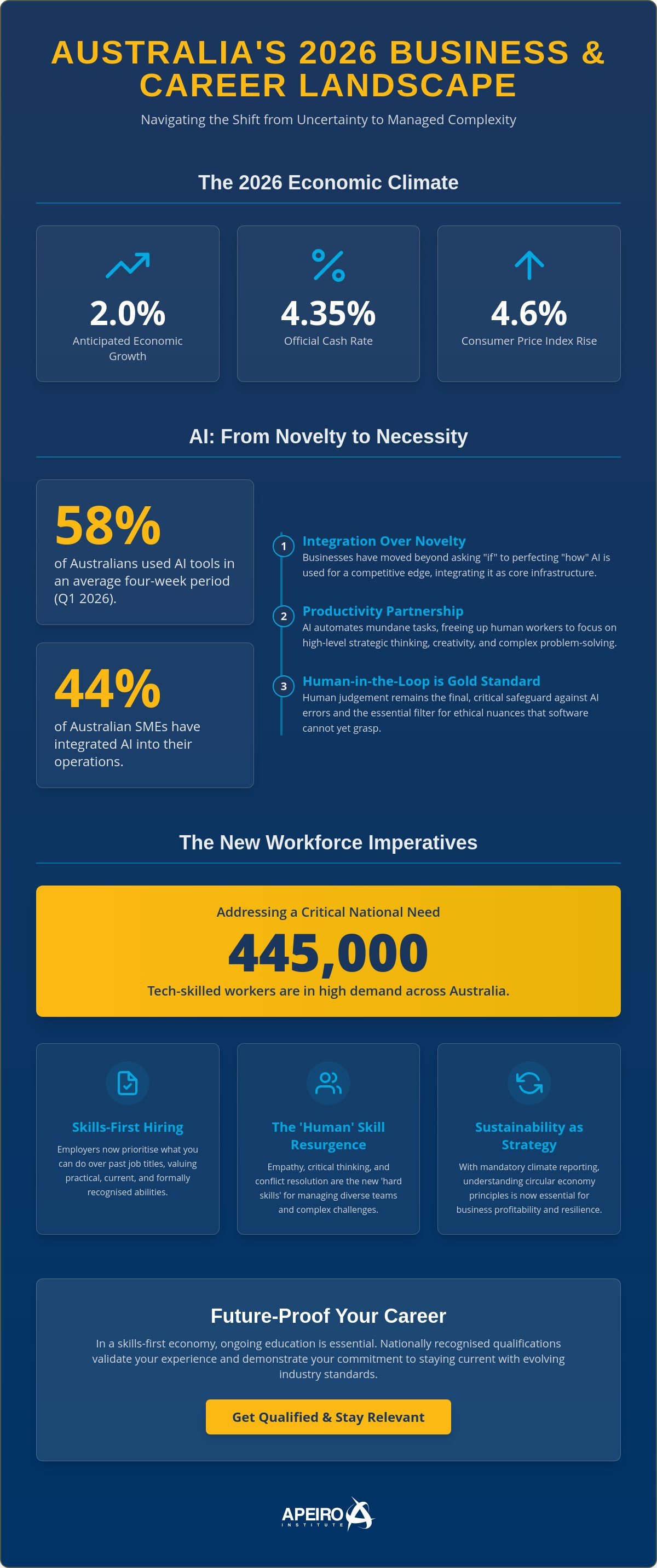
Did you know that 58% of Australians used AI tools in an average four-week period during the first quarter of 2026? It's a staggering figure that highlights just how quickly our workplaces are changing. If you're feeling a bit unsettled by the pace of this shift, you aren't alone. It's perfectly natural to wonder which parts of your role might be automated or how to keep your skills relevant when the goalposts seem to move every month. Understanding the current business trends is the most effective way to turn that uncertainty into a clear competitive advantage.
We've put this guide together to help you make sense of the 2026 economic climate and find your place within it. You'll learn about the rising demand for 445,000 tech-skilled workers and why "human" traits like empathy and critical thinking have become your greatest assets. We'll explore the move toward mandatory sustainability reporting and identify the high-growth industries where your talents are needed most. By the end, you'll have a practical pathway to gaining the nationally recognised qualifications that will help you thrive in the years ahead.
Key Takeaways
- Understand how the Australian market is moving beyond digital uncertainty toward a period of managed complexity.
- Discover how to align your career with current business trends by moving from AI novelty to essential workplace infrastructure.
- Learn why sustainability and circular economy principles have become essential profit drivers for modern Australian organisations.
- Recognise why emotional intelligence and conflict resolution are now the most critical "hard" skills for managing diverse teams.
- Identify the fastest vocational pathways to get qualified and stay relevant in a rapidly changing economic landscape.
The 2026 Australian Business Landscape: Beyond the Buzzwords
The Australian economic landscape has undergone a profound shift as we move through 2026. We've transitioned from a period of reactive "uncertainty" into one of "managed complexity." While the economy is anticipated to grow at a steady rate of 2.0% this year, businesses are no longer waiting for a return to the old ways of working. Instead, they're building systems that can withstand a 4.35% cash rate and a Consumer Price Index rise that reached 4.6% earlier in the year. For professionals, understanding these business trends isn't just for CEOs; it's the key to making informed decisions about your own career path.
By mid-2026, the era of "waiting and seeing" regarding digital transformation has officially ended. Organisations have realised that technology isn't a separate department anymore. It's the very foundation of how we provide value. This means the Australian workforce is now competing on a global stage, where our local expertise must be paired with a high level of digital fluency. National industry standards are evolving rapidly to reflect this, with a renewed focus on data security and sustainable operations that meet new mandatory climate disclosure requirements.
The Shift from Growth at All Costs to Sustainable Value
Business resilience is now the top priority for Australian firms. We've seen a move away from the frantic, high-growth-at-any-cost mindset that dominated previous years. Today, success is measured by how well an organisation can maintain stability through supply chain disruptions and shifting local demands. Companies are restructuring to be more agile, often by flattening their management layers and empowering smaller, multi-skilled teams to make decisions faster. This focus on "sustainable value" means that businesses are looking for employees who don't just perform a task, but who understand how their work contributes to the long-term health of the company.
The New Labour Market Reality
We are currently seeing a "skills-first" hiring trend across the country. Employers are looking past traditional job titles to see what a candidate can actually do. While practical industry experience remains vital, it's now being paired with the need for formal, current qualifications. This is where vocational pathways have become incredibly popular. Programmes like Trade Pathways for Experienced Workers (TPEW) are bridging the gap for many professionals. They allow experienced individuals to have their existing skills recognised formally, ensuring they stay relevant as business trends continue to evolve. In 2026, the most successful workers are those who treat their education as an ongoing journey rather than a one-time event.
The AI Maturity Curve: From Novelty to Essential Infrastructure
In 2026, we've moved past the initial shock of generative technology. We're now seeing business trends shift toward what experts call the AI Maturity Curve. This maturity represents the point where AI tools aren't just shiny new toys; they're the invisible plumbing of our daily workflows. It's about seamless integration. Australian businesses have stopped asking "if" they should use AI and started perfecting "how" they use it to gain a competitive edge. It's no longer a bolt-on feature, but a core part of the organisational strategy.
The hype has finally settled. We're seeing real productivity gains across the board. Research from early 2026 showed that 43-44% of Australian SMEs have now adopted some level of AI integration into their operations. They're using specialised "Local Knowledge" LLMs. These are models trained specifically on Australian regulatory frameworks and local business contexts. This ensures that the advice or content generated isn't just generic, but legally and culturally accurate for our unique market. It's a massive step forward for efficiency.
Even with these advanced tools, the "human-in-the-loop" model remains the gold standard. Human judgement is the final safeguard. It's the check against hallucinations and the filter for ethical nuances that software simply cannot grasp yet. Relying solely on automation is a risk most Australian firms aren't willing to take in 2026.
AI as a Productivity Partner, Not a Replacement
Workflows in 2026 are designed to automate the mundane. This frees up your time for high-level strategic thinking. For example, many Australian small businesses now use AI to analyse customer data patterns in real-time. This allows them to make data-driven decisions that were previously only possible for large corporations with massive budgets. However, this power comes with a responsibility to manage data privacy and bias. Protecting client information isn't just a legal requirement; it's a foundation of brand trust. Ethical management of these tools is now a non-negotiable part of the job.
As these tools become more sophisticated, many professionals are turning to IAB Academy to gain a deeper understanding of how AI can be applied to financial analysis and investment strategies, ensuring they remain competitive in an increasingly automated market.
The Demand for AI-Literate Managers
There's a growing need for leaders who understand tech architecture. You don't need to be a computer scientist, but you must be able to bridge the gap between technical teams and the executive boardroom. AI Literacy is the ability to critically evaluate and implement automated solutions. Modern managers must understand how to vet a tool for security and efficiency before rolling it out to their teams. If you're looking to lead in this environment, exploring Trade Pathways for Experienced Workers can help you formalise your expertise and stay ahead of the curve as these technologies evolve. It's about being prepared for a future where technology and human leadership work side by side.
Sustainability as Strategy: The Rise of Climate-Aligned Models
The shift toward sustainability has moved from a "nice-to-have" marketing angle to a core operational requirement. Looking at Australian business landscape statistics, it's clear that the organisations thriving in 2026 are those aligning with climate-related financial disclosures. This year marks a critical turning point. While Group 1 entities have already begun mandatory reporting, the ripple effect is reaching businesses of all sizes. It's one of the most significant business trends we've seen since the digital revolution, and it's changing how we think about profit.
Waste reduction is no longer just about being "green"; it's a primary profit driver. The transition to a circular economy means that companies are finding ways to turn their waste streams into new revenue. By keeping materials in use for longer, businesses are insulating themselves against local supply chain price hikes. This focus on resilience is exactly what we discussed in the previous sections regarding managed complexity. Aligning with national sustainability targets isn't just a legal obligation; it's a strategic move to ensure long-term viability in a resource-conscious market.
Green Skills: The New Requirement
We're seeing the emergence of "sustainability officer" roles within traditional business structures. These professionals aren't just activists. They're efficiency experts who integrate eco-friendly practices into standard operating procedures. The financial benefits are hard to ignore. Energy efficiency and sustainable procurement can lead to a noticeable reduction in overheads. If you're looking to advance your career, gaining a foundational understanding of ESG (Environmental, Social, and Governance) principles is a brilliant way to stay relevant. It shows employers you're ready to lead in a climate-aligned economy.
Consumer Expectations in 2026
Australian consumers are demanding radical transparency in the supply chain. They want to know exactly where products come from and the impact they have on the planet. This has made "greenwashing" a massive risk for any brand. Authentic trust is built through data-driven disclosures rather than vague marketing claims. This social conscience also extends to the workforce. The best talent in 2026 will choose to work for organisations that share their values. By aligning your business values with this collective conscience, you aren't just doing the right thing; you're securing the future of your team and your brand.
The Soft Skill Resurgence: Why "Human" Skills are the New Hard Skills
As we move through 2026, a surprising shift has occurred in the Australian workplace. While much of the conversation focuses on automation, one of the most defining business trends is the "Soft Skill Resurgence." We've reached a point where technical skills are the baseline, but uniquely "human" abilities are the real differentiator. Success now depends heavily on Emotional Intelligence (EQ). It's about your ability to read a room, understand diverse perspectives, and lead with genuine empathy.
Conflict resolution has climbed to the top of the priority list for hiring managers. Managing diverse, hybrid teams isn't just about checking a dashboard; it's about navigating the subtle interpersonal dynamics that arise when people aren't always in the same room. You need to be adaptable. "Learning Agility"—the capacity to rapidly unlearn old habits and embrace new ways of working—is now a core professional asset. Leaders who can project stability while remaining flexible are the ones who will thrive in this environment.
Leading Through Uncertainty and Volatility
Maintaining team morale during rapid industry shifts is a significant challenge for any manager. It requires clear, inclusive communication that resonates across a multi-generational workforce. You have to bridge the gap between different work styles and expectations. This is where formal training can make a world of difference. You can learn how to organise and lead teams effectively in a high-pressure environment, ensuring your team stays productive and engaged regardless of external volatility.
Strategic Management in a Hybrid World
The hybrid work model has matured. We're no longer just "getting by" with remote setups. We're refining the balance between flexibility and the need for in-office collaboration. Performance metrics have evolved too. In 2026, we measure outcomes, not hours spent at a desk. Building a cohesive company culture is harder when your team is geographically dispersed, but it's more important than ever. This shift reflects broader business trends that prioritise human-centric management over rigid hierarchies. It requires intentionality and a focus on shared values to keep a team connected.
If you're ready to develop the high-level leadership skills required for this new era, explore the range of nationally recognised qualifications at Apeiro Institute to help you lead with confidence.
Future-Proofing Your Career with Nationally Recognised Qualifications
Understanding the shifts in the market is only the first step. To truly thrive, you must translate these business trends into a set of verifiable skills that employers trust. In 2026, a vocational pathway has emerged as the most efficient way to stay ahead. Unlike longer academic routes, vocational education focuses on the immediate application of knowledge. This allows you to pivot your career quickly as new technologies and sustainability requirements reshape your industry. Studying with a nationally recognised Registered Training Organisation (RTO) like Apeiro Institute ensures your credentials meet rigorous Australian standards, giving you a significant advantage in a competitive job market.
If you're looking to transition into a new role, a Diploma of Business in Australia provides a versatile foundation. It covers the essential management and operational skills discussed in our previous sections, from digital fluency to ethical leadership. For those who already have years of hands-on experience but lack the paperwork to prove it, Trade Pathways for Experienced Workers offer a streamlined solution. This process allows you to formalise your existing expertise through Recognition of Prior Learning (RPL). It's a practical way to ensure your hard-earned skills are visible to recruiters looking for 2026-ready talent.
From Management to Executive Leadership
Moving into the upper tiers of an organisation requires a shift in perspective. A Graduate Diploma of Business Management is designed to prepare you for these high-level executive roles. It helps you combine your practical industry experience with formal theoretical frameworks, such as strategic risk management and global supply chain logistics. You'll also benefit from a diverse, global student community. These networking opportunities are invaluable in 2026, as they provide different cultural insights that help you lead more effectively in a globalised economy.
Your 2026 Career Action Plan
Now is the time to be proactive. Start by identifying your own skill gaps based on the business trends we've explored. Do you need to improve your AI literacy, or is it time to sharpen your soft skills for a hybrid management role? Once you've identified your goals, choose the qualification level that matches your professional objectives. Taking the first step is simpler than you might think. You can reach out to our supportive team at Apeiro Institute to discuss your options and learn how to enrol. We're here to act as your partner in success, guiding you through every step of your 2026 professional journey.
Taking Your Next Step in the 2026 Economy
Navigating the 2026 landscape means more than just keeping up with the latest software. It's about finding the perfect balance between AI-driven efficiency and the high-level human leadership that machines simply can't replicate. We've seen how sustainability has shifted from a voluntary side-project to a mandatory financial strategy for organisations of all sizes. These business trends highlight a clear path forward; the most successful professionals will be those who can combine digital literacy with deep emotional intelligence and a commitment to sustainable value.
Apeiro Institute is here to help you turn these insights into a practical, actionable career plan. As a nationally recognised provider (RTO 45394, CRICOS Provider 03703M), we offer industry-focused training that prioritises practical outcomes. Our vibrant community represents over 38 nationalities, ensuring you learn in an inclusive environment that reflects the modern Australian workplace. Whether you're looking to formalise your existing expertise or pivot into a leadership role, we're ready to support your personal and professional growth. Explore Nationally Recognised Business Qualifications at Apeiro Institute today and start building the future you want. You have the talent; we're just here to help you prove it to the world.
Frequently Asked Questions
What are the top 3 business trends in Australia for 2026?
The top three business trends for 2026 are AI maturity, mandatory sustainability disclosures, and the prioritisation of emotional intelligence. These trends represent a shift from reactive technology adoption to a more strategic, human-centred approach in the workplace. Organisations are focusing on long-term resilience rather than just rapid scaling.
How will AI change the way Australian businesses operate in 2026?
AI will move from a standalone tool to essential infrastructure that powers everyday business workflows. Companies are now using generative tools to automate repetitive tasks, allowing teams to focus on high-level strategy and complex problem-solving. This shift requires a "human-in-the-loop" approach to ensure ethical standards and data privacy are maintained.
What skills are most in demand for managers in 2026?
Managers in 2026 need a high level of emotional intelligence, conflict resolution skills, and the ability to lead hybrid teams. They must also possess "AI literacy," which involves critically evaluating and implementing automated solutions within their departments. "Learning Agility" has become a core asset for those navigating rapid industry shifts.
Is a Diploma of Business still worth it in 2026?
Absolutely, a Diploma of Business remains a highly valuable asset because it provides a versatile foundation for navigating modern management challenges. It's particularly useful for career changers who need to align their skills with current business trends and industry standards quickly. The qualification proves you have the formal frameworks to lead effectively.
How can I stay relevant in a rapidly changing business environment?
You can stay relevant by treating your education as an ongoing journey rather than a one-off event. Focus on gaining micro-credentials and formal qualifications that prove your ability to adapt to new technologies and shifting market demands. Regularly identifying your skill gaps and seeking nationally recognised training is the best way to maintain your competitive edge.
What is the role of sustainability in 2026 business strategy?
Sustainability is now a core profit driver and a mandatory reporting requirement for many Australian organisations. It involves integrating circular economy principles into standard operations to reduce waste and improve long-term business resilience. Consumers now demand radical transparency, making authentic green practices essential for brand trust.
How does vocational training help with career progression in 2026?
Vocational training offers the fastest pathway to align your skills with the 2026 economic landscape. It focuses on practical, industry-aligned outcomes that allow you to apply your learning immediately in a professional setting. This direct approach is highly valued by employers who need workers ready to tackle current challenges.
Can I get a qualification based on my existing work experience in 2026?
Yes, you can formalise your existing expertise through Recognition of Prior Learning (RPL) processes. Programmes like Trade Pathways for Experienced Workers are designed specifically to help skilled professionals gain a formal qualification based on their years of on-the-job experience. It's a practical way to ensure your skills are officially recognised by recruiters.
Disclaimer
The information provided on this blog is for general informational and educational purposes only. While every effort is made to ensure the accuracy and reliability of the content, the author makes no representations or warranties of any kind, express or implied, about the completeness, accuracy, suitability, or availability of the information contained on this blog.
The views and opinions expressed in blog posts are those of the individual author and do not necessarily reflect the official policy or position of any organization, company, or employer.
This blog may contain links to external websites or third-party content. These links are provided for convenience only, and the author has no control over and assumes no responsibility for the content, privacy policies, or practices of any third-party sites.
Nothing on this blog constitutes professional advice (legal, financial, medical, or otherwise). Readers are encouraged to seek appropriate professional guidance before making any decisions based on the information provided here.
By using this blog, you acknowledge that any reliance on the information is at your own risk.


