

How many years have you spent mastering your trade, only to find your career stalled because you lack a formal certificate? It's a common frustration for skilled workers who know their industry inside out but feel trapped in mid-level roles without the right paperwork. You shouldn't have to spend months in a classroom listening to lectures about things you already do every day on the job.
We understand that your time is valuable and your experience is your greatest asset. That's why recognition of prior learning vocational pathways are designed to respect the expertise you've built through years of hard work. You can skip the redundant training and move straight to an assessment that acknowledges what you already know. This guide provides everything you need to turn your practical skills into a nationally recognised Australian qualification in 2026. We'll walk you through the latest RTO standards, the evidence required to prove your competency, and the exact steps to formalise your trade experience so you can finally unlock the higher earning potential you deserve.
Key Takeaways
- Discover how to skip the classroom and transform your existing industry skills into a formal qualification recognised across Australia.
- Understand the four essential rules of evidence—validity, sufficiency, authenticity, and currency—that assessors use to verify your professional expertise.
- Learn how recognition of prior learning vocational pathways align with the Australian Qualifications Framework (AQF) to boost your career standing and earning potential.
- Follow a clear, step-by-step guide to mapping your daily work tasks against national standards and building a winning portfolio of evidence.
- Explore specialised trade pathways that help experienced workers in automotive, electronics, and construction design secure their certificates faster.
What is Recognition of Prior Learning (RPL) in Vocational Education?
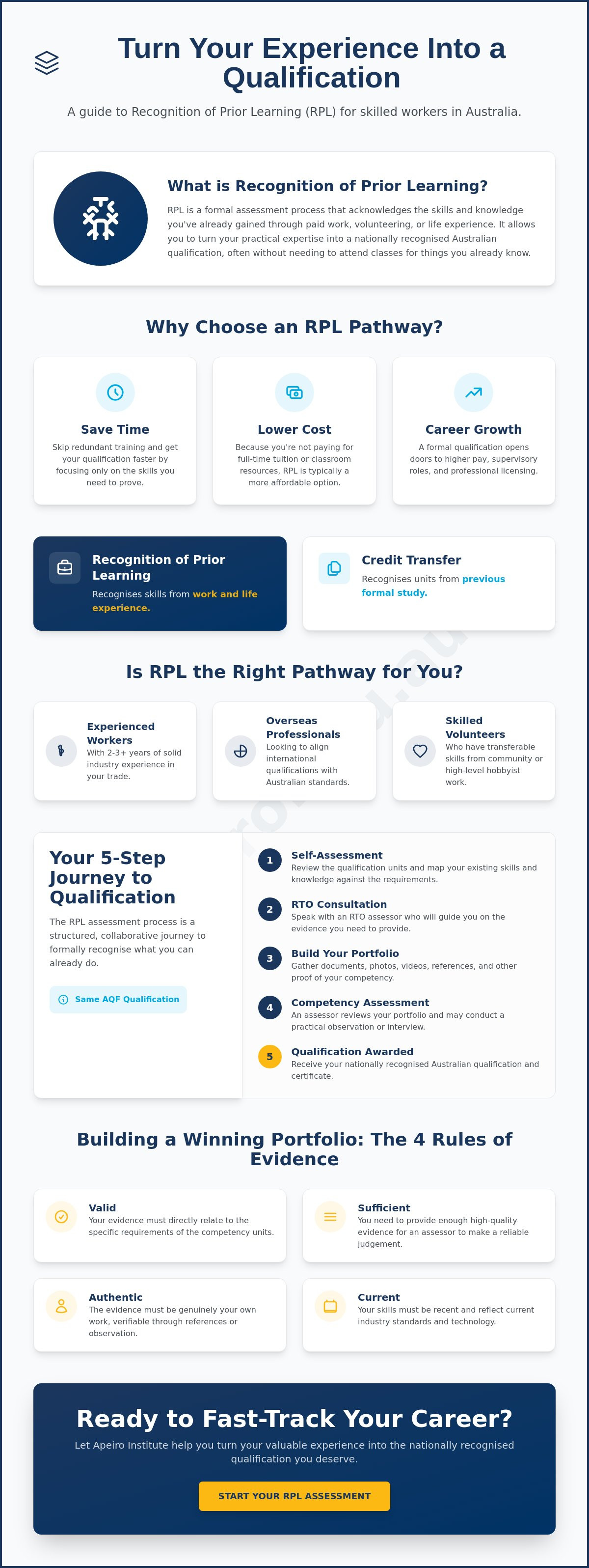
Think about everything you've learned on the tools, in the office, or while managing a team over the last few years. You've likely developed a high level of expertise that isn't reflected on a piece of paper. This is where recognition of prior learning vocational pathways become essential. RPL is the formal process of identifying, assessing, and acknowledging the skills and knowledge you already possess. It doesn't matter whether you gained these abilities through paid work, volunteering, or life experience; if you can prove your competency, it counts.
Many people worry that a certificate earned through assessment won't be as valuable as one earned through a three-year course. That isn't the case. Every RPL assessment in Australia is tied directly to the Australian Qualifications Framework (AQF). This national system ensures that the standards for a Certificate III or a Diploma remain consistent across the country. Whether you sit in a classroom for six months or complete an RPL portfolio, you receive the exact same nationally recognised qualification. It's a rigorous process that honours your hard work while skipping the redundant theory you've already mastered.
Choosing this pathway offers several practical advantages for your career. You'll significantly reduce the time spent away from work, as you won't need to attend lectures for subjects you already understand. Because you aren't paying for full-time tuition and classroom resources, the overall cost is typically lower. Most importantly, it provides a faster route to career progression. Getting your skills on paper opens doors to higher pay grades, supervisory roles, and professional licensing that might otherwise be out of reach.
The Difference Between RPL and Credit Transfer
It's easy to confuse these two terms, but they serve different purposes. Credit transfer is used when you've already completed a formal unit of competency at another Registered Training Organisation (RTO) and want to move that credit to a new course. In contrast, What is Recognition of Prior Learning (RPL) is about proving your competency through informal or on-the-job experience. Simply put: credit transfer recognises previous study, while RPL recognises previous work.
Who is Eligible for a Vocational RPL Assessment?
You don't need a specific background to apply, but you do need evidence. Generally, the best candidates for this process include:
- Experienced Workers: If you've spent at least 2-3 years in your industry, you likely have enough evidence to meet the requirements for several units.
- Overseas Professionals: If you hold qualifications from another country, RPL can help align those skills with Australian standards, making you more employable locally.
- Skilled Volunteers: People who have performed high-level tasks in community organisations or hobbyist groups often find their practical skills are transferable to a formal qualification.
If you're unsure where your experience fits, exploring Trade Pathways for Experienced Workers (TPEW) is a great way to see how your specific background matches up with current industry needs.
How the Vocational RPL Assessment Process Works
The journey toward a formal qualification begins with a simple look at your daily routine. Before you submit a single document, you'll need to conduct a self-assessment. This involves reviewing the units within a specific qualification and asking yourself if you've performed those tasks consistently over time. It's about matching your real-world actions to the formal requirements of the Australian vocational system. If you've been leading teams or troubleshooting complex electrical systems, you're already halfway there.
Once you've identified a likely match, your Registered Training Organisation (RTO) assessor steps in. This person acts as your mentor and evaluator throughout the Vocational RPL Assessment Process. Their role isn't to catch you out, but to help you curate a portfolio of evidence that proves your competency. They look for high-quality documentation that demonstrates you can perform tasks to the required industry standard. This collaborative approach ensures the process remains transparent and focused on your actual achievements.
Every qualification is broken down into individual Units of Competency. Each unit has specific criteria you must meet. During the recognition of prior learning vocational assessment, the assessor "maps" your evidence against these units. If your portfolio shows you've mastered 90% of the course, you won't be asked to repeat that learning. Instead, you might only need "gap training" for the remaining 10%. This targeted training is the fastest way to bridge the divide between your current experience and a full certificate.
The Pre-Assessment Interview
The first formal step is often a conversation with an experienced trainer. This is your chance to deliver an "elevator pitch" of your career. Be ready to describe the projects you've managed, the tools you use, and the level of responsibility you hold. This interview helps the assessor determine if you should aim for a Certificate III or a higher-level Diploma. It's a reassuring way to ensure you're on the right path before you invest too much time in gathering paperwork.
Competency Mapping Explained
Mapping is the technical heart of the process. The assessor takes your resume, photos of your work, and supervisor reports to see where they fit within the national training package. If a particular piece of evidence is unclear, they might suggest a "Challenge Test". This is a practical demonstration where you show your skills in a controlled environment. Apeiro Institute specialises in this detailed mapping, particularly through their Trade Pathways for Experienced Workers (TPEW), ensuring that every bit of your industry knowledge is accounted for. If you're ready to see how your skills map out, speaking with an expert can clarify your next steps immediately.
Gathering Your Evidence: What Do RPL Assessors Look For?
Once you understand how the mapping works, the next step is building your portfolio. When you commit to a recognition of prior learning vocational assessment, you are essentially building a legal case for your own competence. Assessors don't just look for a large volume of paperwork; they look for quality. To ensure your application is successful, every piece of evidence you provide must meet the four rules of evidence required by Australian RTO standards.
- Validity: Does the evidence directly relate to the unit of competency you are claiming?
- Sufficiency: Is there enough proof to show you can perform the task consistently over time, not just once?
- Authenticity: Can you prove the work is yours and not the result of a team effort where you played a minor role?
- Currency: Are the skills still fresh in your mind and relevant to current industry practices?
The core of your application will likely include foundational documents like detailed pay slips, current position descriptions, and your resume. However, the most powerful tool in your kit is often the "Third Party Report". This is a formal statement from a supervisor, client, or licensed contractor who has watched you work. They verify that you perform tasks to a professional standard, which adds a layer of trust that your own documents cannot provide on their own. Organising these files into clear folders labelled by unit of competency will make the assessor’s job easier and speed up your result.
Hard Evidence vs. Soft Evidence
A successful application requires a balance of different proof types. Hard evidence includes tangible items like photos of your work, technical drawings, site logs, or previous non-accredited certificates. For those pursuing a Certificate III in Light Vehicle Mechanical Technology, this might mean photos of a complex engine rebuild you completed. Soft evidence supports these facts through statutory declarations, personal references, and detailed resumes. You need both to tell a complete story of your career.
Digital Proof: Using Technology to Prove Your Skills
In 2026, technology has made gathering evidence much simpler. Using video recordings is a brilliant way to demonstrate practical trade skills safely without an assessor needing to be on-site. You can record yourself performing a specific task, such as a diagnostic test or a safety check, and upload it directly to your digital portfolio. Time-stamped project photos also provide a clear timeline of your involvement in long-term jobs. Currency means showing you have used the skill recently, usually within the last two to three years, to ensure your knowledge aligns with current Australian safety standards. If you are unsure if your digital files are enough, the team at Apeiro Institute can review your initial collection to ensure it meets the mark.
Step-by-Step Guide to Applying for Your RPL Certificate
The path to a formal qualification doesn't have to be a confusing maze of paperwork. Once you've decided to turn your experience into a certificate, following a logical sequence makes the recognition of prior learning vocational process feel manageable. It's about moving from a general idea of your skills to a structured portfolio that an assessor can easily verify.
- Step 1: Identify your qualification. Look at what you actually do every day. If you're working in community care, a Diploma of Community Services might be the right fit. Match your responsibilities to the most relevant national code.
- Step 2: Gather foundational documents. Start with the basics. You'll need an updated resume, current photo ID, and any old certificates or records of results from previous study.
- Step 3: Preliminary review. Before paying full fees, a qualified RTO should conduct an initial check. This conversation ensures you're aiming for the right level and have a high chance of success.
- Step 4: Formal submission. This is where you upload your "portfolio of evidence" that we discussed in the previous section. You'll submit your photos, videos, and supervisor reports.
- Step 5: Assessment and outcome. The assessor reviews your files. If everything matches, you're awarded the qualification. If there are small holes in your experience, you'll complete targeted gap training to finish the course.
Avoiding Common RPL Application Mistakes
Don't fall into the trap of thinking "more is always better." Providing 500 irrelevant photos of every job site you've ever visited only slows down the process. Assessors want specific proof for specific units. Quality beats quantity every time. You must also ensure every document is signed and verified. Unsigned references or blurry photos of ID will lead to immediate delays. Finally, be honest. Assessors are industry experts who have worked in your trade for years. They can spot "fluffed" experience quickly, so stick to the genuine skills you've mastered on the job.
Managing the Costs and Timeline
It's a common misconception that RPL is free because you aren't sitting in a class. You're paying for the expert time required to map your career against national standards. However, it's almost always more affordable than a full-time course. Most assessments are completed within a few weeks rather than the months or years a traditional apprenticeship might take. For many, choosing Trade Pathways for Experienced Workers is the most efficient route to graduation. If you're ready to get started, you can book a preliminary skills review today to see where you stand.
Fast-Track Your Career with Apeiro Institute’s Trade Pathways
You’ve already done the hard yards on site, in the workshop, or behind a drafting desk. Now it’s time to let that experience work for you. At Apeiro Institute, we specialise in recognition of prior learning vocational pathways that turn your years of dedication into a tangible career asset. We don't see you as just another student; we see you as a professional whose skills deserve formal acknowledgement. Our Trade Pathways for Experienced Workers (TPEW) are designed to bridge the gap between your current expertise and the nationally recognised qualification you need to level up.
Our approach focuses on practical vocational outcomes that reflect the modern Australian workforce. We support a diverse community of learners, from local tradies looking to start their own business to international workers seeking to align their overseas experience with Australian standards. By choosing a partner that understands the nuances of trade evidence, you can avoid the frustration of repetitive training and focus on what matters most: your career progression and earning potential.
Specialist RPL for Trades
We know that every trade has its own language and specific requirements. For mechanics, our Certificate III in Light Vehicle Mechanical Technology pathway is a popular choice for those who have spent years under the bonnet but lack the formal ticket. We also offer comprehensive pathways for electronics professionals through our electronics and communications courses, ensuring your technical knowledge is mapped accurately against current national standards. Our assessors aren't just academics; they are industry veterans who understand the specific needs and challenges of Aussie tradies. They know what real-world competency looks like on a job site, which makes the evidence gathering process much smoother for you.
Your Next Steps to Certification
Starting your journey is simpler than you might think. The first step is to book a free initial consultation with our team. During this chat, we’ll discuss your work history, look at the evidence you already have, and determine which qualification level fits your goals. We take pride in being an inclusive training centre, providing dedicated support for both local students and international professionals. In fact, research indicates that over 70% of international students in Australia consider RPL a vital pathway for career advancement. Whether you are looking to meet licensing requirements or simply want the recognition you've earned, we are here to guide you through every step of the recognition of prior learning vocational process. Don't let your skills stay unofficial. Enquire about your RPL pathway today and take the lead in your professional future.
Unlock Your Professional Potential Today
Your years of hard work on the job shouldn't go unrecognised. By choosing a recognition of prior learning vocational pathway, you can finally bridge the gap between your practical expertise and a formal certificate. We've explored how a well-organised portfolio of evidence allows you to skip redundant training and focus on achieving a nationally recognised qualification that reflects your true skill level. This process is about respecting the time you've already spent in the industry and giving you the tools to move into higher-level roles.
Apeiro Institute is here to act as your partner in this journey. As a provider of Nationally Recognised Training (RTO 45394), we are specialists in Trade Pathways for Experienced Workers. With campuses in Perth and Sydney serving students Australia-wide, we provide the expert guidance needed to map your career accurately against Australian standards. You don't have to navigate the requirements alone. Our assessors understand the value of your time and the depth of your industry knowledge. It's time to stop letting a lack of paperwork hold you back from higher pay and better opportunities. Get your trade experience recognised with Apeiro Institute and start the next chapter of your career with confidence. Your future is waiting; let's make it official.
Frequently Asked Questions
Is an RPL certificate the same as a normal qualification?
Yes, a certificate earned through RPL is exactly the same as one obtained through traditional classroom study. It is a nationally recognised qualification issued by a Registered Training Organisation (RTO) and follows the same Australian Qualifications Framework (AQF) standards. Employers and licensing bodies view both pathways as equal because they confirm you have met the required industry competencies.
How much work experience do I need for RPL vocational assessment?
Most RTOs look for at least two to three years of recent, relevant experience in your industry. This timeframe ensures you have had enough exposure to different tasks to meet the sufficiency rule of evidence. While there is no strict legal minimum, having a solid history of full-time work makes it much easier to gather the documentation required for a successful recognition of prior learning vocational assessment.
Can I get RPL if I gained my experience overseas?
You can definitely use overseas experience to apply for RPL in Australia. Assessors look at your skills regardless of where they were acquired, provided you can prove they align with Australian industry standards. You will need to provide translated documents, such as references or work samples, and you might need to demonstrate your skills practically to show you understand local safety regulations and codes.
What happens if I don’t have enough evidence for a full qualification?
If your evidence only covers some parts of a qualification, you won't fail the entire process. Instead, you'll be awarded a Statement of Attainment for the units you've mastered and then complete gap training for the remaining units. This is a highly efficient way to study because you only pay for and attend classes for the specific skills you still need to learn.
How long does the recognition of prior learning process take?
The recognition of prior learning vocational process usually takes between two to six weeks once you have submitted your portfolio of evidence. This timeline is significantly faster than the months or years required for traditional study. The total duration often depends on how quickly you can collect your documents and supervisor reports, as the assessor's review typically happens quite promptly once everything is received.
Do I have to pay for an RPL assessment if I fail?
Yes, you are paying for the assessor's professional time and the formal evaluation process rather than the final certificate itself. Most RTOs charge an assessment fee upfront to cover the costs of reviewing your evidence and conducting interviews. This is why we recommend a preliminary review first; it helps ensure you have a high chance of success before you commit to the full application fee.
Can I use RPL to get a trade licence in Australia?
Yes, obtaining a nationally recognised qualification through RPL is a standard pathway toward getting a trade licence. Once you receive your certificate, you can apply to the relevant state regulator, such as Fair Trading or Consumer and Business Services, to obtain your licence. It's important to check the specific licensing requirements for your trade, as some may require additional exams or specific years of local experience.
Is RPL available for international students on a student visa?
International students on a student visa are eligible for RPL, provided the process complies with the ESOS Act and their specific visa conditions. It can be a great way to reduce your study load and fast-track your graduation if you have previous experience from your home country. You should always speak with your RTO's admissions team to ensure the assessment is recorded correctly on your Confirmation of Enrolment (CoE).

Disclaimer
The information provided on this blog is for general informational and educational purposes only. While every effort is made to ensure the accuracy and reliability of the content, the author makes no representations or warranties of any kind, express or implied, about the completeness, accuracy, suitability, or availability of the information contained on this blog.
The views and opinions expressed in blog posts are those of the individual author and do not necessarily reflect the official policy or position of any organization, company, or employer.
This blog may contain links to external websites or third-party content. These links are provided for convenience only, and the author has no control over and assumes no responsibility for the content, privacy policies, or practices of any third-party sites.
Nothing on this blog constitutes professional advice (legal, financial, medical, or otherwise). Readers are encouraged to seek appropriate professional guidance before making any decisions based on the information provided here.
By using this blog, you acknowledge that any reliance on the information is at your own risk.


