

What if the best place to start your Individual Support career isn’t with a course search, but with an employer offering a genuine traineeship? If you’re asking, “What employers offer Individual Support traineeships in NSW?”, look at aged care providers, disability support organisations and other community care employers. The key is to distinguish a paid job with formal training from a vacancy that requires you to already hold a qualification.
Job ads don’t always explain who employs the trainee, how workplace learning is arranged or which qualification the role leads to. A few checks can help you identify the employer, understand the training pathway and compare vacancies before applying.
A traineeship connects hands-on experience with nationally recognised training, including the CHC33021 Certificate III in Individual Support (Ageing and Disability). The employer provides the job and workplace experience, while a Registered Training Organisation (RTO) delivers the formal qualification. NSW Smart and Skilled funding may support eligible learners, but eligibility depends on individual circumstances. Understanding how these parts fit together makes it easier to assess an opportunity.
Key Takeaways
- Explore aged care, home care, disability support and community service organisations when searching for Individual Support traineeships in NSW.
- Distinguish a direct employer from a recruiter or Group Training Organisation, and identify who will employ you and where you’ll work.
- Search current vacancies and look for clear evidence that the role combines employment with formal training.
- Compare the qualification, RTO, work setting, duties and entry criteria in each advertisement.
- CHC33021 Certificate III in Individual Support (Ageing and Disability) can provide the formal training component, but course enrolment is separate from finding a job.
What does an Individual Support traineeship in NSW actually involve?
An Individual Support traineeship combines paid employment with structured vocational training. You work in a relevant support role while progressing towards a nationally recognised qualification. That is different from enrolling in a course independently: a course provides training, while a traineeship also involves an employment relationship and learning in the workplace.
A course gives you formal training; an employed traineeship combines training with a job and workplace experience. This distinction matters when comparing vacancies. An advertisement mentioning a Certificate III might be for a qualified worker, a student or an employed trainee. Look for explicit information about both the job and the training, rather than relying on the qualification name alone. For a general overview, see What is a traineeship?
How work and CHC33021 training fit together
The CHC33021 Certificate III in Individual Support relates to work in ageing and disability support. Formal training and workplace learning are connected, but they are not interchangeable. Training develops and assesses vocational knowledge and skills, while a job provides experience in a real work setting. The qualification includes Ageing and Disability specialisations, so check which pathway the vacancy and training arrangement refer to. Qualification packaging and traineeship requirements can change, so use current official information to confirm the details before committing.
For example, a trainee may study relevant concepts through an RTO while gaining practical experience in an employed support role. The duties, learning plan and qualification arrangements depend on the specific opportunity. Don’t assume that enrolling in a course makes you a trainee, or that every job ad mentioning training offers a formal qualification pathway.
Who is responsible for each part of the traineeship?
The employer offers the job and provides workplace experience. An RTO delivers the formal vocational training and assesses progress towards the qualification. A recruitment intermediary or Group Training Organisation may support recruitment or administration, depending on the arrangement. The organisation advertising a role, the legal employer and the day-to-day worksite may be different entities.
Before accepting an offer, identify who will employ you, where you’ll work, which RTO will deliver the training and what qualification the arrangement leads to. Read the employment and training details together, including how work and study fit into the arrangement. Check NSW traineeship contract and registration requirements against current NSW Government guidance rather than relying on an advertisement’s wording alone.
This role split also helps answer the question, “What employers offer Individual Support traineeships in NSW?” Employers provide the paid workplace pathway; RTOs deliver the qualification; intermediaries may support parts of the process. Apeiro Institute is an RTO, RTO 45394, and offers CHC33021 Certificate III in Individual Support. The training supports a qualification pathway, but it is separate from employment and job placement.
Which NSW employers commonly recruit Individual Support trainees?
If you’re asking, “What employers offer Individual Support traineeships in NSW?”, focus your search on organisations providing aged care, home support, disability services and community programs. These settings may offer roles suited to workplace learning, but an organisation’s involvement in care doesn’t mean it has a trainee vacancy at any particular time.
Residential aged care, home care, disability support and community service organisations are useful places to search, although vacancies vary between employers. Treat these as search categories, then assess each advertisement individually. A support-worker role isn’t automatically a traineeship just because the work relates to Individual Support.
Aged care and home support employers
Residential aged care providers operate care settings where support workers may assist older people with day-to-day needs. Home care services arrange support in people’s homes or communities. Both types of organisation may recruit entry-level staff, and some vacancies may combine employment with relevant training.
Search terms such as “Individual Support trainee”, “traineeship” and “Certificate III traineeship” can help you find relevant advertisements. Read the full listing: if it requires applicants to already hold a Certificate III, it may be a qualified-worker position rather than a role where you train while employed. Check what the ad says about the employer, employment arrangement and qualification pathway.
Disability and community support employers
Disability support organisations may recruit trainees for roles involving support for people with disability. Community service organisations are also worth including where their support work aligns with structured training. These are potential employer settings, not a guarantee of current vacancies.
Look beyond an organisation’s name or mission. The job description should explain whether training is part of the role. A support-worker vacancy may involve relevant work but require a qualification at entry, or it may offer no formal traineeship. If the advertisement is unclear, use its listed contact to clarify whether the role is an employed traineeship, which qualification it leads to and how the training is arranged.
To organise your search, group employers by setting and compare their advertisements for the same signals:
- Residential care: search aged care provider career pages for trainee-specific wording.
- Home support: include providers delivering in-home or community-based care.
- Disability services: look for trainee roles linked to disability support, not just general support-worker vacancies.
- Community services: include organisations offering relevant support work, and check that training is part of the advertised role.
Apeiro Institute offers the CHC33021 Certificate III in Individual Support (Ageing and Disability). The qualification can form part of a training pathway alongside suitable workplace experience. Reviewing the course details can help you understand the training component as you assess employer opportunities.
Direct employer, recruiter or training provider: who is offering what?
A vacancy can involve several organisations, so the name at the top of an advertisement may not identify either your employer or your training provider. A care organisation might hire a trainee directly, a recruitment intermediary might help source candidates, or a Group Training Organisation (GTO) may employ trainees and place them with host employers. An RTO has a separate training role.
Keep those roles distinct. Recruitment support can connect an applicant with an opportunity, but it is not the same as employing them. Similarly, an RTO can deliver and assess vocational training without offering a job. The role of each organisation should be clear in the vacancy and related documents.
When the care provider employs the trainee directly
If a care organisation offers the job directly, it is the employer and the employment documents should identify the employing entity. You may work at one of the organisation’s services while a separate RTO delivers the qualification. Compare the vacancy, employment agreement and training information to see who is responsible for each part.
When an intermediary or Group Training Organisation is involved
A recruitment intermediary may advertise a role, shortlist applicants or assist with recruitment administration without becoming the employer. In a GTO arrangement, the GTO generally employs the trainee and places them with a host workplace. Responsibilities depend on the arrangement, so read current NSW guidance and the documents for the specific opportunity rather than assuming all intermediaries work the same way.
Use this comparison to make sense of the organisations named in an advertisement:
| Organisation | Typical role | What to identify |
|---|---|---|
| Direct employer | Employs the trainee and provides the workplace. | The legal employing entity and worksite. |
| Recruitment intermediary | May promote vacancies or assist with recruitment. | Whether it is only recruiting or is also the employer. |
| Group Training Organisation | May employ trainees and place them with host employers. | The GTO, host workplace and how responsibilities are set out. |
| Registered Training Organisation | Delivers and assesses the formal vocational training. | The RTO and the qualification attached to the pathway. |
Before applying, note the names of the advertiser, proposed employer, worksite and RTO. Check that the vacancy and training information consistently explain those roles. Different organisation names in the documents don’t automatically indicate a problem, but you should understand how the arrangement works before accepting an offer.
So, what employers offer Individual Support traineeships in NSW? The employer is the organisation responsible for employing the trainee. That may be a care provider directly or, in some arrangements, a GTO. The RTO delivers training, not the job. Apeiro Institute offers the CHC33021 Certificate III in Individual Support as a training pathway separate from employment.
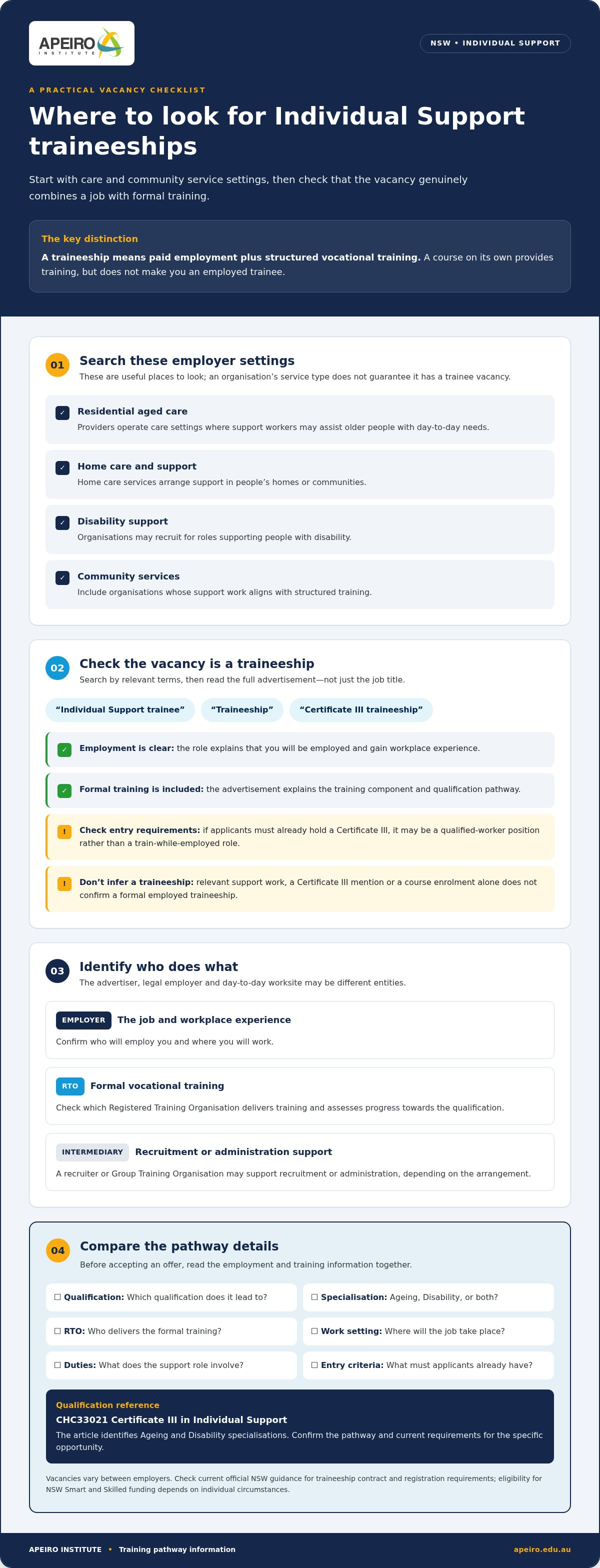
How to find and assess Individual Support traineeship vacancies in NSW
A clear search process helps you separate a work-and-training opportunity from a support-worker vacancy that only mentions a qualification. Search current listings, then compare what each advertisement says about the employer, job, training and application requirements. If important details are missing, clarify them with the listed recruiter or employer before relying on the role being a formal traineeship.
- Search current vacancies. Try job boards such as SEEK and Indeed, employer career pages, and relevant apprenticeship and traineeship recruitment services. Search terms such as “Individual Support traineeship”, “trainee support worker” and “CHC33021 traineeship” may surface different listings.
- Identify who is advertising and employing. Note the organisation named in the ad, the proposed legal employer and the work setting. If a recruiter or GTO is involved, establish its role in the arrangement.
- Confirm the training offer. Look for explicit traineeship wording, the qualification, the RTO delivering training and an explanation of workplace learning. A support-worker role or a course mention alone doesn’t establish that the job is a formal traineeship.
- Compare requirements and practical fit. Review the duties, supervision or support, entry criteria, application steps and work arrangements described. Check that the opportunity suits your availability and that you understand the selection process.
What to look for in a traineeship advertisement
A useful advertisement should state that the role is a traineeship, name or describe the qualification and outline the training arrangement. It should also provide enough information about the work setting, expected duties and application criteria for you to judge whether the opportunity fits. If the employer, training provider or employment details aren’t clear, note what is missing and use the listed contact to clarify it.
How to compare opportunities without relying on a job title
Job titles vary, so compare the substance of each offer: who employs you, where you’ll work, which RTO delivers training and what workplace support is described. Check the stated entry requirements and work arrangements against your circumstances. For funding, don’t rely on a general claim in a vacancy. Verify current NSW Government rules, eligibility and course availability, which can depend on individual circumstances and the training offered.
For context on NSW subsidies, read the Smart and Skilled funded training guide, then check current official information before making decisions about eligibility or course options. No job title tells the whole story. Apply the same checks to every listing so you can assess the actual employment and training pathway instead of relying on labels.
How Apeiro supports the training side of an Individual Support pathway
Finding an employer and choosing training are related steps, but they are separate decisions. Apeiro Institute is a Registered Training Organisation (RTO 45394) offering the CHC33021 Certificate III in Individual Support (Ageing and Disability). The qualification provides a formal learning pathway for people interested in Individual Support in ageing and disability contexts.
Training can help you develop recognised knowledge and skills, while workplace experience gives you the opportunity to apply learning in an employment setting. How those parts connect depends on your circumstances. You might explore study before applying for roles, or compare an RTO’s course details with a vacancy describing an employer-led traineeship. In either case, keep the distinction clear: enrolling in a course does not provide a job or guarantee a placement.
What the CHC33021 qualification can contribute
A nationally recognised qualification provides structured learning relevant to support work with older people and people with disability. It can complement workplace experience, allowing you to develop formal learning alongside practical exposure. The course is not a substitute for an employer’s recruitment process, and completing it doesn’t promise a particular role or career outcome.
As you review course information, consider how the qualification relates to your goals and the work you’d like to pursue. If you’re considering a traineeship advertisement, compare its stated qualification and training arrangements with the course details. Make sure you understand who provides the training, what the workplace component involves and whether the vacancy is an employed traineeship or a separate support-worker position.
Choosing a training pathway alongside an employer search
Set your learning goals beside the details in each vacancy. Note the qualification named, the RTO involved, the type of work setting and any training or workplace support described. This gives you a practical way to compare opportunities and identify which details you need to understand before deciding whether a role matches your interests and circumstances.
Funding may also affect your options. Apeiro Institute delivers NSW Smart and Skilled funded training, but eligibility depends on current NSW rules and individual circumstances. Read the relevant funding information and current official requirements before relying on a funding statement in a course description or vacancy.
When researching What employers offer Individual Support traineeships in NSW?, remember that an employer provides the employment pathway, while an RTO delivers the formal training. Understanding both parts helps you make an informed choice without assuming that a course guarantees work.
Explore the Apeiro Institute CHC33021 Certificate III in Individual Support (Ageing and Disability) course to see how recognised training may fit your learning goals and next career steps.
Take the next step towards your care career
You don’t need to resolve every career question at once. Start with what you want to learn, then use that goal to guide your search for suitable work and training. As you consider “What employers offer Individual Support traineeships in NSW?”, keep your priorities in view: the support setting that interests you, the experience you hope to gain and the qualification pathway that suits your goals.
Apeiro Institute is a Registered Training Organisation, RTO 45394, offering the CHC33021 Certificate III in Individual Support (Ageing and Disability). Reviewing the course information can help you understand the training component and decide how it may fit your plans. It’s a practical step towards making an informed choice while keeping study separate from employment.
Explore the course and consider how the training could fit your plans for work in Individual Support.
Frequently Asked Questions
Is an Individual Support traineeship the same as an aged care traineeship?
Not necessarily. Individual Support training can relate to both ageing and disability support, while an aged care traineeship may focus on work in aged care. Employers use different job titles, so check the qualification and training pathway rather than relying on the title alone. If you want to work with older people, look for details showing that the role and training align with that setting.
Can I start an Individual Support traineeship without previous experience?
Possibly. Some vacancies may suit applicants who are new to the sector, while others may require relevant experience, existing study or particular entry criteria. Read the selection requirements carefully and consider how to demonstrate transferable skills such as communication, reliability and working respectfully with others. Employers set the requirements for their roles, so assess each advertisement individually.
How long does an Individual Support traineeship take in NSW?
There isn’t one duration that applies to every opportunity. The timeframe can depend on the traineeship arrangement, training plan and how the qualification is delivered. Check the expected duration in the vacancy and employment or training documents, and clarify how progress is assessed if that information is missing. A standalone course and an employed traineeship may have different timeframes.
Can mature-age applicants apply for an Individual Support traineeship?
Yes. Mature-age applicants can apply if they meet the requirements for the particular vacancy and employment arrangement. Employers may set criteria around availability, experience or other role-related capabilities, so assess each listing on its own terms. Age may also be relevant to some training or funding rules, but it does not determine every aspect of eligibility. Check current NSW Smart and Skilled requirements separately from the employer’s selection criteria.
Can international students do an Individual Support traineeship in NSW?
It depends on the person’s work rights and the requirements of the specific job and training arrangement. Enrolling in a course does not automatically make an international student eligible for a traineeship, which involves employment as well as training. Check the conditions that apply to your visa and confirm the vacancy’s work and study requirements through the relevant official channels before applying or accepting an offer.
Does Smart and Skilled pay for every Individual Support traineeship?
No. Smart and Skilled funding doesn’t automatically apply to every applicant, course or traineeship. Eligibility depends on current NSW rules and individual circumstances, and funded training availability may depend on the course and provider. Before relying on a funding claim, check the latest NSW Government eligibility information and confirm how the specific training is funded. Keep funding eligibility separate from whether an employer offers you a traineeship.

Disclaimer
The information provided on this blog is for general informational and educational purposes only. While every effort is made to ensure the accuracy and reliability of the content, the author makes no representations or warranties of any kind, express or implied, about the completeness, accuracy, suitability, or availability of the information contained on this blog.
The views and opinions expressed in blog posts are those of the individual author and do not necessarily reflect the official policy or position of any organization, company, or employer.
This blog may contain links to external websites or third-party content. These links are provided for convenience only, and the author has no control over and assumes no responsibility for the content, privacy policies, or practices of any third-party sites.
Nothing on this blog constitutes professional advice (legal, financial, medical, or otherwise). Readers are encouraged to seek appropriate professional guidance before making any decisions based on the information provided here.
By using this blog, you acknowledge that any reliance on the information is at your own risk.


