

Could you earn a wage while building the skills and qualification needed for a career in aged care or disability support? A CHC33021 Certificate III in Individual Support Traineeship NSW pathway combines paid employment with formal training, but the role, qualification and funding arrangements all need to fit together.
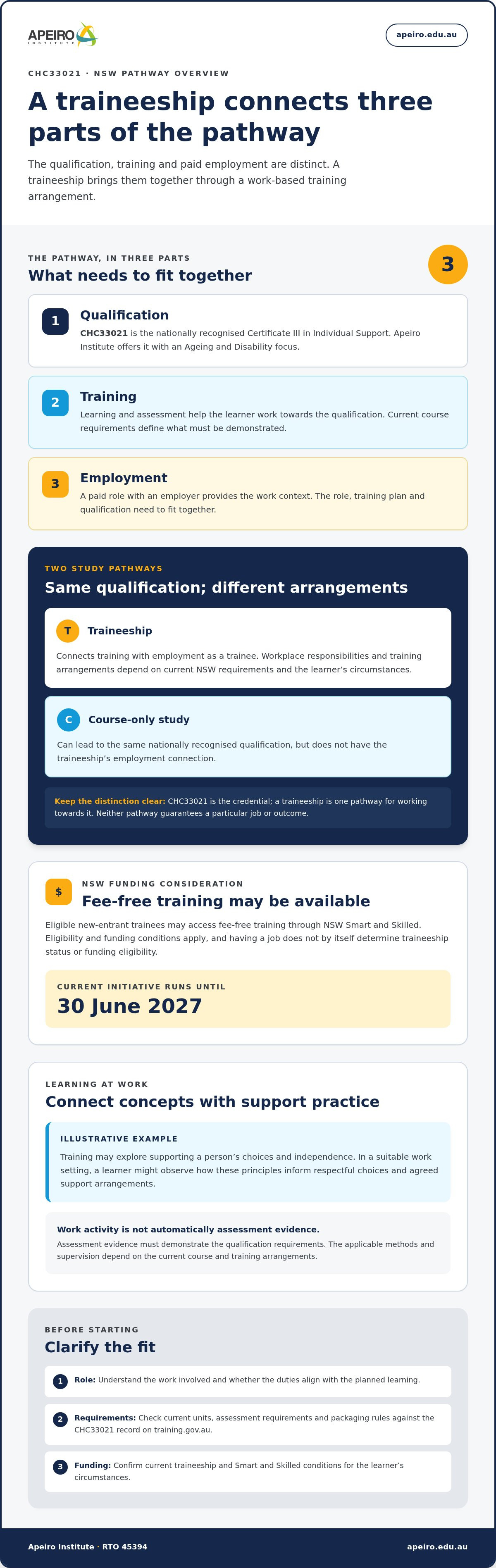
A traineeship and course-only study can lead to the same nationally recognised qualification, but they are different pathways. A traineeship connects training with employment as a trainee. Eligible new-entrant trainees may also access fee-free training through NSW Smart and Skilled, with the current initiative running until 30 June 2027. Eligibility and funding conditions apply.
This guide explains what the CHC33021 Certificate III in Individual Support (Ageing and Disability) covers, how workplace learning relates to the qualification, and how a traineeship compares with course-only study. It also outlines NSW considerations for learners and employers, including Smart and Skilled eligibility, fees and preparation steps. Apeiro Institute, an RTO (45394), delivers the qualification and NSW-funded training.
Key Takeaways
- Separate the qualification from the pathway: CHC33021 is the credential, while a traineeship connects training with employment.
- Consider how formal learning can relate to support work, such as applying person-centred care concepts in practical situations.
- Compare a CHC33021 Certificate III in Individual Support Traineeship NSW with course-only study by considering employment, workplace learning and training arrangements.
- Before planning enrolment, identify your intended role, understand Smart and Skilled eligibility, and review the funding conditions that apply to your circumstances.
- Explore Apeiro Institute’s CHC33021 course information and consider how the qualification aligns with your career goals.
CHC33021 Cert III Individual Support Traineeship in NSW
It helps to distinguish three parts of this pathway. CHC33021 is the nationally recognised qualification. Training is the learning and assessment used to work towards it. Employment is the paid role with an employer. A traineeship connects these parts through a work-based training arrangement. The requirements and responsibilities depend on current NSW traineeship arrangements, so learners and employers need to understand how the role, training plan and qualification fit together before starting.
The qualification’s full title is Certificate III in Individual Support. Apeiro Institute offers it with an Ageing and Disability focus, supporting learning relevant to work with people who need assistance in different care settings. The qualification and the traineeship are not interchangeable: people can study CHC33021 through different pathways, while a traineeship specifically connects training with employment. This distinction affects workplace responsibilities, training arrangements and potential funding.
For a CHC33021 Certificate III in Individual Support Traineeship NSW pathway, having a job does not, on its own, settle the training or funding details. Traineeship status and Smart and Skilled eligibility depend on current programme conditions and the learner’s circumstances. Employers should also consider how training relates to the person’s role, rather than treating course enrolment as a complete workplace development plan.
Who might consider an individual support traineeship?
A prospective support worker may value a traineeship if they want structured learning alongside relevant work experience. It may also suit an employer looking to develop an employee’s skills in connection with their role. Neither pathway guarantees a particular job or outcome. Suitability depends on the learner’s circumstances, the nature of the employment and whether current traineeship requirements can be met.
Before committing, clarify what the role involves and how training will fit around it. Employers can consider whether the planned duties align with the learning arrangements. Learners can weigh the study commitment against workplace expectations.
What does CHC33021 mean for a trainee?
“CHC” is the qualification code prefix, while “33021” identifies this specific training product. Certificate III in Individual Support is the full qualification title. Ageing and disability refer to the focus named in Apeiro’s offering; they do not, by themselves, specify the units or electives in an individual training plan.
Qualification details and packaging requirements can change, so use the current CHC33021 record on training.gov.au as the authoritative reference. Apeiro Institute, RTO 45394, delivers the CHC33021 Certificate III in Individual Support. Apeiro’s course information explains its qualification offering, while the official record provides the current training product details.
How CHC33021 training connects classroom learning with support work
Formal training gives learners a structured way to develop knowledge and skills. Relevant workplace learning can help them understand how that learning connects with support work by providing opportunities to apply and demonstrate it in an appropriate role.
For example, a learner might explore how to support a person’s choices and independence during training. In a suitable work setting, they may observe how those principles inform everyday interactions, such as offering choices respectfully and following the person’s agreed support arrangements. This illustrates how concepts can connect with practice. It is not a prescribed task or a guarantee that every trainee will complete the same activity.
Connecting theory with practice can make learning more meaningful and help employers relate staff development to role responsibilities. The arrangement depends on the training pathway, workplace context and current course requirements. A trainee’s day-to-day duties alone do not establish that they have met a qualification requirement.
How workplace learning and assessment fit together
Workplace learning may give a learner the opportunity to apply relevant knowledge in an appropriate role. Assessment is a separate process: evidence must demonstrate the qualification requirements, and the applicable methods and supervision arrangements depend on the current course and training arrangements.
Before making plans, use the current CHC33021 record on training.gov.au to review its units, assessment requirements and packaging rules. These details define the qualification requirements, while the training arrangement explains how the learner works towards them. Do not assume that performing a task at work automatically counts as assessment evidence.
Understanding the qualification’s ageing and disability focus
The ageing and disability focus areas relate to supporting people in different circumstances and settings. Someone interested in ageing support may be considering roles connected with older people, while someone drawn to disability support may be considering work supporting people with disability. These broad descriptions can help clarify career interests, but they do not define a learner’s duties or replace the qualification’s official requirements.
Think about the setting and role you are aiming for, then consider how the qualification’s current requirements relate to that direction. The Australian Government’s Australian Qualifications Framework (AQF) provides context for nationally recognised qualifications. Apeiro’s CHC33021 Individual Support qualification information describes its Ageing and Disability offering and can help you consider how the training relates to your goals.
For anyone weighing up a CHC33021 Certificate III in Individual Support Traineeship NSW, the practical question is how formal learning, the workplace role and current assessment requirements fit together. Understanding this connection helps learners and employers plan with clearer expectations, without assuming every workplace experience forms part of the qualification.
CHC33021 traineeship or course-only study: compare the NSW pathways
Both pathways can lead to the same CHC33021 qualification. The difference is how training fits alongside employment. A traineeship connects training with a relevant job, while course-only study takes place outside a formal traineeship arrangement. This affects how workplace learning fits your plans and which funding conditions may be relevant.
Use the comparison below to consider your starting point. If you already work in support, consider how a traineeship might fit your role. If you are looking for a new opportunity, the employment and training arrangements need to align. If you prefer to study without a traineeship, compare the course arrangements with your commitments and intended work setting.
| Consideration | Traineeship | Course-only study |
|---|---|---|
| Employment context | Training is connected with employment as a trainee in a relevant role. | Study is not undertaken through a formal traineeship arrangement. Employment may be separate. |
| Workplace learning | The role may provide a context for applying relevant learning, subject to course and assessment requirements. | How practical learning is arranged depends on the course and current requirements. |
| Training arrangements | The learner, employer and training provider need arrangements that align with the traineeship and qualification. | The learner follows the course arrangements, without the employment link that defines a traineeship. |
| Funding questions | Check whether the traineeship and learner meet current NSW Smart and Skilled conditions. | Check the funding and fee arrangements that apply to the learner and course pathway. |
When a traineeship may suit a learner or employer
A traineeship may suit someone who wants to combine relevant employment with structured training, or an employer developing a staff member’s skills in connection with their role. Employers can consider how the training fits work responsibilities and supports participation. The arrangement depends on the employer, learner and current programme requirements. Having a relevant role alone does not establish traineeship or funding eligibility.
When to consider studying without a traineeship
Course-only study is another way to undertake the same qualification, not a separate version of CHC33021. It may suit you if you want to study without a formal traineeship or your employment plans are still taking shape. Compare course arrangements with your work, caring and other commitments, and consider how the learning connects with the support-work setting you have in mind.
For either route, focus on fit rather than assuming one is faster or easier. Consider your current role, preferred learning approach, practical learning arrangements and any funding conditions that apply to your circumstances. Apeiro Institute delivers the qualification and NSW Smart and Skilled funded training. Its CHC33021 course information can help you understand the study pathway as you weigh up a CHC33021 Certificate III in Individual Support Traineeship NSW.
How to explore eligibility, Smart and Skilled funding and next steps in NSW
Investigate funding early, but do not assume every learner or trainee receives the same support. NSW Smart and Skilled assistance depends on current programme conditions and individual eligibility. A clear preparation process can help learners and employers identify the key questions before planning enrolment.
What to establish before starting a NSW traineeship
Start with the intended support-work role. Consider whether you already have relevant employment or are pursuing a position that could connect with training. A traineeship involves an employment arrangement, but the details and required steps depend on current rules and the parties involved.
For general Smart and Skilled eligibility, NSW guidance states that a person must be at least 15, no longer at school, live or work in NSW, and be an Australian or New Zealand citizen, permanent resident or humanitarian visa holder. Fee-free traineeships have additional conditions: the learner must be a new-entrant trainee employed as a trainee in NSW, have training funded under Smart and Skilled, and meet the initiative’s other requirements. The current fee-free initiative is confirmed until 30 June 2027, but eligibility is not automatic.
Before treating an agreement, employer action or enrolment sequence as universal, establish which current traineeship arrangements apply to your circumstances. Learners and employers should understand who is responsible for each step and how the training relates to the role. For broader programme context, read Apeiro’s Smart and Skilled NSW funding guide.
A straightforward preparation checklist
Once you have clarified the likely pathway, prepare for a focused discussion with the employer and Apeiro Institute. Having relevant information ready can help identify what needs to be addressed before enrolment.
- Gather personal and work details. Have identification and relevant employment information ready for eligibility and traineeship discussions.
- Note your learning questions. Write down what you need to understand about study commitments, assessment arrangements and workplace support.
- Collect prior learning records. Previous study or experience may be relevant to assessment or credit only where current qualification and programme rules allow. Do not assume it automatically reduces training requirements.
- Clarify the funding pathway. Establish whether you are exploring a fee-free traineeship, another Smart and Skilled option or a different study arrangement, and identify the conditions that apply to you.
This preparation turns “Am I eligible?” into specific questions about employment, training and funding. It is especially useful if you are considering a CHC33021 Certificate III in Individual Support Traineeship NSW, because the qualification, traineeship arrangement and funding decision are related but distinct. Apeiro Institute delivers CHC33021 and NSW Smart and Skilled funded training; an individual funding outcome depends on the applicable criteria.
Study CHC33021 through Apeiro: connect your training with your career goals
Apeiro Institute is a Registered Training Organisation, RTO 45394, delivering the CHC33021 Certificate III in Individual Support (Ageing and Disability). The qualification provides learning relevant to individual support work, while the right training pathway depends on your intended role and circumstances. If you are weighing up a traineeship or study outside one, start by considering how the qualification requirements relate to the work you hope to do.
Apeiro Institute’s course information is a practical starting point. Use it to understand the qualification’s focus and identify what you want to clarify before taking the next step. You might consider how current course requirements relate to your intended support-work setting, what assessment involves, or how training arrangements connect with your employment situation. Course duration, delivery arrangements and funding outcomes depend on the applicable current details, so do not assume they are the same for every learner.
What prospective trainees can clarify with Apeiro Institute
Starting a qualification can feel like a significant step, especially if you are also considering employment or a new area of work. Think about the support-work pathway you are aiming for and the learning or workplace needs you want to discuss. Clear questions can help you understand your options without needing to have every decision settled in advance.
- Which current CHC33021 requirements and assessment arrangements should you understand?
- How could your intended role or existing employment relate to the training pathway?
- What study commitments and workplace support should you plan around?
- Which Smart and Skilled conditions may be relevant to your individual circumstances?
These questions help separate qualification requirements from details that depend on your employment, training arrangement or funding eligibility. They can also help employers consider how staff training may fit with workplace responsibilities.
Take the next step towards individual support training
Bring the main considerations together before choosing a pathway: the support-work role you have in mind, the CHC33021 qualification requirements, whether employment forms part of your training arrangement, and which funding conditions may apply. This can guide a useful enquiry, but it does not guarantee a particular course arrangement or funding outcome.
If you are considering a CHC33021 Certificate III in Individual Support Traineeship NSW, you do not need to resolve every detail before exploring the qualification. Use Apeiro Institute’s course information to shape your questions and consider a next step that fits your goals and circumstances.
Take a confident step towards your support-work goals
Choosing a training pathway is a chance to shape how you build skills for the work you want to do. Consider the support setting that interests you, the role you are aiming for and whether learning alongside employment feels like the right fit. These priorities can help you focus your questions and make a considered choice.
If you are exploring a CHC33021 Certificate III in Individual Support Traineeship NSW, take a practical next step: review the course details and note what you want to understand about requirements, assessment or training arrangements. You can explore the qualification before having every part of your plan worked out.
A career in individual support starts with a decision to learn. Give yourself room to weigh your options and move forward at a pace that suits your circumstances.
Frequently Asked Questions
Is CHC33021 a nationally recognised qualification in Australia?
Yes. CHC33021 Certificate III in Individual Support is a nationally recognised vocational qualification, currently listed as current on the national register, training.gov.au. Check the register for the latest qualification details and packaging rules, which define the requirements for completing the credential. CHC33021 replaced the earlier CHC33015 qualification, which is not equivalent, so check the code on any course information or records you are considering.
Can I do a CHC33021 traineeship part-time in NSW?
A part-time arrangement may be possible if the employment and training arrangements meet current NSW requirements. Consider expected work hours, study commitments and how training will fit around the role when planning. If you are searching for a CHC33021 Certificate III in Individual Support Traineeship NSW, distinguish part-time employment from part-time study: they are related considerations, but not the same arrangement.
Do I need previous aged care or disability support experience to start?
Previous work in aged care or disability support is not the same as a qualification entry requirement. The current training product record sets out formal course requirements, and Apeiro Institute can explain how its enrolment process applies them. If you are new to the sector, consider the support-work setting that interests you and the study expectations. Employers may also have role-specific requirements separate from the qualification.
Can existing workers undertake a CHC33021 traineeship?
Potentially. An existing worker may be able to undertake a traineeship if the employer, learner and training arrangements meet current requirements. The role should relate appropriately to the training pathway, and the employer needs to consider how the worker can participate in training alongside their duties. An existing employee may not meet the separate “new entrant” condition for the NSW fee-free traineeship initiative.
Can I receive credit for previous study or relevant work experience?
Possibly. Previous study may be considered for credit, while relevant experience may be assessed through recognition of prior learning (RPL), subject to qualification rules and evidence requirements. Workplace records or earlier training documents, for example, may help demonstrate what you already know and can do. Credit is not automatic, and experience alone does not confirm competency. Keep supporting records and consider how they can be assessed against current CHC33021 requirements.
Does Smart and Skilled make every CHC33021 traineeship fee-free?
No. Fee-free training is not automatic for every CHC33021 learner or trainee. Under the NSW initiative, fee-free traineeships are for eligible new-entrant trainees employed as trainees in NSW whose training is funded through Smart and Skilled, subject to other conditions. The initiative applies to qualifying commencements from 1 January 2020 and is confirmed until 30 June 2027; a limit of three fee-free traineeships per person applies. Individual eligibility still matters.
How long does a Certificate III in Individual Support traineeship take?
There is no single duration that applies to every learner. Completion time depends on the training arrangements, progress through the required learning and assessment, and whether eligible credit is granted. CHC33021 also requires at least 120 hours of work placement. How this requirement relates to a trainee’s employment and course arrangements depends on their circumstances. Use Apeiro Institute’s current course information to plan around work and other commitments.

Disclaimer
The information provided on this blog is for general informational and educational purposes only. While every effort is made to ensure the accuracy and reliability of the content, the author makes no representations or warranties of any kind, express or implied, about the completeness, accuracy, suitability, or availability of the information contained on this blog.
The views and opinions expressed in blog posts are those of the individual author and do not necessarily reflect the official policy or position of any organization, company, or employer.
This blog may contain links to external websites or third-party content. These links are provided for convenience only, and the author has no control over and assumes no responsibility for the content, privacy policies, or practices of any third-party sites.
Nothing on this blog constitutes professional advice (legal, financial, medical, or otherwise). Readers are encouraged to seek appropriate professional guidance before making any decisions based on the information provided here.
By using this blog, you acknowledge that any reliance on the information is at your own risk.


