

What if government support could help with your automotive training, while you still need to arrange an apprenticeship? Government supported automotive apprenticeships NSW bring together two connected parts: employment with an employer and formal training towards a recognised qualification. Funding may reduce training costs for eligible apprentices, but it doesn’t guarantee a job, an apprenticeship place or fee-free study. Understanding how these parts fit together can help you plan your next steps.
If you’re keen to work on light vehicles, this guide explains how apprenticeships and NSW Smart and Skilled training fit together, what to consider when checking eligibility and fees, and who is involved in arranging training. You’ll also find practical questions to ask yourself before pursuing AUR30620 Certificate III in Light Vehicle Mechanical Technology. Apeiro Institute delivers apprenticeships, traineeships and funded training, including this light vehicle qualification. Understanding the separate employment and funding requirements can help you choose a pathway that suits your situation.
Key Takeaways
- Government supported automotive apprenticeships NSW combine workplace employment with structured training. Funding alone doesn’t secure an apprenticeship position.
- Consider the employment arrangement, training qualification and subsidy as separate parts of the pathway.
- Before applying, clarify your employment status and check current NSW guidance on residency, prior study, qualification coverage and fees.
- Compare an apprenticeship, traineeship and standalone study by how each combines work experience, formal learning and potential funding.
- Apeiro Institute delivers AUR30620 Certificate III in Light Vehicle Mechanical Technology as a pathway to recognised light vehicle mechanical training.
What government-supported automotive apprenticeships in NSW involve
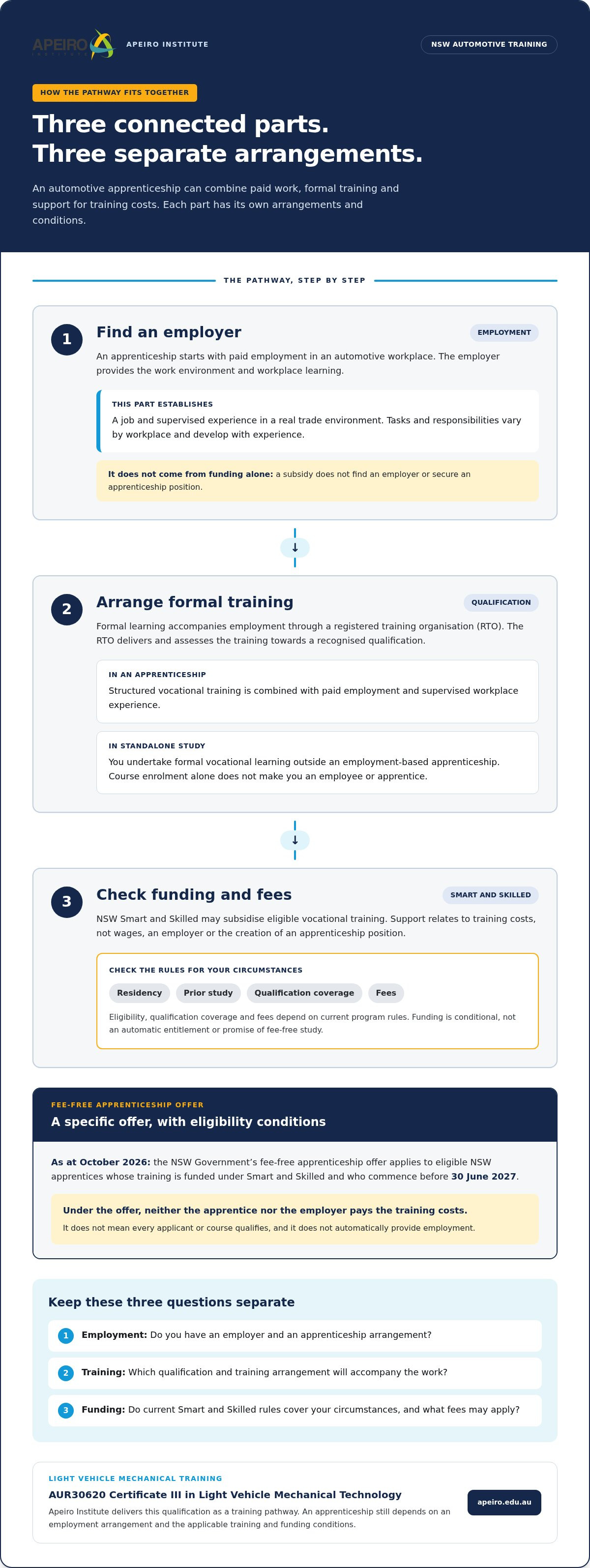
Government supported automotive apprenticeships NSW combine paid work with structured vocational training. An apprentice is employed in a workplace while working towards a formal qualification through a registered training organisation (RTO). The employer provides the work environment, and the RTO delivers and assesses the formal learning. Government support may help fund training, but it doesn’t find you an employer or secure an apprenticeship position.
If you’re starting out, treat finding an employer and arranging training as distinct steps. You’ll need an employer willing to take you on, an apprenticeship and training arrangement, and a clear understanding of which funding rules apply to your circumstances and qualification. What is an Apprenticeship? offers general background. For your pathway, the relevant NSW training and funding conditions are the details to focus on.
What does an automotive apprentice do?
In a light vehicle automotive workplace, apprentices develop practical experience under supervision alongside structured vocational training. Workplace learning gives context to knowledge developed through formal study, helping apprentices build skills in a real trade environment. Tasks and responsibilities vary by workplace and develop as the apprentice gains experience. They also reflect the employer’s work requirements and the level of supervision provided.
A standalone automotive course focuses on formal study. An apprenticeship combines formal learning with paid employment and supervised workplace experience.
What does government support mean in NSW?
NSW Smart and Skilled is a government-funded vocational training program that can subsidise eligible training. The support relates to training costs, not an apprentice’s wages, the availability of an employer or the creation of an apprenticeship position. Eligibility, fees and qualification coverage depend on current program rules, so check how they apply to your circumstances before assuming funding is available.
As at October 2026, the NSW Government’s fee-free apprenticeship offer applies to eligible NSW apprentices whose training is funded under Smart and Skilled and who commence before 30 June 2027. Under that offer, neither the apprentice nor the employer pays the training costs. The offer doesn’t mean every applicant or course qualifies, and it doesn’t include employment automatically.
Separate the pathway into its main parts:
- Find an employer. Explore employment with an automotive business able to provide a suitable workplace for an apprenticeship.
- Establish the training arrangement. Work out how formal learning will accompany the employment with the relevant employer and training provider.
- Clarify funding. Check whether your circumstances and intended qualification meet current Smart and Skilled requirements, and find out what fees may apply.
Apeiro Institute is an RTO delivering apprenticeships, traineeships and NSW Smart and Skilled funded training. Its AUR30620 Certificate III in Light Vehicle Mechanical Technology is a light vehicle mechanical training pathway. The qualification can form part of your plan, while an apprenticeship still depends on an employment arrangement and the applicable training and funding conditions.
How NSW automotive apprenticeship training and funding fit together
It helps to distinguish three things that can sound like one package: a job, formal training and financial support for that training. Government supported automotive apprenticeships NSW may involve all three, but each has its own conditions and arrangements. A subsidy can reduce eligible training fees; it doesn’t create an employment relationship or guarantee a funded place.
| Pathway component | What it covers | What it doesn’t provide by itself |
|---|---|---|
| Apprenticeship employment | Paid employment and workplace learning arranged with an employer. | A subsidy or automatic entitlement to funded training. |
| Subsidised training | A course place where training may receive government support, subject to eligibility and program rules. | An employer, wages or an apprenticeship position. |
| Standalone study | Formal vocational learning undertaken outside an employment-based apprenticeship. | Workplace employment or apprenticeship status. Funding depends on the course and current rules. |
Funding rules determine what training support may apply; employment arrangements determine whether you have a job and an apprenticeship. Keep those questions separate as you plan. NSW Smart and Skilled support is conditional, not an automatic entitlement or promise of fee-free study. Qualification coverage, eligibility and fees depend on the applicable rules and your circumstances. The Australian Automotive Industry Overview provides wider industry context, but it doesn’t determine an individual’s training funding or employment arrangements.
Apprenticeship versus subsidised automotive training
An employment-based apprenticeship connects learning to a workplace and an employer. A subsidised automotive course, by contrast, describes a possible way to fund eligible training. It may suit someone seeking formal study, but course enrolment alone doesn’t make them an employee or apprentice. Neither route is automatically better. Consider whether you’re seeking workplace employment now or want to pursue study separately.
Who does what in the training arrangement?
Each participant has a distinct role, although precise arrangements depend on the apprenticeship and funding scheme:
- Apprentice: participates in workplace learning and formal training as required by the agreed arrangement.
- Employer: provides employment and the workplace setting for practical learning.
- Registered training organisation: delivers training and assesses learning under the applicable arrangement. Apeiro Institute is an RTO that delivers apprenticeship, traineeship and NSW Smart and Skilled funded training.
- Government scheme: sets and administers funding rules, including conditions that determine whether training support applies.
Before committing, compare your intended qualification with your work situation and the current funding conditions. Apeiro’s AUR30620 light vehicle mechanical qualification is one training pathway to consider as you clarify your goals. For an overview of automotive training pathways with Apeiro Institute, visit Apeiro Institute.
Compare NSW automotive apprenticeship pathways before choosing
There isn’t one route that suits every learner. Compare how each option connects workplace employment, structured learning and possible funding. A qualification and an apprenticeship are related, but they aren’t interchangeable. The right option depends on whether you’re already employed, the training arrangement available to you, your experience and the work you want to pursue.
| Pathway | Workplace employment | Structured learning | Funding to consider |
|---|---|---|---|
| Automotive apprenticeship | Paid employment forms part of the pathway. | Workplace learning is paired with formal vocational training. | Support may apply if the apprentice, training and qualification meet current rules. |
| Traineeship | Employment is part of the arrangement. | Structured training is connected to the workplace and the relevant vocational pathway. | Funding depends on the applicable scheme and eligibility conditions. |
| Standalone vocational study | Employment isn’t built into course enrolment. | Learning is undertaken through a course towards a vocational qualification. | A subsidy may be available for eligible learners and qualifications, subject to current rules. |
These are broad distinctions, not a promise that every course is funded or every workplace arrangement is available for every qualification. Course enrolment by itself isn’t apprenticeship recruitment. If your goal is Government supported automotive apprenticeships NSW, assess the employment arrangement and training support as separate parts of your plan.
Where AUR30620 fits into a light vehicle pathway
Apeiro Institute offers AUR30620 Certificate III in Light Vehicle Mechanical Technology, a qualification focused on light vehicle mechanical training. Consider it if your goal is to develop skills in this field. The course title alone doesn’t determine whether you’ll be employed as an apprentice or qualify for a subsidy. Read about the Certificate III in Light Vehicle Mechanical Technology to understand the qualification pathway.
Which route may suit your current situation?
Start with your current position, then compare each pathway’s work and study requirements. These prompts can help you narrow down your options before looking into funding:
- New to the industry: If you want an apprenticeship, finding an employer is a key step because the pathway includes paid work as well as formal training. A course application isn’t a substitute for an employment arrangement.
- Already employed: If you work in an automotive setting, consider whether your employment can be linked to a formal apprenticeship and structured training arrangement. Existing work experience doesn’t by itself mean an apprenticeship is in place.
- Comparing courses: If your priority is study, assess the qualification and potential funding conditions separately from apprenticeship recruitment. Standalone study may suit your current goals, while an employment-based pathway may better match a plan to learn on the job.
Choose based on the work you want to do and the arrangement you can pursue. Then check the current funding conditions for that specific route.
Check eligibility and take these steps towards NSW support
Preparing before you apply makes it easier to compare options and avoid assuming a subsidy will cover a particular course or fee. For Government supported automotive apprenticeships NSW, assess the employment arrangement and training funding separately. Current NSW Smart and Skilled rules may depend on your circumstances, the qualification and the training arrangement. Use current official NSW guidance before making financial decisions.
What should you check before relying on funding?
Check whether your chosen qualification is covered by the current program and whether you meet its eligibility requirements. Review how residency, previous study and existing qualifications may affect eligibility, and whether fees, concessions or other conditions apply. Then make sure the training arrangement matches your situation: an apprenticeship linked to employment differs from standalone course study. A general description of government support isn’t confirmation that your place will be funded or fee-free.
Work through this checklist:
- Define your goal. Decide whether you want paid workplace learning through an apprenticeship, training linked to an existing job, or a standalone automotive qualification. Note the kind of light vehicle mechanical work you’re aiming towards.
- Identify your employment status. Record whether you already work for an automotive employer, are looking for an employer, or are focused on study. This helps you decide whether to establish an employment-based training arrangement or investigate course entry separately.
- Check current funding rules. Use current official NSW Smart and Skilled guidance to review eligibility, qualification coverage, fees and any concessions. Check your residency and prior study against the applicable requirements rather than relying on a general statement about subsidies.
Before committing, confirm the intended qualification and how its training will fit the relevant apprenticeship or study pathway. If you’re already employed, clarify how your work and formal training will be arranged. If you’re not employed, treat course admission and apprenticeship recruitment as separate questions. This distinction helps you make a realistic plan without assuming enrolment creates a job or that funding automatically applies.
What information should you prepare?
Gather the details that may affect your pathway: your residency status, previous qualifications or study, current employment situation and the automotive outcome you’re working towards. Write down the qualification you’re considering, such as AUR30620 Certificate III in Light Vehicle Mechanical Technology. With these details ready, you can compare your intended course with the relevant funding rules.
Prepare practical questions about how training and assessment are delivered, how learning connects with workplace requirements if you’re pursuing an apprenticeship, and whether learner fees or concessions may apply. The answers will help you understand the full arrangement before deciding.
Explore Apeiro's light vehicle training pathway
Start an automotive training pathway with Apeiro Institute
Once you’ve clarified whether you’re looking for employment, training or both, focus on the qualification that fits your automotive goal. Apeiro Institute is Registered Training Organisation 45394 and delivers automotive training, including AUR30620 Certificate III in Light Vehicle Mechanical Technology. Apeiro delivers training and assessment within the relevant arrangement. Course enrolment doesn’t guarantee an apprenticeship position or employment.
How Apeiro's automotive training fits the pathway
AUR30620 Certificate III in Light Vehicle Mechanical Technology is a vocational qualification for people building light vehicle mechanical skills. It can form part of a learner’s training pathway towards a nationally recognised qualification. Whether the course is connected to an apprenticeship, pursued as study, or eligible for government support depends on the learner’s circumstances and the applicable training and funding arrangements.
This distinction helps you plan clearly. The qualification identifies the training you’re considering; it doesn’t determine whether you have an employer, an apprenticeship arrangement or access to a subsidy. Those are separate parts of the decision. Consider how the course aligns with your career direction, then review your employment situation and the current NSW funding conditions that may apply.
Turn your research into a practical next step
Before taking the next step, write down what you want the pathway to achieve. Are you seeking work in the automotive industry, formal training, or a combination of both? If you’re pursuing an apprenticeship, consider how employment and structured training will fit together. If you’re exploring study first, focus on the qualification, entry and training arrangements, and investigate funding separately.
Use these questions to organise your research:
- Qualification: Does AUR30620 Certificate III in Light Vehicle Mechanical Technology match the light vehicle mechanical skills you want to develop?
- Employment: Are you already employed, looking for an employer, or planning to study without an apprenticeship?
- Training: How will formal training and assessment fit the pathway you’re considering?
- Funding: Do current NSW Smart and Skilled rules cover the qualification and your circumstances, and what fees or conditions may apply?
Answering these questions gives you a grounded starting point for Government supported automotive apprenticeships NSW. It also helps separate what you can progress now, such as exploring a relevant qualification, from decisions that depend on an employer or eligibility assessment. You don’t need every detail settled before learning more. Start with your training goal, then use the course information to understand how AUR30620 may fit your plans.
Explore Apeiro's AUR30620 course information
Take your next step with confidence
Your path into automotive work doesn’t need to be mapped out all at once. Start with the decision closest to you: are you ready to look for an employer, explore formal study, or consider how training could fit around your current work? A clear answer gives you a useful starting point and turns questions about Government supported automotive apprenticeships NSW into a practical plan.
As you explore AUR30620 Certificate III in Light Vehicle Mechanical Technology, consider how the qualification connects with the skills you want to build and the work you hope to pursue. Then review training and funding details in light of your circumstances. These steps can help you move forward with realistic expectations and greater confidence.
Every strong career pathway begins with a considered next step. Explore Apeiro Institute’s AUR30620 course information to see how the qualification could fit your automotive training goals.
Frequently Asked Questions
Can I get a government-supported automotive apprenticeship in NSW?
It may be possible if you secure an automotive apprenticeship and meet the requirements for the relevant training support. Government supported automotive apprenticeships NSW involve both employment and training arrangements. Start by identifying the automotive work you want to pursue and whether you have an employer. Then check whether your intended qualification and circumstances fit current funding rules. Support is conditional, not automatic.
Are automotive apprenticeships in NSW fee-free?
Some eligible apprentices may access fee-free training, but it isn’t guaranteed for every learner or qualification. As at October 2026, the NSW Government offer applies to eligible NSW apprentices whose training is funded under Smart and Skilled and who commence before 30 June 2027. Check the current conditions for your situation before budgeting. Fee-free training relates to training costs, not wages, tools or other personal expenses.
Do I need an employer before starting an automotive apprenticeship?
Generally, yes. An apprenticeship is based on employment, so an employer is part of establishing that pathway. If you haven’t secured work yet, you can still investigate automotive qualifications and prepare for conversations with prospective employers. Keep study applications distinct from apprenticeship recruitment: enrolling in a course doesn’t make you an employee or create an apprenticeship. If you already work in the industry, consider how formal training could connect with your employment.
What qualification can I study as a light vehicle mechanic apprentice?
A relevant qualification is AUR30620 Certificate III in Light Vehicle Mechanical Technology. Apeiro Institute offers this qualification for learners pursuing light vehicle mechanical training. If you’re considering it as an apprentice, compare the qualification with the training arrangement connected to your employment. Course details explain the study pathway, while apprenticeship registration and funding depend on the applicable arrangements and your circumstances.
Can I receive Smart and Skilled funding for automotive training?
You may be eligible, depending on current NSW Smart and Skilled requirements, the qualification and your circumstances. Check whether the automotive training you’re considering is covered, and review how residency, previous study and any applicable fees or concessions affect you. Vocational training isn’t automatically subsidised. Review the current program conditions before accepting a place or making decisions based on an expected subsidy.
What is the difference between an apprenticeship and a subsidised course?
An apprenticeship connects paid employment with structured vocational training. A subsidised course is training that may receive government funding if the learner and qualification meet program conditions. Someone can investigate a subsidised automotive course without having an employer, but enrolment alone doesn’t make them an apprentice. Decide whether you need a job-based pathway or study first, then check the matching training and funding requirements.
How do I find out whether I am eligible for NSW apprenticeship funding?
Use current NSW Smart and Skilled guidance to assess your circumstances against the rules for the qualification and training arrangement you’re considering. Have details of your residency, previous study or qualifications, employment status and intended course ready. Check qualification coverage, learner fees and concessions against current information. If you’re already employed, clarify how the proposed training fits your apprenticeship arrangement before relying on funding assumptions.
Disclaimer
The information provided on this blog is for general informational and educational purposes only. While every effort is made to ensure the accuracy and reliability of the content, the author makes no representations or warranties of any kind, express or implied, about the completeness, accuracy, suitability, or availability of the information contained on this blog.
The views and opinions expressed in blog posts are those of the individual author and do not necessarily reflect the official policy or position of any organization, company, or employer.
This blog may contain links to external websites or third-party content. These links are provided for convenience only, and the author has no control over and assumes no responsibility for the content, privacy policies, or practices of any third-party sites.
Nothing on this blog constitutes professional advice (legal, financial, medical, or otherwise). Readers are encouraged to seek appropriate professional guidance before making any decisions based on the information provided here.
By using this blog, you acknowledge that any reliance on the information is at your own risk.


