

Searching for a mechanic apprenticeship? An apprenticeship and a training course are connected, but they are not the same thing. The apprenticeship combines paid work with an employer and structured training towards a qualification.
Before applying, consider which vehicles and systems you want to work with. Light vehicle, diesel and heavy commercial roles can involve different vehicles, workplaces and training pathways. Comparing the duties and qualification in each vacancy helps you focus your search.
This guide explains how workplace learning and formal training fit together, how to compare automotive pathways, and how to prepare an application. It also covers AUR30620 Certificate III in Light Vehicle Mechanical Technology, which Apeiro Institute delivers as an Australian Registered Training Organisation, RTO 45394.
Key Takeaways
- An apprenticeship combines paid employment with structured training and assessment towards a qualification.
- Compare the vehicles, duties and qualification in each vacancy instead of relying on the job title alone.
- Workplace skills develop through relevant tasks, guidance and supervision, alongside formal learning and assessment.
- Tailor your resume to the role, using examples that show reliability, communication, safety awareness and willingness to learn.
- Apeiro Institute delivers AUR30620 Certificate III in Light Vehicle Mechanical Technology for a light vehicle training pathway.
What a mechanic apprenticeship involves: work, training and a qualification
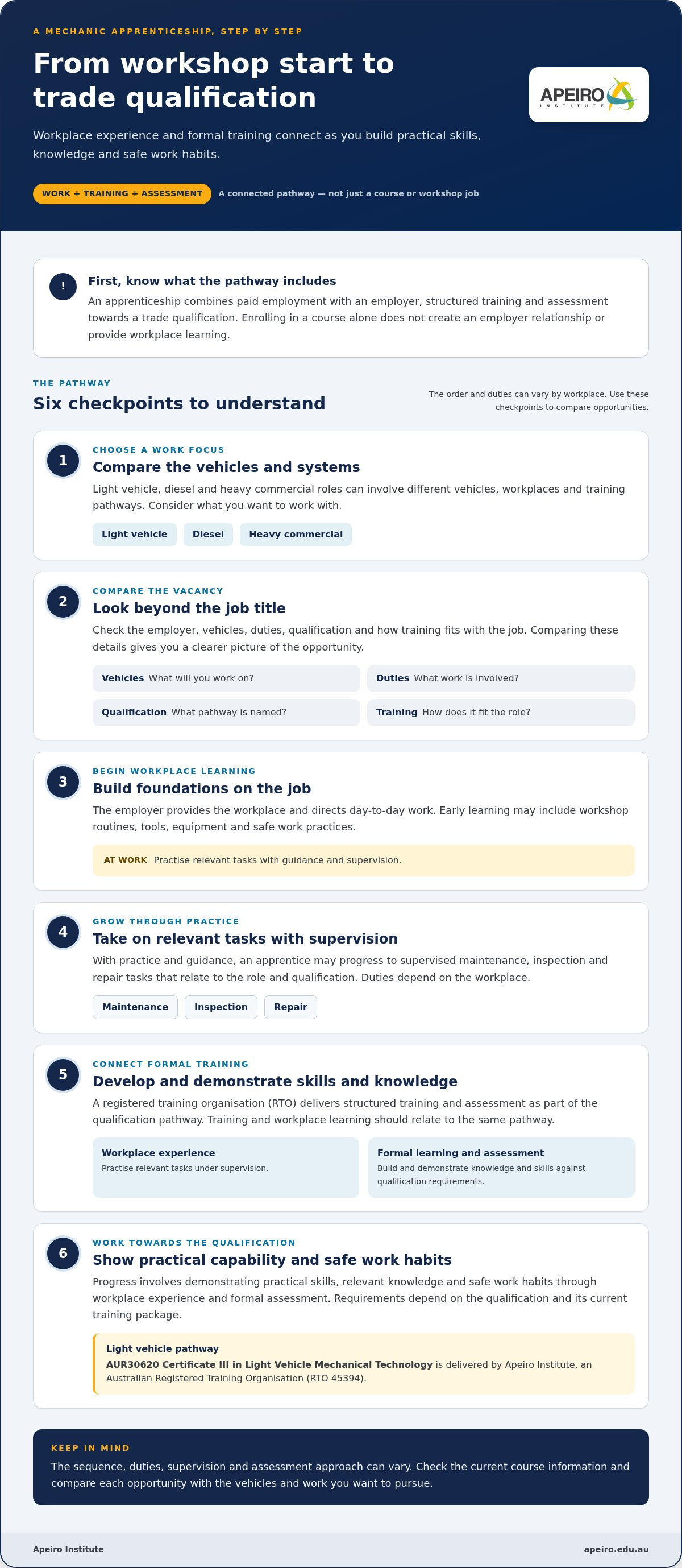
A mechanic apprenticeship combines paid employment with an employer, structured training and assessment towards a trade qualification. Understanding each part helps you plan your next steps and compare opportunities more effectively.
In short: an apprenticeship is not just a workshop job or a course. The employer provides the workplace and directs day-to-day work, while a registered training organisation (RTO) delivers training and assessment as part of the qualification pathway. Enrolling in a course alone does not create an employer relationship or provide workplace learning.
Arrangements can differ between roles. When reviewing an opportunity, note the employer, the work involved, the qualification and how training fits with the job. This gives you a clearer picture than the vacancy title alone. For a general introduction to the occupation and its specialisations, including diesel work, see this overview of auto mechanic apprenticeships.
How workplace learning and formal training fit together
Workplace learning gives an apprentice the chance to practise relevant tasks under supervision. Formal training adds structured learning and assessment, developing the knowledge and skills required for the chosen qualification. These parts should relate to the same pathway, rather than being treated as unrelated experiences.
For light vehicle work, Apeiro Institute delivers AUR30620 Certificate III in Light Vehicle Mechanical Technology. The qualification is one part of a light vehicle training pathway. The apprenticeship opportunity with an employer is a separate part of the process.
What a beginner can expect from the pathway
New starters build their skills over time. Early learning may include workshop routines, tools, equipment and safe work practices. With practice and guidance, an apprentice may progress to supervised maintenance, inspection and repair tasks that relate to the role and qualification. The sequence and duties depend on the workplace.
Progress involves more than completing tasks. Apprentices demonstrate practical skills, relevant knowledge and safe work habits through workplace experience and formal assessment. Requirements depend on the qualification and its current training package, so review the relevant course information when comparing pathways.
- At work: practise relevant tasks with guidance and supervision.
- In training: develop and demonstrate skills and knowledge against qualification requirements.
- Across both: build safe, reliable work habits as your capability grows.
You do not need to know everything before starting. Understanding the work, training and assessment involved gives you a practical basis for deciding what to explore next.
How mechanic apprenticeships build skills and lead to a trade qualification
An apprenticeship develops capability in stages. You begin by learning workshop routines, tools, equipment and safe work practices. With guidance and practice, you can take on more responsibility and work towards supervised maintenance, inspection and repair tasks relevant to your role. The mix depends on the employer, vehicles and qualification.
Day-to-day experience connects with formal learning, but training and assessment requirements are set by the chosen qualification and its current training package. If you searched for a mechanic apprenticeship Central Coast NSW, use the same comparison process as for any vacancy: check how the advertised work relates to the qualification and vehicle types you want to work with.
What the light vehicle qualification pathway covers
AUR30620 Certificate III in Light Vehicle Mechanical Technology is a light vehicle qualification pathway delivered by Apeiro Institute, an Australian Registered Training Organisation, RTO 45394. Check its current units and outcomes on the National Training Register rather than assuming they cover every kind of mechanic work. This makes it easier to compare the qualification with the duties and vehicles in an apprenticeship opportunity.
When reviewing a course or vacancy, look for a clear connection between the training and the work you want to practise. The light vehicle mechanical technology qualification is relevant to a light vehicle pathway. For general information about Australian apprenticeship arrangements, visit the Australian Apprenticeships official website.
Why supervised experience matters
Technical knowledge becomes useful when you can apply it carefully at work. Under supervision, an apprentice can learn to approach tasks methodically, follow safe work practices, communicate clearly about completed work and record information accurately. Knowing when to ask for guidance is part of working reliably.
For example, a learner might first observe how a task is organised, then practise relevant steps with guidance and use feedback to improve. Duties, supervision and assessment approaches vary by workplace, so compare the details in each opportunity rather than assuming every employer follows the same schedule.
Workplace experience and formal assessment work together: demonstrated skills and knowledge contribute to progress towards the qualification. Assessment requirements depend on the qualification and current training package. Keep track of feedback and learning milestones to see what you have practised and where you need more experience.
If you are interested in light vehicle work, explore Apeiro Institute’s AUR30620 qualification pathway as part of your training plan. You will also need to pursue an apprenticeship opportunity with an employer.
Light vehicle or diesel mechanic apprenticeship: compare the work before applying
Automotive job titles can describe different work. “Diesel” refers to an engine type or area of work, while “heavy commercial” describes a vehicle category. The labels can overlap, so check the vehicles, workplace setting, duties and qualification in each advertisement before deciding whether to apply.
| Pathway or role label | Vehicle context | Broad work setting |
|---|---|---|
| Light vehicle mechanic | Cars and other light vehicles | Automotive workshops or service settings working with light vehicles |
| Diesel mechanic | Diesel-powered vehicles or equipment, which may vary in size | Workplaces servicing diesel-powered vehicles or equipment |
| Heavy commercial vehicle mechanic | Large commercial vehicles, such as trucks or buses | Workplaces focused on servicing and maintaining heavy vehicles |
This is a broad guide, not a guarantee that every role fits neatly into one category. A diesel role might involve a light vehicle, a heavy vehicle or another type of equipment. Heavy commercial work may involve diesel vehicles, but a title alone will not explain the full scope. The Motor Trades Association of Australia provides broader context on Australia’s automotive retail sector.
What makes a light vehicle apprenticeship different?
A light vehicle apprenticeship focuses on work with light vehicles. It should not be assumed to have the same scope as a diesel or heavy commercial role. AUR30620 Certificate III in Light Vehicle Mechanical Technology is one relevant light vehicle qualification. Compare the duties in a vacancy with the qualification it names, and check current details against the National Training Register.
Look past the headline. Note the vehicle types, workshop environment and tasks, then consider whether they match the experience you want to build. Apeiro Institute delivers AUR30620 for learners pursuing a light vehicle training pathway.
How to interpret diesel and heavy vehicle job titles
Treat “diesel” and “heavy vehicle” as clues, not interchangeable qualification names. Read each listing for the vehicles, day-to-day duties and stated training pathway. If the title is broad, use the description to understand the focus. Qualification titles and training requirements can differ, so do not assume a light vehicle course covers every specialisation.
To prioritise applications, decide which vehicles you are most interested in working with. Shortlist roles that name those vehicles and describe duties you want to learn. Record the qualification attached to each listing. This makes it easier to compare similar-sounding roles that lead to different work or training pathways.
How to find mechanic apprenticeship vacancies and prepare a strong application
A focused search is more useful than applying for every role with “mechanic” in the title. Decide which vehicles and work settings interest you, then compare current listings by duties and training pathway. This helps you target roles that match the work you want to learn.
Where and how to search for current opportunities
Search job boards, employer career pages and apprenticeship networks. Try several terms, such as “apprentice mechanic”, “light vehicle apprentice” and “diesel mechanic”, because vacancies may use different titles. Listings and closing dates change, so revisit searches and note deadlines rather than relying on an old vacancy count.
Compare each suitable listing before applying:
- Identify your preference. Decide whether you are most interested in light vehicles, diesel work or heavy commercial vehicles.
- Search current opportunities. Use relevant terms across job boards, employer websites and apprenticeship networks.
- Compare the role. Read the duties, vehicle types, stated qualification and application instructions. Similar titles can describe different work.
- Prioritise applications. Focus on openings that match your interests and explain the training pathway clearly.
For a search such as mechanic apprenticeship Central Coast NSW, apply the same checks to relevant listings. An apprenticeship involves an employer relationship as well as formal training, so enrolling in a course alone does not secure a job or apprenticeship place.
What to prepare before applying
Prepare a concise resume that makes relevant experience easy to find. Include previous work, practical projects, school or community activities, and examples that show reliability, safety awareness and interest in learning. You do not need to present yourself as an experienced mechanic. Explain what you have done, which skills you have practised and what you want to develop.
Tailor each application to the role and selection requirements. Check that your resume reflects the vehicle type and duties in the advertisement, provide the requested information and proofread your details. A focused application is easier to assess than a general one that could fit any role.
- Reliability: Give an example of completing a responsibility or following through on a commitment.
- Communication: Describe a time you listened carefully, asked for clarification or worked well with others.
- Willingness to learn: Mention a practical project or new skill you have worked to develop.
- Safety awareness: Explain how you follow instructions and take care around tools or equipment.
Keep a record of where and when you applied, the role’s key requirements and any follow-up steps in the listing. An organised search helps you prepare for each application and learn from the process.
Choose a mechanic training pathway and take your next step with Apeiro
Once you know which mechanic work interests you, compare the qualification pathways that relate to it. Training is one part of the journey. An apprenticeship also involves an employer providing paid workplace learning, so choosing a course by itself does not secure an apprenticeship position.
How Apeiro Institute’s light vehicle training relates to an apprenticeship
Apeiro Institute delivers AUR30620 Certificate III in Light Vehicle Mechanical Technology, a training pathway for people pursuing light vehicle mechanic work. The qualification can form part of your training plan alongside an apprenticeship. The employer relationship is a separate part of the process, so pursue suitable apprenticeship opportunities as well as relevant training.
Review the AUR30620 course information alongside the duties and qualification named in vacancies you are considering. Comparing them helps connect the work you want to do with relevant training, while keeping the course choice and job search clear as separate steps.
If you searched for mechanic apprenticeship Central Coast NSW, use the same approach: identify the vehicle work you prefer, compare relevant vacancies and consider how the qualification fits. Course enrolment does not guarantee a job offer or apprenticeship place.
A practical next step for aspiring mechanics
Start with a simple plan. Write down whether you are most interested in light vehicles, diesel work or heavy commercial vehicles. Then compare current vacancies by vehicle type, workplace duties and stated qualification. This gives you a clearer basis for choosing opportunities to apply for and training to explore.
Apeiro Institute also delivers apprenticeships and traineeships, including NSW Smart and Skilled funded training. Funding and eligibility conditions apply. Check current NSW Government guidance to understand the conditions relevant to your circumstances.
Keep your employer search moving alongside your training research. Note the qualification in each vacancy, check that it relates to your preferred work and prepare applications for suitable roles. If you are aiming for light vehicle mechanics, AUR30620 is a relevant qualification pathway to explore.
Apeiro Institute’s automotive training information explains how light vehicle training can fit into your plans.
Take the next step towards your automotive career
Turn your interest into a plan: choose the mechanic work you want to pursue, look for suitable vacancies and consider which training aligns with that direction. For light vehicle work, Apeiro Institute delivers AUR30620 Certificate III in Light Vehicle Mechanical Technology as an Australian Registered Training Organisation, RTO 45394.
Apeiro also delivers apprenticeships and traineeships, including NSW Smart and Skilled funded training. Eligibility and funding conditions apply, so use current NSW guidance when considering a funding option. Training supports your qualification pathway, while an apprenticeship also involves an employer.
As you compare opportunities, note the vehicles, duties and qualification named in each vacancy. If light vehicle mechanics is your direction, explore AUR30620 and consider how it fits your plans.
A clear direction and a focused application can help you move towards an automotive career step by step.
Frequently Asked Questions
What do you need to become a mechanic apprentice?
Requirements vary by employer, role and qualification. Read the vacancy carefully to see what experience or documents are requested. Prepare a relevant resume with practical examples from school projects, casual work or volunteering, and note the training pathway named in the role. Applying to an employer and enrolling with a training provider are separate steps.
Can you become a mechanic apprentice with no experience?
Some entry-level vacancies may welcome applicants who are new to the trade, though expectations differ between employers. If you have not worked in a workshop, give examples of practical projects, such as maintaining a bicycle or learning to use tools safely. Explain how you follow instructions, turn up reliably and respond to feedback. These examples can support an application but do not guarantee selection.
How long does a mechanic apprenticeship take in Australia?
There is no single timeframe that applies to every apprentice. Completion depends on the apprenticeship arrangement, qualification requirements and individual progress. Workplace learning and formal training both contribute. Use the current training information and your apprenticeship contract to understand the expectations and milestones for your pathway.
What qualification does a light vehicle mechanic apprentice work towards?
A relevant light vehicle pathway is AUR30620 Certificate III in Light Vehicle Mechanical Technology, delivered by Apeiro Institute. Match the qualification named in a vacancy to the work and vehicle types involved, and check current course details against the National Training Register. Light vehicle training should not be assumed to cover diesel or heavy vehicle roles, which may have different requirements.
Is a mechanic apprenticeship the same as enrolling in an automotive course?
No. An apprenticeship involves an employment arrangement with an employer as well as structured training. Enrolling in an automotive course alone does not create an employer relationship or secure an apprenticeship. Compare the vacancy, employer arrangement and qualification requirements separately. A relevant course can support your training plan, but course enrolment does not guarantee a job or apprenticeship position.
How do you find mechanic apprenticeship vacancies?
Search job boards, employer career pages and apprenticeship network resources using terms such as “apprentice mechanic”, “light vehicle apprentice” and “diesel mechanic”. For a search such as mechanic apprenticeship Central Coast NSW, compare each listing’s location, vehicle type, duties, requirements and application instructions. Save suitable searches or set alerts where available, and check listings regularly because vacancies and closing dates can change.
Can a mechanic apprenticeship be funded through Smart and Skilled?
NSW Smart and Skilled may support eligible training, but funding depends on current programme rules and your circumstances. Do not assume every apprenticeship or applicant qualifies, or that training will be fee-free. Check the latest NSW Government guidance for the conditions that apply to you. Funding relates to training; it does not secure an employer or apprenticeship position, so keep your vacancy search separate from funding research.

Disclaimer
The information provided on this blog is for general informational and educational purposes only. While every effort is made to ensure the accuracy and reliability of the content, the author makes no representations or warranties of any kind, express or implied, about the completeness, accuracy, suitability, or availability of the information contained on this blog.
The views and opinions expressed in blog posts are those of the individual author and do not necessarily reflect the official policy or position of any organization, company, or employer.
This blog may contain links to external websites or third-party content. These links are provided for convenience only, and the author has no control over and assumes no responsibility for the content, privacy policies, or practices of any third-party sites.
Nothing on this blog constitutes professional advice (legal, financial, medical, or otherwise). Readers are encouraged to seek appropriate professional guidance before making any decisions based on the information provided here.
By using this blog, you acknowledge that any reliance on the information is at your own risk.


