

What if a nationally recognised qualification opens the door but doesn’t cover every requirement for the role? If you’re asking, “Is CHC33021 recognised in NSW aged care and disability sectors?”, the answer is yes. CHC33021 Certificate III in Individual Support is a nationally recognised qualification used across Australia, including NSW. Its recognition isn’t limited to the training provider that delivers it.
Completing the qualification doesn’t guarantee a job or automatically meet every employer’s requirements. Depending on the position, you may also need role-specific screening, such as an NDIS Worker Screening Check for disability work or a Working with Children Check when working with children. Employers may also request other checks or credentials.
This guide explains what national recognition means in practice, how qualification requirements differ from workplace screening, and what to consider before applying for an aged care or disability support role in NSW. You’ll also find practical steps for comparing course details with job requirements and planning your next move.
Key Takeaways
- Is CHC33021 recognised in NSW aged care and disability sectors? Yes, it’s a nationally recognised vocational qualification. Check its current status and details on training.gov.au.
- Use the Ageing and Disability focus to consider which individual support settings and roles match your interests.
- Before applying, compare each job advertisement’s duties and criteria with your qualification, then note any additional screening or credentials it requires.
- Think of CHC33021 as a practical foundation for your next career step, not a guarantee of employment.
- Apeiro Institute offers CHC33021 Certificate III in Individual Support (Ageing and Disability) as a study pathway into individual support.
Is CHC33021 recognised in NSW? What national recognition means
Yes. CHC33021 Certificate III in Individual Support is a nationally recognised Australian vocational qualification, so its recognition applies in NSW, including aged care and disability settings. National recognition confirms the qualification’s standing within vocational education. It doesn’t guarantee a job, a particular position or selection by every employer.
Before enrolling or relying on an older certificate, check the qualification’s current status and details on training.gov.au, the Australian Government’s National Register of vocational education and training. Training products can change, so use the register to confirm the current code and title.
What does nationally recognised training mean?
Nationally recognised training sits within Australia’s vocational education and training system. A Registered Training Organisation (RTO) is registered to deliver and assess nationally recognised training. When a learner meets the course requirements, the RTO issues the relevant qualification or statement of attainment.
The qualification is part of the national system, rather than a certificate created solely by an individual training provider. The RTO delivers and assesses the training. Apeiro Institute is RTO 45394 and delivers the CHC33021 Certificate III in Individual Support (Ageing and Disability).
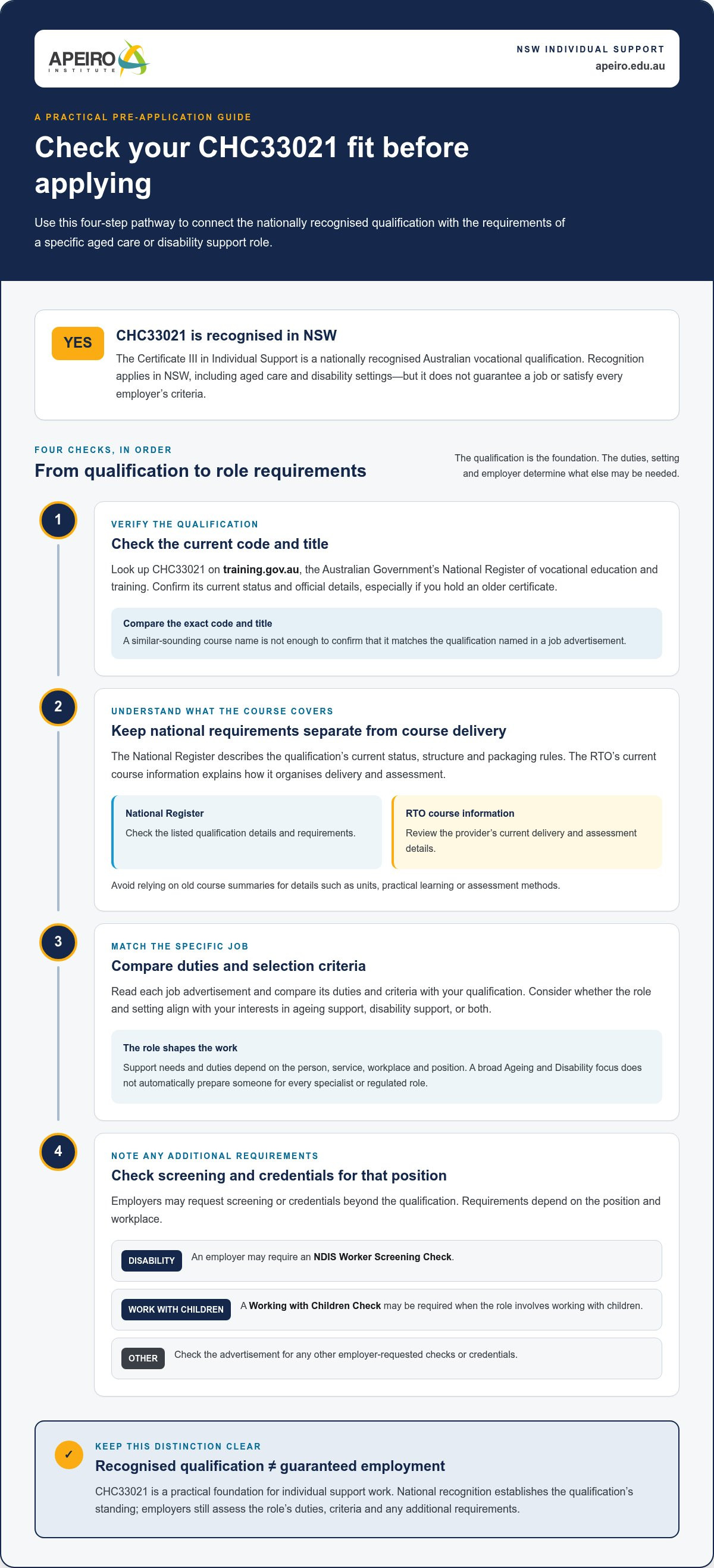
Use the National Register to verify that the qualification is current and review its official details. This is useful when comparing course information or checking whether a qualification you already hold matches the one named in a job advertisement. Compare the exact code and title, rather than relying on a similar-sounding course name.
Does recognition apply to both aged care and disability work?
The qualification’s Ageing and Disability focus makes it relevant to people preparing for individual support work in those areas. National recognition applies to the qualification, not to a promise that every graduate meets the requirements for every role. The duties, setting and employer criteria can affect what else is required.
For example, an employer may assess whether your training aligns with the advertised duties and set additional selection criteria. A role may also involve screening or requirements that sit outside the qualification itself. Those requirements relate to the position and workplace, rather than changing the qualification’s national status.
National recognition establishes that CHC33021 is a recognised vocational qualification across Australia; it doesn’t establish that you meet every employer’s criteria or guarantee employment. To assess how it fits your plans, check the current course details and compare them with the specific roles you’re considering.
What CHC33021 prepares you to learn across individual support
Individual support involves assisting a person in ways that reflect their needs, preferences and circumstances. The work isn’t simply about completing tasks. It also involves respecting a person’s choices, communicating appropriately and supporting their wellbeing and independence within the boundaries of a role.
CHC33021 Certificate III in Individual Support (Ageing and Disability) brings together two areas of interest. This can help you consider the people and settings you hope to work with, while remembering that a qualification alone doesn’t determine your future duties. The person receiving support, the workplace and the position all shape what the work involves.
How the ageing and disability pathways relate to support work
An interest in ageing may lead you to explore support for older people, while an interest in disability may draw you towards services supporting people with disability. These areas can involve different personal goals and support needs, even where the shared aim is person-centred care.
For example, one person may value help to maintain familiar routines, while another may want support to take part in everyday activities. The exact duties depend on the person, service, workplace and role. A broad qualification focus shouldn’t be taken as automatic preparation for every specialist or regulated position. Employers may specify additional experience, checks or credentials.
What to check in the current qualification details
Qualification requirements can change, so use Training.gov.au, National Training Register to review CHC33021’s current status, structure and packaging rules. The register describes the nationally listed qualification. It’s separate from how an individual RTO organises course delivery and assessment.
Keep those sources of information distinct. The National Register helps you understand the qualification requirements; current course information explains how the RTO delivers and assesses its course. Avoid relying on old course summaries for details such as units, practical learning or assessment methods. Compare those details with current information for the course you’re considering.
If you’re exploring Apeiro’s pathway, its CHC33021 course information sets out course-specific details alongside the national qualification listing. Use both to understand the qualification and the course, without assuming that every workplace or role has identical expectations.
So, if you’re still wondering, “Is CHC33021 recognised in NSW aged care and disability sectors?”, its Ageing and Disability focus helps explain its relevance to individual support. Review the qualification details to understand the training, then compare your interests with the duties and criteria of roles you may pursue.
Does CHC33021 guarantee an aged care or disability job in NSW?
No. Completing CHC33021 can support your application by showing you’ve completed recognised training, but it doesn’t guarantee employment or a particular role. Employers make their own recruitment decisions and assess applicants against each position’s requirements.
A qualification confirms your training outcome; an employer decides whether your experience, suitability and checks meet the requirements of a specific job. Keep that distinction in mind when planning your next step. The certificate is one part of an application, not a substitute for meeting the role’s other criteria.
Qualification recognition: Confirms the training outcome sits within Australia’s recognised vocational education system. It doesn’t promise a job.
Employer requirements: Set the selection criteria for a particular position, which may include relevant experience, communication skills or other qualifications.
Role-specific screening: Applies where required for the role, service or applicable rules. It’s separate from completing CHC33021.
What employers may consider alongside the qualification
Recruitment criteria reflect the work involved and the people a service supports. An employer may consider how your skills and experience fit the advertised duties, how you communicate, and whether the role suits your interests and capabilities. One position might prioritise experience in a particular setting; another may be open to applicants with less experience.
There isn’t one additional checklist that every aged care or disability employer uses. Requirements can differ between providers, positions, client groups and service settings. Read each advertisement closely, separate essential from desirable criteria, and prepare examples that show how your background relates to the role. Don’t assume a criterion for one vacancy applies to every job in the sector.
When a separate screening check may apply
Screening depends on the work and the rules that apply to the position. For many disability roles, an NDIS Worker Screening Check is required. The NDIS Quality and Safeguards Commission provides national guidance for NDIS workers and providers. Some roles involving children may also require a Working with Children Check in NSW. These checks are separate from the CHC33021 qualification.
Requirements can change and may differ by role. Before applying, check the job advertisement and current guidance from the relevant NSW or Australian Government authority for the work you’re considering. This helps you identify which checks apply without treating every check or credential as a universal requirement.
So, if you’re asking, “Is CHC33021 recognised in NSW aged care and disability sectors?”, recognition can support an application, but it isn’t a hiring decision. Match your training and experience to each position, then follow the current screening instructions that apply to that role.
How to check your NSW requirements before applying for support work
When you find a role that interests you, check its requirements individually instead of relying on a general list of sector-wide rules. The answer to “Is CHC33021 recognised in NSW aged care and disability sectors?” doesn’t tell you which checks or criteria apply to a particular vacancy. Use this checklist to separate qualification details from requirements set by an employer, regulator or service.
A practical checklist for comparing job advertisements
Before applying, match your qualification and supporting documents against the advertised duties, selection criteria and setting, then verify any screening requirements with current official sources. Work through the steps for each position. An advertisement describes one role, not a universal standard for aged care or disability work.
- Identify the role and setting. Note whether the position is in aged care, disability support or another service, and who the role supports.
- Read the duties closely. Identify the day-to-day responsibilities and compare them with what your training has prepared you to learn.
- Match your qualification. Check the exact qualification title and code against the advertisement. If it asks for a different credential or experience, record that separately.
- List the stated criteria. Separate essential from desirable experience, communication skills, first aid or other credentials. Don’t assume a requirement applies beyond that vacancy unless an official source says it does.
- Check screening and next steps. Identify any named worker check or orientation requirement, who requires it, and whether it must be completed before applying or starting.
Where to verify current qualification and screening information
Use training.gov.au to check CHC33021’s current status and nationally listed qualification details. The register’s requirements are distinct from an employer’s preferences and a training provider’s delivery arrangements.
For disability roles, the NDIS Quality and Safeguards Commission provides national worker guidance. Its information can help you understand requirements such as the NDIS Worker Screening Check and the NDIS Worker Orientation Module, Quality, Safety and You. In NSW, check current Working with Children Check information through NSW Government or Service NSW if the role involves children. For aged care roles, follow relevant official Australian Government guidance as well as the employer’s stated criteria.
Keep a simple record for each vacancy: the exact requirement, whether it comes from the employer or an official source, and where you verified it. Screening rules and processes can change, so revisit the relevant official information before applying rather than relying on an old checklist or another job advertisement. This makes it easier to see what you already meet and what you may need to address.
Explore CHC33021 course information
Study CHC33021 with Apeiro and plan your next step
National recognition gives CHC33021 a place in Australia’s vocational education system, while the requirements for a particular job still depend on the role and employer. If you’re asking, “Is CHC33021 recognised in NSW aged care and disability sectors?”, recognition is one part of the picture. Connect the qualification’s focus with your interests, review current course information and consider what the work you’re exploring may involve.
Apeiro Institute is Registered Training Organisation 45394 and delivers nationally recognised vocational education. Its CHC33021 Certificate III in Individual Support (Ageing and Disability) is a study pathway for people interested in individual support. Completing training can support your preparation, but it doesn’t guarantee a position or replace any separate role-specific criteria.
Is CHC33021 the right starting point for your goals?
Start with the kind of support work that interests you. Are you drawn to supporting older people, people with disability, or both? The qualification’s Ageing and Disability focus may align with those interests, but consider your preferred setting and the duties of the roles you might pursue.
Before deciding, compare your goals with the current qualification details on training.gov.au and the course information for the pathway you’re considering. This gives you a clearer view of the nationally listed requirements and the provider’s learning and assessment arrangements.
- Consider which people and support settings you’re most interested in.
- Review the current qualification structure and course-specific arrangements.
- Use job advertisements to understand the duties and criteria associated with roles that appeal to you.
Explore the CHC33021 study pathway
Apeiro Institute's CHC33021 Certificate III in Individual Support is a nationally recognised training pathway focused on ageing and disability support. Review the course information alongside the National Register to distinguish the qualification requirements from the course’s delivery and assessment.
As you weigh up your options, note any questions about learning arrangements or assessment details and use the current course information to inform your decision. Consider how the qualification’s focus fits your interests and the kinds of roles you may want to pursue. Hiring criteria and any applicable screening remain separate considerations for each position.
Choosing a study pathway is a meaningful step. Take the time you need to make an informed decision, then explore Apeiro Institute's CHC33021 course to see how it fits the direction you have in mind.
Take the next step towards individual support
Choosing a study pathway is also a chance to picture the contribution you’d like to make. Consider which support settings interest you, what you hope to learn and how a qualification could fit into your longer-term plans. If you’re still asking, “Is CHC33021 recognised in NSW aged care and disability sectors?”, use that understanding as a starting point for exploring your options, not as a promise of a particular job.
Apeiro Institute, RTO 45394, offers CHC33021 Certificate III in Individual Support (Ageing and Disability). Review the course information and current qualification details, then consider how the learning pathway aligns with your goals and the roles you may pursue. Each employer’s selection criteria will still matter, so make a choice based on your interests and the requirements of the work you’re considering.
A considered start can help you move towards a future in individual support with greater confidence. Explore Apeiro Institute’s CHC33021 course information and take your next study step.
Frequently Asked Questions
Is CHC33021 nationally recognised in NSW?
Yes. CHC33021 is nationally recognised in NSW when it’s current and awarded by an RTO registered to deliver it. Is CHC33021 recognised in NSW aged care and disability sectors? Its national status means recognition isn’t limited to one NSW employer, but it doesn’t require employers to hire graduates or waive role-specific criteria. Check the exact code and current status on training.gov.au, particularly if you’re relying on older course information.
Can I work in both aged care and disability support with CHC33021?
Potentially, but the qualification title doesn’t automatically make you suitable for every position in both fields. Its Ageing and Disability focus may be relevant to roles supporting older people or people with disability, while your suitability depends on the duties, employer and current requirements. Compare the qualification named in a job advertisement with your course documents, then check any additional credentials or screening it specifies.
Does CHC33021 guarantee a job in NSW aged care?
No qualification can guarantee you a job. CHC33021 may support an application for relevant individual support positions, but an employer may also consider your experience, communication skills, screening and suitability for the work. Criteria can differ between services and vacancies. Read each advertisement carefully and tailor your application to its stated requirements, using examples from your training, work history or other relevant experience where appropriate.
Do disability support workers in NSW need an NDIS Worker Check?
An NDIS Worker Screening Check may be required, depending on the work, provider and applicable rules. Don’t assume that every disability support position has identical screening requirements. Check current guidance from the NDIS Quality and Safeguards Commission and relevant NSW authorities for the role you’re considering. Screening processes can change, so verify the current requirements and steps before applying or commencing work.
Is CHC33021 enough to work in residential aged care?
CHC33021 may be relevant to individual support positions in residential aged care, but the qualification alone may not meet every vacancy’s criteria. An employer can set requirements relating to duties, experience or other credentials, and applicable checks depend on the position and current rules. Compare your qualification documents with the advertisement, then consult official Australian Government aged care information for requirements that apply to the work.
How can I check whether my CHC33021 qualification is current and recognised?
Search the exact code, CHC33021, and qualification title on training.gov.au to review the training product’s current status and details. Compare these with the qualification recorded on your testamur or statement of attainment, and check the RTO named on your documents. The register helps verify training-product information; it can’t confirm whether a particular employer will accept your application or consider you suitable for a role.
Can I study CHC33021 at Apeiro Institute?
Yes. Apeiro Institute offers CHC33021 Certificate III in Individual Support (Ageing and Disability). Review the CHC33021 Certificate III in Individual Support course information to consider the study details and how the qualification may fit your interests. Comparing the course with current qualification information can help you make an informed choice while keeping employment expectations realistic.

Disclaimer
The information provided on this blog is for general informational and educational purposes only. While every effort is made to ensure the accuracy and reliability of the content, the author makes no representations or warranties of any kind, express or implied, about the completeness, accuracy, suitability, or availability of the information contained on this blog.
The views and opinions expressed in blog posts are those of the individual author and do not necessarily reflect the official policy or position of any organization, company, or employer.
This blog may contain links to external websites or third-party content. These links are provided for convenience only, and the author has no control over and assumes no responsibility for the content, privacy policies, or practices of any third-party sites.
Nothing on this blog constitutes professional advice (legal, financial, medical, or otherwise). Readers are encouraged to seek appropriate professional guidance before making any decisions based on the information provided here.
By using this blog, you acknowledge that any reliance on the information is at your own risk.


