

Two people doing similar aged care work in NSW may receive different pay because a job title alone doesn’t set the rate. So, how much do aged care trainees earn in NSW? The answer depends on the pay rules covering the job, the terms of the traineeship and details such as employment type and hours worked.
Online salary figures can be confusing. Some combine trainee pay with rates for qualified workers, while gross earnings may also include allowances, casual loading or penalty rates. To understand what applies to you, start with your employment and training documents, then check the current pay rules for your role.
This guide explains how to identify the relevant pay instrument, check your rate and understand the difference between gross and take-home pay. It also covers how training, including CHC33021 Certificate III in Individual Support (Ageing and Disability), may fit into your career planning. Training can help you build relevant skills, but it doesn’t guarantee a particular wage or job.
Key Takeaways
- There isn’t one rate for every aged care trainee. Your pay depends on the rules and employment arrangements that apply to your role.
- To answer “How much do aged care trainees earn in NSW?”, identify the pay instrument covering your employment and check whether its trainee provisions apply.
- Separate your base rate, hours, penalties, allowances and deductions to understand the difference between gross pay and take-home pay.
- Use your employment and training documents, roster and payslips to compare your pay with current Fair Work information.
- CHC33021 Certificate III in Individual Support (Ageing and Disability) is a relevant training pathway for developing individual support skills.
How much do NSW aged care trainees earn and why?
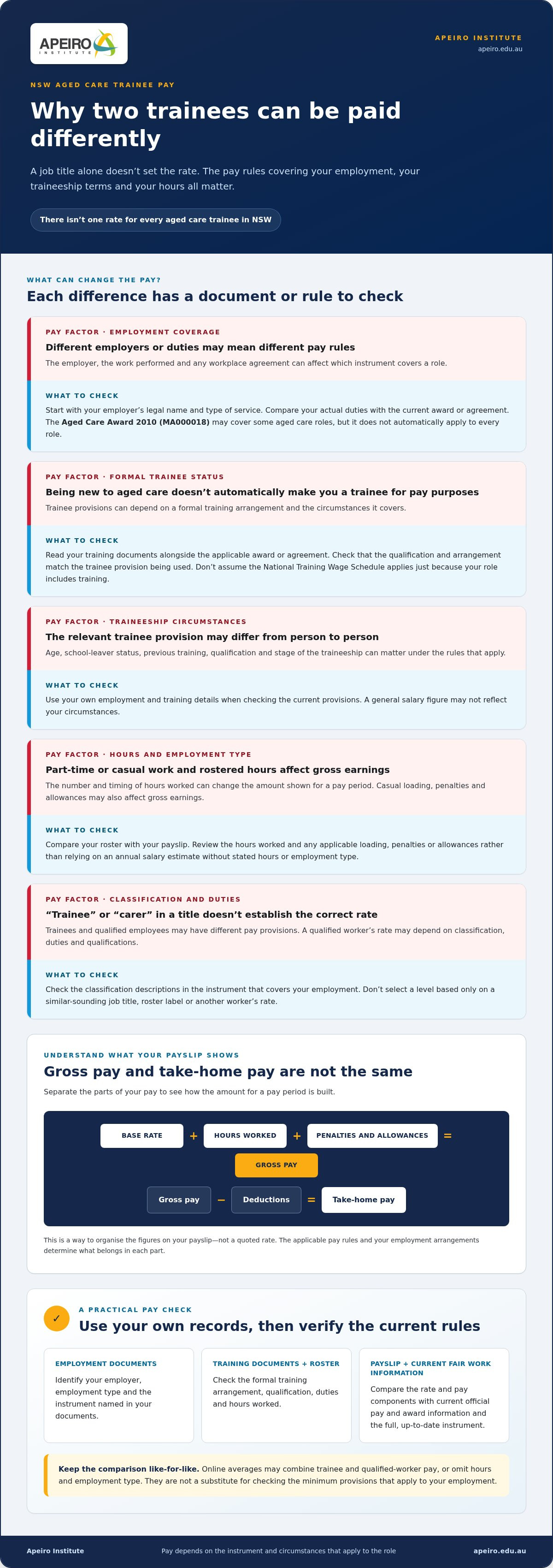
There isn’t one rate for every aged care trainee in NSW. If you’re asking, “How much do aged care trainees earn in NSW?”, begin by identifying the pay instrument that covers your employment. The applicable rate can also depend on your traineeship terms, age, training status, employment type and hours worked. A general salary figure may not reflect those details.
An aged care traineeship pay rate is the minimum hourly or weekly amount payable under the industrial instrument and trainee provisions that apply to a worker’s specific employment. Treat this as a starting point for checking your pay, not a substitute for reviewing the applicable award or agreement and current Fair Work information. For an overview of the sector, including its funding and regulatory context, see Aged care in Australia.
What does an aged care trainee earn compared with a qualified worker?
A trainee and a qualified employee may be covered by different pay provisions, even when they work in similar settings. A formal traineeship may involve provisions linked to training status. A qualified worker’s rate may instead depend on their classification, duties and qualifications. The words “trainee” or “carer” in a job title don’t establish the correct rate on their own.
Online salary averages can also be difficult to compare. They may combine trainee earnings with pay for experienced or qualified workers, or give an annual figure without stating the hours or employment type. Identify the applicable instrument and classification before comparing rates, then check current rates and conditions using the Fair Work Ombudsman’s official pay and award information. Don’t treat a general average as the minimum you’re entitled to as a trainee.
Why can two aged care trainees receive different pay?
Two people undertaking similar training may receive different pay because their employment arrangements aren’t identical. Relevant factors can include:
- Age and trainee circumstances: Some pay provisions distinguish between trainee categories. Age, school-leaver status or previous training may matter under the rules that apply.
- Traineeship details: The qualification, training arrangement and stage of the traineeship can affect which provision is relevant.
- Hours and employment type: Part-time or casual arrangements affect gross earnings. The number and timing of hours worked can also change the amount shown for a pay period.
- Employer and duties: The employer’s type and the work you actually perform can help determine which award, agreement or other instrument covers the role.
- Classification: The applicable instrument and the role’s requirements determine the classification, not simply the title used in a roster or advertisement.
Start with your own employment details rather than a general salary estimate. Compare them with current official rules, as individual circumstances can affect which pay provisions apply. This helps distinguish trainee rates from figures for qualified workers and gives you a clearer basis for reviewing your pay.
Which award or pay rules may apply to aged care trainees in NSW?
Identify the pay instrument that covers your employment before relying on a quoted rate. The Aged Care Award 2010 (MA000018) may apply to some aged care roles, but coverage can depend on the employer, the work performed and any applicable workplace agreement. The award’s current terms and relevant trainee provisions matter too. A rate quoted for one workplace or role doesn’t automatically apply to another.
“Aged care trainee” is an everyday job description, not an award classification that determines pay on its own. The correct rate depends on your employment coverage, classification and any applicable trainee provisions. A title in an advertisement or roster is not enough to establish your pay category.
How do you identify the correct award and classification?
Start with your employer’s legal name and type of service. Then compare your actual duties with the coverage and classification descriptions in the current award or agreement. Read your employment documents alongside those details. Classification and employment type can affect minimum pay and conditions, so don’t choose a level based only on a similar-sounding job title or another worker’s rate.
The Fair Work Ombudsman’s award information and pay tools can help you check coverage and current provisions. Compare the result with the full, up-to-date award or agreement, especially if a classification or trainee provision may apply. If your documents point to different instruments, resolve which one covers your employment before calculating a rate.
How does a formal traineeship affect the pay calculation?
Being new to aged care doesn’t automatically make you a trainee for pay purposes. A formal traineeship involves a training arrangement with relevant documentation. Read the documents alongside the applicable award or agreement, because trainee pay provisions can depend on the arrangement and your circumstances. Don’t assume the National Training Wage Schedule applies just because your role includes training.
Check current Fair Work guidance and the wording of the applicable instrument to see whether the National Training Wage Schedule or another trainee provision is relevant. Make sure the qualification and arrangement in your training documents match the provision being used. The existence of a schedule doesn’t, by itself, establish that it covers a particular aged care role.
To get a reliable answer to How much do aged care trainees earn in NSW?, work through these checks:
- Match your employer and actual duties to the relevant award or agreement.
- Identify the classification that describes your work, then check your employment type.
- Read your traineeship documents alongside the instrument’s current trainee provisions.
- Verify the rate and conditions using Fair Work Ombudsman tools and current official documents.
A qualification can support skills development, but it doesn’t by itself guarantee a particular classification, wage or job outcome. Apeiro Institute delivers CHC33021 Certificate III in Individual Support (Ageing and Disability), a relevant qualification for building individual support skills.
What changes an aged care trainee’s take-home pay?
Your advertised hourly rate is only one part of your pay. Gross earnings depend on the hours you work and any additional pay components that apply under your employment arrangements. Tax withholding and other lawful deductions reduce gross pay to your take-home pay. Reviewing each part separately makes your payslip easier to understand.
| Pay component | How it can affect your pay |
|---|---|
| Base rate | The hourly or salary amount set by the applicable pay rules and classification. |
| Hours worked | Your paid hours affect gross earnings. Check how ordinary hours and any extra hours are recorded. |
| Penalties | Shift timing may attract different rates if the applicable instrument provides for them. |
| Allowances | An allowance may apply for particular work or circumstances, subject to the relevant rules. |
| Deductions | Tax withholding and other lawful deductions reduce the amount you receive. |
Can shifts, weekends or overtime affect trainee earnings?
They can, but there isn’t a universal loading or entitlement for every aged care trainee. Evening, weekend and public holiday work may be treated differently under the instrument covering your employment. Overtime provisions can also depend on the rules and circumstances, including how your hours are arranged and recorded.
Before estimating extra pay, check the relevant award or agreement, your employment type and your rostered hours. Don’t apply a weekend or overtime rate you’ve seen online until you’ve confirmed that it covers your situation. Working a shift on a particular day doesn’t, on its own, establish which provision applies.
What can make take-home pay differ from the advertised rate?
An advertised rate usually describes a base amount, not a guaranteed weekly deposit. Gross pay is your earnings before tax and other deductions. Take-home pay, also called net pay, is what remains after those amounts are taken out. If your hours vary between pay periods, your gross total can change even when your base rate stays the same.
Allowances or penalties may add to gross pay when the applicable rules and circumstances provide for them. Deductions reduce it. Tax withheld isn’t necessarily the same as your final tax position, and you should be able to reconcile other deductions with your payslip and employment arrangements.
- Compare the base rate on your payslip with your employment details and applicable pay rules.
- Check that recorded hours match your roster, including any extra hours.
- Look for separate entries for penalties or allowances, where relevant.
- Review deductions and query anything you can’t reconcile with your records.
For a clearer answer to How much do aged care trainees earn in NSW?, compare the full payslip rather than just the advertised rate. Check the rate, hours, additional pay and deductions together to understand both your gross earnings and the amount you receive.
How can you check your aged care trainee pay in NSW?
Start with your own employment records, not a salary estimate for a similar job. Gather documents showing your role, training arrangement, hours and pay, then compare them with current Fair Work Ombudsman information. This helps you identify what to verify without treating general guidance as a decision about your individual circumstances.
What details should you gather before checking your rate?
Collect your employment contract, traineeship documents, training information, rosters and recent payslips. Note your employer’s details, role duties, employment type, ordinary hours and shift patterns. Your age and training stage may also be relevant to the provisions that apply. Keep the records together so you can compare the same pay period and spot differences between scheduled and paid hours.
How can you check your rate step by step?
Work through these checks in order. The Fair Work Ombudsman’s pay tools and current award information can help you verify minimum rates and conditions. Use current wording rather than an old rate table or a general online estimate.
- Gather your employment details. Use your contract, training documents and role information to establish who employs you, what work you perform and whether your traineeship is formally documented.
- Identify the coverage. Compare the employer, work setting and actual duties with the coverage of the relevant award or agreement. Check that the classification describes your work instead of relying on the job title alone.
- Check current rates and conditions. Use Fair Work Ombudsman tools and the current instrument to verify the applicable classification, employment type and any trainee provisions. Check whether relevant allowances or penalty provisions apply to your circumstances.
- Compare your payslip with your records. Match the pay period to your roster, confirm paid hours and check each listed pay component against the rate and conditions you identified. Note any difference for follow-up.
Keep your contract, traineeship documents, roster, payslips and training information accessible. A simple record of each pay period, hours worked and relevant shift details can make comparisons clearer, especially when your roster changes. Check gross pay components separately from deductions so a difference in take-home pay doesn’t obscure whether your hours and rate have been recorded correctly.
What should you do if the figures do not seem to match?
Before concluding there’s an error, recheck the pay period, classification, employment type, recorded hours and applicable instrument. Compare your documents with current Fair Work guidance, and keep copies of relevant records. An online salary estimate alone isn’t evidence of underpayment, as it may describe a different role or arrangement.
If the discrepancy remains unclear, use the Fair Work Ombudsman’s official information and pay resources to understand the relevant rules and available next steps. This section offers general guidance, not individual legal advice. A careful comparison of your documents gives you a stronger basis for raising informed questions about your pay.
For a relevant learning pathway alongside your career planning, explore aged care training options.
How can aged care training support your next career step?
Pay research can show you how employment arrangements affect earnings, but it’s only one part of planning a career in aged care. Training can help you build relevant skills and understand the expectations of individual support work. Consider the roles you’re interested in, the capabilities they require and the learning that could help you prepare.
CHC33021 Certificate III in Individual Support (Ageing and Disability) is a relevant vocational qualification for people developing skills for individual support roles. It offers a structured way to build knowledge for work with people who need support and to reflect on the responsibilities involved. The qualification doesn’t guarantee a job, a particular classification or a specific wage. Employment outcomes and pay depend on the role, employer and applicable rules.
What can CHC33021 help you learn for individual support work?
Study can help you develop knowledge and practical skills relevant to supporting people in ageing and disability contexts. The value isn’t just having a qualification on your record. Learning can also help you understand the expectations of support roles and consider where you want to build experience as your career develops.
Explore the Certificate III in Individual Support (Ageing and Disability) as one learning pathway. Consider how the qualification fits your interests, current experience and longer-term goals. It’s an opportunity to develop relevant skills, not a promise of employment or a particular pay outcome.
How do traineeships connect workplace learning with study?
A traineeship can combine structured learning with workplace experience, allowing a learner to build skills while gaining exposure to the work environment. The arrangement depends on the training and employment setup. If you’re considering this pathway, look at how the study requirements fit alongside the role, roster and support available for learning at work.
NSW Smart and Skilled funding and eligibility depend on current programme rules and individual circumstances. Don’t assume a course or traineeship will be fee-free based only on a general description. Check the latest NSW Government information for the relevant qualification and your circumstances. The Smart and Skilled funded training guide can help you understand what to look into, alongside current official eligibility details.
Use your pay research as one part of a wider plan. Compare the skills you want to build with the work you hope to do, then consider whether study, a traineeship or further experience best supports that direction. If you’re exploring a structured qualification, take a closer look at CHC33021 and how its learning pathway aligns with your goals.
Take your next step with confidence
Understanding How much do aged care trainees earn in NSW? can help you make informed choices, but your career plan can look beyond your first role. Think about the skills you want to develop and the contribution you hope to make in individual support. A clear direction can make it easier to choose a learning pathway that fits your goals.
Apeiro Institute is a Registered Training Organisation, RTO 45394, and offers CHC33021 Certificate III in Individual Support (Ageing and Disability). The qualification can support your skills development, without promising a particular job or wage.
Explore the Certificate III in Individual Support (Ageing and Disability) and take the next step in your aged care learning pathway.
Frequently Asked Questions
How much do aged care trainees earn in NSW?
There isn’t one set amount for every trainee. The answer to “How much do aged care trainees earn in NSW?” depends on the pay rules covering the job and the trainee’s employment details. Treat job-site figures as estimates, not confirmed entitlements. For a useful comparison, note whether a listing gives an hourly or weekly amount, and check the date and employment conditions behind it.
Are aged care trainees paid less than qualified workers?
They may be, but it isn’t automatic. A formal trainee arrangement may involve different pay provisions from those applying to a qualified worker. The qualified worker’s classification and duties matter too. For example, two job advertisements labelled “carer” might describe roles with different training requirements and employment arrangements. Compare the relevant provisions for each role rather than assuming the title or qualification alone determines who earns more.
Which award covers aged care trainees in NSW?
The Aged Care Award 2010 may cover some aged care employment, but it doesn’t automatically apply to every trainee or workplace. Employer type, duties and any applicable enterprise agreement can affect coverage. Check your employment documents for an award or agreement reference, then compare it with current Fair Work Ombudsman guidance and the instrument’s coverage terms. If coverage remains uncertain, use Fair Work’s official information to understand your options.
Do aged care trainees get penalty rates for weekends or night shifts?
They may receive additional rates for particular shifts if the instrument covering their job provides for them and the relevant conditions are met. Weekend, public holiday, evening and overtime provisions can differ, so don’t assume a rate found online applies to every trainee. Compare the rostered shift with the applicable rules and look for separate entries on your payslip. Employment type and exact hours can also affect the calculation.
Can I check my aged care trainee pay online?
Yes. The Fair Work Ombudsman’s Pay and Conditions Tool can help you estimate minimum pay and conditions using details such as your industry, role and employment arrangement. Treat the result as a guide: confirm the award or agreement and classification it uses, then compare these with your actual duties and documents. Save the result and the date you checked it, particularly if you’re reviewing an older payslip.
Does completing Certificate III in Individual Support guarantee higher pay?
No. Completing CHC33021 Certificate III in Individual Support (Ageing and Disability) doesn’t guarantee a pay rise, a particular classification or a job. A qualification may be relevant to the work and classification rules that apply, but your actual duties and employment arrangements still matter. If you complete the course, keep your certificate and update your employment records. Then check whether your role’s classification or pay provisions have changed.

Disclaimer
The information provided on this blog is for general informational and educational purposes only. While every effort is made to ensure the accuracy and reliability of the content, the author makes no representations or warranties of any kind, express or implied, about the completeness, accuracy, suitability, or availability of the information contained on this blog.
The views and opinions expressed in blog posts are those of the individual author and do not necessarily reflect the official policy or position of any organization, company, or employer.
This blog may contain links to external websites or third-party content. These links are provided for convenience only, and the author has no control over and assumes no responsibility for the content, privacy policies, or practices of any third-party sites.
Nothing on this blog constitutes professional advice (legal, financial, medical, or otherwise). Readers are encouraged to seek appropriate professional guidance before making any decisions based on the information provided here.
By using this blog, you acknowledge that any reliance on the information is at your own risk.


