

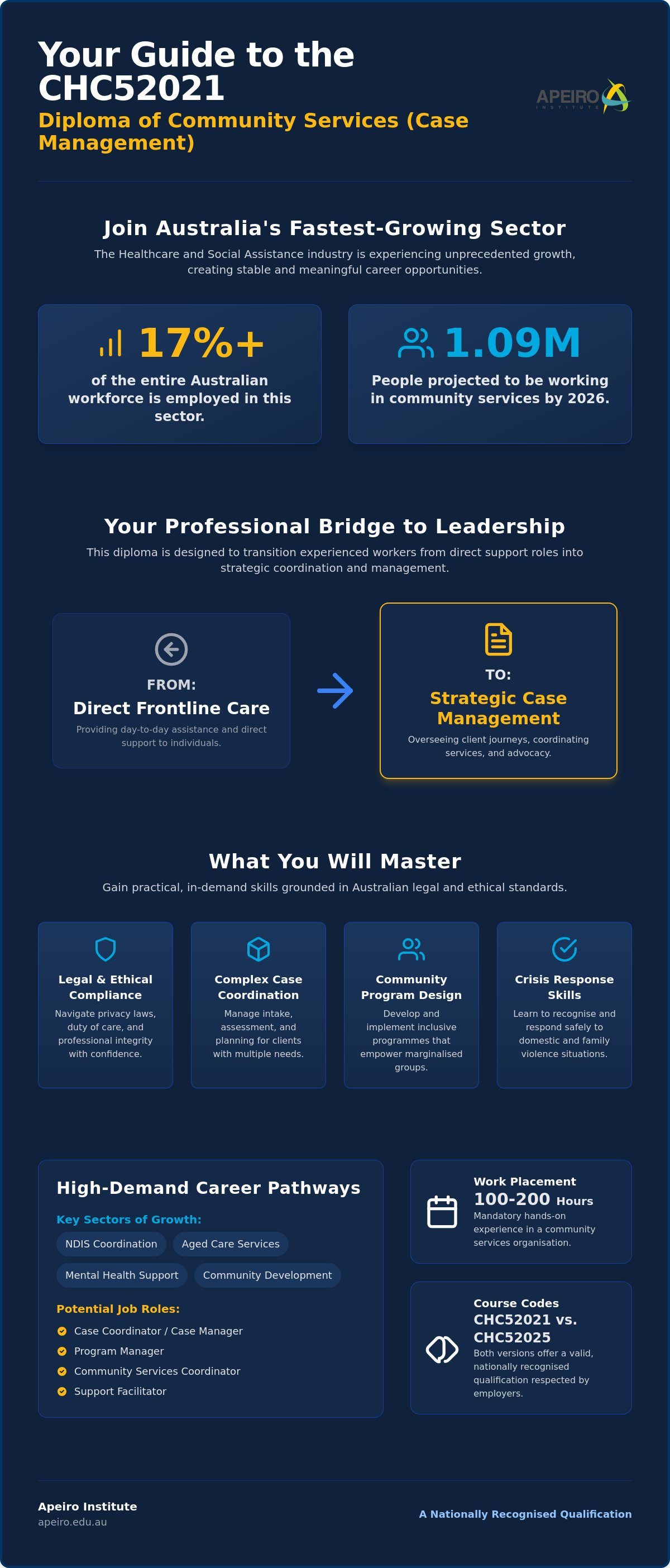
Did you know that the healthcare and social assistance sector is now Australia’s fastest-growing industry, employing over 17% of the entire workforce? With more than 1.09 million people working in community services as of 2026, the opportunities for a stable and meaningful career have never been greater. However, we understand that finding the right path can feel a little daunting. You might be confused by shifting course codes or worried about how to balance a mandatory work placement of 100 to 200 hours with your current life commitments.
It is common to feel stuck in direct care roles, wondering if your years of frontline experience will ever be formally recognised. This guide is here to help you navigate the CHC52021 – Diploma of Community Services (Case Management) with confidence. We'll show you how this respected qualification serves as your professional bridge to management and coordination roles. You will discover how to leverage your existing skills through Recognition of Prior Learning (RPL) and exactly what you need to do to secure a high-demand position in this essential sector.
Key Takeaways
- Understand how the CHC52021 – Diploma of Community Services (Case Management) moves you beyond direct support into strategic coordination and advocacy roles.
- Explore high-demand career pathways for 2026 within the NDIS and aged care sectors, including roles such as Case Coordinator and Program Manager.
- Learn the core skills required for mid-level community work, focusing on legal compliance and the development of inclusive community programs.
- Clarify the essential entry requirements, from English language proficiency to necessary background checks, to streamline your enrolment process.
- Discover the benefits of a student-centred learning environment that values your real-world experience and supports your professional growth.
Understanding the CHC52021 Diploma of Community Services (Case Management)
The CHC52021 – Diploma of Community Services (Case Management) is a nationally recognised qualification designed for those ready to step into leadership. It provides a formal framework for mid-level workers to move beyond basic support tasks and take on greater responsibility. By studying this through a Registered Training Organisation (RTO), you ensure your training meets strict Australian quality standards. These organisations are audited to ensure the skills you learn are exactly what the industry needs right now. Even as we move through 2026, this qualification remains a benchmark for professional excellence in the sector.
This specific stream focuses on moving you from direct, frontline care into roles that involve strategic coordination and advocacy. It's a significant career shift. Instead of just providing day-to-day assistance, you'll learn to oversee a client’s entire journey. This involves managing resources, liaising with other service providers, and ensuring that every individual receives the holistic support they deserve. It's about seeing the bigger picture while still maintaining a personal connection with the people you help. If you're looking to advance your career, you can find more details on the CHC52021 – Diploma of Community Services (Case Management) course page.
What is Case Management in the Australian Context?
Case management in Australia is a collaborative process that puts the individual at the centre of the service. It involves a detailed cycle of assessment, planning, and facilitation to ensure a client’s goals are met. In our local sector, there is a heavy emphasis on person-centred care. This means you aren't just ticking boxes; you're building a support plan that respects the client's choices and culture. Case management is the strategic coordination of services to meet complex client needs. You’ll learn to navigate the NDIS, aged care systems, and mental health frameworks to get the best outcomes for your clients through persistent advocacy.
CHC52021 vs. CHC52025: Navigating the Course Codes
You might have noticed the code CHC52025 appearing in some places and felt a bit confused. It's important to understand that CHC52021 is the predecessor to this newer iteration. During this transition period, many RTOs continue to offer the 2021 version because it remains a robust, high-quality programme. When deciding which code to enrol in, look at what your chosen RTO currently has available on their scope of registration. Don't worry about the change in numbers too much. Both versions provide nationally recognised outcomes that Australian employers respect. Your qualification will be a valid and valuable asset in your professional toolkit regardless of the specific code, as long as it's delivered by a reputable provider.
Key Skills and Units: What You Will Learn
The CHC52021 – Diploma of Community Services (Case Management) is structured to turn your empathy into professional expertise. You won't just be reading textbooks. You'll be mastering the practical frameworks that keep the sector running. A major focus of the core units is legal and ethical compliance. In a field where you work with vulnerable people, understanding privacy laws and duty of care isn't just a requirement; it's the foundation of your practice. You'll learn how to navigate these complexities while maintaining the highest standards of professional integrity.
Building social inclusion is another critical pillar of your training. You will learn to design and implement community programmes that truly make a difference. These aren't just events. They are strategic interventions designed to reduce isolation and empower marginalised groups. Additionally, the curriculum addresses some of the most pressing issues in Australia today. You'll gain practical skills in recognising and responding to domestic and family violence, ensuring you can provide safe, immediate support when it's needed most.
Specialised Case Management Units
The case management stream takes your skills to a higher level of coordination. You will study the entire lifecycle of support, from initial intake and assessment to developing sustainable exit strategies. This involves more than just planning. You'll learn to manage legal compliance for multiple clients and coordinate complex cases where several different service providers are involved. It requires high-level organisation and the ability to advocate fiercely for your client’s best interests within a crowded system.
Elective Streams: Tailoring Your Qualification
Your career goals are unique, so your qualification should be too. You can choose electives that align with your passions, whether that’s mental health, disability, or youth work. We highly recommend units focused on cultural diversity and working respectfully with Aboriginal and Torres Strait Islander people. These units are essential for anyone working in the Australian community sector. If you are starting from scratch, many students find that integrating units from the Certificate III in Individual Support provides a rock-solid foundation for the more advanced diploma units.
Mastering advanced communication techniques will allow you to connect with diverse client groups more effectively. If you're ready to see how these units fit into your schedule, you might want to explore our flexible study options for the CHC52021 – Diploma of Community Services (Case Management) today.
Career Pathways and Industry Demand in 2026
The community services sector is currently Australia's fastest-growing industry. By 2026, over 1.09 million people are employed in this field, with a growth rate of 6.4% recorded over the last five years. This isn't just about numbers; it's about the massive demand for skilled professionals who can manage complex social issues. While entry-level roles are vital, the CHC52021 – Diploma of Community Services (Case Management) is what allows you to step into management and coordination. Securing the CHC52021 – Diploma of Community Services (Case Management) ensures you have the credentials that government agencies and top-tier non-profits look for in 2026.
Graduates often find themselves in rewarding roles such as Case Coordinator, Community Services Worker, Program Manager, or Welfare Worker. These positions offer a significant step up in responsibility and professional standing. Beyond immediate job security, this qualification is a powerful stepping stone. Many students use it as a pathway to higher education, often receiving credit towards a Bachelor of Social Work. It’s a smart way to start your career while keeping the door open for future academic goals.
Where Can You Work with a Diploma of Community Services?
Opportunities exist across a huge range of environments. You might work for large non-profit organisations, state government agencies, or private healthcare providers. The shift towards community-based care models means more coordinators are needed to help people live independently. You could find yourself in specialised settings like:
- Youth centres and adolescent support services
- Refugee and migrant settlement support
- Family violence shelters and crisis accommodation
- Mental health outreach programmes
Meeting the 2026 Labour Market Needs
Australia’s ageing population is creating a massive need for coordination in aged care services. Simultaneously, the NDIS has become a complex landscape that requires expert navigation. Case managers are the ones who help families understand their funding and access the right support. With around 19,000 job openings anticipated in community and welfare support over the next few years, the outlook is incredibly strong. If you want to dive deeper into these trends, check out our Diploma of Community Services Australia: The 2026 Career Guide for a full industry breakdown.
Entry Requirements and Study Options for All Students
Getting started with the CHC52021 – Diploma of Community Services (Case Management) is a straightforward process, but it requires a bit of preparation. Most providers look for a Year 12 certificate or an equivalent level of study. If you're coming from another country, you'll need to demonstrate your English proficiency through tests like IELTS or PTE. It's about ensuring you can handle the complex documentation and high-level communication tasks that come with being a professional case manager.
You'll also need to clear some essential background checks before you can start your practical work placement. Since this role involves working with children and vulnerable adults, a valid National Police Check and a Working with Children Check are mandatory. These aren't just bureaucratic hurdles. They are vital for maintaining the safety and integrity of the Australian community sector. Having these ready early will help you transition smoothly into the practical components of your study.
International Students: Studying on a CRICOS Visa
For international learners, it's vital to study with a CRICOS-registered provider. This ensures your qualification is recognised both in Australia and globally, offering excellent career mobility. We understand that moving to a new country is a big step. That’s why support services are tailored to help you adjust, focusing on your personal growth and professional success within a diverse community representing over 38 nationalities. Gaining an Australian qualification in such a high-demand sector provides a secure foundation for your future.
RPL and Trade Pathways for Experienced Workers
If you've already spent years working in the sector, you shouldn't have to start from scratch. Recognition of Prior Learning (RPL) allows you to use your current work history to gain credits toward your Diploma. We apply the Trade Pathways for Experienced Workers (TPEW) model to community services, acknowledging the expertise you’ve built on the job. This pathway is perfect for those who have the skills but lack the formal paper to prove it.
To start an RPL assessment, you'll need to gather evidence that proves your competency. This might include detailed job descriptions, signed references from supervisors, and samples of your work like case notes or project plans. It’s a methodical way to turn your experience into a formal qualification. Our expert trainers act as mentors throughout this process, helping you identify which parts of your history align with specific course units.
We know life is busy. Flexible study modes are designed to help you balance work and family commitments while you study. Whether you're a local worker or an international student, your journey is unique. If you're ready to take the next step, check your eligibility for the CHC52021 – Diploma of Community Services (Case Management) today.
Why Choose Apeiro Institute for Your Diploma?
Choosing where to study is a significant decision that shapes your professional future. At Apeiro Institute, we believe you deserve more than just a certificate. Our student-centred approach ensures you're treated as a person with unique goals, not just another student ID on a spreadsheet. We've built our CHC52021 – Diploma of Community Services (Case Management) programme around the idea that education should be supportive, inclusive, and deeply empowering. By joining us, you become part of a vibrant community that represents over 38 different nationalities. This diversity isn't just a statistic; it’s a reflection of the multicultural Australian community you’ll be serving as a case manager.
Our trainers are industry experts who bring years of real-world experience from the Australian community sector directly into the classroom. They don't just recite theory from a textbook. Instead, they share practical insights into what employers actually want in 2026. This focus on vocational outcomes ensures that when you graduate, you're ready to step into a coordination or management role with total confidence. You'll learn the nuances of the industry from mentors who have navigated its challenges and celebrated its successes firsthand.
The Apeiro Learning Experience
Professional success often comes down to the quality of support you have during your journey. We keep our class sizes small to ensure you get the personalised attention required to master complex case management frameworks. You'll have access to modern training resources designed specifically for the 2026 professional environment. Beyond the standard curriculum, our mentorship programme helps you find your professional footing. We act as a partner in your success, providing guidance that extends well beyond the final assessment and into your first steps as a qualified professional.
Enrol in the CHC52021 Diploma Today
Applying to study shouldn't be a stressful or confusing experience. We've designed a simple, transparent application process that caters to the needs of both local and international students. If you're unsure about your specific pathway or how your previous experience might count, our friendly team is available for a personalised career consultation. We can help you understand the enrolment process and how to best structure your study schedule to fit your life. Ready to launch your career? Visit the CHC52021 – Diploma of Community Services (Case Management) course page to start your journey with a provider that is truly invested in your growth.
Take the Next Step in Your Community Services Career
The community services sector is evolving quickly. With the industry employing over 17% of Australia's workforce, there has never been a better time to step into a leadership or coordination role. You've seen how the CHC52021 – Diploma of Community Services (Case Management) provides the strategic skills needed to navigate the NDIS and aged care systems with confidence. By moving from direct support to management, you aren't just changing your job title; you're increasing your capacity to create lasting social impact.
At Apeiro Institute, we're committed to your personal and professional growth. As a nationally recognised training provider (RTO 45394) and CRICOS provider, we offer the mentor-led vocational training you need to succeed in a diverse professional environment. Whether you're leveraging your existing experience through RPL or starting a new journey as an international student, our supportive community is here to guide you. It's time to turn your passion for helping others into a stable, rewarding career.
Start your journey in Case Management with Apeiro Institute today
Your future in the community sector is bright, and we can't wait to help you reach your goals.
Frequently Asked Questions
What is the difference between CHC52021 and CHC52025?
The CHC52021 is the current nationally recognised qualification, while CHC52025 is the updated version recently released as part of the national training package transition. During this period, both codes provide high-quality, industry-standard outcomes that Australian employers respect. Most Registered Training Organisations are currently transitioning their programmes, so it is best to check which specific code is available for your preferred intake date.
Can I get a job in case management without a Diploma?
While entry-level support roles are available with a Certificate III, it is very difficult to secure a formal coordination position without the CHC52021 – Diploma of Community Services (Case Management). Employers in the NDIS and aged care sectors specifically look for this qualification. It proves you have the advanced skills in assessment, planning, and legal compliance required to manage complex client cases safely and effectively.
How long does it take to complete the Diploma of Community Services?
Most students finish their studies within 12 to 18 months, depending on their chosen study load and previous experience. If you are studying full-time, you can expect a more intensive pace, while part-time options allow you to spread the units over a longer period. Your duration might also be shorter if you are eligible for credits through Recognition of Prior Learning.
Is work placement required for the CHC52021 qualification?
Yes, completing a mandatory work placement is a core requirement for this qualification. You’ll need to complete between 100 and 200 hours in a real-world community service environment. This practical experience is vital because it allows you to apply the coordination and advocacy theories you've learned in class to actual client scenarios under professional supervision.
Am I eligible for Recognition of Prior Learning (RPL) if I have worked in aged care?
You are definitely a strong candidate for RPL if you have significant experience in the aged care or disability sectors. Many of the skills you've developed in direct care, such as documentation and individualised support, align with the units in the Diploma. We can help you map your work history against the course requirements to potentially reduce your study time and cost.
What are the English language requirements for international students?
International students generally need to demonstrate an upper-intermediate level of English to ensure they can handle the course documentation. This usually means achieving an IELTS score of 5.5 to 6.0, or a comparable score in a PTE Academic test. Since case management involves writing detailed reports and advocating for clients, having strong communication skills is essential for your professional success in Australia.
Can I study the Diploma of Community Services part-time?
Yes, flexible study options are designed to help you balance your education with work and family life. Many students choose to study part-time, especially if they are already working in the industry and want to upskill for a promotion. This approach allows you to maintain your current income while you work toward the CHC52021 – Diploma of Community Services (Case Management) at a pace that suits you.
What is the average salary for a Case Manager in Australia in 2026?
Salaries for case managers are competitive and reflect the high demand in a sector that has seen 6.4% employment growth over the last five years. While exact figures vary based on your location and experience level, the strong job outlook with 19,000 anticipated openings across the country suggests that qualified professionals can expect stable, well-compensated roles. Many graduates find that moving into coordination roles offers a significant increase in their earning potential compared to direct care positions.

Disclaimer
The information provided on this blog is for general informational and educational purposes only. While every effort is made to ensure the accuracy and reliability of the content, the author makes no representations or warranties of any kind, express or implied, about the completeness, accuracy, suitability, or availability of the information contained on this blog.
The views and opinions expressed in blog posts are those of the individual author and do not necessarily reflect the official policy or position of any organization, company, or employer.
This blog may contain links to external websites or third-party content. These links are provided for convenience only, and the author has no control over and assumes no responsibility for the content, privacy policies, or practices of any third-party sites.
Nothing on this blog constitutes professional advice (legal, financial, medical, or otherwise). Readers are encouraged to seek appropriate professional guidance before making any decisions based on the information provided here.
By using this blog, you acknowledge that any reliance on the information is at your own risk.


