

What if the next step in your aged care career wasn't just about working longer hours, but about leading with more heart and higher expertise? If you've spent time in entry-level roles, you're likely familiar with the physical toll of the work and the desire to make a deeper impact. You might even feel a bit lost in the sea of national training codes and shifting regulations. It's a common challenge for dedicated professionals who want to do more but aren't sure how to bridge the gap.
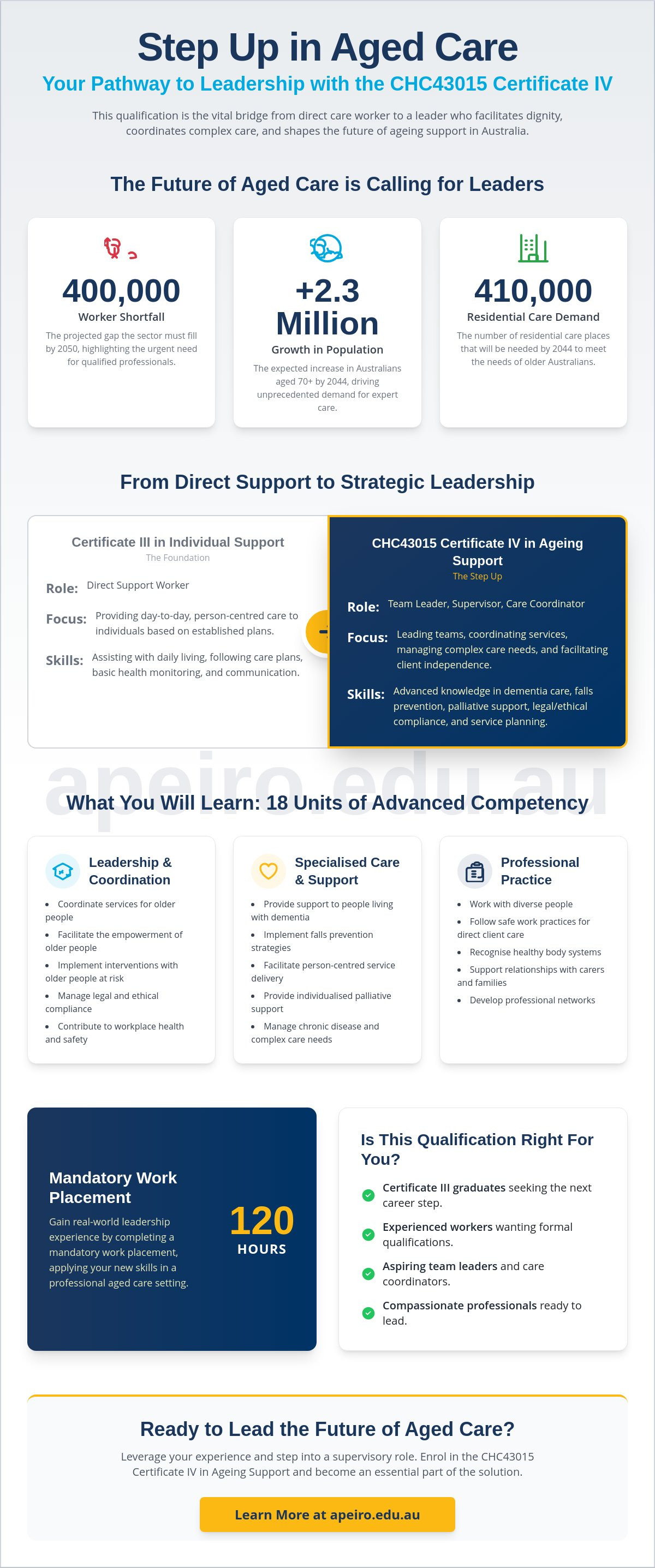
This guide explains how the CHC43015 – Certificate IV in Ageing Support serves as that vital bridge, moving you from being a direct care worker to a leader who facilitates dignity and independence. We'll show you how this qualification empowers you to take on supervisory responsibilities while gaining specialised knowledge in areas like dementia and palliative care. With the number of Australians aged 70 and over projected to grow by 2.3 million by 2044, your expertise is more than just a career move; it's an essential part of the solution for a sector facing a 400,000-worker shortfall by 2050. We'll walk through the career pathways, the 120-hour work placement requirement, and how this nationally recognised certification can help you find your place in the future of Australian care.
Key Takeaways
- Learn how to transition from direct care to a supervisory role focused on service coordination and intervention.
- Explore the 18 units of competency that provide advanced expertise in specialised fields like dementia care and falls prevention.
- Understand the clear career progression and increased responsibilities when moving from a Certificate III to the CHC43015 – Certificate IV in Ageing Support.
- Get practical advice on completing your mandatory 120 hours of work placement while managing your current work schedule.
- Discover how to leverage your existing industry experience to fast-track your qualification through specialised trade pathways.
What is CHC43015 – Certificate IV in Ageing Support?
The CHC43015 – Certificate IV in Ageing Support is a nationally recognised qualification designed for those ready to step up in the aged care sector. It sits at Level 4 within the Australian Qualifications Framework (AQF). This means it provides a higher level of theoretical knowledge and practical skill than entry-level roles. While a Certificate III focuses on day-to-day individual support, this qualification prepares you for coordination and service intervention. It's the professional standard for anyone looking to lead teams or manage complex care plans in residential or community settings.
2026 is a turning point for Australian healthcare. With the new Aged Care Act introducing significant changes to fees and standards by October 2026, the industry needs qualified leaders. A national workforce strategy report is also due in November 2026. These shifts mean that having a recognised qualification isn't just a bonus; it's a requirement for staying relevant in a rapidly professionalising field. You'll move beyond basic tasks to become a vital link between residents, families, and healthcare providers.
The Evolving Role of the Aged Care Professional
The sector has moved away from "task-based" care. In the past, the focus was often on ticking boxes. Today, it's about holistic, person-centred support. This shift follows the findings of the Royal Commission, placing a heavy emphasis on consumer-directed care and the rights of older Australians. You aren't just a worker; you're an advocate. You help residents maintain their dignity and independence through complex care coordination. It's a role that requires empathy, but also the specialised expertise to manage diverse health needs.
Who Should Enrol in This Qualification?
This programme is perfect for experienced support workers who feel stuck in entry-level tasks. If you've already completed the CHC33021 Certificate III in Individual Support, this is your natural next step. It's also ideal for current workers who have years of experience but lack the formal papers to move into a team leader or supervisor role. Our Trade Pathways for Experienced Workers (TPEW) can even help you fast-track the process by recognising the skills you've already built on the job. If you're a compassionate person with a logical mind and a desire to lead, you're the ideal candidate for this journey.
Core Units and Skills: What You Will Learn
The 18 units of competency required for the CHC43015 – Certificate IV in Ageing Support provide a comprehensive toolkit for the modern professional. These units aren't just academic hurdles; they are practical frameworks designed to turn you into a specialist in your field. According to the official CHC43015 training details, the curriculum balances technical clinical knowledge with the administrative and interpersonal skills needed for leadership. You'll learn how to handle the complex reporting requirements of the Australian aged care system while keeping the human element of care front and centre.
This qualification moves you beyond the basics of personal care. You'll develop a deep understanding of legal and ethical compliance, ensuring that every action you take aligns with national standards. You'll also learn to facilitate the empowerment of older people, helping them maintain control over their lives even as their needs change. It's about building a career where your expertise directly improves the quality of life for those in your care.
Specialised Care and Clinical Support
A major part of this programme involves mastering complex care needs and chronic disease management. You'll study specific units focused on falls prevention and palliative support, which are critical as the health needs of older Australians become more complex. Supporting people living with dementia is a core priority. You will learn how to implement individualised care plans that preserve dignity and respect the person's history. This level of specialised knowledge is what makes a Certificate IV holder so valuable to modern facilities, especially as demand for residential care is projected to rise to approximately 410,000 by 2044.
Leadership and Coordination Competencies
Perhaps the most significant shift you'll experience is moving into a leadership mindset. You will develop the confidence to supervise junior staff and volunteers, ensuring that your team delivers a high standard of care. Managing documentation and meeting strict reporting standards is a daily reality in the current regulatory environment. Service coordination is the process of organising various support services to ensure a client's holistic needs are met through a seamless, integrated approach. This skill set is essential for anyone aspiring to become a team leader or supervisor. If you're ready to start building these leadership skills, you can explore how our CHC33021 Certificate III graduates often transition into this higher level of responsibility.
Certificate III vs. Certificate IV: Choosing Your Pathway
Choosing between these two qualifications depends on where you are right now and where you want to be in five years. While both are essential to the sector, they serve very different purposes. The CHC33021 Certificate III is your entry ticket. It focuses on the "how" of care, providing daily assistance with hygiene, meals, and mobility. In contrast, the CHC43015 – Certificate IV in Ageing Support is about the "why" and the "who." It transitions you from a "doer" to a "facilitator" who oversees care plans and leads teams.
Career longevity is a major factor here. Direct care is physically demanding. Many workers find that moving into a Certificate IV role allows them to stay in the industry longer because it shifts the focus toward coordination and supervision. From July 2026, with the National Minimum Wage rising to $26.44 per hour and modern award wages increasing by 4.75%, the financial outlook for the sector is stronger than ever. Graduates of the Certificate IV often find themselves in the $70,000 to $80,000 salary bracket. Interestingly, for those in specific "Aged Care Support Worker" roles, the range can even reach between $80,000 and $90,000, depending on the facility and location.
When to Stick with a Certificate III
If you're completely new to the industry, start here. This qualification is designed to give you the foundational skills needed to work safely and effectively. It's perfect for those who love the hands-on aspect of the job and aren't yet interested in managing others or coordinating complex services. You can find all the entry-level details in our guide to the Certificate III in Individual Support. It provides the grounding you need before taking on higher responsibilities.
When to Advance to a Certificate IV
You'll know you're ready for the CHC43015 – Certificate IV in Ageing Support when you start noticing gaps in service delivery or feel a desire to mentor new staff. This qualification gives you a strategic advantage when applying for management positions. It also serves as a critical stepping stone if you plan to eventually pursue a Diploma of Community Services. Stacking these qualifications makes you highly employable. This is backed by data showing that 72% of Certificate IV graduates find employment within six months of finishing their studies.
Practical Requirements: Work Placement and Assessment
To successfully complete the CHC43015 – Certificate IV in Ageing Support, you must prove you can apply your skills in a clinical environment. This is why a minimum of 120 hours of work placement is a mandatory requirement. It ensures you aren't just memorising facts but can actually lead a team and coordinate care in a high-pressure setting. Balancing these hours with your current job can feel daunting, but most students find that their existing workplace is the best training ground. If you're already employed in the sector, your daily tasks often count toward your hours, provided they meet the specific competency requirements of the course.
Before you start, you'll need to clear regulatory hurdles like the NDIS Worker Screening Check. Fees for this check vary by state; for example, it costs $107 in New South Wales and $156 in Queensland. These checks are essential for protecting vulnerable Australians. During your placement, an assessor from your Registered Training Organisation (RTO) will visit you. They aren't there to catch you out. Instead, they observe how you handle real-world scenarios, like managing a falls prevention strategy or facilitating a family meeting about palliative care. This practical focus ensures you're ready for the 72% of graduates who find employment within six months of finishing.
Finding and Managing Your Work Placement
Securing a placement in a residential facility or community setting is your chance to shine. If you're looking for a new environment, we recommend reaching out to local providers early. Your student logbook will be your most important tool during this time. It acts as a record of your growing expertise, tracking every hour you spend coordinating services or leading junior staff. If you're an experienced worker, you might find that our Trade Pathways for Experienced Workers (TPEW) programme offers a more streamlined way to recognise the skills you've already mastered on the job.
Assessment Methods Beyond the Workplace
Vocational training has come a long way. While the 120-hour placement is vital, your theory-based assessments are equally important. These include case studies and role-play scenarios that prepare you for the administrative side of leadership. We understand that adult learners have busy lives. That's why we use a mentor approach to assessment, providing steady guidance as you work through each unit. You'll gain the confidence to handle legal compliance and reporting without feeling overwhelmed by paperwork. To learn more about how we can help you balance your studies, check out our Trade Pathways for Experienced Workers and start your journey today.
Studying with Apeiro Institute: Your Success Partner
Choosing where to study is just as important as the qualification itself. At Apeiro Institute, we don't just provide a curriculum; we offer a supportive, student-centred community that understands the unique challenges of the aged care sector. Our training is deeply industry-focused, ensuring that every unit you complete in the CHC43015 – Certificate IV in Ageing Support translates directly to the workplace. We take pride in our diverse environment, with students from over 38 nationalities represented across our programmes. This global perspective is invaluable in a country like Australia, where multicultural care is the standard.
We act as a bridge between your current experience and your future leadership goals. Our trainers aren't just academics; they are industry experts who act as mentors throughout your journey. Whether you are looking to move out of a purely physical role or want to master the administrative side of care coordination, we provide the steady guidance you need to succeed. We focus on building your confidence so that you can lead with both empathy and professional authority.
Fast-Track with Recognition of Prior Learning (RPL)
If you've spent years working in aged care, you've already built a wealth of "unwritten" skills. You shouldn't have to start from scratch. Through Recognition of Prior Learning (RPL), we can assess your existing industry expertise and grant credit toward your CHC43015 – Certificate IV in Ageing Support. This process is designed to save you time and reduce the cost of your studies by formalising the knowledge you already use every day on the job. Our Trade Pathways for Experienced Workers (TPEW) programme is the perfect vehicle for this. It's a streamlined assessment pathway that respects your professional history and helps you gain your qualification faster.
Enrolment and Career Outcomes
The aged care sector is entering a period of unprecedented growth and reform. Taking the step to enrol in our next intake for 2026 positions you at the forefront of this evolution. Once you complete your qualification, a variety of leadership roles become available to you. You could find yourself working as a Care Supervisor, Team Leader, Case Coordinator, or Support Facilitator. These aren't just jobs; they are vital positions that offer high job security and the chance to make a systemic difference in people's lives. If you're ready to turn your passion for care into a lifelong career, we invite you to explore our Trade Pathways (TPEW) and take the first step toward your new role today.
Take the Next Step in Your Aged Care Leadership Journey
Moving from direct care to a supervisory role is more than just a promotion. It's a commitment to improving the lives of older Australians through better service coordination and clinical expertise. You've seen how the CHC43015 – Certificate IV in Ageing Support provides the specialised skills needed to lead teams and manage complex care plans with confidence. By bridging the gap between foundational support and professional leadership, you're securing your future in a sector that values your dedication and growing expertise.
At Apeiro Institute, we specialise in making this transition as smooth as possible. As a provider of Nationally Recognised Training (RTO 45394), we offer industry-focused training with national coverage designed for busy professionals. If you have years of experience, our specialists in Recognition of Prior Learning (RPL) can help you turn that on-the-job knowledge into a formal qualification faster. It's time to move beyond the physical demands of entry-level roles and embrace a career built on leadership and advocacy.
Ready to lead with heart and expertise? Enquire about the CHC43015 Certificate IV in Ageing Support today and see how we can support your growth. Your future as a respected aged care leader starts with this single, empowering step.
Frequently Asked Questions
Can I study CHC43015 Certificate IV in Ageing Support online?
Yes, you can complete the theoretical components of the course through blended or online learning. Most modern programmes allow you to study your modules from home at your own pace. However, you must still complete the mandatory 120 hours of hands-on work placement at a local aged care facility. This ensures you can balance your current life commitments while working toward your CHC43015 – Certificate IV in Ageing Support.
How much work placement is required for the Certificate IV in Ageing Support?
You are required to complete a minimum of 120 hours of work placement in a residential or community aged care setting. This is a non-negotiable requirement for national recognition. It provides the opportunity to demonstrate your leadership and clinical skills in a real-world environment. If you're already working in the sector, you can often coordinate with your employer to use your current workplace for these assessment hours.
What is the difference between a Certificate III and a Certificate IV in aged care?
The main difference is the level of responsibility and the focus of your daily tasks. While a Certificate III is designed for entry-level direct care, the Certificate IV prepares you for leadership and specialised support roles. You'll move from performing basic personal care tasks to coordinating services, managing small teams, and handling more complex clinical situations, such as specialised dementia or palliative care planning.
Do I need a Certificate III before I can do a Certificate IV?
You don't strictly need a Certificate III as a prerequisite, but it's highly recommended for those new to the industry. Starting with the foundational course gives you the hands-on confidence needed for higher-level leadership units. However, if you have significant experience working in the field, you might be able to enter the Certificate IV directly or use RPL to bridge the gap between the two levels.
What kind of jobs can I get with a CHC43015 qualification?
This qualification opens doors to various supervisory and coordination roles within the Australian healthcare landscape. Common job titles include Care Supervisor, Aged Care Team Leader, and Case Coordinator. You could also find employment as a Support Facilitator or a Residential Care Coordinator. These positions focus more on managing staff and ensuring high standards of care delivery rather than just performing physical, task-based support.
Is the Certificate IV in Ageing Support a nationally recognised qualification?
Yes, the CHC43015 – Certificate IV in Ageing Support is a nationally recognised qualification within the Australian Qualifications Framework (AQF). It is listed on the National Training Register, which means your certificate is respected by employers in every state and territory across Australia. This recognition ensures that the skills you learn meet the high standards required by the modern aged care and community support sectors.
How long does it take to complete the CHC43015 course?
Most students take between 6 and 12 months to finish the course, depending on their study mode. The exact timeframe varies based on whether you choose to study full-time or part-time. If you have existing industry experience and qualify for Recognition of Prior Learning (RPL), you can often reduce the time it takes to get your qualification. We work with you to create a schedule that fits your career goals.
Can I get RPL for my existing experience in aged care?
Absolutely, you can use your years of industry experience to gain credit toward your qualification. Recognition of Prior Learning (RPL) is a practical way to formalise the skills you've built on the job over time. We look at your work history, previous training, and current responsibilities to see which units you've already mastered. This process can save you significant time and acknowledges the expertise you already bring to the sector.

Disclaimer
The information provided on this blog is for general informational and educational purposes only. While every effort is made to ensure the accuracy and reliability of the content, the author makes no representations or warranties of any kind, express or implied, about the completeness, accuracy, suitability, or availability of the information contained on this blog.
The views and opinions expressed in blog posts are those of the individual author and do not necessarily reflect the official policy or position of any organization, company, or employer.
This blog may contain links to external websites or third-party content. These links are provided for convenience only, and the author has no control over and assumes no responsibility for the content, privacy policies, or practices of any third-party sites.
Nothing on this blog constitutes professional advice (legal, financial, medical, or otherwise). Readers are encouraged to seek appropriate professional guidance before making any decisions based on the information provided here.
By using this blog, you acknowledge that any reliance on the information is at your own risk.


